Help! Calculate the concentration of lysozyme activity if 150uL of enzyme is added to 850uL of...
Help! Calculate the concentration of lysozyme activity if 150uL of enzyme is added to 850uL of substrate to yield a) -0.0435abs/min at A450? b) 0.000abs/min at A450?
The blank used was water...abs/min=0.000.
df is 20
Homework Answers
given,
volume of enzyme = 150 uL
volume of substrate = 850uL
df = 20
A) absorbance/min = -0.0435 abs/min
lysozyme enzyme activity = (absorbance per min/ df) / ( volume of enzyme solution in uL)
= (-0.0435 x 20) / ( 150/850)
= - 4.93
B) absorbance/ min = 0.000 abs/min
lysozyme enzyme activity = (0.000 x 20) / (150/850)
= 0
Add Answer to:
Help! Calculate the concentration of lysozyme activity if 150uL
of enzyme is added to 850uL of...
Enzyme Used Lysozyme Thermal Denaturation Temp (Celsius) Abs (325 nm) 40 0.106 50 0.086 60 0.109...
Enzyme Used Lysozyme Thermal Denaturation Temp (Celsius) Abs (325 nm) 40 0.106 50 0.086 60 0.109 65 0.161 70 0.409 75 2.06 80 2.173 90 0.821 Urea Denaturation M of urea Abs (325 nm) 0 0.464 1 0.07 2 0.056 4 0.05 6 0.035 8 0.028 Please help me calculate the fraction denatured at each urea concentration and plot ΔG vs [urea] graph and Calculate the ΔG of denaturation in water and What is the concentration of urea where half...
Figure 8: ONP Formation v. Enzyme Conc. Enzyme Abs @ concentration 420 nm (units/ml) 0.2 0.372...
 Figure 8: ONP Formation v. Enzyme Conc. Enzyme Abs @ concentration 420 nm (units/ml) 0.2 0.372 0.4 0.648 0.6 0.923 0.8 0.004 1.0 1.572 Examine Figure 8. In this experiment, all five samples were supposed to be subjected to identical conditions (substrate concentration, temperature, reaction time) except for the enzyme concentration, which is indicated in the table. Which of the following procedural errors could account for the unexpected result for the 0.8 units/ml enzyme concentration? This tube was left in...
Can you infinitely infrease the substrate concentration to increase enzyme activity in a closed system such...
 Can
you infinitely infrease the substrate concentration to increase
enzyme activity in a closed system such as a batch culture?
Can you infinitely increase the substrate concentration to increase enzyme activity in a closed system such as a batch culture? Yes Your answer B NO
Can
you infinitely infrease the substrate concentration to increase
enzyme activity in a closed system such as a batch culture?
Can you infinitely increase the substrate concentration to increase enzyme activity in a closed system such as a batch culture? Yes Your answer B NO
Review your knowledge of how enzyme activity is affected by substrate concentration by selecting the correct...
 Review your knowledge of how enzyme activity is affected by substrate concentration by selecting the correct statements concerning enzyme activity at low substrate concentrations. Contact between enzyme and substrate is rare Velocity of the reaction increases Enzyme makes product rapidly Enzyme makes product slowly Enzyme is saturated with substrate
An experiment was conducted to investigate enzyme activity. A small quantity of amylase solution was added...
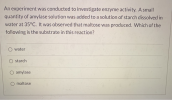 An experiment was conducted to investigate enzyme activity. A small quantity of amylase solution was added to a solution of starch dissolved in water at 35°C. It was observed that maltose was produced. Which of the following is the substrate in this reaction? water O starch O amylase O maltose
Please help me construct a Ferguson plot for a 12% gel concentration containing Lysozyme the distance...
 Please help me construct a Ferguson plot for a 12% gel
concentration containing Lysozyme
the distance for lysozyme is 5.21cm
the distance for BSA is 1.35cm
the distance for RNAse A is 5.58cm
total distance of gel is 7cm
electric field must be approximately E = (100 V)/(20 cm) = 5
V/cm = 500 V/m.
Enzyme MW 02 BSA 66-5K) (2) Lysozyme 14.3 Ra (3) RNase A 13.732 kua -116.0 - 66.2 - 45.0 - 35.0 - 25.0 - -...
Please help me construct a Ferguson plot for a 12% gel
concentration containing Lysozyme
the distance for lysozyme is 5.21cm
the distance for BSA is 1.35cm
the distance for RNAse A is 5.58cm
total distance of gel is 7cm
electric field must be approximately E = (100 V)/(20 cm) = 5
V/cm = 500 V/m.
Enzyme MW 02 BSA 66-5K) (2) Lysozyme 14.3 Ra (3) RNase A 13.732 kua -116.0 - 66.2 - 45.0 - 35.0 - 25.0 - -...
COST-LAB QUESTIONS: 1. What happens to enzyme activity as the enzyme concentration is increased? 2. Based...
 COST-LAB QUESTIONS: 1. What happens to enzyme activity as the enzyme concentration is increased? 2. Based on your results, what is the optimum pH for lactase? 3. Do all enzymes in the body have the same optimum pH? Why or why not? 4. What happens to enzyme activity as the substrate concentration is increased? Explain why this occurs.
please show how to calculate the substrate concentration in the test tubes at time=zero point 3...
 please show how to calculate the substrate concentration in
the test tubes at time=zero point
3 .375 0.84-0.bda 2min What is the amount of enzyme that you chose to use in Part B? Part B- Dis cusion 1. Calculate the units of enzyme activity for the varying amounts of sub- strate. Calculate the substrate concentrations in the test tubes at time = zero point. Substrate Volume (mL) L-DOPA (mM) AA479/min umol/min 0.05 0.jas 0. 10 4 0. a5 0.1 0.208...
please show how to calculate the substrate concentration in
the test tubes at time=zero point
3 .375 0.84-0.bda 2min What is the amount of enzyme that you chose to use in Part B? Part B- Dis cusion 1. Calculate the units of enzyme activity for the varying amounts of sub- strate. Calculate the substrate concentrations in the test tubes at time = zero point. Substrate Volume (mL) L-DOPA (mM) AA479/min umol/min 0.05 0.jas 0. 10 4 0. a5 0.1 0.208...
An enzyme catalyzes the reaction A ⇌ B. The enzyme is present at a concentration of...
An enzyme catalyzes the reaction A ⇌ B. The enzyme is present at a concentration of 2 nM, and the Vmax is 1.2 μM s−1. The Km for substrate A is 10 μM. Calculate the initial velocity of the reaction, V0, when the substrate concentration is (a) 2 μM, (b) 10 μM, (c) 30 μM.
Explain the mechanism of how substrate concentration affects enzyme activity and how this mechanism yields the...
Explain the mechanism of how substrate concentration affects enzyme activity and how this mechanism yields the expected summary curve
 Figure 8: ONP Formation v. Enzyme Conc. Enzyme Abs @ concentration 420 nm (units/ml) 0.2 0.372 0.4 0.648 0.6 0.923 0.8 0.004 1.0 1.572 Examine Figure 8. In this experiment, all five samples were supposed to be subjected to identical conditions (substrate concentration, temperature, reaction time) except for the enzyme concentration, which is indicated in the table. Which of the following procedural errors could account for the unexpected result for the 0.8 units/ml enzyme concentration? This tube was left in...
 Can
you infinitely infrease the substrate concentration to increase
enzyme activity in a closed system such as a batch culture?
Can you infinitely increase the substrate concentration to increase enzyme activity in a closed system such as a batch culture? Yes Your answer B NO
Can
you infinitely infrease the substrate concentration to increase
enzyme activity in a closed system such as a batch culture?
Can you infinitely increase the substrate concentration to increase enzyme activity in a closed system such as a batch culture? Yes Your answer B NO
 Review your knowledge of how enzyme activity is affected by substrate concentration by selecting the correct statements concerning enzyme activity at low substrate concentrations. Contact between enzyme and substrate is rare Velocity of the reaction increases Enzyme makes product rapidly Enzyme makes product slowly Enzyme is saturated with substrate
 An experiment was conducted to investigate enzyme activity. A small quantity of amylase solution was added to a solution of starch dissolved in water at 35°C. It was observed that maltose was produced. Which of the following is the substrate in this reaction? water O starch O amylase O maltose
 Please help me construct a Ferguson plot for a 12% gel
concentration containing Lysozyme
the distance for lysozyme is 5.21cm
the distance for BSA is 1.35cm
the distance for RNAse A is 5.58cm
total distance of gel is 7cm
electric field must be approximately E = (100 V)/(20 cm) = 5
V/cm = 500 V/m.
Enzyme MW 02 BSA 66-5K) (2) Lysozyme 14.3 Ra (3) RNase A 13.732 kua -116.0 - 66.2 - 45.0 - 35.0 - 25.0 - -...
Please help me construct a Ferguson plot for a 12% gel
concentration containing Lysozyme
the distance for lysozyme is 5.21cm
the distance for BSA is 1.35cm
the distance for RNAse A is 5.58cm
total distance of gel is 7cm
electric field must be approximately E = (100 V)/(20 cm) = 5
V/cm = 500 V/m.
Enzyme MW 02 BSA 66-5K) (2) Lysozyme 14.3 Ra (3) RNase A 13.732 kua -116.0 - 66.2 - 45.0 - 35.0 - 25.0 - -...
 COST-LAB QUESTIONS: 1. What happens to enzyme activity as the enzyme concentration is increased? 2. Based on your results, what is the optimum pH for lactase? 3. Do all enzymes in the body have the same optimum pH? Why or why not? 4. What happens to enzyme activity as the substrate concentration is increased? Explain why this occurs.
 please show how to calculate the substrate concentration in
the test tubes at time=zero point
3 .375 0.84-0.bda 2min What is the amount of enzyme that you chose to use in Part B? Part B- Dis cusion 1. Calculate the units of enzyme activity for the varying amounts of sub- strate. Calculate the substrate concentrations in the test tubes at time = zero point. Substrate Volume (mL) L-DOPA (mM) AA479/min umol/min 0.05 0.jas 0. 10 4 0. a5 0.1 0.208...
please show how to calculate the substrate concentration in
the test tubes at time=zero point
3 .375 0.84-0.bda 2min What is the amount of enzyme that you chose to use in Part B? Part B- Dis cusion 1. Calculate the units of enzyme activity for the varying amounts of sub- strate. Calculate the substrate concentrations in the test tubes at time = zero point. Substrate Volume (mL) L-DOPA (mM) AA479/min umol/min 0.05 0.jas 0. 10 4 0. a5 0.1 0.208...
Most questions answered within 3 hours.
-
Where is the error in this code sequence?
String s1 = "Hello";
String s2 = "ello";...
asked 10 months ago -
Financial data for Joel de Paris, Inc., for last year
follow:
Joel de Paris, Inc.
Balance...
asked 10 months ago -
Consider this reaction:
Al2(SO4)3 (aq)+ BaCl3
(aq) Al2Cl6 (aq)- +
3BaSO4(s) . What is the...
asked 10 months ago -
Suppose that Savneet is considering increasing her
recent random sample from 20 car rentals to 40...
asked 10 months ago -
Trucks arrive at an unloading terminal at an average rate of 120
per hour.
Trucks arrive...
asked 10 months ago -
Why are methanol and ethanol completely soluble in water while
octanol is not very little soluble....
asked 10 months ago -
A facilities manager at a university reads in a research report
that the mean amount of...
asked 10 months ago -
When the CuSO4 is rehydrated by adding water to the anhydrous
compound, is this an endothermic...
asked 10 months ago -
A ray of sunlight is passing from diamond into crown glass; the
angle of incidence is...
asked 10 months ago -
A block of mass 0.249 kg is placed on top of a light, vertical
spring of...
asked 10 months ago -
how do the kidneys compensate in the presences of acidosis
a) trigger hyperventilate
b) reserve acid...
asked 10 months ago -
Question 501 pts
The rental rate of capital to the firm increases. Which of the
following...
asked 10 months ago