
Homework Answers
A. It exhibits specificity for a particular type of molecule.
- Facilitated diffusion is movement of molecule from region of high to region of low concentration (towards concentration gradient) with help of transport protein. This process doesn't require energy of ATP. The transport protein is integral membrane protein which form channel in membrane. They are specific for each type of molecules, for example Na+ channel allow moments of Na+ ions only.
- Simple diffusion is movement of molecules towards concentration gradient without use of ant transport proteins. It doesn't require energy.
- Active transport is movement of molecules against concentration gradient. This process requires energy and transport proteins.
If you found this answer helpful then please rate it. Comment if you have any problems in understanding this answer.
Add Answer to:
Question 6 A carrier protein involved with facilitated diffusion has which of the following characteristics? O...
How does facilitated diffusion differ from simple diffusion? Facilitated diffusion requires ATP Facilitated diffusion requires a...
How does facilitated diffusion differ from simple diffusion? Facilitated diffusion requires ATP Facilitated diffusion requires a solute-specific protein carrier Facilitated diffusion transports solute against its’ concentration gradient Which of the following is TRUE about primary active cell membrane transport? It is a form of transport that requires a protein “pump” It is a form of transport that transports ions and/or solute against their concentration gradient It is a transport mechanism that requires energy released from the splitting of ATP by...
Label the substances involved in facilitated diffusion. TEL Region of lower concentration Region of higher concentration...
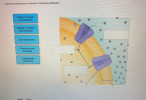 Label the substances involved in facilitated diffusion. TEL Region of lower concentration Region of higher concentration Cell membrane Protein carrier molecule Transported substance Reset Zoom
NH HO HO Man Protein HO HO- Man or What type of membrane protein is shown...
 NH HO HO Man Protein HO HO- Man or What type of membrane protein is shown below? Glycoprotein Man HO- HNo HO OR OH OM o0 wtracedular cell membrane eytesel Integral membrane protein GPI-anchored protein Peripheral membrane protein membrane proteins are bound primarily by electrostatic and hydrogen-bond interactions with the head groups of lipids. Peripheral membrane protein O Integral membrane protein GPI-anchored protein An antiporter and a symporter are examples of: passive diffusion Osecondary active transport O primary active transporters...
Fill in the following chart with the characteristics typical of 5 points Facilitated Diffusion * high...
 Fill in the following chart with the characteristics typical of 5 points Facilitated Diffusion * high to small e either hydrophilic hydrophobic low Molecule Size (small/large/either) hydrophilic/hydrophobic/either high to low concentration on low to high concentration transport protein (yes/no) L energy required (yes/no) Fill in the following chart with the characteristics typical of 3 points prokaryotic cells* Small Large yes no Size (small or large) Cell membrane (yes or no) Membrane-bound organelles (yes or no Nucleus (yes or no
Which statements are false about facilitated diffusion. Select all that apply! a. molecules or ions are transported with the...
Which statements are false about facilitated diffusion. Select all that apply! a. molecules or ions are transported with the help of a protein b. atp energy is required to move the molecules or ions down their concentration gradient. c. the molecules or ions move down their concentration gradient. d. the molecules move against their concentration gradient.
Diffusion: Which following statement is incorrect? Select one: a. Facilitated diffusion requires a transport protein b....
Diffusion: Which following statement is incorrect? Select one: a. Facilitated diffusion requires a transport protein b. It is a form of passive transport c. Isotonic solutions have an equal amount of solute on both sides of the membrane - no change in shape d. Exocytosis involves the diffusion of molecules out of a cell e. Hypotonic solutions result in cell swelling
Which of the following is not a product of the Kreb’s cycle? ATP NADH FADH2 Pyruvate...
Which of the following is not a product of the Kreb’s cycle? ATP NADH FADH2 Pyruvate Which of the type of transport moves molecules across a membrane, against a concentration gradient, and requires the use of ATP? Facilitated diffusion Active transport Simple diffusion Osmosis
33) Which of the following is most likely true of a protein that cotransports glucose and...
 33) Which of the following is most likely true of a protein that cotransports glucose and sodium ions into the intestinal cells of an animal? A) Sodium and glucose bind to the same site on the cotransporter. B) Transport of glucose against its concentration gradient provides energy for uptake of sodium ions against the electrochemical gradient. C) Sodium ions can be transported whether or not glucose is present outside the cell, but glucose transport requires cotransport of sodium ions. D)...
QUESTION 2 Which of the following is NOT an example of facilitated diffusion O A. lon...
 QUESTION 2 Which of the following is NOT an example of facilitated diffusion O A. lon channel transport. OB. All of these answers are examples of facilitated diffusion O C. Glucose transport by GLUT1. O D. None of these answers are examples of facilitated diffusion OE. Aquaporin transport. OF. Oxygen transport.
please answer all three or none at all. Thank you. one transporter is Simultaneous transport of...
 please answer all three or none at all. Thank you.
one transporter is Simultaneous transport of two molecules across the cell membrane in the same direction by called AV Question 9 (1 point) In carrier protein function kinetics, Km is the solute concentration at which the transport rate is half maximal True False Question 10 (1 point) Transmembrane movement of a substance up a concentration gradient requires facilitated diffusion True False
please answer all three or none at all. Thank you.
one transporter is Simultaneous transport of two molecules across the cell membrane in the same direction by called AV Question 9 (1 point) In carrier protein function kinetics, Km is the solute concentration at which the transport rate is half maximal True False Question 10 (1 point) Transmembrane movement of a substance up a concentration gradient requires facilitated diffusion True False
 Label the substances involved in facilitated diffusion. TEL Region of lower concentration Region of higher concentration Cell membrane Protein carrier molecule Transported substance Reset Zoom
 NH HO HO Man Protein HO HO- Man or What type of membrane protein is shown below? Glycoprotein Man HO- HNo HO OR OH OM o0 wtracedular cell membrane eytesel Integral membrane protein GPI-anchored protein Peripheral membrane protein membrane proteins are bound primarily by electrostatic and hydrogen-bond interactions with the head groups of lipids. Peripheral membrane protein O Integral membrane protein GPI-anchored protein An antiporter and a symporter are examples of: passive diffusion Osecondary active transport O primary active transporters...
 Fill in the following chart with the characteristics typical of 5 points Facilitated Diffusion * high to small e either hydrophilic hydrophobic low Molecule Size (small/large/either) hydrophilic/hydrophobic/either high to low concentration on low to high concentration transport protein (yes/no) L energy required (yes/no) Fill in the following chart with the characteristics typical of 3 points prokaryotic cells* Small Large yes no Size (small or large) Cell membrane (yes or no) Membrane-bound organelles (yes or no Nucleus (yes or no
 33) Which of the following is most likely true of a protein that cotransports glucose and sodium ions into the intestinal cells of an animal? A) Sodium and glucose bind to the same site on the cotransporter. B) Transport of glucose against its concentration gradient provides energy for uptake of sodium ions against the electrochemical gradient. C) Sodium ions can be transported whether or not glucose is present outside the cell, but glucose transport requires cotransport of sodium ions. D)...
 QUESTION 2 Which of the following is NOT an example of facilitated diffusion O A. lon channel transport. OB. All of these answers are examples of facilitated diffusion O C. Glucose transport by GLUT1. O D. None of these answers are examples of facilitated diffusion OE. Aquaporin transport. OF. Oxygen transport.
 please answer all three or none at all. Thank you.
one transporter is Simultaneous transport of two molecules across the cell membrane in the same direction by called AV Question 9 (1 point) In carrier protein function kinetics, Km is the solute concentration at which the transport rate is half maximal True False Question 10 (1 point) Transmembrane movement of a substance up a concentration gradient requires facilitated diffusion True False
please answer all three or none at all. Thank you.
one transporter is Simultaneous transport of two molecules across the cell membrane in the same direction by called AV Question 9 (1 point) In carrier protein function kinetics, Km is the solute concentration at which the transport rate is half maximal True False Question 10 (1 point) Transmembrane movement of a substance up a concentration gradient requires facilitated diffusion True False
Most questions answered within 3 hours.
-
Where is the error in this code sequence?
String s1 = "Hello";
String s2 = "ello";...
asked 10 months ago -
Financial data for Joel de Paris, Inc., for last year
follow:
Joel de Paris, Inc.
Balance...
asked 10 months ago -
Consider this reaction:
Al2(SO4)3 (aq)+ BaCl3
(aq) Al2Cl6 (aq)- +
3BaSO4(s) . What is the...
asked 10 months ago -
Suppose that Savneet is considering increasing her
recent random sample from 20 car rentals to 40...
asked 10 months ago -
Trucks arrive at an unloading terminal at an average rate of 120
per hour.
Trucks arrive...
asked 10 months ago -
Why are methanol and ethanol completely soluble in water while
octanol is not very little soluble....
asked 10 months ago -
A facilities manager at a university reads in a research report
that the mean amount of...
asked 10 months ago -
When the CuSO4 is rehydrated by adding water to the anhydrous
compound, is this an endothermic...
asked 10 months ago -
A ray of sunlight is passing from diamond into crown glass; the
angle of incidence is...
asked 10 months ago -
A block of mass 0.249 kg is placed on top of a light, vertical
spring of...
asked 10 months ago -
how do the kidneys compensate in the presences of acidosis
a) trigger hyperventilate
b) reserve acid...
asked 10 months ago -
Question 501 pts
The rental rate of capital to the firm increases. Which of the
following...
asked 10 months ago