
Homework Answers
Add Answer to:
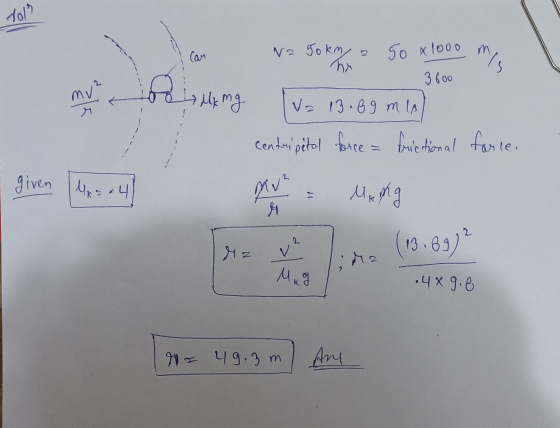
Question 13 1 points Save Answer What is the smallest radius of a curved road around...
What is the maximum speed a car can travel around a curved road (assume the radius...
What is the maximum speed a car can travel around a curved road (assume the radius of curvature is 30 meters) which is banked at 10-degrees without relying on friction?
What is the smallest radius of an unbanked (flat) track around which a bicyclist can travel...
What is the smallest radius of an unbanked (flat) track around which a bicyclist can travel if her speed is 30 km/h and the coefficient of static friction between tires and track is 0.31?
A car is driving around a banked curve, with the road surface at an angle of...
A car is driving around a banked curve, with the road surface at an angle of 10.0º. If the radius of curvature of the road is 30.0 m and the coefficient of static friction between the tires of the car and the road is 0.65, what is the maximum speed (in km/hr) the car can go without skidding?
A curved road has a radius of 0.489 km. A 647.2 kg truck moves around the...
A curved road has a radius of 0.489 km. A 647.2 kg truck moves around the curve at a speed of 63 km/hr with no acceleration. What is the minimum coefficient of friction that will prevent the truck from sliding left-to-right?
A curve of radius 70 m is banked so that a 1000 kg car traveling at...
A curve of radius 70 m is banked so that a 1000 kg car traveling at 60 km/h can round it even if the road is so icy that the coefficient of static friction is approximately zero. The acceleration of gravity is 9.81 m/s 2 . a) Find the minimum speed at which a car can travel around this curve without skidding if the coefficient of static friction between the road and the tires is 0.2 b) Find the maximum...
What is the smallest radius of an unbanked (flat) track aroundwhich a bicyclist can travel...
What is the smallest radius of an unbanked (flat) track around which a bicyclist can travel if her speed is 27 km/h and the coefficient of static friction between tires and track is 0.22?
A 780 kg car is driving around a comer with a radius of 25 m at...
 A 780 kg car is driving around a comer with a radius of 25 m at a velocity of 14 m/s. a) Draw a FBD of the car on the corner. Be sure to indicate which direction is towards the center of the corner. b) Use the FBD to find an equation for the normal force and the force due to friction c) What is the smallest possible coefficient of friction between the tires and the road without the car...
I just need Question 4 3) A car is driven around one curved road, whose radius...
 I just need Question 4
3) A car is driven around one curved road, whose radius is 320 m and then another whose radius is 960 m. In both cases, the speed is 28 m/s. Compare the centripetal acceleration for both turns. 4) Compare the maximum speeds at which a car can safely negotiate an unbanked turn (radius 50.0 m) under normal conditions (Lis 09) and icy condition (M.-0.1).
I just need Question 4
3) A car is driven around one curved road, whose radius is 320 m and then another whose radius is 960 m. In both cases, the speed is 28 m/s. Compare the centripetal acceleration for both turns. 4) Compare the maximum speeds at which a car can safely negotiate an unbanked turn (radius 50.0 m) under normal conditions (Lis 09) and icy condition (M.-0.1).
1) A car with mass m = 1000 kg is traveling around a circular curve of...
1) A car with mass m = 1000 kg is traveling around a circular curve of radius r = 990 m when it begins to rain. The coefficients of static friction between the road and tires is μd = 0.66 when dry and μw = 0.26 when wet. a) Write an expression for the maximum magnitude of the force of static friction Ff acting on the car if μs is the coefficient of friction. b) What is the maximum tangential...
009 (part 1 of 2) 10.0 points A civil engineer is asked to design a curved...
 009 (part 1 of 2) 10.0 points A civil engineer is asked to design a curved section of roadway that meets the following conditions: With ice on the road, when the coefficient of static friction between the road and rubber is 0.24, a car at rest must not slide into the ditch and a car traveling less than 70 km/h must not skid to the outside of the curve. The acceleration of gravity is 9.81 m/s2. At what angle should...
 A 780 kg car is driving around a comer with a radius of 25 m at a velocity of 14 m/s. a) Draw a FBD of the car on the corner. Be sure to indicate which direction is towards the center of the corner. b) Use the FBD to find an equation for the normal force and the force due to friction c) What is the smallest possible coefficient of friction between the tires and the road without the car...
 I just need Question 4
3) A car is driven around one curved road, whose radius is 320 m and then another whose radius is 960 m. In both cases, the speed is 28 m/s. Compare the centripetal acceleration for both turns. 4) Compare the maximum speeds at which a car can safely negotiate an unbanked turn (radius 50.0 m) under normal conditions (Lis 09) and icy condition (M.-0.1).
I just need Question 4
3) A car is driven around one curved road, whose radius is 320 m and then another whose radius is 960 m. In both cases, the speed is 28 m/s. Compare the centripetal acceleration for both turns. 4) Compare the maximum speeds at which a car can safely negotiate an unbanked turn (radius 50.0 m) under normal conditions (Lis 09) and icy condition (M.-0.1).
 009 (part 1 of 2) 10.0 points A civil engineer is asked to design a curved section of roadway that meets the following conditions: With ice on the road, when the coefficient of static friction between the road and rubber is 0.24, a car at rest must not slide into the ditch and a car traveling less than 70 km/h must not skid to the outside of the curve. The acceleration of gravity is 9.81 m/s2. At what angle should...
Most questions answered within 3 hours.
-
Where is the error in this code sequence?
String s1 = "Hello";
String s2 = "ello";...
asked 10 months ago -
Financial data for Joel de Paris, Inc., for last year
follow:
Joel de Paris, Inc.
Balance...
asked 10 months ago -
Consider this reaction:
Al2(SO4)3 (aq)+ BaCl3
(aq) Al2Cl6 (aq)- +
3BaSO4(s) . What is the...
asked 10 months ago -
Suppose that Savneet is considering increasing her
recent random sample from 20 car rentals to 40...
asked 10 months ago -
Trucks arrive at an unloading terminal at an average rate of 120
per hour.
Trucks arrive...
asked 10 months ago -
Why are methanol and ethanol completely soluble in water while
octanol is not very little soluble....
asked 10 months ago -
A facilities manager at a university reads in a research report
that the mean amount of...
asked 10 months ago -
When the CuSO4 is rehydrated by adding water to the anhydrous
compound, is this an endothermic...
asked 10 months ago -
A ray of sunlight is passing from diamond into crown glass; the
angle of incidence is...
asked 10 months ago -
A block of mass 0.249 kg is placed on top of a light, vertical
spring of...
asked 10 months ago -
how do the kidneys compensate in the presences of acidosis
a) trigger hyperventilate
b) reserve acid...
asked 10 months ago -
Question 501 pts
The rental rate of capital to the firm increases. Which of the
following...
asked 10 months ago