


Homework Answers
Question 8 Consider the tree below. What is the value stored in the parent node of...
 Question 8
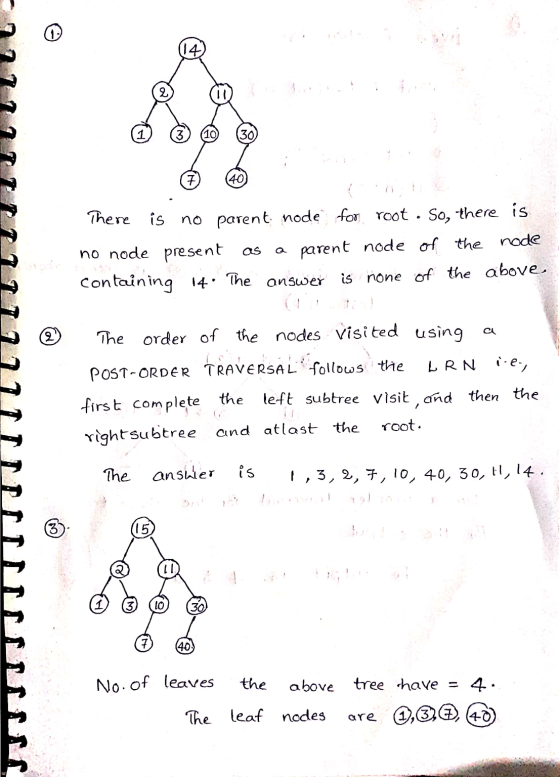
Consider the tree below. What is the value stored in the parent
node of the node containing 30?
Question 8 options:
10
11
14
40
None of the above
Question 9
Consider the tree below. How many descendants does the root
have?
Question 9 options:
0
2
4
8
Question 10
Consider the tree below. What is the depth of the tree?
Question 10 options:
2
3
4
8
9
Question 11
Consider the tree below. How many...
Question 8
Consider the tree below. What is the value stored in the parent
node of the node containing 30?
Question 8 options:
10
11
14
40
None of the above
Question 9
Consider the tree below. How many descendants does the root
have?
Question 9 options:
0
2
4
8
Question 10
Consider the tree below. What is the depth of the tree?
Question 10 options:
2
3
4
8
9
Question 11
Consider the tree below. How many...
9) 10 pts. What is the final result that will be stored in "a? double a...
 9) 10 pts. What is the final result that will be stored in "a? double a = 3. double b = 12. double c = 4 .; a 3. For 10 & 11 use the following function prototype: void Funl (int a, float c, double d); 10) 5 pts. Write the function call. Include the variable definitions. 11) 5 pts. Write the function header with an empty function body. 12) 5 pts The following code does NOT get a runtime...
C++ EXERCISE (DATA STRUCTURES). I just need a code for some functions that are missing. Please...
C++ EXERCISE (DATA STRUCTURES). I just need a code for some functions that are missing. Please help me figure out. Thanks. C++ BST implementation (using a struct) Enter the code below, and then compile and run the program. After the program runs successfully, add the following functions: postorder() This function is similar to the inorder() and preorder() functions, but demonstrates postorder tree traversal. displayParentsWithTwo() This function is similar to the displayParents WithOne() function, but displays nodes having only two children....
11. What is the output of the following program fragment? int v[5] = {10, 20, 30,...
11. What is the output of the following program fragment? int v[5] = {10, 20, 30, 40, 50}; for (int i=3; i>0; i--) { cout << v[i] << " "; } A. 102030 B. 302010 C. 403020 D. 40302010 12. Given the following code: char a[20]; char b[30]; Copy(a, b); // Copy all elements of b into a What is the best signature (header) of the Copy function? A. void Copy(char x[], char y[]) B. void Copy(const char x[], char...
C++ Binary tree, help pls #pragma once // include this library to use NULL, otherwise use...
C++ Binary tree, help pls #pragma once // include this library to use NULL, otherwise use nullptr instead #include <cstddef> #include <iostream> #include "node.hpp" template<class T> class BST{ public: // Constructor for the BST class, creates an empty tree BST(void); // Destructor for the BST class, destroys the tree ~BST(void); // Inserts data into the tree // param: The data to be inserted into the tree void insert(T); // Removes data from the tree // param: The data to be...
8 3 10 1 6 (14 4 7 13 For each of the following traversal orders,...
 8 3 10 1 6 (14 4 7 13 For each of the following traversal orders, list the order in which nodes in this tree will be visited. (a) Inorder (1) Preorder
LANGUAGE IS C++ Lab Ch14 Recursion In this lab, you are provided with startup code which...
LANGUAGE IS C++ Lab Ch14 Recursion In this lab, you are provided with startup code which has six working functions that use looping (for, while, or do loops) to repeat the same set of statements multiple times. You will create six equivalent functions that use recursion instead of looping. Although looping and recursion can be interchanged, for many problems, recursion is easier and more elegant. Like loops, recursion must ALWAYS contain a condition; otherwise, you have an infinite recursion (or...
Your task is to complete the following function/functions: 1. Given a position in the linked list,...
Your task is to complete the following function/functions: 1. Given a position in the linked list, delete the node at that position.(Silver problem - Mandatory ) 2. Print the sum of all negative elements in the linked list.(Gold problem) If you want, you can refer to the the previous recitation manual (which was on Linked Lists) to implement node deletion. #include <iostream> using namespace std; //----------- Define Node --------------------------------------------------- struct Node{ int key; Node *next; }; //----------- Define Linked List...
Part-1: find the longest block (subsequence of elements with same value) in an array. Part-2: find...
Part-1: find the longest block (subsequence of elements with same value) in an array. Part-2: find all subsequences in an array of int that add up to a given sum. */ #include <iostream> #include <cstdlib> using namespace std; void printSeq(int* a, int s, int e); // -------------------------------------------- functions to be implemented by you void longestBlock(const int* a, int n, int& s, int& e) { // s = start index of the block // e = end index of the block...
Lines 10& 11 are wrong Lines 12 & 13 are wrong CHALLENGE 2.19.2 rand function: Seed...
 Lines 10& 11 are wrong
Lines 12 & 13 are wrong
CHALLENGE 2.19.2 rand function: Seed and then get random numbers Type a statement using srand0 to seed random number generation using variable seedVal. Then type two statements using rand to print two random integers between (and including) 0 and 9. End with a newline. Ex Note. For this activity, using one statement may yield different output (due to the compiler calling rand0 in a different order). Use two statements...
Lines 10& 11 are wrong
Lines 12 & 13 are wrong
CHALLENGE 2.19.2 rand function: Seed and then get random numbers Type a statement using srand0 to seed random number generation using variable seedVal. Then type two statements using rand to print two random integers between (and including) 0 and 9. End with a newline. Ex Note. For this activity, using one statement may yield different output (due to the compiler calling rand0 in a different order). Use two statements...
 Question 8
Consider the tree below. What is the value stored in the parent
node of the node containing 30?
Question 8 options:
10
11
14
40
None of the above
Question 9
Consider the tree below. How many descendants does the root
have?
Question 9 options:
0
2
4
8
Question 10
Consider the tree below. What is the depth of the tree?
Question 10 options:
2
3
4
8
9
Question 11
Consider the tree below. How many...
Question 8
Consider the tree below. What is the value stored in the parent
node of the node containing 30?
Question 8 options:
10
11
14
40
None of the above
Question 9
Consider the tree below. How many descendants does the root
have?
Question 9 options:
0
2
4
8
Question 10
Consider the tree below. What is the depth of the tree?
Question 10 options:
2
3
4
8
9
Question 11
Consider the tree below. How many...
 9) 10 pts. What is the final result that will be stored in "a? double a = 3. double b = 12. double c = 4 .; a 3. For 10 & 11 use the following function prototype: void Funl (int a, float c, double d); 10) 5 pts. Write the function call. Include the variable definitions. 11) 5 pts. Write the function header with an empty function body. 12) 5 pts The following code does NOT get a runtime...
 8 3 10 1 6 (14 4 7 13 For each of the following traversal orders, list the order in which nodes in this tree will be visited. (a) Inorder (1) Preorder
 Lines 10& 11 are wrong
Lines 12 & 13 are wrong
CHALLENGE 2.19.2 rand function: Seed and then get random numbers Type a statement using srand0 to seed random number generation using variable seedVal. Then type two statements using rand to print two random integers between (and including) 0 and 9. End with a newline. Ex Note. For this activity, using one statement may yield different output (due to the compiler calling rand0 in a different order). Use two statements...
Lines 10& 11 are wrong
Lines 12 & 13 are wrong
CHALLENGE 2.19.2 rand function: Seed and then get random numbers Type a statement using srand0 to seed random number generation using variable seedVal. Then type two statements using rand to print two random integers between (and including) 0 and 9. End with a newline. Ex Note. For this activity, using one statement may yield different output (due to the compiler calling rand0 in a different order). Use two statements...
Most questions answered within 3 hours.
-
Where is the error in this code sequence?
String s1 = "Hello";
String s2 = "ello";...
asked 11 months ago -
Financial data for Joel de Paris, Inc., for last year
follow:
Joel de Paris, Inc.
Balance...
asked 11 months ago -
Consider this reaction:
Al2(SO4)3 (aq)+ BaCl3
(aq) Al2Cl6 (aq)- +
3BaSO4(s) . What is the...
asked 11 months ago -
Suppose that Savneet is considering increasing her
recent random sample from 20 car rentals to 40...
asked 11 months ago -
Trucks arrive at an unloading terminal at an average rate of 120
per hour.
Trucks arrive...
asked 11 months ago -
Why are methanol and ethanol completely soluble in water while
octanol is not very little soluble....
asked 11 months ago -
A facilities manager at a university reads in a research report
that the mean amount of...
asked 11 months ago -
When the CuSO4 is rehydrated by adding water to the anhydrous
compound, is this an endothermic...
asked 11 months ago -
A ray of sunlight is passing from diamond into crown glass; the
angle of incidence is...
asked 11 months ago -
A block of mass 0.249 kg is placed on top of a light, vertical
spring of...
asked 11 months ago -
how do the kidneys compensate in the presences of acidosis
a) trigger hyperventilate
b) reserve acid...
asked 11 months ago -
Question 501 pts
The rental rate of capital to the firm increases. Which of the
following...
asked 11 months ago