
Homework Answers
Consider that the object is floating in a water of density d and it is partially subnerged. Let us assume that the volume V of the object is submerged. Suppose y axis point upwards orthogonal to the water surface.
When the object is floating at rest, the net force it experiences is zero. If we displace the object by a small amount y from its equilibrium position, then the submerged volume will change by an amount

where A is the cross-sectional area of the portion of the object intersecting the surface of the water. The buoyant force experienced by the displaced object will have changed by an amount equal to the change in the weight of the displaced liquid

Here, g is the acceleration due to gravilty. Since the net force on the object is the difference of buoyant force and the force due to gravity. But only the buoyant force changes for the displaced object, the net force on the object when it is displaced by an amount y is

Applying Newton's Second law in the y direction
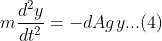
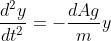
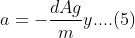
Clearly this is the equation of SHM as the acceleration is directly proportional to the displacement.
Comparing Eq. (5) with

we get

or

Add Answer to:
We know that objects undergoing simple harmonic motion have an acceleration that is proportional to their...
The acceleration of an oscillator undergoing simple harmonic motion is described by the equation ax(t)=−(16m/s2)cos(36t), where...
The acceleration of an oscillator undergoing simple harmonic motion is described by the equation ax(t)=−(16m/s2)cos(36t), where the time t is measured in seconds. What is the amplitude of this oscillator?
The acceleration of an oscillator undergoing simple harmonic motion is described by the equation ax(t)=−(22m/s2)cos(24t), where...
The acceleration of an oscillator undergoing simple harmonic motion is described by the equation ax(t)=−(22m/s2)cos(24t), where the time t is measured in seconds. What is the amplitude of this oscillator?
An object is undergoing simple harmonic motion in the -direction such that is equilibrium position is...
 An object is undergoing simple harmonic motion in the -direction such that is equilibrium position is at z 0. At time t 0 the objects position, velocity, and acceleration are z = 0.448 m, u = 0.207 m/s, and a =-0.359 rn/82. respectively. For radians, enter 'rad" as the unit. For a full list of accepted units, use the "Units Help" link below. (a) What is the angular frequency of the object's motion? Number Units (b) What is the amplitude...
1) A 12.3 kg particle is undergoing simple harmonic motion with an amplitude of 1.86 mm....
1) A 12.3 kg particle is undergoing simple harmonic motion with an amplitude of 1.86 mm. The maximum acceleration experienced by the particle is 7.93 km/s2. (a) Find the period of the motion. (b) What is the maximum speed of the particle? (c) Calculate the total mechanical energy of this simple harmonic oscillator. 2) The orbit of the Moon around the Earth as projected along a diameter can be viewed as simple harmonic motion. Calculate the effective force constant k...
The equation of motion of a particle undergoing simple harmonic motion is x=4.00sin0.500t, where x is...
The equation of motion of a particle undergoing simple harmonic motion is x=4.00sin0.500t, where x is in centimeters. At t=1.00 s, determine the particle's displacement, velocity, and acceleration.
An object undergoing simple harmonic motion in the x-direction has a period of 2.0 seconds, an...
An object undergoing simple harmonic motion in the x-direction has a period of 2.0 seconds, an amplitude of 5 cm and begins its oscillation at t = 0 at its maximum value of x. What equation could describe its motion?
A toy of mass 0.155 kg is undergoing simple harmonic motion (SHM) on the end of...
 A toy of mass 0.155 kg is undergoing simple harmonic motion (SHM) on the end of a horizontal spring with force constant 305 N/m. When the object is a distance 1.15 times 10^-2 m from its equilibrium position, it is observed to have a speed of 0.305 m/s. What is the total energy of the object at any point of its motion? What is the amplitude of the motion?
A Wave Packet in Simple Harmonic Motion: Coherent State of Simple Harmonic Oscillator 2 Background: Without...
 A Wave Packet in Simple Harmonic Motion: Coherent State of Simple Harmonic Oscillator 2 Background: Without the general tools for solving the Time Dependent Schrödinger Equation DSwhich we will lear in ciect ssoltions io the TDSEi are diflieli but not impossible to find. In this problem, you will consider one such solution, the "Coherent States" of a Simple Harmonic Oscillator (SHO) of frequency w. We will use the solution to this problem to illustrate the general principles of the Correspondence...
An object is undergoing simple harmonic motion. The graph shows the position of the object as...
An object is undergoing simple harmonic motion. The graph shows the position of the object as a function of time. What is the first time after t = 0 s when the speed reaches a maximum? x (cm) á ábOENWA 0 1 2 4 5 6 3 t (s)
8. [1pt] An object is undergoing simple harmonic motion. The graph shows the position of the...
8. [1pt] An object is undergoing simple harmonic motion. The graph shows the position of the object as a function of time. What is the first time after t = 0 s when the speed reaches a maximum? Answer: 9. [1pt] What is the first time after t = 0 s, when the magnitude of the acceleration is a maximum? Answer: 10. [1pt] What is the maximum acceleration that the object experiences? Answer: 6 דיוי די, ידידידידידין 5 4 t...
 An object is undergoing simple harmonic motion in the -direction such that is equilibrium position is at z 0. At time t 0 the objects position, velocity, and acceleration are z = 0.448 m, u = 0.207 m/s, and a =-0.359 rn/82. respectively. For radians, enter 'rad" as the unit. For a full list of accepted units, use the "Units Help" link below. (a) What is the angular frequency of the object's motion? Number Units (b) What is the amplitude...
 A toy of mass 0.155 kg is undergoing simple harmonic motion (SHM) on the end of a horizontal spring with force constant 305 N/m. When the object is a distance 1.15 times 10^-2 m from its equilibrium position, it is observed to have a speed of 0.305 m/s. What is the total energy of the object at any point of its motion? What is the amplitude of the motion?
 A Wave Packet in Simple Harmonic Motion: Coherent State of Simple Harmonic Oscillator 2 Background: Without the general tools for solving the Time Dependent Schrödinger Equation DSwhich we will lear in ciect ssoltions io the TDSEi are diflieli but not impossible to find. In this problem, you will consider one such solution, the "Coherent States" of a Simple Harmonic Oscillator (SHO) of frequency w. We will use the solution to this problem to illustrate the general principles of the Correspondence...
Most questions answered within 3 hours.
-
Where is the error in this code sequence?
String s1 = "Hello";
String s2 = "ello";...
asked 10 months ago -
Financial data for Joel de Paris, Inc., for last year
follow:
Joel de Paris, Inc.
Balance...
asked 10 months ago -
Consider this reaction:
Al2(SO4)3 (aq)+ BaCl3
(aq) Al2Cl6 (aq)- +
3BaSO4(s) . What is the...
asked 10 months ago -
Suppose that Savneet is considering increasing her
recent random sample from 20 car rentals to 40...
asked 10 months ago -
Trucks arrive at an unloading terminal at an average rate of 120
per hour.
Trucks arrive...
asked 10 months ago -
Why are methanol and ethanol completely soluble in water while
octanol is not very little soluble....
asked 10 months ago -
A facilities manager at a university reads in a research report
that the mean amount of...
asked 10 months ago -
When the CuSO4 is rehydrated by adding water to the anhydrous
compound, is this an endothermic...
asked 10 months ago -
A ray of sunlight is passing from diamond into crown glass; the
angle of incidence is...
asked 10 months ago -
A block of mass 0.249 kg is placed on top of a light, vertical
spring of...
asked 10 months ago -
how do the kidneys compensate in the presences of acidosis
a) trigger hyperventilate
b) reserve acid...
asked 10 months ago -
Question 501 pts
The rental rate of capital to the firm increases. Which of the
following...
asked 10 months ago