
Homework Answers

Add Answer to:
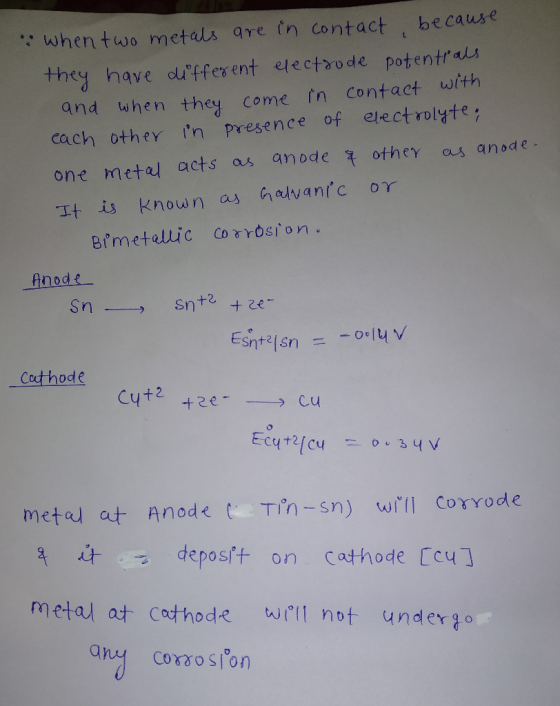
3. Name these compounds: Cu(OH)2: H2SO3: K2SO, Tin metal is in contact with copper metal and...
7. Iron metal is coated with tin. Is this anodic or cathodic coating? Which of metals...
 7. Iron metal is coated with tin. Is this anodic or cathodic coating? Which of metals will undergo corrosion when coating is damaged? Give the scheme of electrochemical corrosion in neutral and acidic medium and write equations for the reactions that occur.
Data Table 1: Physical Properties of Copper and Copper Compounds State Species (s. aq) Color Name...
 Data Table 1: Physical Properties of Copper and Copper Compounds State Species (s. aq) Color Name noun Copper Curou Copper, Cu (a penny) Copper, Cu (recovered, wet) Copper, Cu (recovered, dry) Cu(NO3)2 Cu(OH)2 Cuo Cuso Table 2: Mass of Copper Before and After Performing the Copper Cycle Mass of the penny before any reaction 2.u Mass of the penny after reacting with concentrated HNO (aq) 1.86 Mass of copper used (i.e., difference between the two previous masses) 0.54 Mass of...
Synthesis of Observation Instructor Approval Balanced Equation A. Cu(NO3)2 (aq) B. Cu(OH), (3) C. CuO (5)...
 Synthesis of Observation Instructor Approval Balanced Equation A. Cu(NO3)2 (aq) B. Cu(OH), (3) C. CuO (5) p. CuSO, (aq) E. Copper(II) sulfate to copper metal. Write a full description of the reactions that occurred. Include a balanced equation in your discussion
2. Corrosion in neutral medium Some item is made of two metals -zink and nickel which are in contact with each othe...
 2. Corrosion in neutral medium Some item is made of two metals -zink and nickel which are in contact with each other. The item corrosion procesg ergoes corrosion process in neutral moisture containing environment. What metal is going to oxidize W hat chemical element (depolizer) is going to reduce? Write down redox equations for both processes: for metal: for depolizer -0.23 V 3. Protection metal against Corrosion (anodic coating) Opt right anodic coating for Pb from the following metals: Pt,...
Consider the insoluble compound copper(II) hydroxide , Cu(OH)2 . The copper(II) ion also forms a complex...
 Consider the insoluble compound copper(II) hydroxide , Cu(OH)2 .
The copper(II) ion also forms a complex with ammonia . Write a
balanced net ionic equation to show why the solubility of Cu(OH)2
(s) increases in the presence of ammonia and calculate the
equilibrium constant for this reaction. For Cu(NH3)42+ , Kf =
6.8×10¹² . Use the pull-down boxes to specify states such as (aq)
or (s). + + K = Submit Answer
Voit needed for this question. Consider the insoluble...
Consider the insoluble compound copper(II) hydroxide , Cu(OH)2 .
The copper(II) ion also forms a complex with ammonia . Write a
balanced net ionic equation to show why the solubility of Cu(OH)2
(s) increases in the presence of ammonia and calculate the
equilibrium constant for this reaction. For Cu(NH3)42+ , Kf =
6.8×10¹² . Use the pull-down boxes to specify states such as (aq)
or (s). + + K = Submit Answer
Voit needed for this question. Consider the insoluble...
V. Concentration Cell Copper - Copper Cy(s), CuCl2 (0.01) || Cu(s), CuCl2 (1.0 M) 1. Draw...
V. Concentration Cell Copper - Copper Cy(s), CuCl2 (0.01) || Cu(s), CuCl2 (1.0 M) 1. Draw the schematic of the electrochemical cell that includes all the components (metals, solutions, salt bridges, voltmeters, etc.). Annotate on the schematic which side is the anode, which side is the cathode, the sign of each half cell, the composition of the metals and solutions, and the direction of the flow of the electrons through the cell. 2. Write the half reactions that occur at...
Lawine six chemical equations describe the six reactions that you used to convert copper into compounds...
 Lawine six chemical equations describe the six reactions that you used to convert copper into compounds and ultimately reproduce the original copper sample. Consistent with the law of rvation of mass, determine if each of the given equations are balanced. Balance those that are unbalanced by including the appropriate coefficients. Reaction 1: Cu(s) + 4H*(aq) + 2NO;(aq) - Cu + (aq) + 2NO2(g) + H2O(l) Reaction 2: Cu?(aq) + OH(aq) - Cu(OH),(s) Reaction 3: Cu(OH),(s) - CuO(s) + 2H,0(1) Reaction...
Reactions and Neutralization in the Copper Cycle A Cycle of Chemical Reactions of Copper PRE-LABORATORY ASSIGNMENT...
 Reactions and Neutralization in the Copper Cycle
A Cycle of Chemical Reactions of Copper PRE-LABORATORY ASSIGNMENT Finish the pre-laboratory assignments before the laboratory experiment. Read the manual of this experiment and complete the following questions. 1. a. Identify oxidation-reduction reactions in the copper cycle experiment. For each oxidation-reduction reaction, write half reactions to show what is oxidized and what is reduced. Identify acid-base reactions and precipitation reactions in the copper cycle experi- ment. Write equations for the corresponding reactions. b....
Reactions and Neutralization in the Copper Cycle
A Cycle of Chemical Reactions of Copper PRE-LABORATORY ASSIGNMENT Finish the pre-laboratory assignments before the laboratory experiment. Read the manual of this experiment and complete the following questions. 1. a. Identify oxidation-reduction reactions in the copper cycle experiment. For each oxidation-reduction reaction, write half reactions to show what is oxidized and what is reduced. Identify acid-base reactions and precipitation reactions in the copper cycle experi- ment. Write equations for the corresponding reactions. b....
2. Corrosion in neutral medium Some item is made of two metals - zink and nickel which are in contact with each oth...
 2. Corrosion in neutral medium Some item is made of two metals - zink and nickel which are in contact with each other. The item undergoes corrosion process in neutral moisture containing environment. What metal is going to oxidize? What chemical element (depolizer) is going to reduce? Write down redox equations for both processes: for metal: for depolizer: po-0.23 V 3. Protection metal against Corrosion (anodic coating) Opt right anodic coating for Pb from the following metals: Pt, Al, Cu,...
3. a. Why should the Cu(OH)2 precipitate that is formed during reaction (ii) be heated slowly...
 3. a. Why should the Cu(OH)2 precipitate that is formed during reaction (ii) be heated slowly during reaction (ii)? b. Why does reaction (i) have to be carried out in the fume hood? 4. Reaction (iii) is considered to be c) decomposition d) acid-base e) precipitation b) single displacement a) combination EXPERIMENT 9 REACTION OF COPPER AND ITS COMPOUNDS PRE-LABORATORY QUESTIONS The following preparatory questions should be answered before coming to lab. They are intended to introduce you to several...
 7. Iron metal is coated with tin. Is this anodic or cathodic coating? Which of metals will undergo corrosion when coating is damaged? Give the scheme of electrochemical corrosion in neutral and acidic medium and write equations for the reactions that occur.
 Data Table 1: Physical Properties of Copper and Copper Compounds State Species (s. aq) Color Name noun Copper Curou Copper, Cu (a penny) Copper, Cu (recovered, wet) Copper, Cu (recovered, dry) Cu(NO3)2 Cu(OH)2 Cuo Cuso Table 2: Mass of Copper Before and After Performing the Copper Cycle Mass of the penny before any reaction 2.u Mass of the penny after reacting with concentrated HNO (aq) 1.86 Mass of copper used (i.e., difference between the two previous masses) 0.54 Mass of...
 Synthesis of Observation Instructor Approval Balanced Equation A. Cu(NO3)2 (aq) B. Cu(OH), (3) C. CuO (5) p. CuSO, (aq) E. Copper(II) sulfate to copper metal. Write a full description of the reactions that occurred. Include a balanced equation in your discussion
 2. Corrosion in neutral medium Some item is made of two metals -zink and nickel which are in contact with each other. The item corrosion procesg ergoes corrosion process in neutral moisture containing environment. What metal is going to oxidize W hat chemical element (depolizer) is going to reduce? Write down redox equations for both processes: for metal: for depolizer -0.23 V 3. Protection metal against Corrosion (anodic coating) Opt right anodic coating for Pb from the following metals: Pt,...
 Consider the insoluble compound copper(II) hydroxide , Cu(OH)2 .
The copper(II) ion also forms a complex with ammonia . Write a
balanced net ionic equation to show why the solubility of Cu(OH)2
(s) increases in the presence of ammonia and calculate the
equilibrium constant for this reaction. For Cu(NH3)42+ , Kf =
6.8×10¹² . Use the pull-down boxes to specify states such as (aq)
or (s). + + K = Submit Answer
Voit needed for this question. Consider the insoluble...
Consider the insoluble compound copper(II) hydroxide , Cu(OH)2 .
The copper(II) ion also forms a complex with ammonia . Write a
balanced net ionic equation to show why the solubility of Cu(OH)2
(s) increases in the presence of ammonia and calculate the
equilibrium constant for this reaction. For Cu(NH3)42+ , Kf =
6.8×10¹² . Use the pull-down boxes to specify states such as (aq)
or (s). + + K = Submit Answer
Voit needed for this question. Consider the insoluble...
 Lawine six chemical equations describe the six reactions that you used to convert copper into compounds and ultimately reproduce the original copper sample. Consistent with the law of rvation of mass, determine if each of the given equations are balanced. Balance those that are unbalanced by including the appropriate coefficients. Reaction 1: Cu(s) + 4H*(aq) + 2NO;(aq) - Cu + (aq) + 2NO2(g) + H2O(l) Reaction 2: Cu?(aq) + OH(aq) - Cu(OH),(s) Reaction 3: Cu(OH),(s) - CuO(s) + 2H,0(1) Reaction...
 Reactions and Neutralization in the Copper Cycle
A Cycle of Chemical Reactions of Copper PRE-LABORATORY ASSIGNMENT Finish the pre-laboratory assignments before the laboratory experiment. Read the manual of this experiment and complete the following questions. 1. a. Identify oxidation-reduction reactions in the copper cycle experiment. For each oxidation-reduction reaction, write half reactions to show what is oxidized and what is reduced. Identify acid-base reactions and precipitation reactions in the copper cycle experi- ment. Write equations for the corresponding reactions. b....
Reactions and Neutralization in the Copper Cycle
A Cycle of Chemical Reactions of Copper PRE-LABORATORY ASSIGNMENT Finish the pre-laboratory assignments before the laboratory experiment. Read the manual of this experiment and complete the following questions. 1. a. Identify oxidation-reduction reactions in the copper cycle experiment. For each oxidation-reduction reaction, write half reactions to show what is oxidized and what is reduced. Identify acid-base reactions and precipitation reactions in the copper cycle experi- ment. Write equations for the corresponding reactions. b....
 2. Corrosion in neutral medium Some item is made of two metals - zink and nickel which are in contact with each other. The item undergoes corrosion process in neutral moisture containing environment. What metal is going to oxidize? What chemical element (depolizer) is going to reduce? Write down redox equations for both processes: for metal: for depolizer: po-0.23 V 3. Protection metal against Corrosion (anodic coating) Opt right anodic coating for Pb from the following metals: Pt, Al, Cu,...
 3. a. Why should the Cu(OH)2 precipitate that is formed during reaction (ii) be heated slowly during reaction (ii)? b. Why does reaction (i) have to be carried out in the fume hood? 4. Reaction (iii) is considered to be c) decomposition d) acid-base e) precipitation b) single displacement a) combination EXPERIMENT 9 REACTION OF COPPER AND ITS COMPOUNDS PRE-LABORATORY QUESTIONS The following preparatory questions should be answered before coming to lab. They are intended to introduce you to several...
Most questions answered within 3 hours.
-
Where is the error in this code sequence?
String s1 = "Hello";
String s2 = "ello";...
asked 10 months ago -
Financial data for Joel de Paris, Inc., for last year
follow:
Joel de Paris, Inc.
Balance...
asked 10 months ago -
Consider this reaction:
Al2(SO4)3 (aq)+ BaCl3
(aq) Al2Cl6 (aq)- +
3BaSO4(s) . What is the...
asked 10 months ago -
Suppose that Savneet is considering increasing her
recent random sample from 20 car rentals to 40...
asked 10 months ago -
Trucks arrive at an unloading terminal at an average rate of 120
per hour.
Trucks arrive...
asked 10 months ago -
Why are methanol and ethanol completely soluble in water while
octanol is not very little soluble....
asked 10 months ago -
A facilities manager at a university reads in a research report
that the mean amount of...
asked 10 months ago -
When the CuSO4 is rehydrated by adding water to the anhydrous
compound, is this an endothermic...
asked 10 months ago -
A ray of sunlight is passing from diamond into crown glass; the
angle of incidence is...
asked 10 months ago -
A block of mass 0.249 kg is placed on top of a light, vertical
spring of...
asked 10 months ago -
how do the kidneys compensate in the presences of acidosis
a) trigger hyperventilate
b) reserve acid...
asked 10 months ago -
Question 501 pts
The rental rate of capital to the firm increases. Which of the
following...
asked 10 months ago