Derive time equation but for that first we have to derive acceleration using the following equations:...
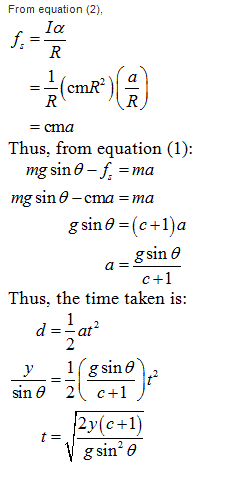
Derive time equation but for that first we have to derive acceleration using the following equations: [1] mg*sin(θ) – fs = ma [2] Rfs = Iα [3] I = cmR2 [4] α = a/R Once we have derived acceleration in terms of sin(θ), g, and c , we are then asked to derive time based on kinematic equation. The time equation should be based on of y, c, g, and d. d=length of Ramp.y=Height of ramp.
Homework Answers
Add Answer to:
Derive time equation but for that first we have to derive
acceleration using the following equations:...
derive a symbolic solution for the theoretical acceleration of a rotating, rolling item in terms of...
derive a symbolic solution for the theoretical acceleration of a rotating, rolling item in terms of sin(θ), g, and c using equations mg*sin(θ) – fs = ma Rfs = Iα I = cmR2 α = a/R
3. For experiment A, use equations 1&3 to develop a general equation for the value of...
 3. For experiment A, use equations 1&3 to develop a general equation for the value of tension (T) based on the values of the two masses. You will need this later to answer lab question (4), so write it in now. 4. Based on the "net force" and "total mass" approach that was used to derive equations 3,4, and 5; develop the equation for acceleration of two masses (m, and m2) hanging vertically from either side of a frictionless pulley....
2. The acceleration equation We have derived in lectures the Friedmann and fluid equations, that describe...
 2. The acceleration equation We have derived in lectures the Friedmann and fluid equations, that describe the evolution of simple cosmologies. The Friedmann equation is usually given (adopting c 1) as where a(t) is the scale factor of the universe, p is the mass (energy) density, and k is constant. (a) (5 points) The simplest (although spectacularly uninteresting) cosmology has zero mass-energy, i.e. ρ 0. Solve the Friedmann equation under this condition to obtain an expression for at(t). Describe the...
3. Let X1, X2,... , Xn be i.i.dExp(0) NOTE: We have previously found that θMLE X (a) Assuming a l...
 3. Let X1, X2,... , Xn be i.i.dExp(0) NOTE: We have previously found that θMLE X (a) Assuming a large n' derive an approximate 100(1-a)% L for θ that is based on the MLE (b) Now use the pivot Xi ~ χ n to derive an exact 100(1-a)% C.1, for θ. (c) Data was collected on the service time (in minutes) of 100 customers in a bank teller The average service time was 4.382 minutes. Based on the histogram of...
Could I get help with these problems please. For the first problem are we using two...
 Could I get help with these problems please. For the first
problem are we using two different equations. Are we using a
horizontal and vertical equation. V(t)=axt+vox. I am confused
here
Suppose a baseball player throws a ball. When she releases the ball, her hand is 1 meter above the ground, and the ball leaves her hand at 18 m/s in a direction that makes a 32° angle with the horizontal. (a) What is the maximum height above the ground...
Could I get help with these problems please. For the first
problem are we using two different equations. Are we using a
horizontal and vertical equation. V(t)=axt+vox. I am confused
here
Suppose a baseball player throws a ball. When she releases the ball, her hand is 1 meter above the ground, and the ball leaves her hand at 18 m/s in a direction that makes a 32° angle with the horizontal. (a) What is the maximum height above the ground...
please explain the answer 1) Up until now we have always ignored air resistance. We should...
 please explain the answer
1) Up until now we have always ignored air resistance. We should now add it. Let us just think of simple 1-dimensional problem, dropping a ball of mass m from a height H but 2 with air resistance. We can model the air resistance as a force proportional to the velocity, fair = bv. The coefficient bis a constant. (For this problem you can use calculus textbooks or wolfram alpha to do the calculus.) What are...
please explain the answer
1) Up until now we have always ignored air resistance. We should now add it. Let us just think of simple 1-dimensional problem, dropping a ball of mass m from a height H but 2 with air resistance. We can model the air resistance as a force proportional to the velocity, fair = bv. The coefficient bis a constant. (For this problem you can use calculus textbooks or wolfram alpha to do the calculus.) What are...
1) Up until now we have always ignored air resistance. We should now add it. Let...
 1) Up until now we have always ignored air resistance. We should now add it. Let us just think of simple 1-dimensional problem, dropping a ball of mass m from a height H but with air resistance. We can model the air resistance as a force proportional to the velocity, fair = bu. The coefficient b is a constant. (For this problem you can use calculus textbooks or wolfram alpha to do the calculus.) • What are the units on...
please explain the answer. 1) Up until now we have always ignored air resistance. We should...
 please explain the answer.
1) Up until now we have always ignored air resistance. We should now add it. Let us just think of simple 1-dimensional problem, dropping a ball of mass m from a height H but 2 with air resistance. We can model the air resistance as a force proportional to the velocity, fair = bv. The coefficient bis a constant. (For this problem you can use calculus textbooks or wolfram alpha to do the calculus.) What are...
please explain the answer.
1) Up until now we have always ignored air resistance. We should now add it. Let us just think of simple 1-dimensional problem, dropping a ball of mass m from a height H but 2 with air resistance. We can model the air resistance as a force proportional to the velocity, fair = bv. The coefficient bis a constant. (For this problem you can use calculus textbooks or wolfram alpha to do the calculus.) What are...
1. Given the following shaft/connector assembly: 2. We have a kinematic equation relating the po...
 1. Given the following shaft/connector
assembly:
2. We have a kinematic equation relating the position of
the input shaft to the output shaft and the misalignment angle (w1
= input angular speed and w2 = output angular speed):
3. The following conditions are given to find the angle
alpha:
4. Please complete the following by using the equation
above with the listed conditions (NOTE: 100 rpm = 600 degrees/sec
and 120 rpm = 720 degrees/sec):
Output Shaft Connector Input Shaft...
1. Given the following shaft/connector
assembly:
2. We have a kinematic equation relating the position of
the input shaft to the output shaft and the misalignment angle (w1
= input angular speed and w2 = output angular speed):
3. The following conditions are given to find the angle
alpha:
4. Please complete the following by using the equation
above with the listed conditions (NOTE: 100 rpm = 600 degrees/sec
and 120 rpm = 720 degrees/sec):
Output Shaft Connector Input Shaft...
How do I get the equation on the second page from the two equations on the...
 How do I get the equation on the second page from the two
equations on the first page?
Download Page of 5 ZOOM Calculating the path Once a projectile is launched its motion is completely determined by its initial velocity (speed and direction) and the acceleration of gravity. Thus, once the bean bag leaves the player hand the success of the throw is determined no matter how much they may try and will the bag through the hole. The motion...
How do I get the equation on the second page from the two
equations on the first page?
Download Page of 5 ZOOM Calculating the path Once a projectile is launched its motion is completely determined by its initial velocity (speed and direction) and the acceleration of gravity. Thus, once the bean bag leaves the player hand the success of the throw is determined no matter how much they may try and will the bag through the hole. The motion...
 3. For experiment A, use equations 1&3 to develop a general equation for the value of tension (T) based on the values of the two masses. You will need this later to answer lab question (4), so write it in now. 4. Based on the "net force" and "total mass" approach that was used to derive equations 3,4, and 5; develop the equation for acceleration of two masses (m, and m2) hanging vertically from either side of a frictionless pulley....
 2. The acceleration equation We have derived in lectures the Friedmann and fluid equations, that describe the evolution of simple cosmologies. The Friedmann equation is usually given (adopting c 1) as where a(t) is the scale factor of the universe, p is the mass (energy) density, and k is constant. (a) (5 points) The simplest (although spectacularly uninteresting) cosmology has zero mass-energy, i.e. ρ 0. Solve the Friedmann equation under this condition to obtain an expression for at(t). Describe the...
 3. Let X1, X2,... , Xn be i.i.dExp(0) NOTE: We have previously found that θMLE X (a) Assuming a large n' derive an approximate 100(1-a)% L for θ that is based on the MLE (b) Now use the pivot Xi ~ χ n to derive an exact 100(1-a)% C.1, for θ. (c) Data was collected on the service time (in minutes) of 100 customers in a bank teller The average service time was 4.382 minutes. Based on the histogram of...
 Could I get help with these problems please. For the first
problem are we using two different equations. Are we using a
horizontal and vertical equation. V(t)=axt+vox. I am confused
here
Suppose a baseball player throws a ball. When she releases the ball, her hand is 1 meter above the ground, and the ball leaves her hand at 18 m/s in a direction that makes a 32° angle with the horizontal. (a) What is the maximum height above the ground...
Could I get help with these problems please. For the first
problem are we using two different equations. Are we using a
horizontal and vertical equation. V(t)=axt+vox. I am confused
here
Suppose a baseball player throws a ball. When she releases the ball, her hand is 1 meter above the ground, and the ball leaves her hand at 18 m/s in a direction that makes a 32° angle with the horizontal. (a) What is the maximum height above the ground...
 please explain the answer
1) Up until now we have always ignored air resistance. We should now add it. Let us just think of simple 1-dimensional problem, dropping a ball of mass m from a height H but 2 with air resistance. We can model the air resistance as a force proportional to the velocity, fair = bv. The coefficient bis a constant. (For this problem you can use calculus textbooks or wolfram alpha to do the calculus.) What are...
please explain the answer
1) Up until now we have always ignored air resistance. We should now add it. Let us just think of simple 1-dimensional problem, dropping a ball of mass m from a height H but 2 with air resistance. We can model the air resistance as a force proportional to the velocity, fair = bv. The coefficient bis a constant. (For this problem you can use calculus textbooks or wolfram alpha to do the calculus.) What are...
 1) Up until now we have always ignored air resistance. We should now add it. Let us just think of simple 1-dimensional problem, dropping a ball of mass m from a height H but with air resistance. We can model the air resistance as a force proportional to the velocity, fair = bu. The coefficient b is a constant. (For this problem you can use calculus textbooks or wolfram alpha to do the calculus.) • What are the units on...
 please explain the answer.
1) Up until now we have always ignored air resistance. We should now add it. Let us just think of simple 1-dimensional problem, dropping a ball of mass m from a height H but 2 with air resistance. We can model the air resistance as a force proportional to the velocity, fair = bv. The coefficient bis a constant. (For this problem you can use calculus textbooks or wolfram alpha to do the calculus.) What are...
please explain the answer.
1) Up until now we have always ignored air resistance. We should now add it. Let us just think of simple 1-dimensional problem, dropping a ball of mass m from a height H but 2 with air resistance. We can model the air resistance as a force proportional to the velocity, fair = bv. The coefficient bis a constant. (For this problem you can use calculus textbooks or wolfram alpha to do the calculus.) What are...
 1. Given the following shaft/connector
assembly:
2. We have a kinematic equation relating the position of
the input shaft to the output shaft and the misalignment angle (w1
= input angular speed and w2 = output angular speed):
3. The following conditions are given to find the angle
alpha:
4. Please complete the following by using the equation
above with the listed conditions (NOTE: 100 rpm = 600 degrees/sec
and 120 rpm = 720 degrees/sec):
Output Shaft Connector Input Shaft...
1. Given the following shaft/connector
assembly:
2. We have a kinematic equation relating the position of
the input shaft to the output shaft and the misalignment angle (w1
= input angular speed and w2 = output angular speed):
3. The following conditions are given to find the angle
alpha:
4. Please complete the following by using the equation
above with the listed conditions (NOTE: 100 rpm = 600 degrees/sec
and 120 rpm = 720 degrees/sec):
Output Shaft Connector Input Shaft...
 How do I get the equation on the second page from the two
equations on the first page?
Download Page of 5 ZOOM Calculating the path Once a projectile is launched its motion is completely determined by its initial velocity (speed and direction) and the acceleration of gravity. Thus, once the bean bag leaves the player hand the success of the throw is determined no matter how much they may try and will the bag through the hole. The motion...
How do I get the equation on the second page from the two
equations on the first page?
Download Page of 5 ZOOM Calculating the path Once a projectile is launched its motion is completely determined by its initial velocity (speed and direction) and the acceleration of gravity. Thus, once the bean bag leaves the player hand the success of the throw is determined no matter how much they may try and will the bag through the hole. The motion...
Most questions answered within 3 hours.
-
Where is the error in this code sequence?
String s1 = "Hello";
String s2 = "ello";...
asked 10 months ago -
Financial data for Joel de Paris, Inc., for last year
follow:
Joel de Paris, Inc.
Balance...
asked 10 months ago -
Consider this reaction:
Al2(SO4)3 (aq)+ BaCl3
(aq) Al2Cl6 (aq)- +
3BaSO4(s) . What is the...
asked 10 months ago -
Suppose that Savneet is considering increasing her
recent random sample from 20 car rentals to 40...
asked 10 months ago -
Trucks arrive at an unloading terminal at an average rate of 120
per hour.
Trucks arrive...
asked 10 months ago -
Why are methanol and ethanol completely soluble in water while
octanol is not very little soluble....
asked 10 months ago -
A facilities manager at a university reads in a research report
that the mean amount of...
asked 10 months ago -
When the CuSO4 is rehydrated by adding water to the anhydrous
compound, is this an endothermic...
asked 10 months ago -
A ray of sunlight is passing from diamond into crown glass; the
angle of incidence is...
asked 10 months ago -
A block of mass 0.249 kg is placed on top of a light, vertical
spring of...
asked 10 months ago -
how do the kidneys compensate in the presences of acidosis
a) trigger hyperventilate
b) reserve acid...
asked 10 months ago -
Question 501 pts
The rental rate of capital to the firm increases. Which of the
following...
asked 10 months ago