
Homework Answers
2H2 + O2 ---> 2H2O
change in moles delta(n) = 2 - 3 = -1
T = 25 oC = 25 + 273 = 298 K
R = 8.314 J/K.mol
Feed values,
maximum work done = -delta(n)RT = -(-1) x 8.314 x 298 = 2.48 kJ
Change in entropy deltaS = -nRlnX
X being the mole fraction of H2 or O2
mole fraction of H2 = 2/3 = 0.67
mole fraction of O2 = 1/3 = 0.33
deltaS = -(2 x 8.314)ln0.67 - (1 x 8.314)ln0.33
= 6.66 + 9.22
= 15.88 J/K
Add Answer to:
Consider the reaction of 2 mol H_2(g) at 25 degree C and 1 atm with 1...
For the reaction N_2(g) + 3 H_2(g) rightarrow 2 NH_3(g) Delta G degree = -23.6 kJ...
 For the reaction N_2(g) + 3 H_2(g) rightarrow 2 NH_3(g) Delta G degree = -23.6 kJ and Delta S degree = -198.7 J/K at 345 K and 1 atm. This reaction is (reactant, product) favored under standard conditions at 345 K. The standard enthalpy change for the reaction of 2.30 moles of N_2(g) at this temperature would be kJ. For the reaction 2 H_2O_2(l) rightarrow 2 H_2O(l) + O_2(g) Delta G degree = -236.9 kJ and Delta H degree =...
The reaction 2 H_2 O_2(aq) right arrow 2 H_2 O(I) + O_2 (g) is first order...
 The reaction 2 H_2 O_2(aq) right arrow 2 H_2 O(I) + O_2 (g) is first order in H_2 O_2 and has a rate constant of 0.00790 s^-1 at 20 degree C. A reaction vassel initially contains 159 mL of 26% H_2 O_2 by mass solution (the density of the solution is 1.17 g/mL). The gaseous oxygen is collected over water at 20 degree C as it forms. What volume of O_2 forms in 86 seconds at a barometric pressure of...
Co (g) + H_2O(g) CO_2 (g) + H_2(g) In an experiment, 0.35 mol of CO and...
 Co (g) + H_2O(g) CO_2 (g) + H_2(g) In an experiment, 0.35 mol of CO and 0.40 mol H_2O were placed in a 1.00 - L reaction vessel. At equilibrium, there were 0.19 mol of CO remaining. Keq at the temperature of the experiments is The acid-dissociation constant, K_a, for a weak acid is 4.57 x 10^-3. What is the base-dissociation constant, K_b+ for its conjugate base? Give one example of an amphoteric substance. At 200 degree C, the equilibrium...
K_p for NH_3 at 25 degree C N_2 (g) + 3 H_2(g) irreversible 2 NH_3 (g),...
 K_p for NH_3 at 25 degree C N_2 (g) + 3 H_2(g) irreversible 2 NH_3 (g), Delta G degree = -31.0 kJ consider the galvanic cell that uses the reaction 2 Ag^+ (aq) plus Cu(s) rightarrow Cu^2+ (aq) + 2Ag (s) clearly sketch the experimental set-up, write down the anode and cathode half- give the shorthand notation for the cell For the following cell, write a balanced equation for the cell reaction and calc Delta G degree C: Pt(s) |H_2(1.0...
At 25 degree C, the following heats of reaction are known: 2CIF (g) + O_2 (g)...
 At 25 degree C, the following heats of reaction are known: 2CIF (g) + O_2 (g) rightarrow Cl_2O (g)+ F_2O (g) Delta H_rxn^degree = 167.4 kJ/mol 2ClF_3 (g) +2O_2 (g) rightarrow Cl_2O (g) + 3F_2O (g) Delta H_rxn^degree = 341.4 kJ/mol 2F_2 (g) + O_2 (g) rightarrow 2F_2O (g) Delta H_rxn^degree = -43.4 kJ/mol At the same temperature, use Hess' law to calculate Delta H_rxn^degree for the following reaction: ClF (g) + F_2 (g) rightarrow ClF_3 (g)
IV Consider the reaction: H_2 (g) + I_2 (g) = 2 HI(g) A reaction mixture in...
 IV
Consider the reaction: H_2 (g) + I_2 (g) = 2 HI(g) A reaction mixture in a 4.25 L flask at a certain temperature initially contains 0.668 g H_2 (g) and 86.9 g of I_2 (g). At equilibrium, the flask contains 78.4 g HI. Calculate K_c degree for this reaction at this temperature.
IV
Consider the reaction: H_2 (g) + I_2 (g) = 2 HI(g) A reaction mixture in a 4.25 L flask at a certain temperature initially contains 0.668 g H_2 (g) and 86.9 g of I_2 (g). At equilibrium, the flask contains 78.4 g HI. Calculate K_c degree for this reaction at this temperature.
When the reaction 2H_2S(g)^f 2H_2(g) + S_2(g) is carried out at 1065 degree C, K_P =...
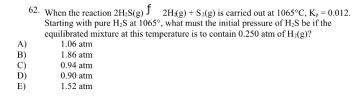 When the reaction 2H_2S(g)^f 2H_2(g) + S_2(g) is carried out at 1065 degree C, K_P = 0.012. Starting with pure H_2S at 1065 degree, what must the initial pressure of H_2S be if the equilibrated mixture at this temperature is to contain 0.250 atm of H_2(g)? A) 1.06 atm B) 1.86 atm C) 0.94 atm D) 0.90 atm E) 1.52 atm
2) Consider the combustion reaction of ethylene at 25 °C and 1 bar, but in the...
 2) Consider the combustion reaction of ethylene at 25 °C and 1 bar, but in the case that H20 is produced as a gas rather than a liquid: C2Halg)+3 O2(g)>2 CO2(g) + 2 H20(g) What is the standard enthalpy of the reaction? Information that may be useful for the calculation is given below (at the same temperature and pressure): C2H4(g)3 O2(g) -»2 CO2(g)+ 2 H2O(liq) AtusH(H20) 6.008 kJ mol-; AvaphH°(H2O) = 44.016 kJ mol-; AtH°(H20,g) = -241.82 kJ mol- (A)-1410.0...
Combustion of 4.93 g of liquid benzene (C_6H_6) causes a temperature rise of 20.9 degree C...
 Combustion of 4.93 g of liquid benzene (C_6H_6) causes a temperature rise of 20.9 degree C in a constant pressure calorimeter that has a heat capacity following reaction? -41.8 kJ/mol-rxn 41.8 kJ/mol-rxn -3.27 times 10^3 kJ/mol-rxn 206 kJ/mol-rxn 206 kJ/mol-rxn What is the correct formula for gallium (III)peroxide? Ga(O_2)_2 Ga_2(O_2)_3 Ga_3(O_2)_2 Ga_2O_2 GaO_2
At 248 ºC and a total pressure of 1.00 atm the degree of dissociation of SbCl5(g)...
At 248 ºC and a total pressure of 1.00 atm the degree of dissociation of SbCl5(g) is alpha = 0.718 for the reaction SbCl5(g) ↔ SbCl3(g) + Cl2(g) . The degree of dissociation alpha is defined as: alpha = (number of moles of SbCl5 dissociated at equilibrium) / (original number of moles of SbCl5) . (a) What is the value of the equilibrium constant K(T) at 248 ºC and 1.00 atm? (b) What is the value of Kx (the equilibrium...
 For the reaction N_2(g) + 3 H_2(g) rightarrow 2 NH_3(g) Delta G degree = -23.6 kJ and Delta S degree = -198.7 J/K at 345 K and 1 atm. This reaction is (reactant, product) favored under standard conditions at 345 K. The standard enthalpy change for the reaction of 2.30 moles of N_2(g) at this temperature would be kJ. For the reaction 2 H_2O_2(l) rightarrow 2 H_2O(l) + O_2(g) Delta G degree = -236.9 kJ and Delta H degree =...
 The reaction 2 H_2 O_2(aq) right arrow 2 H_2 O(I) + O_2 (g) is first order in H_2 O_2 and has a rate constant of 0.00790 s^-1 at 20 degree C. A reaction vassel initially contains 159 mL of 26% H_2 O_2 by mass solution (the density of the solution is 1.17 g/mL). The gaseous oxygen is collected over water at 20 degree C as it forms. What volume of O_2 forms in 86 seconds at a barometric pressure of...
 Co (g) + H_2O(g) CO_2 (g) + H_2(g) In an experiment, 0.35 mol of CO and 0.40 mol H_2O were placed in a 1.00 - L reaction vessel. At equilibrium, there were 0.19 mol of CO remaining. Keq at the temperature of the experiments is The acid-dissociation constant, K_a, for a weak acid is 4.57 x 10^-3. What is the base-dissociation constant, K_b+ for its conjugate base? Give one example of an amphoteric substance. At 200 degree C, the equilibrium...
 K_p for NH_3 at 25 degree C N_2 (g) + 3 H_2(g) irreversible 2 NH_3 (g), Delta G degree = -31.0 kJ consider the galvanic cell that uses the reaction 2 Ag^+ (aq) plus Cu(s) rightarrow Cu^2+ (aq) + 2Ag (s) clearly sketch the experimental set-up, write down the anode and cathode half- give the shorthand notation for the cell For the following cell, write a balanced equation for the cell reaction and calc Delta G degree C: Pt(s) |H_2(1.0...
 At 25 degree C, the following heats of reaction are known: 2CIF (g) + O_2 (g) rightarrow Cl_2O (g)+ F_2O (g) Delta H_rxn^degree = 167.4 kJ/mol 2ClF_3 (g) +2O_2 (g) rightarrow Cl_2O (g) + 3F_2O (g) Delta H_rxn^degree = 341.4 kJ/mol 2F_2 (g) + O_2 (g) rightarrow 2F_2O (g) Delta H_rxn^degree = -43.4 kJ/mol At the same temperature, use Hess' law to calculate Delta H_rxn^degree for the following reaction: ClF (g) + F_2 (g) rightarrow ClF_3 (g)
 IV
Consider the reaction: H_2 (g) + I_2 (g) = 2 HI(g) A reaction mixture in a 4.25 L flask at a certain temperature initially contains 0.668 g H_2 (g) and 86.9 g of I_2 (g). At equilibrium, the flask contains 78.4 g HI. Calculate K_c degree for this reaction at this temperature.
IV
Consider the reaction: H_2 (g) + I_2 (g) = 2 HI(g) A reaction mixture in a 4.25 L flask at a certain temperature initially contains 0.668 g H_2 (g) and 86.9 g of I_2 (g). At equilibrium, the flask contains 78.4 g HI. Calculate K_c degree for this reaction at this temperature.
 When the reaction 2H_2S(g)^f 2H_2(g) + S_2(g) is carried out at 1065 degree C, K_P = 0.012. Starting with pure H_2S at 1065 degree, what must the initial pressure of H_2S be if the equilibrated mixture at this temperature is to contain 0.250 atm of H_2(g)? A) 1.06 atm B) 1.86 atm C) 0.94 atm D) 0.90 atm E) 1.52 atm
 2) Consider the combustion reaction of ethylene at 25 °C and 1 bar, but in the case that H20 is produced as a gas rather than a liquid: C2Halg)+3 O2(g)>2 CO2(g) + 2 H20(g) What is the standard enthalpy of the reaction? Information that may be useful for the calculation is given below (at the same temperature and pressure): C2H4(g)3 O2(g) -»2 CO2(g)+ 2 H2O(liq) AtusH(H20) 6.008 kJ mol-; AvaphH°(H2O) = 44.016 kJ mol-; AtH°(H20,g) = -241.82 kJ mol- (A)-1410.0...
 Combustion of 4.93 g of liquid benzene (C_6H_6) causes a temperature rise of 20.9 degree C in a constant pressure calorimeter that has a heat capacity following reaction? -41.8 kJ/mol-rxn 41.8 kJ/mol-rxn -3.27 times 10^3 kJ/mol-rxn 206 kJ/mol-rxn 206 kJ/mol-rxn What is the correct formula for gallium (III)peroxide? Ga(O_2)_2 Ga_2(O_2)_3 Ga_3(O_2)_2 Ga_2O_2 GaO_2
Most questions answered within 3 hours.
-
Where is the error in this code sequence?
String s1 = "Hello";
String s2 = "ello";...
asked 11 months ago -
Financial data for Joel de Paris, Inc., for last year
follow:
Joel de Paris, Inc.
Balance...
asked 11 months ago -
Consider this reaction:
Al2(SO4)3 (aq)+ BaCl3
(aq) Al2Cl6 (aq)- +
3BaSO4(s) . What is the...
asked 11 months ago -
Suppose that Savneet is considering increasing her
recent random sample from 20 car rentals to 40...
asked 11 months ago -
Trucks arrive at an unloading terminal at an average rate of 120
per hour.
Trucks arrive...
asked 11 months ago -
Why are methanol and ethanol completely soluble in water while
octanol is not very little soluble....
asked 11 months ago -
A facilities manager at a university reads in a research report
that the mean amount of...
asked 11 months ago -
When the CuSO4 is rehydrated by adding water to the anhydrous
compound, is this an endothermic...
asked 11 months ago -
A ray of sunlight is passing from diamond into crown glass; the
angle of incidence is...
asked 11 months ago -
A block of mass 0.249 kg is placed on top of a light, vertical
spring of...
asked 11 months ago -
how do the kidneys compensate in the presences of acidosis
a) trigger hyperventilate
b) reserve acid...
asked 11 months ago -
Question 501 pts
The rental rate of capital to the firm increases. Which of the
following...
asked 11 months ago