
Homework Answers

Add Answer to:
Endothermic processes always give off heat at the completion of the
reaction.
QUESTION 1 Endothermic processes...
A spontaneous reaction Select one: a. is always exothermic. b. may be exothermic or endothermic. c....
A spontaneous reaction Select one: a. is always exothermic. b. may be exothermic or endothermic. c. is always endothermic. d. does not involve any heat exchange with surroundings. Which one? Need help please!
Determine whether the following statement is true or false: If a reaction is endothermic and entropically...
 Determine whether the following statement is true or false: If a reaction is endothermic and entropically favoured, the reaction is always spontaneous. Select one: True False
Question 1 (1 point) The specific heat of water is 4.184 J/g – °C . Question...
Question 1 (1 point) The specific heat of water is 4.184 J/g – °C . Question 1 options: True False Question 2 (1 point) Saved An exothermic reaction absorbs heat from its surroundings. Question 2 options: True False Question 3 (1 point) The melting of ice is an endothermic reaction. Question 3 options: True False Question 4 (1 point) Hess’s Law states that a reaction will have the same enthalpy change regardless of whether the reaction occurs in a single...
2. Indicate whether each statements is true of false. (a) Endothermic reaction cannot be spontaneous (b)...
 2. Indicate whether each statements is true of false. (a) Endothermic reaction cannot be spontaneous (b) Water can be decomposed to form H2 and O2, and the H2 and O2 can be recombined to from water This means the processes are thermodynamically reversible.
2. Indicate whether each statements is true of false. (a) Endothermic reaction cannot be spontaneous (b) Water can be decomposed to form H2 and O2, and the H2 and O2 can be recombined to from water This...
2. Indicate whether each statements is true of false. (a) Endothermic reaction cannot be spontaneous (b) Water can be decomposed to form H2 and O2, and the H2 and O2 can be recombined to from water This means the processes are thermodynamically reversible.
2. Indicate whether each statements is true of false. (a) Endothermic reaction cannot be spontaneous (b) Water can be decomposed to form H2 and O2, and the H2 and O2 can be recombined to from water This...
TRUE/FALSE QUESTIONS Question 1 Spontaneous processes proceed without outside intervention once initiated. Yet, spontaneous processes are...
TRUE/FALSE QUESTIONS Question 1 Spontaneous processes proceed without outside intervention once initiated. Yet, spontaneous processes are not always rapid. Group of answer choices True False Question 2 The sign of ∆G tells us how fast a reaction (or a process) might occur. Group of answer choices True False Question 3 The sublimation of dry ice (solid CO2), where CO2(s) LaTeX: \longrightarrow ⟶ CO2(g), has ∆S>0, ∆H>0, and ∆G<0 at 25°C. Group of answer choices True False Question 4 If a...
For the reaction of carbon dioxide to form carbon monoxide and oxygen, heat is given off....
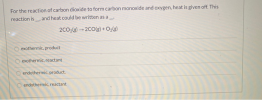 For the reaction of carbon dioxide to form carbon monoxide and oxygen, heat is given off. This reaction is _, and heat could be written as a _. 2002(g) → 2CO(g) + O2(g) exothermic, product ooo exothermic, reactant endothermic, product. endothermic, reactant
QUESTION 1 Heat is required to dissolve NaOH(s) in water. A-True B-False -------------------- QUESTiON 2 The...
QUESTION 1 Heat is required to dissolve NaOH(s) in water. A-True B-False -------------------- QUESTiON 2 The below equation represents an exothermic reaction: Reactants + delta H ----> product ATrue B-False -------------------- QUESTION 3 The Styrofoam cup was used as an insulated device that allows heat loss A-True B-False -------------------- QUESTION 4 The following is an endothermic reaction; NaOH+ HCI------> NaCl+H2O+42.12KJ A-True B-False -------------------- QUESTION 5 NaOH(s)---> Na^+(aq)+CH^-(aq)+44.02kJ Calculate the amount (in moles) of NaOH needed to make the reaction above...
Which of the following is true regarding endothermic and exothermic reactions? a reaction which releases energy...
 Which of the following is true regarding endothermic and exothermic reactions? a reaction which releases energy is exothermic areaction which absorbs energy is endothermic in an exothermic reaction, heat is released in an endothermic reaction, heat is absorbed all of the above are true Oonly a andc are true only b and d are true
Write a balanced equation for each of the processes in Part A. Remember to include heat...
 Write a balanced equation for each of the processes in Part A.
Remember to include heat on the reactant or product side, as
appropiate.
Reaction Solid + Liquid A NH,Cl(s) + H2O(1) CaCl (s) + H20(1) C NaHCO3(s) + HCl(aq) Reaction A B c Physical or Chemical Change? Chemical Chemical Chemical Exothermic or Endothermic? Endo Thermic Exothermic Endothermic
Write a balanced equation for each of the processes in Part A.
Remember to include heat on the reactant or product side, as
appropiate.
Reaction Solid + Liquid A NH,Cl(s) + H2O(1) CaCl (s) + H20(1) C NaHCO3(s) + HCl(aq) Reaction A B c Physical or Chemical Change? Chemical Chemical Chemical Exothermic or Endothermic? Endo Thermic Exothermic Endothermic
please slove both O False DQuestion 7 1 pts An endothermic reaction can be spontaneous. O...
 please slove both
O False DQuestion 7 1 pts An endothermic reaction can be spontaneous. O True O False D Question 8 1 pts Consider liquid water boiling at 1 atm of pressure. Liquid water and water vapor are at at 100°C. O True ○ False 1 pts Question 9
please slove both
O False DQuestion 7 1 pts An endothermic reaction can be spontaneous. O True O False D Question 8 1 pts Consider liquid water boiling at 1 atm of pressure. Liquid water and water vapor are at at 100°C. O True ○ False 1 pts Question 9
 Determine whether the following statement is true or false: If a reaction is endothermic and entropically favoured, the reaction is always spontaneous. Select one: True False
 2. Indicate whether each statements is true of false. (a) Endothermic reaction cannot be spontaneous (b) Water can be decomposed to form H2 and O2, and the H2 and O2 can be recombined to from water This means the processes are thermodynamically reversible.
2. Indicate whether each statements is true of false. (a) Endothermic reaction cannot be spontaneous (b) Water can be decomposed to form H2 and O2, and the H2 and O2 can be recombined to from water This...
2. Indicate whether each statements is true of false. (a) Endothermic reaction cannot be spontaneous (b) Water can be decomposed to form H2 and O2, and the H2 and O2 can be recombined to from water This means the processes are thermodynamically reversible.
2. Indicate whether each statements is true of false. (a) Endothermic reaction cannot be spontaneous (b) Water can be decomposed to form H2 and O2, and the H2 and O2 can be recombined to from water This...
 For the reaction of carbon dioxide to form carbon monoxide and oxygen, heat is given off. This reaction is _, and heat could be written as a _. 2002(g) → 2CO(g) + O2(g) exothermic, product ooo exothermic, reactant endothermic, product. endothermic, reactant
 Which of the following is true regarding endothermic and exothermic reactions? a reaction which releases energy is exothermic areaction which absorbs energy is endothermic in an exothermic reaction, heat is released in an endothermic reaction, heat is absorbed all of the above are true Oonly a andc are true only b and d are true
 Write a balanced equation for each of the processes in Part A.
Remember to include heat on the reactant or product side, as
appropiate.
Reaction Solid + Liquid A NH,Cl(s) + H2O(1) CaCl (s) + H20(1) C NaHCO3(s) + HCl(aq) Reaction A B c Physical or Chemical Change? Chemical Chemical Chemical Exothermic or Endothermic? Endo Thermic Exothermic Endothermic
Write a balanced equation for each of the processes in Part A.
Remember to include heat on the reactant or product side, as
appropiate.
Reaction Solid + Liquid A NH,Cl(s) + H2O(1) CaCl (s) + H20(1) C NaHCO3(s) + HCl(aq) Reaction A B c Physical or Chemical Change? Chemical Chemical Chemical Exothermic or Endothermic? Endo Thermic Exothermic Endothermic
 please slove both
O False DQuestion 7 1 pts An endothermic reaction can be spontaneous. O True O False D Question 8 1 pts Consider liquid water boiling at 1 atm of pressure. Liquid water and water vapor are at at 100°C. O True ○ False 1 pts Question 9
please slove both
O False DQuestion 7 1 pts An endothermic reaction can be spontaneous. O True O False D Question 8 1 pts Consider liquid water boiling at 1 atm of pressure. Liquid water and water vapor are at at 100°C. O True ○ False 1 pts Question 9
Most questions answered within 3 hours.
-
Where is the error in this code sequence?
String s1 = "Hello";
String s2 = "ello";...
asked 11 months ago -
Financial data for Joel de Paris, Inc., for last year
follow:
Joel de Paris, Inc.
Balance...
asked 11 months ago -
Consider this reaction:
Al2(SO4)3 (aq)+ BaCl3
(aq) Al2Cl6 (aq)- +
3BaSO4(s) . What is the...
asked 11 months ago -
Suppose that Savneet is considering increasing her
recent random sample from 20 car rentals to 40...
asked 11 months ago -
Trucks arrive at an unloading terminal at an average rate of 120
per hour.
Trucks arrive...
asked 11 months ago -
Why are methanol and ethanol completely soluble in water while
octanol is not very little soluble....
asked 11 months ago -
A facilities manager at a university reads in a research report
that the mean amount of...
asked 11 months ago -
When the CuSO4 is rehydrated by adding water to the anhydrous
compound, is this an endothermic...
asked 11 months ago -
A ray of sunlight is passing from diamond into crown glass; the
angle of incidence is...
asked 11 months ago -
A block of mass 0.249 kg is placed on top of a light, vertical
spring of...
asked 11 months ago -
how do the kidneys compensate in the presences of acidosis
a) trigger hyperventilate
b) reserve acid...
asked 11 months ago -
Question 501 pts
The rental rate of capital to the firm increases. Which of the
following...
asked 11 months ago