The amino acid asparagine can promote cancer cell proliferation. Treating patients with the enzyme asparaginase is sometimes used as a chemotherapy treatment. Asparaginase hydrolyzes asparagine to aspartate and ammonia.
Considering the provided Michaelis–Menten curves for two different asparaginase enzymes, complete the passage. The arrow indicates the concentration of asparagine in the human body.
![< Question 2 of 4 > Asparaginase 1 Asparaginase 2 [S] The Vmax of asparaginase 1 is equal to the Vmax of asparaginase 2. At t](http://img.homeworklib.com/questions/c31bdd10-f516-11eb-8d6c-97f1580ba008.png?x-oss-process=image/resize,w_560)
Homework Answers
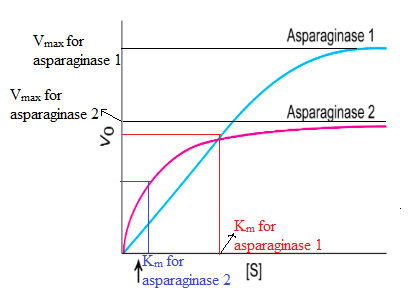
From the graph, the following conclusions can be made:
1. Vmax of asparaginase 1 is higher than Vmax of asparaginase 2.
2. Km of asparaginase 1 is higher than Km of asparaginase 2.
Lower the Michaelis-Menten constant (Km), higher is the affinity of the enzyme for substrate. Such enzymes need a high amount of substrate to reach the maximum velocity. So, in this case, asparaginase 2 is a better enzyme because it will use more amount of asparagine amino acid and will decrease the chances of cancer.
Add Answer to:
The amino acid asparagine can promote cancer cell proliferation.
Treating patients with the enzyme asparaginase is...
will rate thanks Q1. WHAT ARE ENZYMES? HOW DOES ENZYME-SUBSTRATE BINDING TAKES PLACE? Q2. IN MICHAELIS...
 will rate thanks
Q1. WHAT ARE ENZYMES? HOW DOES ENZYME-SUBSTRATE BINDING TAKES PLACE? Q2. IN MICHAELIS -MENTEN GRAPH, WHY DOES THE CURVE REACHES PLATEAU? Vmax Reaction velocity (v) Vm/2 Km Substrate concentration (S) Q3. IN MICHAELIS MENTEN GRAPH, HOW WOULD YOU INCREASE VELOCITY BEYOND Vmax? Q4. SMALLER VALUE OF THE MICHAELIS CONSTANT (Km) REFLECTS HIGHER EFFICIENCY OF THE ENZYME. (TRUE/FALSE).
will rate thanks
Q1. WHAT ARE ENZYMES? HOW DOES ENZYME-SUBSTRATE BINDING TAKES PLACE? Q2. IN MICHAELIS -MENTEN GRAPH, WHY DOES THE CURVE REACHES PLATEAU? Vmax Reaction velocity (v) Vm/2 Km Substrate concentration (S) Q3. IN MICHAELIS MENTEN GRAPH, HOW WOULD YOU INCREASE VELOCITY BEYOND Vmax? Q4. SMALLER VALUE OF THE MICHAELIS CONSTANT (Km) REFLECTS HIGHER EFFICIENCY OF THE ENZYME. (TRUE/FALSE).
3. The Michaelis-Menten Graph also shows the theoretical maximum rate of the enzyme (Vmax), the point...
 3. The Michaelis-Menten Graph also shows the theoretical maximum rate of the enzyme (Vmax), the point where the enzyme is working at its maximum rate (Vmax/2), and amount of substrate needed to bind half of the active sites (Km). Label these points on the graph. Vmax represents: Vm Vmax/2 represents: Reaction velocity v Vmax 2 Km represents: Kim Substrate concentration (5)
9. Applying the Michaelis-Menten Equation I An enzyme catalyzes the reaction A = B. The enzyme is present at a con- cen...
 9. Applying the Michaelis-Menten Equation I An enzyme catalyzes the reaction A = B. The enzyme is present at a con- centration of 2 nm, and the Vmax is 1.2 ums". The Km for substrate A is 10 um. Calculate the initial velocity of the reaction, Vo, when the substrate concentration is (a) 2 um, (b) 10 um, (C) 30 um.
The Michaelis-Menten equation is often used to describe the kinetic characteristics of an enzyme-catalyzed react...
 The Michaelis-Menten equation is often used to describe the kinetic characteristics of an enzyme-catalyzed reaction. S Where v is the velocity or rate, Vmax is the maximum velocity, Km is the +IST Michaelis- Menten constant, and I5 s the substrate concentration. K + S v (uM/min) a) A graph of the Michaelis-Menten equation is a plot of a reaction's initial velocity (Vo) at different substrate concentrations ([S]) 300 Vmax 250 1/2 Vmax First, move the line labeled "Vmax to a...
4. Basic concepts of Michaelis-Menten kinetics. The Michaelis-Menten equation is expression of the relationship between the...
 4. Basic concepts of Michaelis-Menten kinetics. The Michaelis-Menten equation is expression of the relationship between the initial velocity, Vo, of an enzymatic reaction and substrate concentration, [S]. There are three conditions that are useful for simplifying the Michaelis-Menten equation: [S] <<Km; [S] = Km; [S] >> Km. Match each condition with the statement(s) that describe it. TV, Vmox[S] Vo =Vmax m . V Vo - Vmax [S] Km +[S] V. (um/min) max [S] (mm) (a) Doubling [S] will almost double...
The relation between Reaction Velocity and Substrate Concentration: Michaelis-Menten Equation a) At what substrate concentration would...
The relation between Reaction Velocity and Substrate Concentration: Michaelis-Menten Equation a) At what substrate concentration would an enzyme with a kcat of 30.0 s-1 and a Km of 0.0050 M operate at one-quarter of its maximum rate? b) Determine the fraction of Vmax that would be obtained at the following substrate concentrations: [S]=Km/2, [S]=2Km, [S]=10Km
Choose the correct answer from the list below. is a type of mathematical model that describes...
 Choose the correct answer from the list below. is a type of mathematical model that describes the kinetics of many enzymes. The study of rates of chemical reactions. A -> P is an example of a reaction. A. Substrate B. first-order At , there is no net change in the concentration of substrate or product. C. Vmax D. k-2 The value Vo is called the of a reaction. E. initial velocity F. second-order - One way to measure the rate...
Estimation of Vmax and K by Inspection Although graphical methods are available for accurate determination of...
 Estimation of Vmax and K by Inspection Although graphical methods are available for accurate determination of the Vmax and K of an enzyme-catalyzed reaction (see Box 6-1), sometimes these quantities can be quickly estimated by inspecting values of Vat increasing (Sl. Estimate the Vmax and Km of the enzyme-catalyzed reaction for which the following data were obtained. V (pm/min) V (m/min) 112 [S] (M) 2.5 x 10 4.0 x 100 1 x 10⁻⁵ 2 x 10⁻⁵ [S(M) 4 x 10⁻⁵...
Question 5 (1 point) Saved Suppose a cell that had a total enzyme concentration of 1,...
 Question 5 (1 point) Saved Suppose a cell that had a total enzyme concentration of 1, suddenly reduced that concentration to 0.5; everything else in the cell was constant. Choose all of the values from the list below that must change as a result of the change in enzyme concentration. 1) Km 2) Vmax 3) substrate concentration 4) reaction velocity
biochemistry if you could please help me answer the following questions! 741) (5 pts) Transition state theory relate...
 biochemistry
if you could please help me answer the following questions!
741) (5 pts) Transition state theory relates the rate constant to the free energy of activation, AG. How can enzymes reduce the activation energy barrier? a) decrease the free energy of the product b) high affinity binding to the transition state c) increase the free energy of the substrate d) increase entropy upon release of product e) bind to the substrate with high affinity 2) (5 pts) Which is...
biochemistry
if you could please help me answer the following questions!
741) (5 pts) Transition state theory relates the rate constant to the free energy of activation, AG. How can enzymes reduce the activation energy barrier? a) decrease the free energy of the product b) high affinity binding to the transition state c) increase the free energy of the substrate d) increase entropy upon release of product e) bind to the substrate with high affinity 2) (5 pts) Which is...
 will rate thanks
Q1. WHAT ARE ENZYMES? HOW DOES ENZYME-SUBSTRATE BINDING TAKES PLACE? Q2. IN MICHAELIS -MENTEN GRAPH, WHY DOES THE CURVE REACHES PLATEAU? Vmax Reaction velocity (v) Vm/2 Km Substrate concentration (S) Q3. IN MICHAELIS MENTEN GRAPH, HOW WOULD YOU INCREASE VELOCITY BEYOND Vmax? Q4. SMALLER VALUE OF THE MICHAELIS CONSTANT (Km) REFLECTS HIGHER EFFICIENCY OF THE ENZYME. (TRUE/FALSE).
will rate thanks
Q1. WHAT ARE ENZYMES? HOW DOES ENZYME-SUBSTRATE BINDING TAKES PLACE? Q2. IN MICHAELIS -MENTEN GRAPH, WHY DOES THE CURVE REACHES PLATEAU? Vmax Reaction velocity (v) Vm/2 Km Substrate concentration (S) Q3. IN MICHAELIS MENTEN GRAPH, HOW WOULD YOU INCREASE VELOCITY BEYOND Vmax? Q4. SMALLER VALUE OF THE MICHAELIS CONSTANT (Km) REFLECTS HIGHER EFFICIENCY OF THE ENZYME. (TRUE/FALSE).
 3. The Michaelis-Menten Graph also shows the theoretical maximum rate of the enzyme (Vmax), the point where the enzyme is working at its maximum rate (Vmax/2), and amount of substrate needed to bind half of the active sites (Km). Label these points on the graph. Vmax represents: Vm Vmax/2 represents: Reaction velocity v Vmax 2 Km represents: Kim Substrate concentration (5)
 9. Applying the Michaelis-Menten Equation I An enzyme catalyzes the reaction A = B. The enzyme is present at a con- centration of 2 nm, and the Vmax is 1.2 ums". The Km for substrate A is 10 um. Calculate the initial velocity of the reaction, Vo, when the substrate concentration is (a) 2 um, (b) 10 um, (C) 30 um.
 The Michaelis-Menten equation is often used to describe the kinetic characteristics of an enzyme-catalyzed reaction. S Where v is the velocity or rate, Vmax is the maximum velocity, Km is the +IST Michaelis- Menten constant, and I5 s the substrate concentration. K + S v (uM/min) a) A graph of the Michaelis-Menten equation is a plot of a reaction's initial velocity (Vo) at different substrate concentrations ([S]) 300 Vmax 250 1/2 Vmax First, move the line labeled "Vmax to a...
 4. Basic concepts of Michaelis-Menten kinetics. The Michaelis-Menten equation is expression of the relationship between the initial velocity, Vo, of an enzymatic reaction and substrate concentration, [S]. There are three conditions that are useful for simplifying the Michaelis-Menten equation: [S] <<Km; [S] = Km; [S] >> Km. Match each condition with the statement(s) that describe it. TV, Vmox[S] Vo =Vmax m . V Vo - Vmax [S] Km +[S] V. (um/min) max [S] (mm) (a) Doubling [S] will almost double...
 Choose the correct answer from the list below. is a type of mathematical model that describes the kinetics of many enzymes. The study of rates of chemical reactions. A -> P is an example of a reaction. A. Substrate B. first-order At , there is no net change in the concentration of substrate or product. C. Vmax D. k-2 The value Vo is called the of a reaction. E. initial velocity F. second-order - One way to measure the rate...
 Estimation of Vmax and K by Inspection Although graphical methods are available for accurate determination of the Vmax and K of an enzyme-catalyzed reaction (see Box 6-1), sometimes these quantities can be quickly estimated by inspecting values of Vat increasing (Sl. Estimate the Vmax and Km of the enzyme-catalyzed reaction for which the following data were obtained. V (pm/min) V (m/min) 112 [S] (M) 2.5 x 10 4.0 x 100 1 x 10⁻⁵ 2 x 10⁻⁵ [S(M) 4 x 10⁻⁵...
 Question 5 (1 point) Saved Suppose a cell that had a total enzyme concentration of 1, suddenly reduced that concentration to 0.5; everything else in the cell was constant. Choose all of the values from the list below that must change as a result of the change in enzyme concentration. 1) Km 2) Vmax 3) substrate concentration 4) reaction velocity
 biochemistry
if you could please help me answer the following questions!
741) (5 pts) Transition state theory relates the rate constant to the free energy of activation, AG. How can enzymes reduce the activation energy barrier? a) decrease the free energy of the product b) high affinity binding to the transition state c) increase the free energy of the substrate d) increase entropy upon release of product e) bind to the substrate with high affinity 2) (5 pts) Which is...
biochemistry
if you could please help me answer the following questions!
741) (5 pts) Transition state theory relates the rate constant to the free energy of activation, AG. How can enzymes reduce the activation energy barrier? a) decrease the free energy of the product b) high affinity binding to the transition state c) increase the free energy of the substrate d) increase entropy upon release of product e) bind to the substrate with high affinity 2) (5 pts) Which is...
Most questions answered within 3 hours.
-
Where is the error in this code sequence?
String s1 = "Hello";
String s2 = "ello";...
asked 11 months ago -
Financial data for Joel de Paris, Inc., for last year
follow:
Joel de Paris, Inc.
Balance...
asked 11 months ago -
Consider this reaction:
Al2(SO4)3 (aq)+ BaCl3
(aq) Al2Cl6 (aq)- +
3BaSO4(s) . What is the...
asked 11 months ago -
Suppose that Savneet is considering increasing her
recent random sample from 20 car rentals to 40...
asked 11 months ago -
Trucks arrive at an unloading terminal at an average rate of 120
per hour.
Trucks arrive...
asked 11 months ago -
Why are methanol and ethanol completely soluble in water while
octanol is not very little soluble....
asked 11 months ago -
A facilities manager at a university reads in a research report
that the mean amount of...
asked 11 months ago -
When the CuSO4 is rehydrated by adding water to the anhydrous
compound, is this an endothermic...
asked 11 months ago -
A ray of sunlight is passing from diamond into crown glass; the
angle of incidence is...
asked 11 months ago -
A block of mass 0.249 kg is placed on top of a light, vertical
spring of...
asked 11 months ago -
how do the kidneys compensate in the presences of acidosis
a) trigger hyperventilate
b) reserve acid...
asked 11 months ago -
Question 501 pts
The rental rate of capital to the firm increases. Which of the
following...
asked 11 months ago