) Use ChemDraw to draw the structure of one molecule of canola oil soap from the...
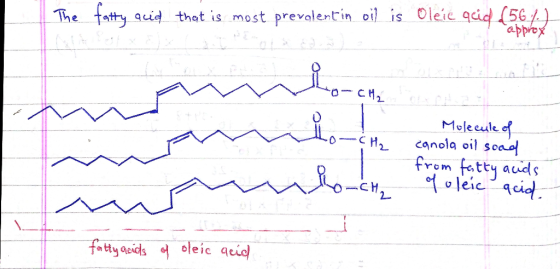
) Use ChemDraw to draw the structure of one molecule of canola oil soap from the fatty acid that is most prevalent in your oil.
Homework Answers
Add Answer to:
) Use ChemDraw to draw the structure of one molecule of canola
oil soap from the...
Draw the structure of a soap surfactant molecule. Label the relevant features that enable it to...
Draw the structure of a soap surfactant molecule. Label the relevant features that enable it to be a good cleaning agent. Explain why surfactants dissolve in both water and water/oil mixtures. Use your knowledge of intermolecular forces in your explanation.
Lab 12: Saponification – Making Soap Objective: To make soap using the process call saponification, an...
Lab 12: Saponification – Making Soap Objective: To make soap using the process call saponification, an organic form of the neutralization reaction that an acid reacts with a base to form a salt. Introduction: A soap is the sodium or potassium salt of a long chained carbohydrate called a fatty acid. A fatty acid usually contains between 12 – 18 carbon atoms. Fatty acids are esters of either animal or vegetable fats. They are called triglycerides if they are solids at room...
a. Draw the backbone for a fat and a sterol. b. Draw a chiral fat. c....
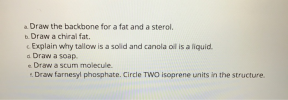 a. Draw the backbone for a fat and a sterol. b. Draw a chiral fat. c. Explain why tallow is a solid and canola oil is a liquid. d. Draw a soap. e. Draw a scum molecule. f. Draw farnesyl phosphate. Circle TWO isoprene units in the structure.
1. Imagine a triglyceride molecule is made from the following three fatty acids: a myristic acid,...
 1. Imagine a triglyceride molecule is made from the following three fatty acids: a myristic acid, a palmitoleic acid, and an oleic acid. . Draw the structure of the triglyceride molecule described above by using line-angle formulas for the hydrocarbon tails. b. Write the saponification reaction of this triglyceride molecule in KOH solution to produce potassium soap. Use condensed structural formulas for the hydrocarbon tails. c. Write the condensed structural formula for two insoluble ionic compounds produced when this potassium...
~What are the three most prevalent fatty acids in peanut oil? I occasionally use peanut oil...
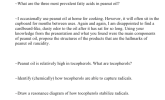 ~What are the three most prevalent fatty acids in peanut oil? I occasionally use peanut oil at home for cooking. However, it will often sit in the cupboard for months between uses. Again and again, I am disappointed to find a cardboard-like, dusty odor to the oil after it has sat for so long. Using your knowledge from the presentation and what you found were the main components of peanut oil, propose the structures of the products that are the...
How does soap function as an emulsifying agent for oil in water? Draw a picture of...
How does soap function as an emulsifying agent for oil in water? Draw a picture of an oil droplet and several soap molecules to illustrate your answer.
Draw the structure of the compound you would expect from E2 reaction of the molecule below...
 Draw the structure of the compound you would expect from E2 reaction of the molecule below with NaOH. NH G C ball & stick + labels • Consider E/Z stereochemistry of alkenes. • You do not have to explicitly draw H atoms. • In cases where there is a choice, draw the most substituted alkene product. Draw the structure of the alkyl bromide from which the alkyl acetate shown below was made by Sn2 reaction. CH ball & stick +...
Tor F 1. With the exception of steroids, all lipids contain at least one fatty acid. 2. Some lipids contain monosaccharides as part of their structure. 3. Some lipids contain an amino acid as part of...
 Tor F 1. With the exception of steroids, all lipids contain at least one fatty acid. 2. Some lipids contain monosaccharides as part of their structure. 3. Some lipids contain an amino acid as part of their structure. 4. Glycerophospholipids contain a phosphate portion in their structure. 5. All lipids have a molecule of glycerin as their backbone. 6. Polyunsaturated fatty acids have more than one C-C double bond in their "backbone." 7. Fatty acids are soluble in water. 8....
1. Imagine a triglyceride molecule is made from the following three fatty acids: a myristic acid,...
1. Imagine a triglyceride molecule is made from the following three fatty acids: a myristic acid, a palmitoleic acid, and an oleic acid. b. Write the saponification reaction of this triglyceride molecule in KOH solution to produce potassium soap. Use condensed structural formulas for the hydrocarbon tails.
discuss and draw the chemical reactions with structures: (You can try to use CHEMDRAW if you...
 discuss and draw the chemical reactions with structures: (You can try to use CHEMDRAW if you want) during extraction (ex. aspirin + sodium bicarbonate --> aspirin sodium salt + carbonic acid) O acidify with HCl (aspirin salt + HCI->
 a. Draw the backbone for a fat and a sterol. b. Draw a chiral fat. c. Explain why tallow is a solid and canola oil is a liquid. d. Draw a soap. e. Draw a scum molecule. f. Draw farnesyl phosphate. Circle TWO isoprene units in the structure.
 1. Imagine a triglyceride molecule is made from the following three fatty acids: a myristic acid, a palmitoleic acid, and an oleic acid. . Draw the structure of the triglyceride molecule described above by using line-angle formulas for the hydrocarbon tails. b. Write the saponification reaction of this triglyceride molecule in KOH solution to produce potassium soap. Use condensed structural formulas for the hydrocarbon tails. c. Write the condensed structural formula for two insoluble ionic compounds produced when this potassium...
 ~What are the three most prevalent fatty acids in peanut oil? I occasionally use peanut oil at home for cooking. However, it will often sit in the cupboard for months between uses. Again and again, I am disappointed to find a cardboard-like, dusty odor to the oil after it has sat for so long. Using your knowledge from the presentation and what you found were the main components of peanut oil, propose the structures of the products that are the...
 Draw the structure of the compound you would expect from E2 reaction of the molecule below with NaOH. NH G C ball & stick + labels • Consider E/Z stereochemistry of alkenes. • You do not have to explicitly draw H atoms. • In cases where there is a choice, draw the most substituted alkene product. Draw the structure of the alkyl bromide from which the alkyl acetate shown below was made by Sn2 reaction. CH ball & stick +...
 Tor F 1. With the exception of steroids, all lipids contain at least one fatty acid. 2. Some lipids contain monosaccharides as part of their structure. 3. Some lipids contain an amino acid as part of their structure. 4. Glycerophospholipids contain a phosphate portion in their structure. 5. All lipids have a molecule of glycerin as their backbone. 6. Polyunsaturated fatty acids have more than one C-C double bond in their "backbone." 7. Fatty acids are soluble in water. 8....
 discuss and draw the chemical reactions with structures: (You can try to use CHEMDRAW if you want) during extraction (ex. aspirin + sodium bicarbonate --> aspirin sodium salt + carbonic acid) O acidify with HCl (aspirin salt + HCI->
Most questions answered within 3 hours.
-
Where is the error in this code sequence?
String s1 = "Hello";
String s2 = "ello";...
asked 10 months ago -
Financial data for Joel de Paris, Inc., for last year
follow:
Joel de Paris, Inc.
Balance...
asked 10 months ago -
Consider this reaction:
Al2(SO4)3 (aq)+ BaCl3
(aq) Al2Cl6 (aq)- +
3BaSO4(s) . What is the...
asked 10 months ago -
Suppose that Savneet is considering increasing her
recent random sample from 20 car rentals to 40...
asked 10 months ago -
Trucks arrive at an unloading terminal at an average rate of 120
per hour.
Trucks arrive...
asked 10 months ago -
Why are methanol and ethanol completely soluble in water while
octanol is not very little soluble....
asked 10 months ago -
A facilities manager at a university reads in a research report
that the mean amount of...
asked 10 months ago -
When the CuSO4 is rehydrated by adding water to the anhydrous
compound, is this an endothermic...
asked 10 months ago -
A ray of sunlight is passing from diamond into crown glass; the
angle of incidence is...
asked 10 months ago -
A block of mass 0.249 kg is placed on top of a light, vertical
spring of...
asked 10 months ago -
how do the kidneys compensate in the presences of acidosis
a) trigger hyperventilate
b) reserve acid...
asked 10 months ago -
Question 501 pts
The rental rate of capital to the firm increases. Which of the
following...
asked 10 months ago