

Homework Answers
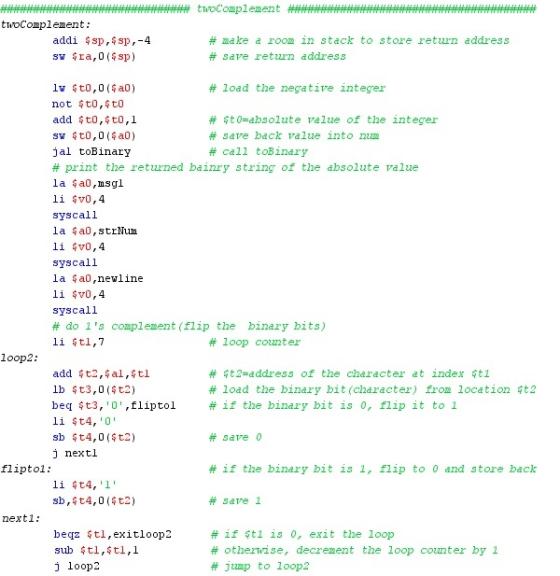
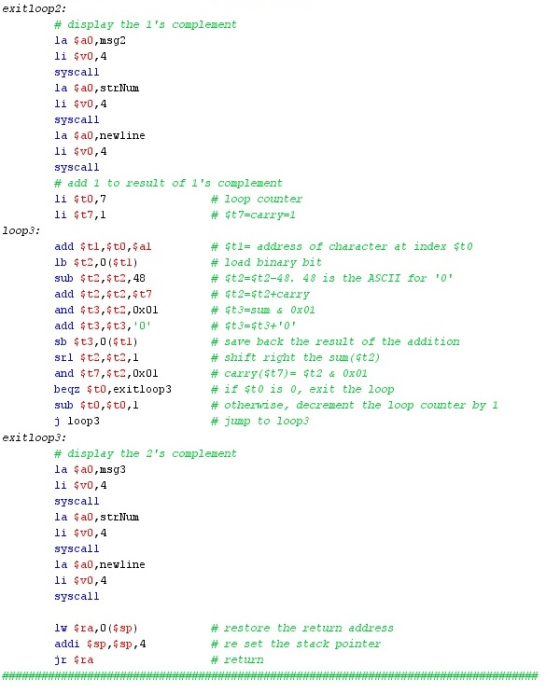
Required non-leaf function:
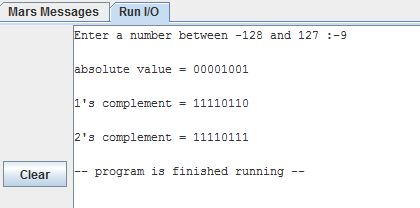
Sample output:
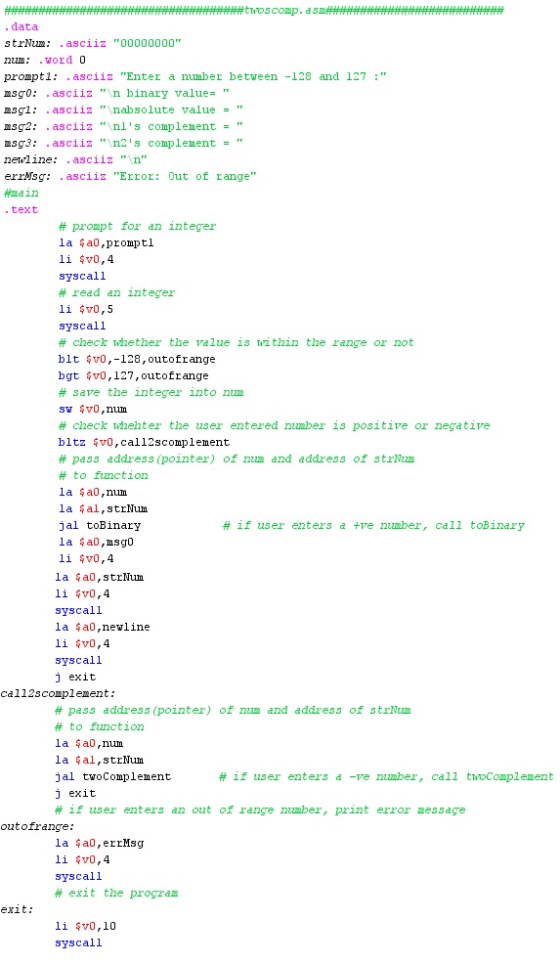
Complete program:
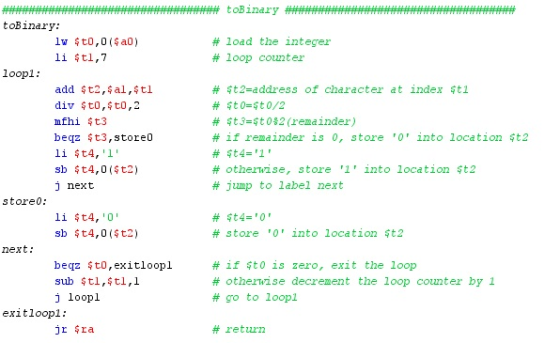
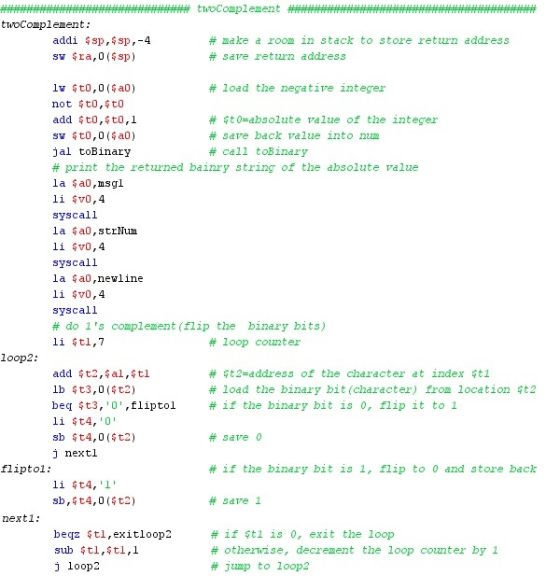
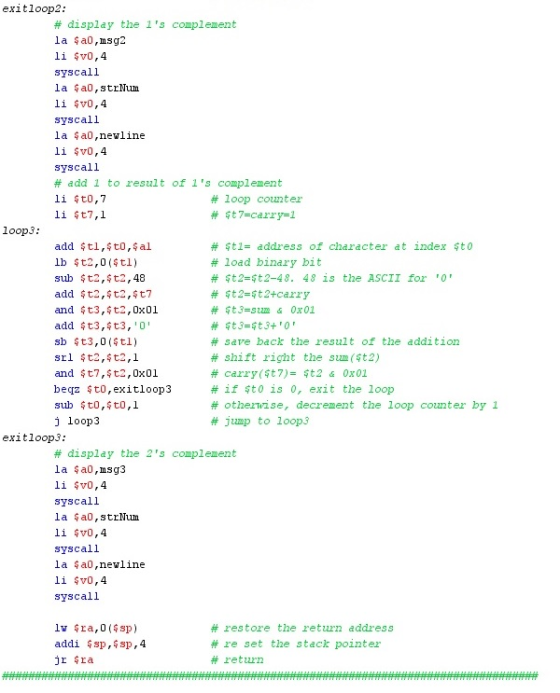
Sample output:
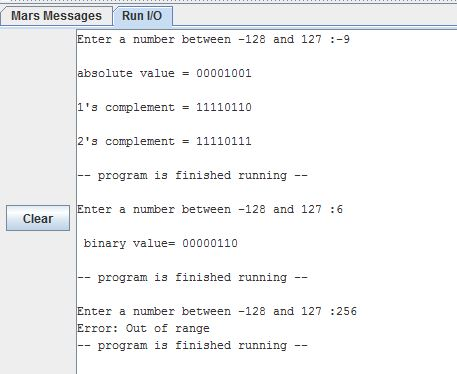
Code to copy:
###################################twoscomp.asm##########################
.data
strNum: .asciiz "00000000"
num: .word 0
prompt1: .asciiz "Enter a number between -128 and 127 :"
msg0: .asciiz "\n binary value= "
msg1: .asciiz "\nabsolute value = "
msg2: .asciiz "\n1's complement = "
msg3: .asciiz "\n2's complement = "
newline: .asciiz "\n"
errMsg: .asciiz "Error: Out of range"
#main
.text
# prompt for an integer
la $a0,prompt1
li $v0,4
syscall
# read an integer
li $v0,5
syscall
# check whether the value is within the range or
not
blt $v0,-128,outofrange
bgt $v0,127,outofrange
# save the integer into num
sw $v0,num
# check whehter the user entered number is positive or
negative
bltz $v0,call2scomplement
# pass address(pointer) of num and address of
strNum
# to function
la $a0,num
la $a1,strNum
jal toBinary # if user
enters a +ve number, call toBinary
la $a0,msg0
li $v0,4
syscall
la $a0,strNum
li $v0,4
syscall
la $a0,newline
li $v0,4
syscall
j exit
call2scomplement:
# pass address(pointer) of num and address of
strNum
# to function
la $a0,num
la $a1,strNum
jal twoComplement # if user enters a -ve
number, call twoComplement
j exit
# if user enters an out of range number, print error
message
outofrange:
la $a0,errMsg
li $v0,4
syscall
# exit the program
exit:
li $v0,10
syscall
################################# toBinary
###################################
toBinary:
lw $t0,0($a0) # load
the integer
li $t1,7 # loop
counter
loop1:
add $t2,$a1,$t1 #
$t2=address of character at index $t1
div $t0,$t0,2 #
$t0=$t0/2
mfhi $t3 #
$t3=$t0%2(remainder)
beqz $t3,store0 # if
remainder is 0, store '0' into location $t2
li $t4,'1' #
$t4='1'
sb $t4,0($t2) #
otherwise, store '1' into location $t2
j next
# jump to label next
store0:
li $t4,'0' #
$t4='0'
sb $t4,0($t2) # store
'0' into location $t2
next:
beqz $t0,exitloop1 # if $t0 is zero, exit
the loop
sub $t1,$t1,1 #
otherwise decrement the loop counter by 1
j loop1
# go to loop1
exitloop1:
jr $ra
# return
############################# twosComplement
######################################
twoComplement:
addi $sp,$sp,-4 # make
a room in stack to store return address
sw $ra,0($sp) # save
return address
lw $t0,0($a0) # load
the negative integer
not $t0,$t0
add $t0,$t0,1 #
$t0=absolute value of the integer
sw $t0,0($a0) # save
back value into num
jal toBinary # call
toBinary
# print the returned bainry string of the absolute
value
la $a0,msg1
li $v0,4
syscall
la $a0,strNum
li $v0,4
syscall
la $a0,newline
li $v0,4
syscall
# do 1's complement(flip the binary bits)
li $t1,7 # loop
counter
loop2:
add $t2,$a1,$t1 #
$t2=address of the character at index $t1
lb $t3,0($t2) # load
the binary bit(character) from location $t2
beq $t3,'0',flipto1 # if the binary bit is
0, flip it to 1
li $t4,'0'
sb $t4,0($t2) # save
0
j next1
flipto1: # if the
binary bit is 1, flip to 0 and store back
li $t4,'1'
sb,$t4,0($t2) # save
1
next1:
beqz $t1,exitloop2 # if $t1 is 0, exit the
loop
sub $t1,$t1,1 #
otherwise, decrement the loop counter by 1
j loop2
# jump to loop2
exitloop2:
# display the 1's complement
la $a0,msg2
li $v0,4
syscall
la $a0,strNum
li $v0,4
syscall
la $a0,newline
li $v0,4
syscall
# add 1 to result of 1's complement
li $t0,7 # loop
counter
li $t7,1 #
$t7=carry=1
loop3:
add $t1,$t0,$a1 # $t1=
address of character at index $t0
lb $t2,0($t1) # load
binary bit
sub $t2,$t2,48 #
$t2=$t2-48. 48 is the ASCII for '0'
add $t2,$t2,$t7 #
$t2=$t2+carry
and $t3,$t2,0x01 # $t3=sum &
0x01
add $t3,$t3,'0' #
$t3=$t3+'0'
sb $t3,0($t1) # save
back the result of the addition
srl $t2,$t2,1 # shift
right the sum($t2)
and $t7,$t2,0x01 # carry($t7)= $t2 &
0x01
beqz $t0,exitloop3 # if $t0 is 0, exit the
loop
sub $t0,$t0,1 #
otherwise, decrement the loop counter by 1
j loop3
# jump to loop3
exitloop3:
# display the 2's complement
la $a0,msg3
li $v0,4
syscall
la $a0,strNum
li $v0,4
syscall
la $a0,newline
li $v0,4
syscall
lw $ra,0($sp) # restore
the return address
addi $sp,$sp,4 # re set
the stack pointer
jr $ra
# return
##################################################################################
Add Answer to:
MIPS Programming 1 In this project, you are going to write a MIPS program to read...
write a C program!! Q2 and Q3 Write the following functioned int search(int a[], int n,...
 write a C program!! Q2 and Q3
Write the following functioned int search(int a[], int n, int key, int **loc); a is an array to be searched, n is the number of elements in the array, key is the search key, and loc is a pointer to the first location of the search key in array a (if found) or NULL otherwise. The function returns 1 if key is found in a, and returns 0 otherwise. Write a main() and...
write a C program!! Q2 and Q3
Write the following functioned int search(int a[], int n, int key, int **loc); a is an array to be searched, n is the number of elements in the array, key is the search key, and loc is a pointer to the first location of the search key in array a (if found) or NULL otherwise. The function returns 1 if key is found in a, and returns 0 otherwise. Write a main() and...
2. Searching a String: Write a MIPS assembly language program to do the following: Read a...
 2. Searching a String: Write a
MIPS assembly language program to do the following: Read a string
and store it in memory. Limit the string length to 100 characters.
Then, ask the user to enter a character. Search and count the
number of occurrences of the character in the string. The search is
not case sensitive. Lowercase and uppercase letters should be
equal. Then ask the user to enter a string of two characters.
Search and count the number of...
2. Searching a String: Write a
MIPS assembly language program to do the following: Read a string
and store it in memory. Limit the string length to 100 characters.
Then, ask the user to enter a character. Search and count the
number of occurrences of the character in the string. The search is
not case sensitive. Lowercase and uppercase letters should be
equal. Then ask the user to enter a string of two characters.
Search and count the number of...
MIPS programming question Problem 1: Write a program that asks the user to input a string...
MIPS programming question Problem 1: Write a program that asks the user to input a string (or no more than 50 characters). Your program should then output the length of the string. The string length should be determined using a separate function strlen that will accept the address of the string and return its length. For the purposes of this exercise, the length of a string will be defined as the number of non-null and non-newline characters until either the...
Introduction: In this lab, you will write a MIPS program to read in (up to) 50...
 Introduction: In this lab, you will write a MIPS program to read in (up to) 50 integer values from the user, store them in an array, print out the amay, one number per line, reverse the elements in the array and finally print out the elements in the just-reversed) array. Feel free to do this lab and all assembly programming labs) in Windows. You must use MARS Getting started: l. In MARS, create a new assembly file with the name...
Create a program (java): that reads a 8-bit String input, must be read in as such....
Create a program (java): that reads a 8-bit String input, must be read in as such. Then convert that string of 1s and 0s to decimal as if it were encoded using the following representations: Unsigned 1's Complement 2's Complement Q(4.4) (2's complement) 1 bit (sign) - 3 bits (exponent: use bias) - 4 bits (significand), implied binary point w/ 1. Also check for 0.... Do not use helper functions, must be done iterating string and modifying an int/long value....
Write a C program, that would take a negative number as a input from the console,...
Write a C program, that would take a negative number as a input from the console, and convert it into 2’s complement binary representation. Recall that, there are two steps to that: ● 1’s complement of the positive bitwise representation, which is similar to bit flipping. ○ Find out the appropriate bitwise operator for that, or do it manually. ● Add 1 with the 1’s complement number. ○ Simply add 1 with the number you get in the previous step....
Write a C++ program that simulate a menu based binary number calculator.You don't have to write the main part of the...
Write a C++ program that simulate a menu based binary number calculator.You don't have to write the main part of the program just the two functions for my C++ program. I wanted to post the sample code from my class but it won't allow me it's too long. This calculate shall have the following five functionalities: Provide sign extension for a binary number Provide two’s complement for a binary nunber string signed_extension(string b); // precondition: s is a string that...
How do I write a C program called binary that takes a single command line argument,...
How do I write a C program called binary that takes a single command line argument, and integer, in decimal, and prints out the binary representation of the number with 64 bits. The argument must be stored as a long. Use atol to convert the command line argument. Include a function char *binary(long n, char *b) { ... } that stores the binary representation in the string b with '0's and '1's. It is the responsibility of the calling program...
question 1 part 2 and 3 thank you (47) Naruto Notone C Sign In er Sign...
 question 1 part 2 and 3 thank you
(47) Naruto Notone C Sign In er Sign Up | Ch ® UFC & MMA × Secure I https://piazza-resourcess3.amazonaws.com/jgopch0cb93d8/j .pdfAWSAccessKeyld-AKAILDNRL/4ALKBWOHA8lexpires-15200435/2&Signature-ol9aXG9 /UAKIHS0QUwMeyBX.. ☆ ミ quations must be properly tyne-set including superscript-s expunents, Always watch the course websile for updates on the assignments. Question 1 (4 points) Show you work I. Convert 2727 into a 32-bit two's complement binary number 2. Convert -5795 into a 16-bit two's complement binary number 3. Add the above...
question 1 part 2 and 3 thank you
(47) Naruto Notone C Sign In er Sign Up | Ch ® UFC & MMA × Secure I https://piazza-resourcess3.amazonaws.com/jgopch0cb93d8/j .pdfAWSAccessKeyld-AKAILDNRL/4ALKBWOHA8lexpires-15200435/2&Signature-ol9aXG9 /UAKIHS0QUwMeyBX.. ☆ ミ quations must be properly tyne-set including superscript-s expunents, Always watch the course websile for updates on the assignments. Question 1 (4 points) Show you work I. Convert 2727 into a 32-bit two's complement binary number 2. Convert -5795 into a 16-bit two's complement binary number 3. Add the above...
In this part of the assignment, you will write MIPS assembly code to replace characters in...
In this part of the assignment, you will write MIPS assembly code to replace characters in a string. This program asks the user for a string named string and two characters orig and new. It then replaces each instance of the character orig found in string with the character new. It outputs the resulting string and the number of substitutions that were made. For example, if string were "wow", orig were 'w', and new were 'b', the program would output...
 write a C program!! Q2 and Q3
Write the following functioned int search(int a[], int n, int key, int **loc); a is an array to be searched, n is the number of elements in the array, key is the search key, and loc is a pointer to the first location of the search key in array a (if found) or NULL otherwise. The function returns 1 if key is found in a, and returns 0 otherwise. Write a main() and...
write a C program!! Q2 and Q3
Write the following functioned int search(int a[], int n, int key, int **loc); a is an array to be searched, n is the number of elements in the array, key is the search key, and loc is a pointer to the first location of the search key in array a (if found) or NULL otherwise. The function returns 1 if key is found in a, and returns 0 otherwise. Write a main() and...
 2. Searching a String: Write a
MIPS assembly language program to do the following: Read a string
and store it in memory. Limit the string length to 100 characters.
Then, ask the user to enter a character. Search and count the
number of occurrences of the character in the string. The search is
not case sensitive. Lowercase and uppercase letters should be
equal. Then ask the user to enter a string of two characters.
Search and count the number of...
2. Searching a String: Write a
MIPS assembly language program to do the following: Read a string
and store it in memory. Limit the string length to 100 characters.
Then, ask the user to enter a character. Search and count the
number of occurrences of the character in the string. The search is
not case sensitive. Lowercase and uppercase letters should be
equal. Then ask the user to enter a string of two characters.
Search and count the number of...
 Introduction: In this lab, you will write a MIPS program to read in (up to) 50 integer values from the user, store them in an array, print out the amay, one number per line, reverse the elements in the array and finally print out the elements in the just-reversed) array. Feel free to do this lab and all assembly programming labs) in Windows. You must use MARS Getting started: l. In MARS, create a new assembly file with the name...
 question 1 part 2 and 3 thank you
(47) Naruto Notone C Sign In er Sign Up | Ch ® UFC & MMA × Secure I https://piazza-resourcess3.amazonaws.com/jgopch0cb93d8/j .pdfAWSAccessKeyld-AKAILDNRL/4ALKBWOHA8lexpires-15200435/2&Signature-ol9aXG9 /UAKIHS0QUwMeyBX.. ☆ ミ quations must be properly tyne-set including superscript-s expunents, Always watch the course websile for updates on the assignments. Question 1 (4 points) Show you work I. Convert 2727 into a 32-bit two's complement binary number 2. Convert -5795 into a 16-bit two's complement binary number 3. Add the above...
question 1 part 2 and 3 thank you
(47) Naruto Notone C Sign In er Sign Up | Ch ® UFC & MMA × Secure I https://piazza-resourcess3.amazonaws.com/jgopch0cb93d8/j .pdfAWSAccessKeyld-AKAILDNRL/4ALKBWOHA8lexpires-15200435/2&Signature-ol9aXG9 /UAKIHS0QUwMeyBX.. ☆ ミ quations must be properly tyne-set including superscript-s expunents, Always watch the course websile for updates on the assignments. Question 1 (4 points) Show you work I. Convert 2727 into a 32-bit two's complement binary number 2. Convert -5795 into a 16-bit two's complement binary number 3. Add the above...
Most questions answered within 3 hours.
-
Where is the error in this code sequence?
String s1 = "Hello";
String s2 = "ello";...
asked 10 months ago -
Financial data for Joel de Paris, Inc., for last year
follow:
Joel de Paris, Inc.
Balance...
asked 10 months ago -
Consider this reaction:
Al2(SO4)3 (aq)+ BaCl3
(aq) Al2Cl6 (aq)- +
3BaSO4(s) . What is the...
asked 10 months ago -
Suppose that Savneet is considering increasing her
recent random sample from 20 car rentals to 40...
asked 10 months ago -
Trucks arrive at an unloading terminal at an average rate of 120
per hour.
Trucks arrive...
asked 10 months ago -
Why are methanol and ethanol completely soluble in water while
octanol is not very little soluble....
asked 10 months ago -
A facilities manager at a university reads in a research report
that the mean amount of...
asked 10 months ago -
When the CuSO4 is rehydrated by adding water to the anhydrous
compound, is this an endothermic...
asked 10 months ago -
A ray of sunlight is passing from diamond into crown glass; the
angle of incidence is...
asked 10 months ago -
A block of mass 0.249 kg is placed on top of a light, vertical
spring of...
asked 10 months ago -
how do the kidneys compensate in the presences of acidosis
a) trigger hyperventilate
b) reserve acid...
asked 10 months ago -
Question 501 pts
The rental rate of capital to the firm increases. Which of the
following...
asked 10 months ago