Write a C program, that would take a negative number as a input from the console,...
Write a C program, that would take a negative number as a input from the console, and convert it into 2’s complement binary representation. Recall that, there are two steps to that:
● 1’s complement of the positive bitwise representation, which is similar to bit flipping.
○ Find out the appropriate bitwise operator for that, or do it manually.
● Add 1 with the 1’s complement number.
○ Simply add 1 with the number you get in the previous step. And for this problem, assume that the number is 5 bits long. Obviously, the most significant bit is used for the sign. Sample input output are:
| Input | Output |
| -12 | 10100 |
| -9 | 10111 |
| -7 | 11001 |
| -16 | 10000 |
Homework Answers
| C Program |
#include<stdio.h>
// function declaration
void getBinary(int, int[]);
void flipBits(int[]);
void addBit1(int[]);

// main function
int main()
{
    int i;
    int number;
    int binary[] = {0,0,0,0,0};
    printf("Enter the number: ");
    scanf("%d",&number);
    getBinary(number, binary);
    flipBits(binary);
    addBit1(binary);
    printf("2's complement is: ");
    for(i = 0; i < 5; i++)
       printf("%d", binary[i]);
    printf("
");
}

// function to convert a decimal to binary and
// store it into an array of integers 0,1
void getBinary(int number, int binary[])
{
    int index = 4;
    if(number < 0)
      number = number * -1;
    while(number > 0)
    {
        int r = number % 2;
        binary[index--] = r;
        number /= 2;
    }
}

// function to flip bits of the binary array
void flipBits(int binary[])
{
    int i;
    for(i = 0; i < 5; i++)
    {
        if(binary[i] == 0)
           binary[i] = 1;
        else
           binary[i] = 0;
    }
}

// function to add binary 1 to the
// array
void addBit1(int binary[])
{
    int i;
    int rem = 0;
    // loop from back to front of the array
    for(i = 4; i >= 0; i--)
    {
        // extract the bit at i'th position
        int bit = binary[i];
        // if at iteration i = 4 (at first iteration)
        if(i == 4)
        {
            // if bit is 1
            if(bit == 1)
            {
                // make that bit to 0
                binary[i] = 0;
                // store the remainder
                rem = 1;
            }
            else // else simply make the bit to 1
                binary[i] = 1;
        }
        // for all other iterations
        else
        {
            if(bit == 1 && rem == 1)
                binary[i] = 0;

            else if(bit == 0 && rem == 1)
            {
                binary[i] = 1;
                rem = 0;
            }
        }
    }
}
|
OUTPUT

Add Answer to:
Write a C program, that would take a negative number as a input
from the console,...
Given an integer N as input, write a program to check whether Least Significant Bit (LSB)...
Given an integer N as input, write a program to check whether Least Significant Bit (LSB) of a number is set or not. Use bitwise operator to solve the problem. Your code should NOT use conditional statement nor loop strucutre. Input: 5 where: First line represents the integer N. Output: Yes Here binary representation of 5 is 0101 and LSB is 1. Assumption: Value of N can be in the range 0 to 10000?
Create a program (java): that reads a 8-bit String input, must be read in as such....
Create a program (java): that reads a 8-bit String input, must be read in as such. Then convert that string of 1s and 0s to decimal as if it were encoded using the following representations: Unsigned 1's Complement 2's Complement Q(4.4) (2's complement) 1 bit (sign) - 3 bits (exponent: use bias) - 4 bits (significand), implied binary point w/ 1. Also check for 0.... Do not use helper functions, must be done iterating string and modifying an int/long value....
please include only the digits of the appropriate number system. In particular, do not precede the...
 please include only the digits of the appropriate number
system. In particular, do not precede the answers with ‘0x’ or ‘0b’
or follow your answers with base indicators, like subscript 2 or
10.
1. A processor uses 24 bits for its memory addressing. How many possible distinct locations (in decimal) can the computer address? The computer memory address locations are numbered from 0 to the maximum. If a memory locations' address is (7243)10, how is this address represented in binary...
please include only the digits of the appropriate number
system. In particular, do not precede the answers with ‘0x’ or ‘0b’
or follow your answers with base indicators, like subscript 2 or
10.
1. A processor uses 24 bits for its memory addressing. How many possible distinct locations (in decimal) can the computer address? The computer memory address locations are numbered from 0 to the maximum. If a memory locations' address is (7243)10, how is this address represented in binary...
Edit, compile, and run the following programs on the UNIX shell: Write a program that takes...
Edit, compile, and run the following programs on the UNIX shell: Write a program that takes in six commandline arguments and has four functions (described below) that use bitwise operators. The user should enter six space-separated commandline arguments: four characters (any ASCII character) followed by two integers. Anything else should print an error message telling the user what the correct input is and end the program. Convert the commandline input into "unsigned char" and "unsigned int" datatypes. Be careful with...
(a) Write a truth table. The input is 4-bit binary ABCD, A is MSB, D is...
 (a) Write a truth table. The input is 4-bit binary ABCD, A is
MSB, D is LSB. The output is also represented by x.
(b) Obtain an output expression in the form of a SOP.
(c) Use Boolean Algebra to design a circuit consisting of only
four inverters, four 3-input and gate, and one 4-input OR gate
using the simplified and simplified expression obtained in (b).
4-6. The Excess-3 coding system is a four-bit digital coding system for encoding all...
(a) Write a truth table. The input is 4-bit binary ABCD, A is
MSB, D is LSB. The output is also represented by x.
(b) Obtain an output expression in the form of a SOP.
(c) Use Boolean Algebra to design a circuit consisting of only
four inverters, four 3-input and gate, and one 4-input OR gate
using the simplified and simplified expression obtained in (b).
4-6. The Excess-3 coding system is a four-bit digital coding system for encoding all...
MIPS Programming 1 In this project, you are going to write a MIPS program to read...
 MIPS Programming 1 In this project, you are going to write a MIPS program to read an integer number and convert it to 8- bit signed binary in a string. Your program should do the followings: Part II (50%, due date: March 1) for negative number . Write a non-leaf function to convert a negative integer number to 2's complement in string . Two parameters: integer number, string array or pointer -Get absolute value of the negative number o Call...
C++ Convert a Number from Binary to Decimal using a stack: The language of a computer...
 C++
Convert a Number from Binary to Decimal using a stack: The language of a computer is a sequence of Os and 1s. The numbering system we use is called the decimal system, or base 10 system. The numbering system that the computer uses is called the binary system, or base 2 system. The purpose of this exercise is to write a function to convert a string representing a binary number from base 2 to base 10. To convert a...
C++
Convert a Number from Binary to Decimal using a stack: The language of a computer is a sequence of Os and 1s. The numbering system we use is called the decimal system, or base 10 system. The numbering system that the computer uses is called the binary system, or base 2 system. The purpose of this exercise is to write a function to convert a string representing a binary number from base 2 to base 10. To convert a...
Implement a Java method named addBinary() that takes two String arguments (each representing a binary value)...
Implement a Java method named addBinary() that takes two String arguments (each representing a binary value) and returns a new String corresponding to the result of performing binary addition on those arguments. Before you begin, if one of the arguments is shorter than the other, call your pad() method from the previous step to extend it to the desired length. Note: ped() method is public static String pad(String input, int size) { if(input.length()>=size) { return input; } String a =...
Please show that it works and show the output. Description Develop a program (in C++) that...
 Please show that it works and show the output.
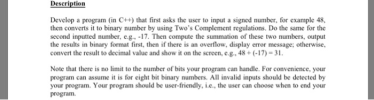
Description Develop a program (in C++) that first asks the user to input a signed number, for example 48, then converts it to binary number by using Two's Complement regulations. Do the same for the second inputted number, eg. 17. Then compute the summation of these two numbers, output the results in binary format first, then if there is an overflow, display error message; otherwise, convert the result to decimal value...
Please show that it works and show the output.
Description Develop a program (in C++) that first asks the user to input a signed number, for example 48, then converts it to binary number by using Two's Complement regulations. Do the same for the second inputted number, eg. 17. Then compute the summation of these two numbers, output the results in binary format first, then if there is an overflow, display error message; otherwise, convert the result to decimal value...
How do I write a C program called binary that takes a single command line argument,...
How do I write a C program called binary that takes a single command line argument, and integer, in decimal, and prints out the binary representation of the number with 64 bits. The argument must be stored as a long. Use atol to convert the command line argument. Include a function char *binary(long n, char *b) { ... } that stores the binary representation in the string b with '0's and '1's. It is the responsibility of the calling program...
 please include only the digits of the appropriate number
system. In particular, do not precede the answers with ‘0x’ or ‘0b’
or follow your answers with base indicators, like subscript 2 or
10.
1. A processor uses 24 bits for its memory addressing. How many possible distinct locations (in decimal) can the computer address? The computer memory address locations are numbered from 0 to the maximum. If a memory locations' address is (7243)10, how is this address represented in binary...
please include only the digits of the appropriate number
system. In particular, do not precede the answers with ‘0x’ or ‘0b’
or follow your answers with base indicators, like subscript 2 or
10.
1. A processor uses 24 bits for its memory addressing. How many possible distinct locations (in decimal) can the computer address? The computer memory address locations are numbered from 0 to the maximum. If a memory locations' address is (7243)10, how is this address represented in binary...
 (a) Write a truth table. The input is 4-bit binary ABCD, A is
MSB, D is LSB. The output is also represented by x.
(b) Obtain an output expression in the form of a SOP.
(c) Use Boolean Algebra to design a circuit consisting of only
four inverters, four 3-input and gate, and one 4-input OR gate
using the simplified and simplified expression obtained in (b).
4-6. The Excess-3 coding system is a four-bit digital coding system for encoding all...
(a) Write a truth table. The input is 4-bit binary ABCD, A is
MSB, D is LSB. The output is also represented by x.
(b) Obtain an output expression in the form of a SOP.
(c) Use Boolean Algebra to design a circuit consisting of only
four inverters, four 3-input and gate, and one 4-input OR gate
using the simplified and simplified expression obtained in (b).
4-6. The Excess-3 coding system is a four-bit digital coding system for encoding all...
 MIPS Programming 1 In this project, you are going to write a MIPS program to read an integer number and convert it to 8- bit signed binary in a string. Your program should do the followings: Part II (50%, due date: March 1) for negative number . Write a non-leaf function to convert a negative integer number to 2's complement in string . Two parameters: integer number, string array or pointer -Get absolute value of the negative number o Call...
 C++
Convert a Number from Binary to Decimal using a stack: The language of a computer is a sequence of Os and 1s. The numbering system we use is called the decimal system, or base 10 system. The numbering system that the computer uses is called the binary system, or base 2 system. The purpose of this exercise is to write a function to convert a string representing a binary number from base 2 to base 10. To convert a...
C++
Convert a Number from Binary to Decimal using a stack: The language of a computer is a sequence of Os and 1s. The numbering system we use is called the decimal system, or base 10 system. The numbering system that the computer uses is called the binary system, or base 2 system. The purpose of this exercise is to write a function to convert a string representing a binary number from base 2 to base 10. To convert a...
 Please show that it works and show the output.
Description Develop a program (in C++) that first asks the user to input a signed number, for example 48, then converts it to binary number by using Two's Complement regulations. Do the same for the second inputted number, eg. 17. Then compute the summation of these two numbers, output the results in binary format first, then if there is an overflow, display error message; otherwise, convert the result to decimal value...
Please show that it works and show the output.
Description Develop a program (in C++) that first asks the user to input a signed number, for example 48, then converts it to binary number by using Two's Complement regulations. Do the same for the second inputted number, eg. 17. Then compute the summation of these two numbers, output the results in binary format first, then if there is an overflow, display error message; otherwise, convert the result to decimal value...
Most questions answered within 3 hours.
-
Where is the error in this code sequence?
String s1 = "Hello";
String s2 = "ello";...
asked 11 months ago -
Financial data for Joel de Paris, Inc., for last year
follow:
Joel de Paris, Inc.
Balance...
asked 11 months ago -
Consider this reaction:
Al2(SO4)3 (aq)+ BaCl3
(aq) Al2Cl6 (aq)- +
3BaSO4(s) . What is the...
asked 11 months ago -
Suppose that Savneet is considering increasing her
recent random sample from 20 car rentals to 40...
asked 11 months ago -
Trucks arrive at an unloading terminal at an average rate of 120
per hour.
Trucks arrive...
asked 11 months ago -
Why are methanol and ethanol completely soluble in water while
octanol is not very little soluble....
asked 11 months ago -
A facilities manager at a university reads in a research report
that the mean amount of...
asked 11 months ago -
When the CuSO4 is rehydrated by adding water to the anhydrous
compound, is this an endothermic...
asked 11 months ago -
A ray of sunlight is passing from diamond into crown glass; the
angle of incidence is...
asked 11 months ago -
A block of mass 0.249 kg is placed on top of a light, vertical
spring of...
asked 11 months ago -
how do the kidneys compensate in the presences of acidosis
a) trigger hyperventilate
b) reserve acid...
asked 11 months ago -
Question 501 pts
The rental rate of capital to the firm increases. Which of the
following...
asked 11 months ago