Suppose that each β–adrenergicβ–adrenergic receptor bound to epinephrine converts 100100 molecules of the GαGα subunit to...
Suppose that each β–adrenergicβ–adrenergic receptor bound to epinephrine converts 100100 molecules of the GαGα subunit to the GTP-bound form, Gαs.Gαs.
If each molecule of activated adenylate cyclase produces 1000 molecules of cAMP per second, how many molecules of cAMP are produced in 10 seconds10 seconds after the formation of a single complex between epinephrine and the β–adrenergicβ–adrenergic receptor? Assume the pathway is fully responsive.
Molecules of cAMP = ??
Homework Answers
since 1 epinephrine activates 100 G alpha subunits. one G alpha subunits activate 1 adenylate cyclase, so 100 G alpha subunits will activate 100 adenylate cyclase.
1 adenylate cyclase makes 1000 cAMP in 1 second. then 100 adenylate cyclase will make 100*1000 = 100000 cAMP per second.
So the total number of cAMP produced in 10 seconds = 100000 cAMP/sec * 10 sec = 1000000 = 106 cAMP
Add Answer to:
Suppose that each β–adrenergicβ–adrenergic receptor bound to
epinephrine converts 100100 molecules of the GαGα subunit to...
Epinephrine B-Adrenergic receptor Adenylate cyclase GDP ATP Cyclic AMP ✓ Protein kinase A Protein kinase A...
 Epinephrine B-Adrenergic receptor Adenylate cyclase GDP ATP Cyclic AMP ✓ Protein kinase A Protein kinase A Describe the steps by which epinephrine causes cAMP production. [Choose ] Epinephrine binds to the extracellular portion of the beta-adrenergic receptor [Choose] The binding of epinephrine causes dimerization of its receptor. Choose] On the intracellular side, this change propagates to membrane-bound heterotrimeric G proteins. This causes them to hydrolyze GTP. [Choose ] < [Choose ] The G-proteins then dissociate into their alpha and beta/gamma...
Place in the right order the sequence of biochemical events between the release of epinephrine by...
Place in the right order the sequence of biochemical events between the release of epinephrine by the adrenal glands and the breakdown of glycogen in the liver. (1) Epinephrine is released by the adrenal glands. ( ) Activated beta-adrenergic receptors cause GTP for GDP exchange in the alpha subunits of Gs G proteins ( ) The activated catalytic subunits of PKA phosphorylate the inactive phosphorylase kinase b, activating it. ( ) Epinephrine travels in the bloodstream ( ) Two cAMP...
Assume that the binding of one molecule of epinephrine to a seven-transmembrane helix (7TM) receptor (also...
Assume that the binding of one molecule of epinephrine to a seven-transmembrane helix (7TM) receptor (also called the G protein-coupled receptor, or GPCR) results in the activation of 480 Gα subunits. In addition, suppose that each activated adenylyl cyclase catalyzes the conversion of 40 ATP molecules to cAMP per second. (Assume that each G protein activates a single unique adenylyl cyclase.) Calculate the number of moles of cAMP that are produced per second. Enter your answer to at least two...
Epinephrine and Glucose Let's assume that one mo lecule of epinephrine binding to the cell activates...
 Epinephrine and Glucose Let's assume that one mo lecule of epinephrine binding to the cell activates one G-protein, which activates one adenylate cyclase. From there, assume that every enzyme catalyzes 10 reactions (for example, each activated adenlylate cyclase produces 10 molecules of activated cAMP dependent protein kinase). Finally, assume that each activated glycogen phosphorylase rees" 10 molecules of glucose to be released from the cell into the bloodstream. 1. How many molecules of glucose are released into the blood for...
Use the following diagram to answer the questions. The diagram illustrates a member of the β-adrenergic...
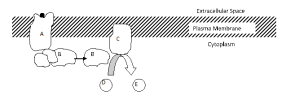 Use the following diagram to answer the questions. The diagram
illustrates a member of the β-adrenergic family of receptors (that
bind adrenaline) and the molecules involved in its signaling
pathway. Binding of adrenaline to its receptor results in the
formation of cAMP. Each shape is a protein or nucleotide.
A G protein-coupled receptor
Select shape
from A-E
A subunit in a heterotrimeric G protein
Select shape from A-E
An enzyme whose physiological substrate is ATP...
Use the following diagram to answer the questions. The diagram
illustrates a member of the β-adrenergic family of receptors (that
bind adrenaline) and the molecules involved in its signaling
pathway. Binding of adrenaline to its receptor results in the
formation of cAMP. Each shape is a protein or nucleotide.
A G protein-coupled receptor
Select shape
from A-E
A subunit in a heterotrimeric G protein
Select shape from A-E
An enzyme whose physiological substrate is ATP...
Assume that the binding of one molecule of epinephrine to a seven‑transmembrane helix (7TM) receptor (also...
Assume that the binding of one molecule of epinephrine to a seven‑transmembrane helix (7TM) receptor (also called the G protein‑coupled receptor, or GPCR) results in the activation of 360 Gα360 Gα subunits. In addition, suppose that each activated adenylyl cyclase catalyzes the conversion of 30 ATP30 ATP molecules to cAMP per second. Assume that each G protein activates a single unique adenylyl cyclase. Calculate the number of moles of cAMP that are produced per second. Enter your answer to two...
Question 1 (1 point) Vasoconstriction occurs when epinephrine (adrenaline) binds to the a-adrenergic receptor on vascular...
 Question 1 (1 point) Vasoconstriction occurs when epinephrine (adrenaline) binds to the a-adrenergic receptor on vascular smooth muscle cells. One way to treat high blood pressure is to administer competitive inhibitors that bind to this receptor. The Kd for binding of epinephrine to this receptor is ~UM. Based on the measured affinity (Kd) of the following drugs for the a-adrenergic receptor, which might be good candidates for high blood pressure medication? Drug A: Kd = 0.6 M; Drug B: Kd...
or each of the following sentences, select the best word or phrase from the list below to fill in the blanks ot all words or phrases will be used; each word or phrase should be used only once 38....
 or each of the following sentences, select the best word or phrase from the list below to fill in the blanks ot all words or phrases will be used; each word or phrase should be used only once 38. (3) An extracellular signal molecule can act to change a cell's behavior by acting through cell that control intracellular signaling proteins. These intracellular proteins that bring surface signaling proteins ultimately change the activity of about cell responses. Intracellular signaling proteins can...
1. According to the paper, what does lactate dehydrogenase (LDH) do and what does it allow...
 1. According to the paper, what does lactate dehydrogenase
(LDH) do and what does it allow to happen within the myofiber? (5
points)
2. According to the paper, what is the major disadvantage of
relying on glycolysis during high-intensity exercise? (5
points)
3. Using Figure 1 in the paper, briefly describe the different
sources of ATP production at 50% versus 90% AND explain whether you
believe this depiction of ATP production applies to a Type IIX
myofiber in a human....
1. According to the paper, what does lactate dehydrogenase
(LDH) do and what does it allow to happen within the myofiber? (5
points)
2. According to the paper, what is the major disadvantage of
relying on glycolysis during high-intensity exercise? (5
points)
3. Using Figure 1 in the paper, briefly describe the different
sources of ATP production at 50% versus 90% AND explain whether you
believe this depiction of ATP production applies to a Type IIX
myofiber in a human....
 Epinephrine B-Adrenergic receptor Adenylate cyclase GDP ATP Cyclic AMP ✓ Protein kinase A Protein kinase A Describe the steps by which epinephrine causes cAMP production. [Choose ] Epinephrine binds to the extracellular portion of the beta-adrenergic receptor [Choose] The binding of epinephrine causes dimerization of its receptor. Choose] On the intracellular side, this change propagates to membrane-bound heterotrimeric G proteins. This causes them to hydrolyze GTP. [Choose ] < [Choose ] The G-proteins then dissociate into their alpha and beta/gamma...
 Epinephrine and Glucose Let's assume that one mo lecule of epinephrine binding to the cell activates one G-protein, which activates one adenylate cyclase. From there, assume that every enzyme catalyzes 10 reactions (for example, each activated adenlylate cyclase produces 10 molecules of activated cAMP dependent protein kinase). Finally, assume that each activated glycogen phosphorylase rees" 10 molecules of glucose to be released from the cell into the bloodstream. 1. How many molecules of glucose are released into the blood for...
 Use the following diagram to answer the questions. The diagram
illustrates a member of the β-adrenergic family of receptors (that
bind adrenaline) and the molecules involved in its signaling
pathway. Binding of adrenaline to its receptor results in the
formation of cAMP. Each shape is a protein or nucleotide.
A G protein-coupled receptor
Select shape
from A-E
A subunit in a heterotrimeric G protein
Select shape from A-E
An enzyme whose physiological substrate is ATP...
Use the following diagram to answer the questions. The diagram
illustrates a member of the β-adrenergic family of receptors (that
bind adrenaline) and the molecules involved in its signaling
pathway. Binding of adrenaline to its receptor results in the
formation of cAMP. Each shape is a protein or nucleotide.
A G protein-coupled receptor
Select shape
from A-E
A subunit in a heterotrimeric G protein
Select shape from A-E
An enzyme whose physiological substrate is ATP...
 Question 1 (1 point) Vasoconstriction occurs when epinephrine (adrenaline) binds to the a-adrenergic receptor on vascular smooth muscle cells. One way to treat high blood pressure is to administer competitive inhibitors that bind to this receptor. The Kd for binding of epinephrine to this receptor is ~UM. Based on the measured affinity (Kd) of the following drugs for the a-adrenergic receptor, which might be good candidates for high blood pressure medication? Drug A: Kd = 0.6 M; Drug B: Kd...
 or each of the following sentences, select the best word or phrase from the list below to fill in the blanks ot all words or phrases will be used; each word or phrase should be used only once 38. (3) An extracellular signal molecule can act to change a cell's behavior by acting through cell that control intracellular signaling proteins. These intracellular proteins that bring surface signaling proteins ultimately change the activity of about cell responses. Intracellular signaling proteins can...
 1. According to the paper, what does lactate dehydrogenase
(LDH) do and what does it allow to happen within the myofiber? (5
points)
2. According to the paper, what is the major disadvantage of
relying on glycolysis during high-intensity exercise? (5
points)
3. Using Figure 1 in the paper, briefly describe the different
sources of ATP production at 50% versus 90% AND explain whether you
believe this depiction of ATP production applies to a Type IIX
myofiber in a human....
1. According to the paper, what does lactate dehydrogenase
(LDH) do and what does it allow to happen within the myofiber? (5
points)
2. According to the paper, what is the major disadvantage of
relying on glycolysis during high-intensity exercise? (5
points)
3. Using Figure 1 in the paper, briefly describe the different
sources of ATP production at 50% versus 90% AND explain whether you
believe this depiction of ATP production applies to a Type IIX
myofiber in a human....
Most questions answered within 3 hours.
-
Where is the error in this code sequence?
String s1 = "Hello";
String s2 = "ello";...
asked 10 months ago -
Financial data for Joel de Paris, Inc., for last year
follow:
Joel de Paris, Inc.
Balance...
asked 10 months ago -
Consider this reaction:
Al2(SO4)3 (aq)+ BaCl3
(aq) Al2Cl6 (aq)- +
3BaSO4(s) . What is the...
asked 10 months ago -
Suppose that Savneet is considering increasing her
recent random sample from 20 car rentals to 40...
asked 10 months ago -
Trucks arrive at an unloading terminal at an average rate of 120
per hour.
Trucks arrive...
asked 10 months ago -
Why are methanol and ethanol completely soluble in water while
octanol is not very little soluble....
asked 10 months ago -
A facilities manager at a university reads in a research report
that the mean amount of...
asked 10 months ago -
When the CuSO4 is rehydrated by adding water to the anhydrous
compound, is this an endothermic...
asked 10 months ago -
A ray of sunlight is passing from diamond into crown glass; the
angle of incidence is...
asked 10 months ago -
A block of mass 0.249 kg is placed on top of a light, vertical
spring of...
asked 10 months ago -
how do the kidneys compensate in the presences of acidosis
a) trigger hyperventilate
b) reserve acid...
asked 10 months ago -
Question 501 pts
The rental rate of capital to the firm increases. Which of the
following...
asked 10 months ago