
Homework Answers


Thank you
Add Answer to:
03 (a) By assuming that the circuit in Figure Q3(a) operates at 6 = 100 rad/s;...
18. The circuit of Figure P10.18 operates in the sinusoidal steady state at a frequency of...
 18. The circuit of Figure P10.18 operates in the sinusoidal steady state at a frequency of (1), = 2000 rad/sec, R, = R, = 10 S2, V:,, = 50 V, and I. = 22 - 53.13º A. Compute the phasor volt- age across R2 and then find the impedance Z(w). Now construct a simple series circuit that represents this impedance at (1) N Figure P10.18 ANSWER: 2 = 2.5 + 710 12
SC 9) (5 marks) Figure 9 represents a simple circuit in the time domain. The impedance...
 SC 9) (5 marks) Figure 9 represents a simple circuit in the time domain. The impedance of a capacitor in the complex frequency domain is Z = 1 and for an inductor Z = sl. If the complex frequency describing the circuit in Fig. 9 is s = -150 +j100 s-1, determine the time domain voltage vs(t) (provided by the source) which corresponds to a frequency-domain voltage V2 = 52-250 V. i(t) 21 12 + V1 + Vs 100 mH...
Problem 1: Find the input impedance for the following circuit. Assume an angular frequency of 0...
 Problem 1: Find the input impedance for the following circuit. Assume an angular frequency of 0 = 50 rad/sec. 2 mF 200 mH Zin 10 mF T10mF Problem 2: Calculate average power absorbed by impedance Z = 30-7092 when a voltage V = 120 20° is applied across it. Problem 3: Assuming w=1, for the following circuit find: a. Input impedance ZH b. Thevenin voltage V c. The value of R, that will absorb the maximum average power (recall this...
2. Determine the input Impedance of the circuit in figure below at w 10 rad/s 0.5...
 2. Determine the input Impedance of the circuit in figure below at w 10 rad/s 0.5 mF 80 22 8H Lin lmF 3200
+12 V Transfer curve for the given JFET Q3 (30 p.) For the given amplifier circuit,...
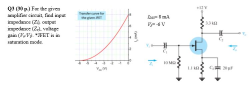 +12 V Transfer curve for the given JFET Q3 (30 p.) For the given amplifier circuit, find input impedance (Zi), output impedance (Z.), voltage gain (V/V). *JFET is in saturation mode. 10ss 8 ma V = -6 V 3.32 O (vw) HE C с. int 2 -1 z 10 M2 VV 1. ΚΩ 20 uF
Q6) [CLO:03] [10 marks] Analyze the circuit in the following figure for percent line regulation using...
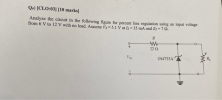 Q6) [CLO:03] [10 marks] Analyze the circuit in the following figure for percent line regulation using an input voltage from 6 V to 12 V with no load. Assume Vz = 5.1 V at Iz= 35 mA and Zz-7 22 RI VIN 1N4733A
Question 4. Refer to the circuit of Figure 4. R 802 50 uF с vi(t) v.(t)...
 Question 4. Refer to the circuit of Figure 4. R 802 50 uF с vi(t) v.(t) Figure 4 a) Draw the circuit in the Laplace domain, and then apply basic circuit theory in the Laplace domain to show that the Laplace transfer function H(s) defined for this system is: HS) V.(5) V (5) sta where a= RC [8 Marks] b) Use Laplace methods to determine the output voltage vo(t) when the input voltage is defined as: v (1) 40(1) The...
QUESTION 1 Figure Q1 shows a common emitter (CE) and common Base (CB) cascade amplifier circuit....
 QUESTION 1 Figure Q1 shows a common emitter (CE) and common Base (CB) cascade amplifier circuit. Determine the input and output impedance, Z; and Zo, voltage gain, Avi and Av2 and total cascade voltage gain, Ayr and Ays. [25 marks) 2 +8V 1.5 kn 2.2 F 82 k2 3.3 k2 Vo 2.2 uf B = 100 6.8 k12 1 k 2 what B = 100 tuf ZA 5.6 k 2 47012 ZA V. 33 k2 IuF w 10k_2 -2V w...
please solve as soon as possible, thank you. Q3: For the following circuit, Z;=6+j9.2, Z=2+j112, ZL=2-310...
 please solve as soon as possible, thank you.
Q3: For the following circuit, Z;=6+j9.2, Z=2+j112, ZL=2-310 S2, Vab= 90 cos(120xt+10°) V, Vbc= 90 cos(120t-110°) V, Vca= 90 cos(120xt+130°) V. Vbc Z, Fig. Q3: the circuit of Q3. a) Find the line currents I, I, and Ic. (15 marks) b) Compute the current through each voltage source, 11, 12, and 13. (9 marks) c) Find the reactive power produced by each voltage source in the delta configuration. (6 marks)
please solve as soon as possible, thank you.
Q3: For the following circuit, Z;=6+j9.2, Z=2+j112, ZL=2-310 S2, Vab= 90 cos(120xt+10°) V, Vbc= 90 cos(120t-110°) V, Vca= 90 cos(120xt+130°) V. Vbc Z, Fig. Q3: the circuit of Q3. a) Find the line currents I, I, and Ic. (15 marks) b) Compute the current through each voltage source, 11, 12, and 13. (9 marks) c) Find the reactive power produced by each voltage source in the delta configuration. (6 marks)
3. In the amplifier circuit given below; Zi input impedance and circuit from input to output...
 3. In the amplifier circuit given below; Zi input
impedance and circuit from input to output Calculate the total
voltage gain [AV=(Vo/Vi)] which
is.
S-3) (20 Puan) Aşağıda verilen yükselteç devresinde; Zi giriş empedansını ve devrenin girişten çıkışa V olan toplam gerilim kazancını 4, = hesaplayınız. V +10 V R 10K R 10KOS Q Si B=100 R4 1ΚΩ Q6 Si B=100 r=o0 Vi R 15ΚΩ Si B=100 N Q3 Si B=100 RS 1202 Si B=100 Q5 Si B=100 3,6ΚΩΣ RE...
3. In the amplifier circuit given below; Zi input
impedance and circuit from input to output Calculate the total
voltage gain [AV=(Vo/Vi)] which
is.
S-3) (20 Puan) Aşağıda verilen yükselteç devresinde; Zi giriş empedansını ve devrenin girişten çıkışa V olan toplam gerilim kazancını 4, = hesaplayınız. V +10 V R 10K R 10KOS Q Si B=100 R4 1ΚΩ Q6 Si B=100 r=o0 Vi R 15ΚΩ Si B=100 N Q3 Si B=100 RS 1202 Si B=100 Q5 Si B=100 3,6ΚΩΣ RE...
 18. The circuit of Figure P10.18 operates in the sinusoidal steady state at a frequency of (1), = 2000 rad/sec, R, = R, = 10 S2, V:,, = 50 V, and I. = 22 - 53.13º A. Compute the phasor volt- age across R2 and then find the impedance Z(w). Now construct a simple series circuit that represents this impedance at (1) N Figure P10.18 ANSWER: 2 = 2.5 + 710 12
 SC 9) (5 marks) Figure 9 represents a simple circuit in the time domain. The impedance of a capacitor in the complex frequency domain is Z = 1 and for an inductor Z = sl. If the complex frequency describing the circuit in Fig. 9 is s = -150 +j100 s-1, determine the time domain voltage vs(t) (provided by the source) which corresponds to a frequency-domain voltage V2 = 52-250 V. i(t) 21 12 + V1 + Vs 100 mH...
 Problem 1: Find the input impedance for the following circuit. Assume an angular frequency of 0 = 50 rad/sec. 2 mF 200 mH Zin 10 mF T10mF Problem 2: Calculate average power absorbed by impedance Z = 30-7092 when a voltage V = 120 20° is applied across it. Problem 3: Assuming w=1, for the following circuit find: a. Input impedance ZH b. Thevenin voltage V c. The value of R, that will absorb the maximum average power (recall this...
 2. Determine the input Impedance of the circuit in figure below at w 10 rad/s 0.5 mF 80 22 8H Lin lmF 3200
 +12 V Transfer curve for the given JFET Q3 (30 p.) For the given amplifier circuit, find input impedance (Zi), output impedance (Z.), voltage gain (V/V). *JFET is in saturation mode. 10ss 8 ma V = -6 V 3.32 O (vw) HE C с. int 2 -1 z 10 M2 VV 1. ΚΩ 20 uF
 Q6) [CLO:03] [10 marks] Analyze the circuit in the following figure for percent line regulation using an input voltage from 6 V to 12 V with no load. Assume Vz = 5.1 V at Iz= 35 mA and Zz-7 22 RI VIN 1N4733A
 Question 4. Refer to the circuit of Figure 4. R 802 50 uF с vi(t) v.(t) Figure 4 a) Draw the circuit in the Laplace domain, and then apply basic circuit theory in the Laplace domain to show that the Laplace transfer function H(s) defined for this system is: HS) V.(5) V (5) sta where a= RC [8 Marks] b) Use Laplace methods to determine the output voltage vo(t) when the input voltage is defined as: v (1) 40(1) The...
 QUESTION 1 Figure Q1 shows a common emitter (CE) and common Base (CB) cascade amplifier circuit. Determine the input and output impedance, Z; and Zo, voltage gain, Avi and Av2 and total cascade voltage gain, Ayr and Ays. [25 marks) 2 +8V 1.5 kn 2.2 F 82 k2 3.3 k2 Vo 2.2 uf B = 100 6.8 k12 1 k 2 what B = 100 tuf ZA 5.6 k 2 47012 ZA V. 33 k2 IuF w 10k_2 -2V w...
 please solve as soon as possible, thank you.
Q3: For the following circuit, Z;=6+j9.2, Z=2+j112, ZL=2-310 S2, Vab= 90 cos(120xt+10°) V, Vbc= 90 cos(120t-110°) V, Vca= 90 cos(120xt+130°) V. Vbc Z, Fig. Q3: the circuit of Q3. a) Find the line currents I, I, and Ic. (15 marks) b) Compute the current through each voltage source, 11, 12, and 13. (9 marks) c) Find the reactive power produced by each voltage source in the delta configuration. (6 marks)
please solve as soon as possible, thank you.
Q3: For the following circuit, Z;=6+j9.2, Z=2+j112, ZL=2-310 S2, Vab= 90 cos(120xt+10°) V, Vbc= 90 cos(120t-110°) V, Vca= 90 cos(120xt+130°) V. Vbc Z, Fig. Q3: the circuit of Q3. a) Find the line currents I, I, and Ic. (15 marks) b) Compute the current through each voltage source, 11, 12, and 13. (9 marks) c) Find the reactive power produced by each voltage source in the delta configuration. (6 marks)
 3. In the amplifier circuit given below; Zi input
impedance and circuit from input to output Calculate the total
voltage gain [AV=(Vo/Vi)] which
is.
S-3) (20 Puan) Aşağıda verilen yükselteç devresinde; Zi giriş empedansını ve devrenin girişten çıkışa V olan toplam gerilim kazancını 4, = hesaplayınız. V +10 V R 10K R 10KOS Q Si B=100 R4 1ΚΩ Q6 Si B=100 r=o0 Vi R 15ΚΩ Si B=100 N Q3 Si B=100 RS 1202 Si B=100 Q5 Si B=100 3,6ΚΩΣ RE...
3. In the amplifier circuit given below; Zi input
impedance and circuit from input to output Calculate the total
voltage gain [AV=(Vo/Vi)] which
is.
S-3) (20 Puan) Aşağıda verilen yükselteç devresinde; Zi giriş empedansını ve devrenin girişten çıkışa V olan toplam gerilim kazancını 4, = hesaplayınız. V +10 V R 10K R 10KOS Q Si B=100 R4 1ΚΩ Q6 Si B=100 r=o0 Vi R 15ΚΩ Si B=100 N Q3 Si B=100 RS 1202 Si B=100 Q5 Si B=100 3,6ΚΩΣ RE...
Most questions answered within 3 hours.
-
Where is the error in this code sequence?
String s1 = "Hello";
String s2 = "ello";...
asked 10 months ago -
Financial data for Joel de Paris, Inc., for last year
follow:
Joel de Paris, Inc.
Balance...
asked 10 months ago -
Consider this reaction:
Al2(SO4)3 (aq)+ BaCl3
(aq) Al2Cl6 (aq)- +
3BaSO4(s) . What is the...
asked 10 months ago -
Suppose that Savneet is considering increasing her
recent random sample from 20 car rentals to 40...
asked 10 months ago -
Trucks arrive at an unloading terminal at an average rate of 120
per hour.
Trucks arrive...
asked 10 months ago -
Why are methanol and ethanol completely soluble in water while
octanol is not very little soluble....
asked 10 months ago -
A facilities manager at a university reads in a research report
that the mean amount of...
asked 10 months ago -
When the CuSO4 is rehydrated by adding water to the anhydrous
compound, is this an endothermic...
asked 10 months ago -
A ray of sunlight is passing from diamond into crown glass; the
angle of incidence is...
asked 10 months ago -
A block of mass 0.249 kg is placed on top of a light, vertical
spring of...
asked 10 months ago -
how do the kidneys compensate in the presences of acidosis
a) trigger hyperventilate
b) reserve acid...
asked 10 months ago -
Question 501 pts
The rental rate of capital to the firm increases. Which of the
following...
asked 10 months ago