
Homework Answers
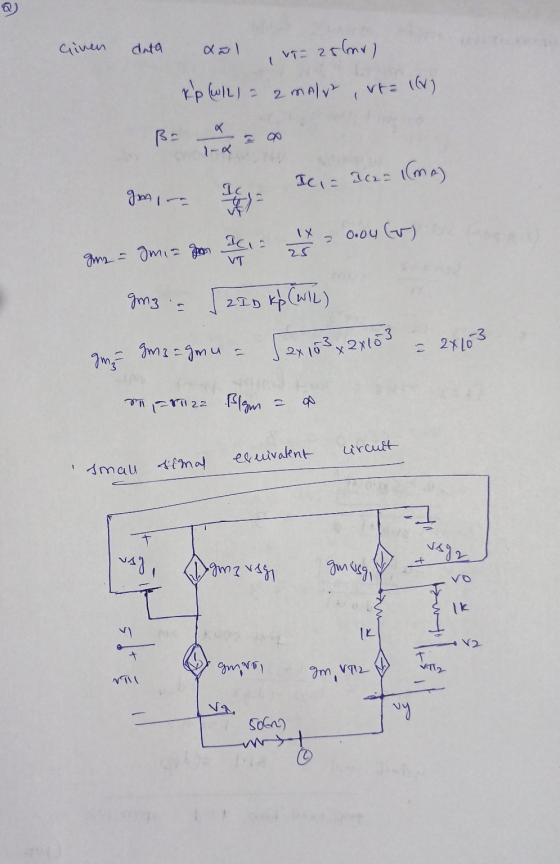
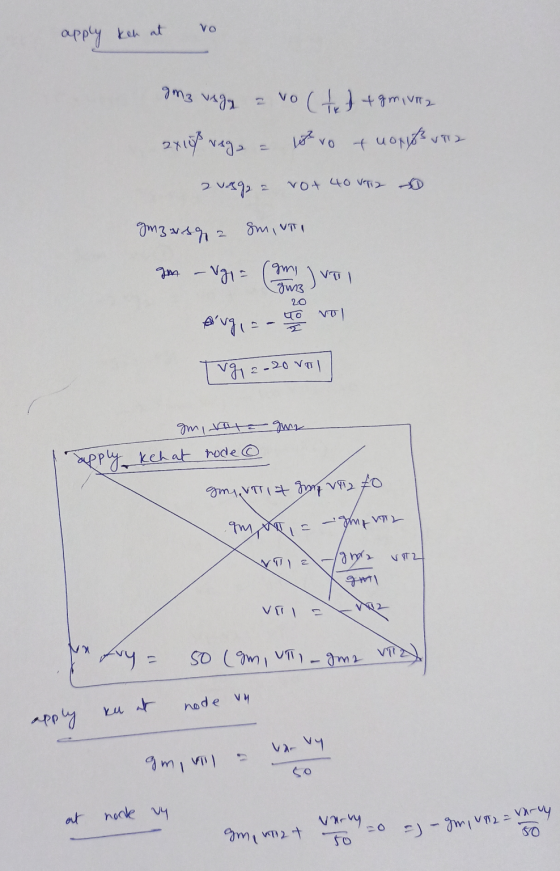
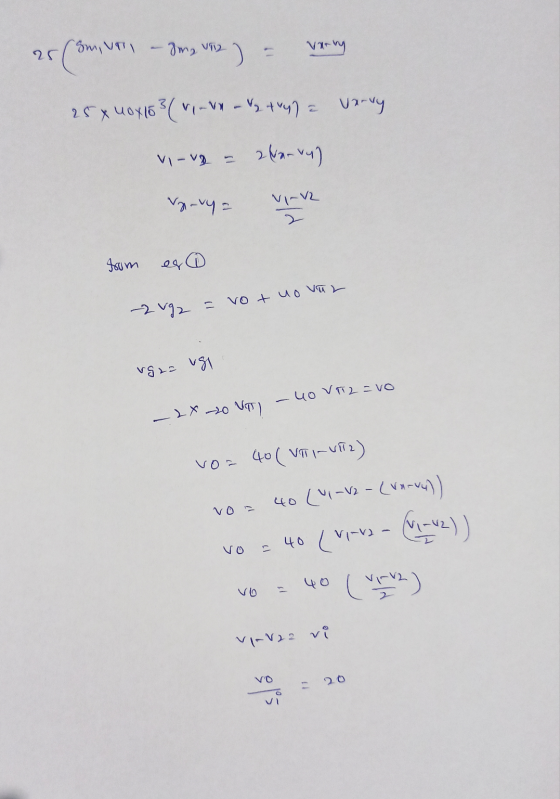
Add Answer to:
is applied to equalize the current values of Q1 and Q2. Answer the In the circuit...
The BJTs in the circuit below has the same β = 90 and the same collector...
 The BJTs in the circuit below has the same β = 90 and the same
collector current. Assume I = 1.9 mA, RC=900 Ω, and use VT = 25
mV.
a- What is the configuration of each stage of the amplifier?
Explain and add to the figure below the input and the output of
each stage.
b- Draw the small signal equivalent circuit and find the small
signal parameters.
c- Find the voltage gain of this amplifier
Vcc Rc Vo...
The BJTs in the circuit below has the same β = 90 and the same
collector current. Assume I = 1.9 mA, RC=900 Ω, and use VT = 25
mV.
a- What is the configuration of each stage of the amplifier?
Explain and add to the figure below the input and the output of
each stage.
b- Draw the small signal equivalent circuit and find the small
signal parameters.
c- Find the voltage gain of this amplifier
Vcc Rc Vo...
Problem 2: In the circuit on Figure P2, BJT NPN Q1 and Q2 emulate a Darlington...
 Problem 2: In the circuit on Figure P2, BJT NPN Q1 and Q2 emulate a Darlington Pair (DP). It should be noted that Q1 and Q2 are such that their current gains are B1 B2 = B = 99. Moreover, capacitors C1 and C2 can be assumed to be very large. Note: The DC analysis of the DP circuit below can be done in a similar fashion as what you do when only dealing with one transistor. Express the current...
Problem 3: 1. 2. What kind of amplifier (given what you have studied in class) is the circuit on ...
 Problem 3: 1. 2. What kind of amplifier (given what you have studied in class) is the circuit on Figure P3? Why? Draw the small-signal equivalent circuit of the amplifier circuit on Figure P3 operating at mid- band frequencies. V1 C2 V2 Vout Q2 R3 R1 C1 Rsig Q1 Vsig R2 Figure P3
Problem 3: 1. 2. What kind of amplifier (given what you have studied in class) is the circuit on Figure P3? Why? Draw the small-signal equivalent circuit...
Problem 3: 1. 2. What kind of amplifier (given what you have studied in class) is the circuit on Figure P3? Why? Draw the small-signal equivalent circuit of the amplifier circuit on Figure P3 operating at mid- band frequencies. V1 C2 V2 Vout Q2 R3 R1 C1 Rsig Q1 Vsig R2 Figure P3
Problem 3: 1. 2. What kind of amplifier (given what you have studied in class) is the circuit on Figure P3? Why? Draw the small-signal equivalent circuit...
pls answer all and asap.tqvm. (a) () What is the significant used of multistage amplifier compared...
 pls
answer all and asap.tqvm.
(a) () What is the significant used of multistage amplifier compared to single stage amplifier? (2 marks) (ii) In terms of circuit connection, how to differentiate between direct and capacitively coupled amplifier circuit? (1 mark) (ii) Give a reason why the capacitively coupled amplifier circuit is not suitable for amplifying DC voltage? (2 marks) (b) The multistage amplifier circuit of Figure Q.3 have the following parameters: Q1, Q2: B = 200, VBE = 0.7 V,....
pls
answer all and asap.tqvm.
(a) () What is the significant used of multistage amplifier compared to single stage amplifier? (2 marks) (ii) In terms of circuit connection, how to differentiate between direct and capacitively coupled amplifier circuit? (1 mark) (ii) Give a reason why the capacitively coupled amplifier circuit is not suitable for amplifying DC voltage? (2 marks) (b) The multistage amplifier circuit of Figure Q.3 have the following parameters: Q1, Q2: B = 200, VBE = 0.7 V,....
1-Clear handwriting 2-Correct answer 3-Organized 4-answer all the questions Please Problem 2 On the circuit on...
 1-Clear handwriting
2-Correct answer
3-Organized
4-answer all the questions
Please
Problem 2 On the circuit on Figure P2, transi stor Q1 has a threshold voltage of Vt = 2 V and a transconductance parameter of k = 100 mA/V2. Note that Vcc = -Vee = 4.5 V. Moreover, capacitors C1, C2, and C3 can be assumed to be very large VDD 4.5.0 R3 25kQ R1 300kn C2 Vout C1 Rsig Q1 1k0 R2 200kn Vsig (R4 2kQ C3 -4.5V VSS...
1-Clear handwriting
2-Correct answer
3-Organized
4-answer all the questions
Please
Problem 2 On the circuit on Figure P2, transi stor Q1 has a threshold voltage of Vt = 2 V and a transconductance parameter of k = 100 mA/V2. Note that Vcc = -Vee = 4.5 V. Moreover, capacitors C1, C2, and C3 can be assumed to be very large VDD 4.5.0 R3 25kQ R1 300kn C2 Vout C1 Rsig Q1 1k0 R2 200kn Vsig (R4 2kQ C3 -4.5V VSS...
Q1(a) [5 Marks The diagram of Fig Ql(a) below describes how a Bipolar Junction Transistor (BJT)...
 Q1(a) [5 Marks The diagram of Fig Ql(a) below describes how a Bipolar Junction Transistor (BJT) may be represented as a two-port network. With the aid of this diagram, derive expressions for the small signal parameters: hie, hoe, hre and hfe. 01- Port 1 V1 Two-Port Network V2 Port 2 Fig Ql(a) Q1(b) [25 Marks) The small signal Common-Emitter (CE) amplifier circuit of Fig Q1(b) below has the following parameters: hie = 1k22, hre = 104, hfe = 100, hoe...
Consider the amplifier given in the figure below. Assume that the transistors Q1 and Q2 are...
 Consider the amplifier given in the figure below. Assume that the transistors Q1 and Q2 are biased in saturation and have small-signal parameters given as: gml, 9m2, rol, ro2. Vop=2.0V Include channel length modulation (you have an r.) and solve for the low frequency small-signal voltage gain A, C= Vout/Vin) of the circuit. SHOW YOUR WORK, INCLUDING YOUR SMALL SIGNAL MODEL!
For the differential amplifier shown in Figure 6: Assume well-matched transistors and = 100 for all transistors: a) Wh...
 For the differential amplifier shown in Figure 6: Assume
well-matched transistors and = 100 for all transistors:
a) Why it is important to use well-matched transistors in
differential amplifier circuits? What is the potential influence of
mismatched transistors on the performance of the differential
amplifier?
b) Determine the resistor values (R1, R2 and R3) such that the
emitter coupled current IE = 0.5 mA and VC1 = 3 V.
c) Draw the ac equivalent circuit for the single ended...
For the differential amplifier shown in Figure 6: Assume
well-matched transistors and = 100 for all transistors:
a) Why it is important to use well-matched transistors in
differential amplifier circuits? What is the potential influence of
mismatched transistors on the performance of the differential
amplifier?
b) Determine the resistor values (R1, R2 and R3) such that the
emitter coupled current IE = 0.5 mA and VC1 = 3 V.
c) Draw the ac equivalent circuit for the single ended...
Problem 1: (4 pts) The circuit below uses current source biasing and two amplifier stages. Assume...
 Problem 1: (4 pts) The circuit below uses current source biasing and two amplifier stages. Assume the transistors are biased so they have the same 9m and ro values, and that the current sources have output resistance ro equal to the ro of the two transistors. In other words, in the small signal model you will replace the de current sources with resistors of value ro Q2 Ui Q1 U) (a) Draw a small-signal model for this amplifier. Be sure...
Q2: In the following BUT circuit, small signal parameters for Q1 and Q2 are labeled symbolically...
 Q2: In the following BUT circuit, small signal parameters for Q1 and Q2 are labeled symbolically (8., and B). Assuming V, - . Please derive the symbolie mathematical expressions for (a) Small signal voltage gain 4 =. .(b) input resistance R. (e) output resistance R . Hints: (1) This problem has identical requirements as Quiz!20. (2) Use the techniques discussed in Lecture#21. Vcc Q : 8MPL B Q2: 8m2» !-2,B2 Vin La te Vout
 The BJTs in the circuit below has the same β = 90 and the same
collector current. Assume I = 1.9 mA, RC=900 Ω, and use VT = 25
mV.
a- What is the configuration of each stage of the amplifier?
Explain and add to the figure below the input and the output of
each stage.
b- Draw the small signal equivalent circuit and find the small
signal parameters.
c- Find the voltage gain of this amplifier
Vcc Rc Vo...
The BJTs in the circuit below has the same β = 90 and the same
collector current. Assume I = 1.9 mA, RC=900 Ω, and use VT = 25
mV.
a- What is the configuration of each stage of the amplifier?
Explain and add to the figure below the input and the output of
each stage.
b- Draw the small signal equivalent circuit and find the small
signal parameters.
c- Find the voltage gain of this amplifier
Vcc Rc Vo...
 Problem 2: In the circuit on Figure P2, BJT NPN Q1 and Q2 emulate a Darlington Pair (DP). It should be noted that Q1 and Q2 are such that their current gains are B1 B2 = B = 99. Moreover, capacitors C1 and C2 can be assumed to be very large. Note: The DC analysis of the DP circuit below can be done in a similar fashion as what you do when only dealing with one transistor. Express the current...
 Problem 3: 1. 2. What kind of amplifier (given what you have studied in class) is the circuit on Figure P3? Why? Draw the small-signal equivalent circuit of the amplifier circuit on Figure P3 operating at mid- band frequencies. V1 C2 V2 Vout Q2 R3 R1 C1 Rsig Q1 Vsig R2 Figure P3
Problem 3: 1. 2. What kind of amplifier (given what you have studied in class) is the circuit on Figure P3? Why? Draw the small-signal equivalent circuit...
Problem 3: 1. 2. What kind of amplifier (given what you have studied in class) is the circuit on Figure P3? Why? Draw the small-signal equivalent circuit of the amplifier circuit on Figure P3 operating at mid- band frequencies. V1 C2 V2 Vout Q2 R3 R1 C1 Rsig Q1 Vsig R2 Figure P3
Problem 3: 1. 2. What kind of amplifier (given what you have studied in class) is the circuit on Figure P3? Why? Draw the small-signal equivalent circuit...
 pls
answer all and asap.tqvm.
(a) () What is the significant used of multistage amplifier compared to single stage amplifier? (2 marks) (ii) In terms of circuit connection, how to differentiate between direct and capacitively coupled amplifier circuit? (1 mark) (ii) Give a reason why the capacitively coupled amplifier circuit is not suitable for amplifying DC voltage? (2 marks) (b) The multistage amplifier circuit of Figure Q.3 have the following parameters: Q1, Q2: B = 200, VBE = 0.7 V,....
pls
answer all and asap.tqvm.
(a) () What is the significant used of multistage amplifier compared to single stage amplifier? (2 marks) (ii) In terms of circuit connection, how to differentiate between direct and capacitively coupled amplifier circuit? (1 mark) (ii) Give a reason why the capacitively coupled amplifier circuit is not suitable for amplifying DC voltage? (2 marks) (b) The multistage amplifier circuit of Figure Q.3 have the following parameters: Q1, Q2: B = 200, VBE = 0.7 V,....
 1-Clear handwriting
2-Correct answer
3-Organized
4-answer all the questions
Please
Problem 2 On the circuit on Figure P2, transi stor Q1 has a threshold voltage of Vt = 2 V and a transconductance parameter of k = 100 mA/V2. Note that Vcc = -Vee = 4.5 V. Moreover, capacitors C1, C2, and C3 can be assumed to be very large VDD 4.5.0 R3 25kQ R1 300kn C2 Vout C1 Rsig Q1 1k0 R2 200kn Vsig (R4 2kQ C3 -4.5V VSS...
1-Clear handwriting
2-Correct answer
3-Organized
4-answer all the questions
Please
Problem 2 On the circuit on Figure P2, transi stor Q1 has a threshold voltage of Vt = 2 V and a transconductance parameter of k = 100 mA/V2. Note that Vcc = -Vee = 4.5 V. Moreover, capacitors C1, C2, and C3 can be assumed to be very large VDD 4.5.0 R3 25kQ R1 300kn C2 Vout C1 Rsig Q1 1k0 R2 200kn Vsig (R4 2kQ C3 -4.5V VSS...
 Q1(a) [5 Marks The diagram of Fig Ql(a) below describes how a Bipolar Junction Transistor (BJT) may be represented as a two-port network. With the aid of this diagram, derive expressions for the small signal parameters: hie, hoe, hre and hfe. 01- Port 1 V1 Two-Port Network V2 Port 2 Fig Ql(a) Q1(b) [25 Marks) The small signal Common-Emitter (CE) amplifier circuit of Fig Q1(b) below has the following parameters: hie = 1k22, hre = 104, hfe = 100, hoe...
 Consider the amplifier given in the figure below. Assume that the transistors Q1 and Q2 are biased in saturation and have small-signal parameters given as: gml, 9m2, rol, ro2. Vop=2.0V Include channel length modulation (you have an r.) and solve for the low frequency small-signal voltage gain A, C= Vout/Vin) of the circuit. SHOW YOUR WORK, INCLUDING YOUR SMALL SIGNAL MODEL!
 For the differential amplifier shown in Figure 6: Assume
well-matched transistors and = 100 for all transistors:
a) Why it is important to use well-matched transistors in
differential amplifier circuits? What is the potential influence of
mismatched transistors on the performance of the differential
amplifier?
b) Determine the resistor values (R1, R2 and R3) such that the
emitter coupled current IE = 0.5 mA and VC1 = 3 V.
c) Draw the ac equivalent circuit for the single ended...
For the differential amplifier shown in Figure 6: Assume
well-matched transistors and = 100 for all transistors:
a) Why it is important to use well-matched transistors in
differential amplifier circuits? What is the potential influence of
mismatched transistors on the performance of the differential
amplifier?
b) Determine the resistor values (R1, R2 and R3) such that the
emitter coupled current IE = 0.5 mA and VC1 = 3 V.
c) Draw the ac equivalent circuit for the single ended...
 Problem 1: (4 pts) The circuit below uses current source biasing and two amplifier stages. Assume the transistors are biased so they have the same 9m and ro values, and that the current sources have output resistance ro equal to the ro of the two transistors. In other words, in the small signal model you will replace the de current sources with resistors of value ro Q2 Ui Q1 U) (a) Draw a small-signal model for this amplifier. Be sure...
 Q2: In the following BUT circuit, small signal parameters for Q1 and Q2 are labeled symbolically (8., and B). Assuming V, - . Please derive the symbolie mathematical expressions for (a) Small signal voltage gain 4 =. .(b) input resistance R. (e) output resistance R . Hints: (1) This problem has identical requirements as Quiz!20. (2) Use the techniques discussed in Lecture#21. Vcc Q : 8MPL B Q2: 8m2» !-2,B2 Vin La te Vout
Most questions answered within 3 hours.
-
Where is the error in this code sequence?
String s1 = "Hello";
String s2 = "ello";...
asked 10 months ago -
Financial data for Joel de Paris, Inc., for last year
follow:
Joel de Paris, Inc.
Balance...
asked 10 months ago -
Consider this reaction:
Al2(SO4)3 (aq)+ BaCl3
(aq) Al2Cl6 (aq)- +
3BaSO4(s) . What is the...
asked 10 months ago -
Suppose that Savneet is considering increasing her
recent random sample from 20 car rentals to 40...
asked 10 months ago -
Trucks arrive at an unloading terminal at an average rate of 120
per hour.
Trucks arrive...
asked 10 months ago -
Why are methanol and ethanol completely soluble in water while
octanol is not very little soluble....
asked 10 months ago -
A facilities manager at a university reads in a research report
that the mean amount of...
asked 10 months ago -
When the CuSO4 is rehydrated by adding water to the anhydrous
compound, is this an endothermic...
asked 10 months ago -
A ray of sunlight is passing from diamond into crown glass; the
angle of incidence is...
asked 10 months ago -
A block of mass 0.249 kg is placed on top of a light, vertical
spring of...
asked 10 months ago -
how do the kidneys compensate in the presences of acidosis
a) trigger hyperventilate
b) reserve acid...
asked 10 months ago -
Question 501 pts
The rental rate of capital to the firm increases. Which of the
following...
asked 10 months ago