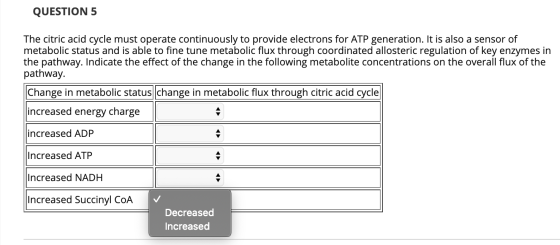
Each option is either increased or decreased
Homework Answers
| Increased energy charge | decreased |
| Increased ADP | increased |
| Increased ATP | decreased |
| Increased NADH | Decreased |
| Increased succinyl CoA | decreased |
Add Answer to:
Each option is either increased or decreased
QUESTION 5 The citric acid cycle must operate continuously...
not sure about reaction 3 and 4 acetyl-CoA COA The reactions of the citric acid cycle...
 not sure about reaction 3 and 4
acetyl-CoA COA The reactions of the citric acid cycle are shown in the figure Reactions 1, 3, and 4 are regulation points in the citric acid cycle. 1 citrate oxaloacetate 1 synthase citrate NADH + NAD malate dehydrogenase aconitase 2 malate Which of the molecules inhibits reaction 1? Isocitrate HO 17 fumarase NAD socitrate 3 dehydrogenase S D NADP ADP ОАТР O citrate synthase fumarate FADHI succinate co-ketoglutarate dehydrogenase ci-ketoglutarate NAD dehydrogenase +...
not sure about reaction 3 and 4
acetyl-CoA COA The reactions of the citric acid cycle are shown in the figure Reactions 1, 3, and 4 are regulation points in the citric acid cycle. 1 citrate oxaloacetate 1 synthase citrate NADH + NAD malate dehydrogenase aconitase 2 malate Which of the molecules inhibits reaction 1? Isocitrate HO 17 fumarase NAD socitrate 3 dehydrogenase S D NADP ADP ОАТР O citrate synthase fumarate FADHI succinate co-ketoglutarate dehydrogenase ci-ketoglutarate NAD dehydrogenase +...
acetyl-CoA COA The reactions of the citric acid cycle are shown in the image. As labeled...
 acetyl-CoA COA The reactions of the citric acid cycle are shown in the image. As labeled in the diagram, reactions 1, 3, and 4 are regulation points in the citric acid cycle. oxaloacetate citrate synthase citrate NADH +Hi 7 malate dehydrogenase NAD malate aconitase 2 Which molecule inhibits reaction 1? isocitrate 7 fumarase NAD isocitrate dehydrogenase 3 NADH + H+ O citrate O NAD acetyl-CoA + CO2 fumarate C-ketoglutarate FADH succinate O dehydrogenase FAD O-ketoglutarate a dehydrogenase NAD + COA...
Which of the following is not a net product of the citric acid cycle for each...
Which of the following is not a net product of the citric acid cycle for each molecule of pyruvate generated in glycolysis? Select one: a. 1 ATP (GTP) b. 1 acetyl coA c. 3 NADH d. 1 FADH2 Question 2 Which of the following is NOT an end product for an acetyl group that enters the citric acid cycle? Select one: a. ATP b. NADH c. FADH2 d. oxaloacetate Question 3 Once they have been processed through the citric acid...
Part B Use the structures given in the cycle shown before this part identify the enzymes involved in each step of the citric acid cycle by completing each sentence Match the words in the left column...
 Part B Use the structures given in the cycle shown before this part identify the enzymes involved in each step of the citric acid cycle by completing each sentence Match the words in the left column to the appropriate blanks in the sentences on the right. View Available Hint(s) Reset Help isocitrate dehydrogenase aconitase citrate synthase fumarate hydratase succinate dehydrogenase succinyl-CoA synthetase a-ketoglutarate dehydrogenase malate dehydrogenase In step 1, oxaloacetate condenses with acetyl-CoA to form citrate, which is catalyzed by...
1. Select the TRUE statement about the citric acid cycle. A. Isocitrate dehydrogenase is a multienzyme...
1. Select the TRUE statement about the citric acid cycle. A. Isocitrate dehydrogenase is a multienzyme complex that is very similar to the pyruvate dehydrogenase complex B. The two decarboxylation steps occur right after each other, first via oxidative alpha- decarboxylation, then via oxidative beta- decarboxylation. C. In one turn of the cycle, the two carbons that enter the cycle as acetyl CoA are the same two carbons that are released as CO2. D. A flavin containing dehydrogenase enzymes oxidizes...
1220 Which is not a result of one pass through the citric acid cycle? A. 2...
 1220 Which is not a result of one pass through the citric acid cycle? A. 2 molecules of Co, are produced. B. 3 molecules of NADH are produced from NAD C. 1 substrate-level phosphorylation occurs to produce GTP or ATP. D. 2 QH, are produced by the succinate dehydrogenase complex. E. The oxidation of L-malate regenerates oxaloacetate. 2012 Which enzyme catalyzes a substrate-level phosphorylation reaction? A. Isocitrate dehydrogenase B. Succinyl-CoA synthetase C. Fumarase D. Aconitase E. Citrate synthase 14.30 What...
QUESTION 1 Which of the following is NOT a product of the Citric Acid Cycle? O...
 QUESTION 1 Which of the following is NOT a product of the Citric Acid Cycle? O Citric acid O CO2 O NADH O FADH2 O All of the above are products QUESTION 2 What do glycolysis and the Citric Acid Cycle have in common? O They both involve oxidation of glucose. O They both occur in the cytoplasm. O They both produce CO2 O They both produce ATP and NADH QUESTION 3 Pyrimidines are synthesized through a long series of...
QUESTION 16 How many (total) CO2 molecules are released from the citric acid cycle from the...
 QUESTION 16 How many (total) CO2 molecules are released from the citric acid cycle from the breakdown of ONE MOLECULE of GLUCOSE? one two four six QUESTION 17 Fate(s) of pyruvate isare) Check all that apply. formation of ethyl alcohol by yeasts 2 formation of glucose by gluconeogenesis in liver cells production of ketone bodies formation of lactate under anaerobic conditions phosphorylation of ADP to produce ATP formation of acetyl-CoA under aerobic conditions QUESTION 18 In the electron transport chain,...
Fatty Acid Metabolism. The reactions of the fatty acid spiral are shown below. Use the description...
 Fatty Acid Metabolism. The reactions of the fatty acid spiral are shown below. Use the description on the left side of the page to classify the reactions and fill in the boxes on the right side of the page Activation Step. The activation of the fatty acid begins by the addition of CoA which will carry the fatty acid from the cytosol into the mitochondria. The product, which is a fatty acid with a CoA attached, is known as a...
I'd like to ask the answers for all of the uestions Question 1. A reaction in...
 I'd
like to ask the answers for all of the uestions
Question 1. A reaction in an anabolic pathway in a cell has a AG of +2.5 kcal/mol. Which of the following is true regarding this reaction? A. It will occur spontaneously. B. The product of the reaction has a lower free energy than the reactants. C. It can occur if it is coupled to ATP hydrolysis. D. It is an exergonic reaction. E. It is breaking a polymer into...
I'd
like to ask the answers for all of the uestions
Question 1. A reaction in an anabolic pathway in a cell has a AG of +2.5 kcal/mol. Which of the following is true regarding this reaction? A. It will occur spontaneously. B. The product of the reaction has a lower free energy than the reactants. C. It can occur if it is coupled to ATP hydrolysis. D. It is an exergonic reaction. E. It is breaking a polymer into...
 not sure about reaction 3 and 4
acetyl-CoA COA The reactions of the citric acid cycle are shown in the figure Reactions 1, 3, and 4 are regulation points in the citric acid cycle. 1 citrate oxaloacetate 1 synthase citrate NADH + NAD malate dehydrogenase aconitase 2 malate Which of the molecules inhibits reaction 1? Isocitrate HO 17 fumarase NAD socitrate 3 dehydrogenase S D NADP ADP ОАТР O citrate synthase fumarate FADHI succinate co-ketoglutarate dehydrogenase ci-ketoglutarate NAD dehydrogenase +...
not sure about reaction 3 and 4
acetyl-CoA COA The reactions of the citric acid cycle are shown in the figure Reactions 1, 3, and 4 are regulation points in the citric acid cycle. 1 citrate oxaloacetate 1 synthase citrate NADH + NAD malate dehydrogenase aconitase 2 malate Which of the molecules inhibits reaction 1? Isocitrate HO 17 fumarase NAD socitrate 3 dehydrogenase S D NADP ADP ОАТР O citrate synthase fumarate FADHI succinate co-ketoglutarate dehydrogenase ci-ketoglutarate NAD dehydrogenase +...
 acetyl-CoA COA The reactions of the citric acid cycle are shown in the image. As labeled in the diagram, reactions 1, 3, and 4 are regulation points in the citric acid cycle. oxaloacetate citrate synthase citrate NADH +Hi 7 malate dehydrogenase NAD malate aconitase 2 Which molecule inhibits reaction 1? isocitrate 7 fumarase NAD isocitrate dehydrogenase 3 NADH + H+ O citrate O NAD acetyl-CoA + CO2 fumarate C-ketoglutarate FADH succinate O dehydrogenase FAD O-ketoglutarate a dehydrogenase NAD + COA...
 Part B Use the structures given in the cycle shown before this part identify the enzymes involved in each step of the citric acid cycle by completing each sentence Match the words in the left column to the appropriate blanks in the sentences on the right. View Available Hint(s) Reset Help isocitrate dehydrogenase aconitase citrate synthase fumarate hydratase succinate dehydrogenase succinyl-CoA synthetase a-ketoglutarate dehydrogenase malate dehydrogenase In step 1, oxaloacetate condenses with acetyl-CoA to form citrate, which is catalyzed by...
 1220 Which is not a result of one pass through the citric acid cycle? A. 2 molecules of Co, are produced. B. 3 molecules of NADH are produced from NAD C. 1 substrate-level phosphorylation occurs to produce GTP or ATP. D. 2 QH, are produced by the succinate dehydrogenase complex. E. The oxidation of L-malate regenerates oxaloacetate. 2012 Which enzyme catalyzes a substrate-level phosphorylation reaction? A. Isocitrate dehydrogenase B. Succinyl-CoA synthetase C. Fumarase D. Aconitase E. Citrate synthase 14.30 What...
 QUESTION 1 Which of the following is NOT a product of the Citric Acid Cycle? O Citric acid O CO2 O NADH O FADH2 O All of the above are products QUESTION 2 What do glycolysis and the Citric Acid Cycle have in common? O They both involve oxidation of glucose. O They both occur in the cytoplasm. O They both produce CO2 O They both produce ATP and NADH QUESTION 3 Pyrimidines are synthesized through a long series of...
 QUESTION 16 How many (total) CO2 molecules are released from the citric acid cycle from the breakdown of ONE MOLECULE of GLUCOSE? one two four six QUESTION 17 Fate(s) of pyruvate isare) Check all that apply. formation of ethyl alcohol by yeasts 2 formation of glucose by gluconeogenesis in liver cells production of ketone bodies formation of lactate under anaerobic conditions phosphorylation of ADP to produce ATP formation of acetyl-CoA under aerobic conditions QUESTION 18 In the electron transport chain,...
 Fatty Acid Metabolism. The reactions of the fatty acid spiral are shown below. Use the description on the left side of the page to classify the reactions and fill in the boxes on the right side of the page Activation Step. The activation of the fatty acid begins by the addition of CoA which will carry the fatty acid from the cytosol into the mitochondria. The product, which is a fatty acid with a CoA attached, is known as a...
 I'd
like to ask the answers for all of the uestions
Question 1. A reaction in an anabolic pathway in a cell has a AG of +2.5 kcal/mol. Which of the following is true regarding this reaction? A. It will occur spontaneously. B. The product of the reaction has a lower free energy than the reactants. C. It can occur if it is coupled to ATP hydrolysis. D. It is an exergonic reaction. E. It is breaking a polymer into...
I'd
like to ask the answers for all of the uestions
Question 1. A reaction in an anabolic pathway in a cell has a AG of +2.5 kcal/mol. Which of the following is true regarding this reaction? A. It will occur spontaneously. B. The product of the reaction has a lower free energy than the reactants. C. It can occur if it is coupled to ATP hydrolysis. D. It is an exergonic reaction. E. It is breaking a polymer into...
Most questions answered within 3 hours.
-
Where is the error in this code sequence?
String s1 = "Hello";
String s2 = "ello";...
asked 10 months ago -
Financial data for Joel de Paris, Inc., for last year
follow:
Joel de Paris, Inc.
Balance...
asked 10 months ago -
Consider this reaction:
Al2(SO4)3 (aq)+ BaCl3
(aq) Al2Cl6 (aq)- +
3BaSO4(s) . What is the...
asked 10 months ago -
Suppose that Savneet is considering increasing her
recent random sample from 20 car rentals to 40...
asked 10 months ago -
Trucks arrive at an unloading terminal at an average rate of 120
per hour.
Trucks arrive...
asked 10 months ago -
Why are methanol and ethanol completely soluble in water while
octanol is not very little soluble....
asked 10 months ago -
A facilities manager at a university reads in a research report
that the mean amount of...
asked 10 months ago -
When the CuSO4 is rehydrated by adding water to the anhydrous
compound, is this an endothermic...
asked 10 months ago -
A ray of sunlight is passing from diamond into crown glass; the
angle of incidence is...
asked 10 months ago -
A block of mass 0.249 kg is placed on top of a light, vertical
spring of...
asked 10 months ago -
how do the kidneys compensate in the presences of acidosis
a) trigger hyperventilate
b) reserve acid...
asked 10 months ago -
Question 501 pts
The rental rate of capital to the firm increases. Which of the
following...
asked 10 months ago