true or false with explanation a- A separately excited DC generator terminal current increases as a...
true or false with explanation
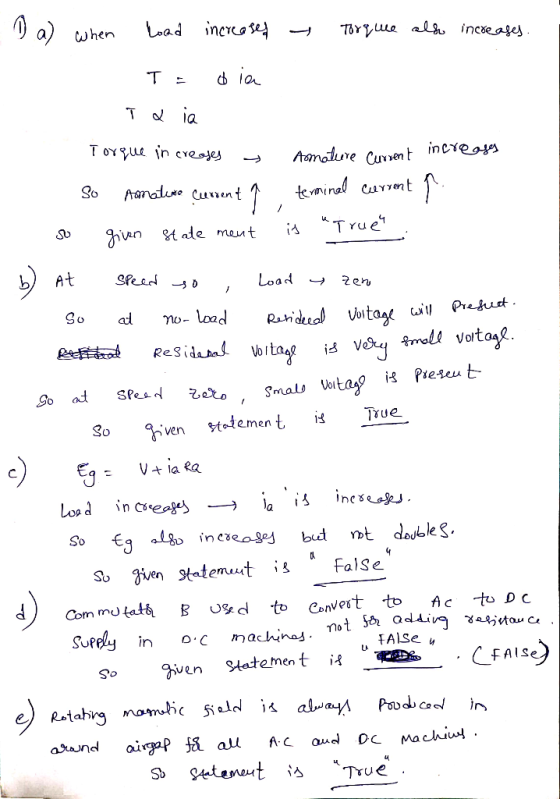
a- A separately excited DC generator terminal current increases as a resistive load is applied
b- In a separately excited DC generator, a voltage will exist at the terminals for a zero speed
c- Doubling the load on the generator will increase the generator voltage by a factor of two.
d- The commutator is used for adding a resistor to the rotor.
e- A rotating magnetic field is produced around the air gap.
Homework Answers
Add Answer to:
true or false with explanation
a- A separately excited DC generator terminal current increases
as a...
LAB MANUAL LAB EXPERIMENT - 04: LOAD CHARACTERISTICS OF SEPARATELY EXCITED DC GE ATELY EXCITED DC...
 LAB MANUAL LAB EXPERIMENT - 04: LOAD CHARACTERISTICS OF SEPARATELY EXCITED DC GE ATELY EXCITED DC GENERATOR REVIEW QUESTIONS: 1. A separately excited generator has constant: a Field Strength b Load Current c Terminal Voltage The terminal voltage of a separately-excited generator a Goes up as load increases b Goes down as load increases C Stays the same as load increases. 3. The current drawn from a separately-excited generator by the load a is also its armature current b Has...
A second separately excited DC generator has the same electrical parameters as the generator in part...
 A second separately excited DC generator has the same electrical
parameters as the generator in part (a) first but does not have
compensating windings. The full-load demagnetising armature
reaction is equivalent to 500 Ampere-turns. (i) With Radj = 63Ω and
the generator is driven at 1600rpm, what is the no-load terminal
voltage? (ii) What would be the output terminal voltage if 364A
were drawn from the armature at 1600rpm?
Q2. (a) Fig. Q20) shows a separately excited DC generator with...
A second separately excited DC generator has the same electrical
parameters as the generator in part (a) first but does not have
compensating windings. The full-load demagnetising armature
reaction is equivalent to 500 Ampere-turns. (i) With Radj = 63Ω and
the generator is driven at 1600rpm, what is the no-load terminal
voltage? (ii) What would be the output terminal voltage if 364A
were drawn from the armature at 1600rpm?
Q2. (a) Fig. Q20) shows a separately excited DC generator with...
4. A separately excited de generator is rated at 172 kW, 430 V, 400 A, and...
 4. A separately excited de generator is rated at 172 kW, 430 V, 400 A, and 1800 rpm. Its field circuit has a total resistance Radi +Rp. Its magnetizing curve is shown in Fig. P4.1. The machine has the following characteristics: RA = 0.05 2; Rr = 20 2; Radi (a) Draw the schematic diagram of the generator. (b) If the variable resistor Radi in this generator's field circuit is adjusted to 63 2 and the generator's =0 to 300...
separately excited series, shunt, compound DC motor: *Describe how does decreasing the field current IF affect...
separately excited series, shunt, compound DC motor: *Describe how does decreasing the field current IF affect the speed versus voltage characteristic and constant K1 of a separately-excited dc motor. K1=(n2-n1)/(E2-E1) *Describe how does decreasing the field current IF affect the torque versus current characteristic and constant K2 of a separately-excited dc motor? k2=(T2-T1)/(I1-I2) *Briefly describe how the speed varies as the mechanical load applied to the series motor increases, i.e. as the motor torque increases.
A4-pole, 500V DC separately excited generator is running at a speed of 450 rpm. Its field...
A4-pole, 500V DC separately excited generator is running at a speed of 450 rpm. Its field and armature resistances are 35 and 0.007 ohms respectively. If the generator is supplying a 750 kW load and the rotational power loss is 12180 W, find: a) The armature induced voltage, b) The input power
A separately excited DC shunt generator produces a no-load voltage of 150 Vdc at 1200 RPM....
A separately excited DC shunt generator produces a no-load voltage of 150 Vdc at 1200 RPM. If the armature resistance is 3 Ohms, calculate the output voltage under the following conditions: (Note all calculations for each problem are to be performed from the base values given above). a) The speed is reduced to 875 RPM. Vout = __________________ b) The field current is increased by 22% (assume a linear field current/flux relationship). Vout = __________________ c) The speed is increased...
A separately excited DC motor is known with: Pv-30KWUN-200V, IN-160A, nN-1000rpm, Imax# 1.81. when TL-o5TN, please t...
 A separately excited DC motor is known with: Pv-30KWUN-200V, IN-160A, nN-1000rpm, Imax# 1.81. when TL-o5TN, please try to find: (5 points) 2. a) the rated efficiency b) the mechanical characteristic figure c) the minimum resistance quired for the resistive braking. 3. A 3-phase asynchronous motor with PN-5.5kW and fi-50Hz. With rated load, the power source input power is 6.32kW, the stator copper loss is 415W, the rotor copper loss is 290W, the mechanical loss is 55W and the additional loss...
one of the following is not essential in generating a dc voltage UNIT 1 OPERATING PRINCIPLES...
 one of the following is not essential in generating a dc
voltage
UNIT 1 OPERATING PRINCIPLES OF D 8 ng ACHIEVEMENT REVIEW Select the correct answer for each of the following statements, and pl letter in the space provided. I. A generator ace the ce a. changes electrical energy to mechanical energy. b) changes mechanical energy to electrical energy c. is always self excited. d. is always separately excited. One of the following is not essential in generating a DC...
one of the following is not essential in generating a dc
voltage
UNIT 1 OPERATING PRINCIPLES OF D 8 ng ACHIEVEMENT REVIEW Select the correct answer for each of the following statements, and pl letter in the space provided. I. A generator ace the ce a. changes electrical energy to mechanical energy. b) changes mechanical energy to electrical energy c. is always self excited. d. is always separately excited. One of the following is not essential in generating a DC...
Problem 2 A separately excited DC motor is characterized by the followng intormation Armature res...
 Problem 2 A separately excited DC motor is characterized by the followng intormation Armature resistance Ra-5 2 armature inductance La . very large, Field resistance RS200 Ω, ted voltage Vt 200 V, and an inertia constant J-12 kg m Neglecting friction losses and assuming no-saturation in the machine magnetic core system, answer the folowing questions: Part 1: (6 marks) he motor a as shown in figure 2a. The motor drives a constant power load of vaue 1 40375 hp (ie...
POR2-QUESTIONS FOR GENERATORS Answer True or False for the following. (Mechancal inbo Eleetvical) 1) Generators Convert...
 POR2-QUESTIONS FOR GENERATORS Answer True or False for the following. (Mechancal inbo Eleetvical) 1) Generators Convert Thermal energy into Electrical energy. x 2) Increasing the speed of rotation of the magnet increases the rate of change of flux and higher voltage is induced. The same increase in voltage may be accomplished with out changing the speed, but by using a strong magnet. 3) The order or sequence in which the voltage waves of the three phases reach their max positive...
 LAB MANUAL LAB EXPERIMENT - 04: LOAD CHARACTERISTICS OF SEPARATELY EXCITED DC GE ATELY EXCITED DC GENERATOR REVIEW QUESTIONS: 1. A separately excited generator has constant: a Field Strength b Load Current c Terminal Voltage The terminal voltage of a separately-excited generator a Goes up as load increases b Goes down as load increases C Stays the same as load increases. 3. The current drawn from a separately-excited generator by the load a is also its armature current b Has...
 A second separately excited DC generator has the same electrical
parameters as the generator in part (a) first but does not have
compensating windings. The full-load demagnetising armature
reaction is equivalent to 500 Ampere-turns. (i) With Radj = 63Ω and
the generator is driven at 1600rpm, what is the no-load terminal
voltage? (ii) What would be the output terminal voltage if 364A
were drawn from the armature at 1600rpm?
Q2. (a) Fig. Q20) shows a separately excited DC generator with...
A second separately excited DC generator has the same electrical
parameters as the generator in part (a) first but does not have
compensating windings. The full-load demagnetising armature
reaction is equivalent to 500 Ampere-turns. (i) With Radj = 63Ω and
the generator is driven at 1600rpm, what is the no-load terminal
voltage? (ii) What would be the output terminal voltage if 364A
were drawn from the armature at 1600rpm?
Q2. (a) Fig. Q20) shows a separately excited DC generator with...
 4. A separately excited de generator is rated at 172 kW, 430 V, 400 A, and 1800 rpm. Its field circuit has a total resistance Radi +Rp. Its magnetizing curve is shown in Fig. P4.1. The machine has the following characteristics: RA = 0.05 2; Rr = 20 2; Radi (a) Draw the schematic diagram of the generator. (b) If the variable resistor Radi in this generator's field circuit is adjusted to 63 2 and the generator's =0 to 300...
 A separately excited DC motor is known with: Pv-30KWUN-200V, IN-160A, nN-1000rpm, Imax# 1.81. when TL-o5TN, please try to find: (5 points) 2. a) the rated efficiency b) the mechanical characteristic figure c) the minimum resistance quired for the resistive braking. 3. A 3-phase asynchronous motor with PN-5.5kW and fi-50Hz. With rated load, the power source input power is 6.32kW, the stator copper loss is 415W, the rotor copper loss is 290W, the mechanical loss is 55W and the additional loss...
 one of the following is not essential in generating a dc
voltage
UNIT 1 OPERATING PRINCIPLES OF D 8 ng ACHIEVEMENT REVIEW Select the correct answer for each of the following statements, and pl letter in the space provided. I. A generator ace the ce a. changes electrical energy to mechanical energy. b) changes mechanical energy to electrical energy c. is always self excited. d. is always separately excited. One of the following is not essential in generating a DC...
one of the following is not essential in generating a dc
voltage
UNIT 1 OPERATING PRINCIPLES OF D 8 ng ACHIEVEMENT REVIEW Select the correct answer for each of the following statements, and pl letter in the space provided. I. A generator ace the ce a. changes electrical energy to mechanical energy. b) changes mechanical energy to electrical energy c. is always self excited. d. is always separately excited. One of the following is not essential in generating a DC...
 Problem 2 A separately excited DC motor is characterized by the followng intormation Armature resistance Ra-5 2 armature inductance La . very large, Field resistance RS200 Ω, ted voltage Vt 200 V, and an inertia constant J-12 kg m Neglecting friction losses and assuming no-saturation in the machine magnetic core system, answer the folowing questions: Part 1: (6 marks) he motor a as shown in figure 2a. The motor drives a constant power load of vaue 1 40375 hp (ie...
 POR2-QUESTIONS FOR GENERATORS Answer True or False for the following. (Mechancal inbo Eleetvical) 1) Generators Convert Thermal energy into Electrical energy. x 2) Increasing the speed of rotation of the magnet increases the rate of change of flux and higher voltage is induced. The same increase in voltage may be accomplished with out changing the speed, but by using a strong magnet. 3) The order or sequence in which the voltage waves of the three phases reach their max positive...
Most questions answered within 3 hours.
-
Where is the error in this code sequence?
String s1 = "Hello";
String s2 = "ello";...
asked 10 months ago -
Financial data for Joel de Paris, Inc., for last year
follow:
Joel de Paris, Inc.
Balance...
asked 10 months ago -
Consider this reaction:
Al2(SO4)3 (aq)+ BaCl3
(aq) Al2Cl6 (aq)- +
3BaSO4(s) . What is the...
asked 10 months ago -
Suppose that Savneet is considering increasing her
recent random sample from 20 car rentals to 40...
asked 10 months ago -
Trucks arrive at an unloading terminal at an average rate of 120
per hour.
Trucks arrive...
asked 10 months ago -
Why are methanol and ethanol completely soluble in water while
octanol is not very little soluble....
asked 10 months ago -
A facilities manager at a university reads in a research report
that the mean amount of...
asked 10 months ago -
When the CuSO4 is rehydrated by adding water to the anhydrous
compound, is this an endothermic...
asked 10 months ago -
A ray of sunlight is passing from diamond into crown glass; the
angle of incidence is...
asked 10 months ago -
A block of mass 0.249 kg is placed on top of a light, vertical
spring of...
asked 10 months ago -
how do the kidneys compensate in the presences of acidosis
a) trigger hyperventilate
b) reserve acid...
asked 10 months ago -
Question 501 pts
The rental rate of capital to the firm increases. Which of the
following...
asked 10 months ago