
Homework Answers
Answer-
Add Answer to:
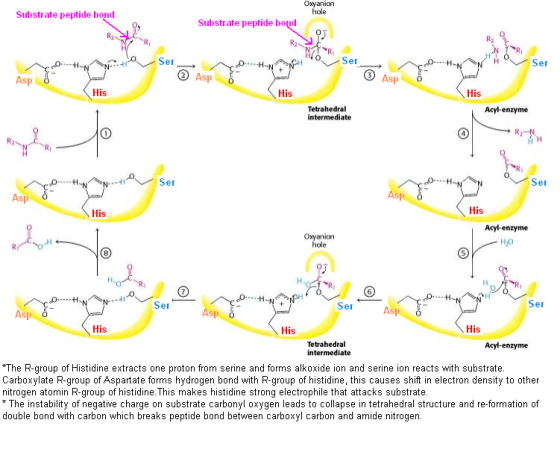
22. Label three amino acids- Asp, His and Ser and substrate peptide bond in the following...
How do amino acid residues Asp102, His 57, and Ser 195 participate in peptide bond hydrolysis...
How do amino acid residues Asp102, His 57, and Ser 195 participate in peptide bond hydrolysis as catalyzed by chymotrypsin?
Which amino acids in chymotrypsin are found in the active site and are participants in substrate...
 Which amino acids in chymotrypsin are found in the active site and are participants in substrate cleavage? His, Ser, Asp His, Ser, Arg His, Ser Lys, Ser, Asp Where does cleavage of the peptide bond by chymotrypsin occur? On the C-terminal side of positively charged residues (lysine or). On the N-terminal side of aromatic residues (e.g. phonylalanine or tryprophase). On the C-terminal side of aromatic residues (e.g. phenylalanine or). All of the above When substrate concentration is much greater than...
Put these steps in the mechanism of chymotrypsin catalysis in order from first to last. Note...
 Put these steps in the mechanism of chymotrypsin catalysis in order from first to last. Note that some references may not break out each of these steps individually, but all steps should be ordered. There will be eight steps. First step His 57 catalyzes removal of H from Ser 195 hydroxyl. Ser 195's nucleophilic O attacks carbonyl C of substrate. The portion (the C-terminal end) of original substrate with the new amino terminus diffuses away. His 57 donates H to...
Put these steps in the mechanism of chymotrypsin catalysis in order from first to last. Note...
 Put these steps in the mechanism of chymotrypsin catalysis in
order from first to last. Note that your textbook may not break out
each of these steps individually, but all steps should be ordered.
(There will be eight steps.
)
first step last step Resulting OH attacks carbonyl of remaining substrate. His 57 donates H to Ser 195 O, leading to collapse of tetrahedral intermediate. mato Ser 195 the portion (N-terminal end) of original substrate with the new carboxylate terminus...
Put these steps in the mechanism of chymotrypsin catalysis in
order from first to last. Note that your textbook may not break out
each of these steps individually, but all steps should be ordered.
(There will be eight steps.
)
first step last step Resulting OH attacks carbonyl of remaining substrate. His 57 donates H to Ser 195 O, leading to collapse of tetrahedral intermediate. mato Ser 195 the portion (N-terminal end) of original substrate with the new carboxylate terminus...
24. Explain the energetic benefits of making the enzyme active state rather than to the substrate...
 24. Explain the energetic benefits of making the enzyme active state rather than to the substrate conformation. Also explain how contribute to enzyme action. In other words, how do these weak intera enzyme and the transition state lower the activation energy?) of making the enzyme active site complementary to the transition nation. Also explain how multiple weak interactions words, how do these weak interactions between the 25. 1/F. The pk's of titratable groups of amino acids remain constant irrespective of...
19) The form of dipeptide aspatylserine (Asp-Ser) obtained from two amino acids, aspartic acid an...
 19) The form of dipeptide aspatylserine (Asp-Ser) obtained from two amino acids, aspartic acid and serine, whose structures are shown here, is HiN-CH-C-0HIN-CH-C-0 CH2 CH OH aspartic acid serine A HN-CH-C-o-N-CH-C-o CH OH CH2 coo -(H-C-o-H-c-o CH OH CH2 HIN CH-C-N-CH-C-O CH OH CH H-CH-CH CH CH OH coo- 20) Where is the peptide bond located in this dipeptide? serine valine a) the CO-NH joining serine and the valine b) the doubly bonded oxygen just left of center between the...
Water is required in chymotrypsin's peptide bond hydrolysis reaction. The-OH from the water is released as...
 Water is required in chymotrypsin's peptide bond hydrolysis reaction. The-OH from the water is released as a part of the following product (or enzymatic R-group: Ser, to restore the enzyme to its original form. Asp, to restore the enzyme to its original form. His, to restore the enzyme to its original form the portion of the broken polypeptide chain that retains the amino N from the cleaved peptide bond. the portion of the broken polypeptide chain that retains the carbonyl...
Put these steps in the mechanism of chymotrypsin catalysis in order from first to last. Note...
Put these steps in the mechanism of chymotrypsin catalysis in order from first to last. Note that your textbook may not break out each of these steps individually, but all steps should be ordered. (There will be eight steps.) A. His 57 catalyzes removal of H from Ser 195 hydroxyl. B. His 57 donates H to N of sissile peptide bond, tetrahedral intermediate decomposes. C. The portion (N-terminal end) of the original substrate with the new carboxylate terminus diffuses away....
On your internship, you visit the Mass Spectrometry Lab. Mass spectrometry can identify short peptide fragments...
On your internship, you visit the Mass Spectrometry Lab. Mass spectrometry can identify short peptide fragments based on their molecular weights. Your fellow intern Jerry has neglected to label his tubes of amyloid beta peptide 42 after digesting them with some proteases that we learned about in Module 6: pepsin, trypsin, and chymotrypsin. Help him figure out what protease is in each tube. Jerry’s supervisor has the fragments listed in the same order as the original peptide primary sequence, which...
A. Choose anly one correcet answer for each of the following questions (4 pts cach). AL Some and ...
 A. Choose anly one correcet answer for each of the following questions (4 pts cach). AL Some and KM values are shown below for enzyme-substrate pairs. Which of the following enzymes is most efficient in converting the substrate into the product? b) kes.-4x10s s", KM-0.026 M d)k,,-5.7 x1o's", K-2x10s M c)人at-900 s", KM-2.5 × 10.5 M A2. Which of the following enzyme reaction mechanisms has multiple substrates? a) induced-fit e) Michaclis-Menton b) random sequential d) reversible covalent modification e) None...
 Which amino acids in chymotrypsin are found in the active site and are participants in substrate cleavage? His, Ser, Asp His, Ser, Arg His, Ser Lys, Ser, Asp Where does cleavage of the peptide bond by chymotrypsin occur? On the C-terminal side of positively charged residues (lysine or). On the N-terminal side of aromatic residues (e.g. phonylalanine or tryprophase). On the C-terminal side of aromatic residues (e.g. phenylalanine or). All of the above When substrate concentration is much greater than...
 Put these steps in the mechanism of chymotrypsin catalysis in order from first to last. Note that some references may not break out each of these steps individually, but all steps should be ordered. There will be eight steps. First step His 57 catalyzes removal of H from Ser 195 hydroxyl. Ser 195's nucleophilic O attacks carbonyl C of substrate. The portion (the C-terminal end) of original substrate with the new amino terminus diffuses away. His 57 donates H to...
 Put these steps in the mechanism of chymotrypsin catalysis in
order from first to last. Note that your textbook may not break out
each of these steps individually, but all steps should be ordered.
(There will be eight steps.
)
first step last step Resulting OH attacks carbonyl of remaining substrate. His 57 donates H to Ser 195 O, leading to collapse of tetrahedral intermediate. mato Ser 195 the portion (N-terminal end) of original substrate with the new carboxylate terminus...
Put these steps in the mechanism of chymotrypsin catalysis in
order from first to last. Note that your textbook may not break out
each of these steps individually, but all steps should be ordered.
(There will be eight steps.
)
first step last step Resulting OH attacks carbonyl of remaining substrate. His 57 donates H to Ser 195 O, leading to collapse of tetrahedral intermediate. mato Ser 195 the portion (N-terminal end) of original substrate with the new carboxylate terminus...
 24. Explain the energetic benefits of making the enzyme active state rather than to the substrate conformation. Also explain how contribute to enzyme action. In other words, how do these weak intera enzyme and the transition state lower the activation energy?) of making the enzyme active site complementary to the transition nation. Also explain how multiple weak interactions words, how do these weak interactions between the 25. 1/F. The pk's of titratable groups of amino acids remain constant irrespective of...
 19) The form of dipeptide aspatylserine (Asp-Ser) obtained from two amino acids, aspartic acid and serine, whose structures are shown here, is HiN-CH-C-0HIN-CH-C-0 CH2 CH OH aspartic acid serine A HN-CH-C-o-N-CH-C-o CH OH CH2 coo -(H-C-o-H-c-o CH OH CH2 HIN CH-C-N-CH-C-O CH OH CH H-CH-CH CH CH OH coo- 20) Where is the peptide bond located in this dipeptide? serine valine a) the CO-NH joining serine and the valine b) the doubly bonded oxygen just left of center between the...
 Water is required in chymotrypsin's peptide bond hydrolysis reaction. The-OH from the water is released as a part of the following product (or enzymatic R-group: Ser, to restore the enzyme to its original form. Asp, to restore the enzyme to its original form. His, to restore the enzyme to its original form the portion of the broken polypeptide chain that retains the amino N from the cleaved peptide bond. the portion of the broken polypeptide chain that retains the carbonyl...
 A. Choose anly one correcet answer for each of the following questions (4 pts cach). AL Some and KM values are shown below for enzyme-substrate pairs. Which of the following enzymes is most efficient in converting the substrate into the product? b) kes.-4x10s s", KM-0.026 M d)k,,-5.7 x1o's", K-2x10s M c)人at-900 s", KM-2.5 × 10.5 M A2. Which of the following enzyme reaction mechanisms has multiple substrates? a) induced-fit e) Michaclis-Menton b) random sequential d) reversible covalent modification e) None...
Most questions answered within 3 hours.
-
Where is the error in this code sequence?
String s1 = "Hello";
String s2 = "ello";...
asked 11 months ago -
Financial data for Joel de Paris, Inc., for last year
follow:
Joel de Paris, Inc.
Balance...
asked 11 months ago -
Consider this reaction:
Al2(SO4)3 (aq)+ BaCl3
(aq) Al2Cl6 (aq)- +
3BaSO4(s) . What is the...
asked 11 months ago -
Suppose that Savneet is considering increasing her
recent random sample from 20 car rentals to 40...
asked 11 months ago -
Trucks arrive at an unloading terminal at an average rate of 120
per hour.
Trucks arrive...
asked 11 months ago -
Why are methanol and ethanol completely soluble in water while
octanol is not very little soluble....
asked 11 months ago -
A facilities manager at a university reads in a research report
that the mean amount of...
asked 11 months ago -
When the CuSO4 is rehydrated by adding water to the anhydrous
compound, is this an endothermic...
asked 11 months ago -
A ray of sunlight is passing from diamond into crown glass; the
angle of incidence is...
asked 11 months ago -
A block of mass 0.249 kg is placed on top of a light, vertical
spring of...
asked 11 months ago -
how do the kidneys compensate in the presences of acidosis
a) trigger hyperventilate
b) reserve acid...
asked 11 months ago -
Question 501 pts
The rental rate of capital to the firm increases. Which of the
following...
asked 11 months ago