
Homework Answers


Add Answer to:
Question 1 Water flows through the round tube with 50mm diameter shown in the figure. You...
6. (Bonus question) In the experimental setup shown in Figure 6, water flows through soils 1...
 6. (Bonus question) In the experimental setup shown in Figure 6, water flows through soils 1 and 2 upward under constant head. Assume c-c as the datum. (1) Find the total and pressure heads at c-c; (2) If the head loss after flowing through Soil 2 is 30% of the total head difference, determine the total and pressure heads at b-b; (3) Given the coefficient of permeability of Soil 2 as 0.05 cm/sec, determine the rate of discharge; (4) Calculate...
Water flows through a horizontal tube of diameter 2.0 cm that is joined to a second...
 Water flows through a horizontal tube of diameter 2.0 cm that is joined to a second horizontal tube of diameter 1.0 cm. The pressure difference between the tubes is 15 kPa. The density of water is 1000 kg/m. Treat the water as an ideal fluid. Find the speed of flow in the first tube. 1.41 m/s 1.73 m/s 2.00 m/s 1.00 m/s
Tutorial 3, 09] Water flows through a head exchanger tube at a rate of 10*m2/s. The...
 Tutorial 3, 09] Water flows through a head exchanger tube at a rate of 10*m2/s. The diameter of the tube is 10cm. Water enters at 20°C and the rate of heat exchange is such that the temperature of the water reaches 60°C. At what temperature within this pipe length is there a transition in the flow regime. Draw the expected flow profile across the length of the tube. 1. Water in 104m2/s, 20°C Water out 10 m/s, 60°C
Water flows in a pipe as shown in Figure Q3. At section 1, height to the...
 Water flows in a pipe as shown in Figure Q3. At section 1, height to the centre line of pipe in relation to some datum is Zi (=3m). At section 2, the respective height is Z2 = 5m) as shown. The pipe diameters in section 1 and 2 are 500mm and 440mm respectively. Water velocity at section 1 is 5.6 m/s and the pressure is 45 kPa. Assuming ideal flow conditions and taking water density as 1000 kg/m. 1. Calculate...
Question 3 (a) Water flows through a horizontal pipeline of constant 400 mm diameter in a...
 Question 3 (a) Water flows through a horizontal pipeline of constant 400 mm diameter in a water treatment plant. The pipe bends through a 70° angle. In order to design a thrust block for the bend, calculate the magnitude and line of action of the force exerted by the water on the pipe. The discharge through the pipe is 0.4 m/s. The water pressure at the inlet is equivalent to 22 m head of water. [10 marks] (b) Oil of...
Air at 20 C flows through the tube shown in (Figure 1). Assume that air is...
 Air at 20 C flows through the tube shown in (Figure 1). Assume
that air is an ideal fluid. The density of air is 1.20
kg/m3, the density of mercury is 13600 kg/m3.
Suppose that d1 = 2 mm and
d2 = 1.4 cm.
(A) What is the air speed of v1 at point 1? = 149
m/s
(B) What is the air speed v2 at point 2? =
????
(C) What is the volume flow rate? = 4.7*10-4
m3/s...
Air at 20 C flows through the tube shown in (Figure 1). Assume
that air is an ideal fluid. The density of air is 1.20
kg/m3, the density of mercury is 13600 kg/m3.
Suppose that d1 = 2 mm and
d2 = 1.4 cm.
(A) What is the air speed of v1 at point 1? = 149
m/s
(B) What is the air speed v2 at point 2? =
????
(C) What is the volume flow rate? = 4.7*10-4
m3/s...
(40 points) Engine oil flows at a rate of 1 kg/s through a 5-mm diameter smooth straight tube. Th...
 (40 points) Engine oil flows at a rate of 1 kg/s through a 5-mm diameter smooth straight tube. The oil has an inlet temperature of 47°C and it is desired to heat the oil to a mean temperature of 87°C at the exit of the tube. The surface of the tube is maintained at 150°C. Assuming the flow is fully developed both hydrodynamically and thermally, determine the required length of the tube. Note: by calculating Reynolds number at the entrance...
Water flows in the converging section of the figure. The diameter of section 1 is 5.3...
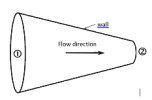 Water flows in the converging section of the figure. The
diameter of section 1 is 5.3 cm, while that in
section is 20.0 mm. The water's velocity in
section 1 is 2.0 m/s. Determine the average velocity in section 2
in m/s.
wall Flow direction 0 2
Water flows in the converging section of the figure. The
diameter of section 1 is 5.3 cm, while that in
section is 20.0 mm. The water's velocity in
section 1 is 2.0 m/s. Determine the average velocity in section 2
in m/s.
wall Flow direction 0 2
Water flows in a 20 cm diameter pipe at 5 m/s as shown in Fig. A.4....
 Water flows in a 20 cm diameter pipe at 5 m/s as shown in Fig.
A.4. It exits by impacting upon a 90- cone and leaves with a
uniform flow of thickness 1 cm around the cone edge.
(a) Calculate the force acting on the cone. (15 marks)
(b) If the flow exits non-uniformly, explain how the movement of
the cone will be affected. (5 marks)
A.4 Water flows in a 20 cm diameter pipe at 5 m/s as shown...
Water flows in a 20 cm diameter pipe at 5 m/s as shown in Fig.
A.4. It exits by impacting upon a 90- cone and leaves with a
uniform flow of thickness 1 cm around the cone edge.
(a) Calculate the force acting on the cone. (15 marks)
(b) If the flow exits non-uniformly, explain how the movement of
the cone will be affected. (5 marks)
A.4 Water flows in a 20 cm diameter pipe at 5 m/s as shown...
1) Air under standard conditions flows through a 5 mm diameter drawn tubing with an average...
 1) Air under standard conditions flows through a 5 mm diameter drawn tubing with an average velocity of V 40 m/s. Determine the pressure drop (Ap) and head loss (h) if the length of tube is 10 cm. Assume minor losses are zero. Air density 1.23 kg/m3 Air viscosity 0.0000179 N.s/m2
 6. (Bonus question) In the experimental setup shown in Figure 6, water flows through soils 1 and 2 upward under constant head. Assume c-c as the datum. (1) Find the total and pressure heads at c-c; (2) If the head loss after flowing through Soil 2 is 30% of the total head difference, determine the total and pressure heads at b-b; (3) Given the coefficient of permeability of Soil 2 as 0.05 cm/sec, determine the rate of discharge; (4) Calculate...
 Water flows through a horizontal tube of diameter 2.0 cm that is joined to a second horizontal tube of diameter 1.0 cm. The pressure difference between the tubes is 15 kPa. The density of water is 1000 kg/m. Treat the water as an ideal fluid. Find the speed of flow in the first tube. 1.41 m/s 1.73 m/s 2.00 m/s 1.00 m/s
 Tutorial 3, 09] Water flows through a head exchanger tube at a rate of 10*m2/s. The diameter of the tube is 10cm. Water enters at 20°C and the rate of heat exchange is such that the temperature of the water reaches 60°C. At what temperature within this pipe length is there a transition in the flow regime. Draw the expected flow profile across the length of the tube. 1. Water in 104m2/s, 20°C Water out 10 m/s, 60°C
 Water flows in a pipe as shown in Figure Q3. At section 1, height to the centre line of pipe in relation to some datum is Zi (=3m). At section 2, the respective height is Z2 = 5m) as shown. The pipe diameters in section 1 and 2 are 500mm and 440mm respectively. Water velocity at section 1 is 5.6 m/s and the pressure is 45 kPa. Assuming ideal flow conditions and taking water density as 1000 kg/m. 1. Calculate...
 Question 3 (a) Water flows through a horizontal pipeline of constant 400 mm diameter in a water treatment plant. The pipe bends through a 70° angle. In order to design a thrust block for the bend, calculate the magnitude and line of action of the force exerted by the water on the pipe. The discharge through the pipe is 0.4 m/s. The water pressure at the inlet is equivalent to 22 m head of water. [10 marks] (b) Oil of...
 Air at 20 C flows through the tube shown in (Figure 1). Assume
that air is an ideal fluid. The density of air is 1.20
kg/m3, the density of mercury is 13600 kg/m3.
Suppose that d1 = 2 mm and
d2 = 1.4 cm.
(A) What is the air speed of v1 at point 1? = 149
m/s
(B) What is the air speed v2 at point 2? =
????
(C) What is the volume flow rate? = 4.7*10-4
m3/s...
Air at 20 C flows through the tube shown in (Figure 1). Assume
that air is an ideal fluid. The density of air is 1.20
kg/m3, the density of mercury is 13600 kg/m3.
Suppose that d1 = 2 mm and
d2 = 1.4 cm.
(A) What is the air speed of v1 at point 1? = 149
m/s
(B) What is the air speed v2 at point 2? =
????
(C) What is the volume flow rate? = 4.7*10-4
m3/s...
 (40 points) Engine oil flows at a rate of 1 kg/s through a 5-mm diameter smooth straight tube. The oil has an inlet temperature of 47°C and it is desired to heat the oil to a mean temperature of 87°C at the exit of the tube. The surface of the tube is maintained at 150°C. Assuming the flow is fully developed both hydrodynamically and thermally, determine the required length of the tube. Note: by calculating Reynolds number at the entrance...
 Water flows in the converging section of the figure. The
diameter of section 1 is 5.3 cm, while that in
section is 20.0 mm. The water's velocity in
section 1 is 2.0 m/s. Determine the average velocity in section 2
in m/s.
wall Flow direction 0 2
Water flows in the converging section of the figure. The
diameter of section 1 is 5.3 cm, while that in
section is 20.0 mm. The water's velocity in
section 1 is 2.0 m/s. Determine the average velocity in section 2
in m/s.
wall Flow direction 0 2
 Water flows in a 20 cm diameter pipe at 5 m/s as shown in Fig.
A.4. It exits by impacting upon a 90- cone and leaves with a
uniform flow of thickness 1 cm around the cone edge.
(a) Calculate the force acting on the cone. (15 marks)
(b) If the flow exits non-uniformly, explain how the movement of
the cone will be affected. (5 marks)
A.4 Water flows in a 20 cm diameter pipe at 5 m/s as shown...
Water flows in a 20 cm diameter pipe at 5 m/s as shown in Fig.
A.4. It exits by impacting upon a 90- cone and leaves with a
uniform flow of thickness 1 cm around the cone edge.
(a) Calculate the force acting on the cone. (15 marks)
(b) If the flow exits non-uniformly, explain how the movement of
the cone will be affected. (5 marks)
A.4 Water flows in a 20 cm diameter pipe at 5 m/s as shown...
 1) Air under standard conditions flows through a 5 mm diameter drawn tubing with an average velocity of V 40 m/s. Determine the pressure drop (Ap) and head loss (h) if the length of tube is 10 cm. Assume minor losses are zero. Air density 1.23 kg/m3 Air viscosity 0.0000179 N.s/m2
Most questions answered within 3 hours.
-
Where is the error in this code sequence?
String s1 = "Hello";
String s2 = "ello";...
asked 10 months ago -
Financial data for Joel de Paris, Inc., for last year
follow:
Joel de Paris, Inc.
Balance...
asked 10 months ago -
Consider this reaction:
Al2(SO4)3 (aq)+ BaCl3
(aq) Al2Cl6 (aq)- +
3BaSO4(s) . What is the...
asked 10 months ago -
Suppose that Savneet is considering increasing her
recent random sample from 20 car rentals to 40...
asked 10 months ago -
Trucks arrive at an unloading terminal at an average rate of 120
per hour.
Trucks arrive...
asked 10 months ago -
Why are methanol and ethanol completely soluble in water while
octanol is not very little soluble....
asked 10 months ago -
A facilities manager at a university reads in a research report
that the mean amount of...
asked 10 months ago -
When the CuSO4 is rehydrated by adding water to the anhydrous
compound, is this an endothermic...
asked 10 months ago -
A ray of sunlight is passing from diamond into crown glass; the
angle of incidence is...
asked 10 months ago -
A block of mass 0.249 kg is placed on top of a light, vertical
spring of...
asked 10 months ago -
how do the kidneys compensate in the presences of acidosis
a) trigger hyperventilate
b) reserve acid...
asked 10 months ago -
Question 501 pts
The rental rate of capital to the firm increases. Which of the
following...
asked 10 months ago