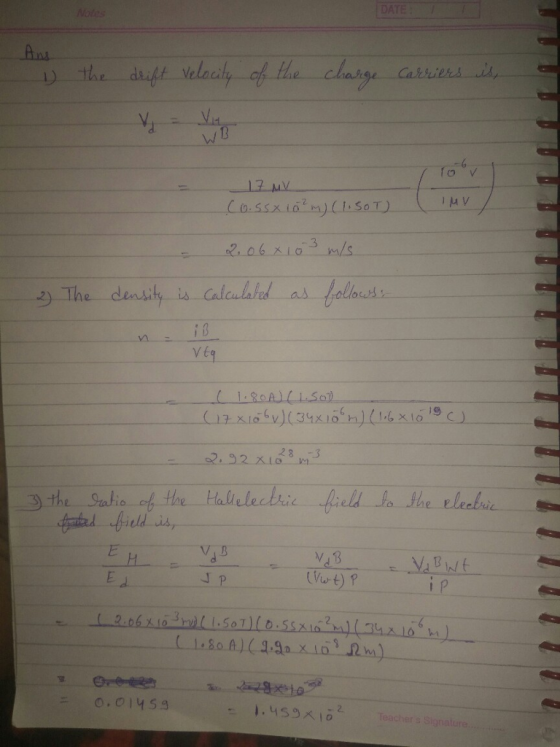
A thin metal film of length 2.20 cm, width of 0.550 cm, and thickness of 34.0...
A thin metal film of length 2.20 cm, width of 0.550 cm, and
thickness of 34.0 micrometers is used to measure the Hall effect. A
current of 1.80 A is maintained along the length of the sample. The
Hall voltage of 17.0 microVolts is detected across its width, when
a magnetic field of 1.50 Tesla is applied normal to the film.
1. Calculate the drift velocity of the charge carriers.
2. Assuming the charge carriers are electrons, calculate their
density.
3. By measuring the voltage drop along the sample, the resistivity
of the metal was found to be 2.20·10-8 Ω-m. Find the
ratio of the Hall electric field to the electric field responsible
for maintaining the electric current through the sample.
Homework Answers
Add Answer to:
A thin metal film of length 2.20 cm, width of 0.550 cm, and
thickness of 34.0...
A thin film of aluminum has length 1 cm, width 1 mm and thickness 1000 angstroms....
 A thin film of aluminum has length 1 cm, width 1 mm and thickness 1000 angstroms. A 50 mA current is flowing along the length of this film. What will be the Hall voltage developed across the width of this sample when a magnetic field of 1 tesla is applied perpendicular to the plane of the film? The carrier concentration in aluminum is 2 x 10"/cm'. Please give your answer in SI units.
A metal strip 2.50 cm wide and 1.80 cm thick carries a current of 25.9 A...
A metal strip 2.50 cm wide and 1.80 cm thick carries a current of 25.9 A in a region containing a perpendicular uniform magnetic field of strength 1.65 T. The Hall voltage across the 2.50 cm width of the strip is measured to be 4.36 μV. Calculate the drift speed of the electrons in the strip. Find the number density of the charge carriers in the strip (in m-3).
A Hall sample is made of p-type silicon doped with 1019 borons/cm². Its resistivity is 0.009...
 A Hall sample is made of p-type silicon doped with 1019 borons/cm². Its resistivity is 0.009 ohm-cm. The sample has a cross section of 0.2mmx2mm and a length of 50mm. A voltage of 10V is applied in the longitudinal (length) direction. The effective mass of holes is 2 of electron rest mass. Temperature is 300K. Calculate: a. The Hall coefficient, b. Hole mobility, c. Longitudinal electrical field, d. Drift velocity, e. Mean free time, f. The Hall voltage across 2mm...
11. An aluminum wire with a square cross-section 2 mm on a side is carrying a current of 1.5 amps. Aluminum has a resistivity of 2.69 x 10* ohm-cm and an atormic volume of 10 cc/mol. Assuming alum...
 11. An aluminum wire with a square cross-section 2 mm on a side is carrying a current of 1.5 amps. Aluminum has a resistivity of 2.69 x 10* ohm-cm and an atormic volume of 10 cc/mol. Assuming aluminum has three free electrons per atom, calculate the (a) Hall coeffcient, (b) electron mobility, (c) drift velocity, d) collision time. (e) electric field, (f) power dissipated (heat generated) per cm length, and (g) the Hall voltage across the wire in a transverse...
In a Hall-effect experiment, a current of 2.2 A sent lengthwise through a conductor 1.1 cm...
In a Hall-effect experiment, a current of 2.2 A sent lengthwise through a conductor 1.1 cm wide, 4.4cm long, and 8μm thick produces a transverse (across the width) Hall voltage of 9.4 μV when a magnetic field of 1.7 T is passed perpendicularly through the thickness of the conductor. From these data, find the drift velocity of the charge carriers. Tries 0/20 Find the number density of charge carriers. ( m-3) Tries 0/20
A current I = 19.0 A flows through a strip of metal of width 3.5 cm...
A current I = 19.0 A flows through a strip of metal of width 3.5 cm (the figure below). An electromagnet is switched on so that there is a uniform magnetic field of magnitude 0.49 T directed into the page, and the Hall voltage is measured to be 6.3
2. (20 points) A copper wire with a square cross-section (side length 5 of 3.00 A. The two wires are parallel over a region of 20.0 cm, where they are 1.60 cm apa produces a magnetic field on the...
 2. (20 points) A copper wire with a square cross-section (side length 5 of 3.00 A. The two wires are parallel over a region of 20.0 cm, where they are 1.60 cm apa produces a magnetic field on the copper wire. The copper wire is conn current directed rightward. Data of copper: resistivity = 1.68 x 10⁻⁸ Ωm; free electron number density-8.50 x 1028/㎡ a. What is the magnetic field the iron wire exert on the copper wire? (For this...
Chapter 23, Problem 037 A square metal plate of edge length 7.1 cm and negligible thickness...
 Chapter 23, Problem 037 A square metal plate of edge length 7.1 cm and negligible thickness has a total charge of 7.9 x 10⁶ C. (a) Estimate the magnitude E of the electric field just off the center of the plate (at, say, a distance of 0.62 mm from the center) by assuming that the charge is spread uniformly over the two faces of the plate. (b) Estimate E at a distance of 41 m (large relative to the plate...
18] #. Match the name below with the device at the right that it represents. I....
 18] #. Match the name below with the device at the right that it represents. I. Et Il Resistance. ideal emf (8) device. Capacitance Real battery IV. [12] #2. Circle all the TRUE statements below. a) The Loop Rule is simply a statement of Conservation of Energy in an electrical circuit. b) The Junction Rule is simply a statement of Conservation of Electric Charge in an electrical circuit. e) When measuring the electric potential difference across a component in an...
 A thin film of aluminum has length 1 cm, width 1 mm and thickness 1000 angstroms. A 50 mA current is flowing along the length of this film. What will be the Hall voltage developed across the width of this sample when a magnetic field of 1 tesla is applied perpendicular to the plane of the film? The carrier concentration in aluminum is 2 x 10"/cm'. Please give your answer in SI units.
 A Hall sample is made of p-type silicon doped with 1019 borons/cm². Its resistivity is 0.009 ohm-cm. The sample has a cross section of 0.2mmx2mm and a length of 50mm. A voltage of 10V is applied in the longitudinal (length) direction. The effective mass of holes is 2 of electron rest mass. Temperature is 300K. Calculate: a. The Hall coefficient, b. Hole mobility, c. Longitudinal electrical field, d. Drift velocity, e. Mean free time, f. The Hall voltage across 2mm...
 11. An aluminum wire with a square cross-section 2 mm on a side is carrying a current of 1.5 amps. Aluminum has a resistivity of 2.69 x 10* ohm-cm and an atormic volume of 10 cc/mol. Assuming aluminum has three free electrons per atom, calculate the (a) Hall coeffcient, (b) electron mobility, (c) drift velocity, d) collision time. (e) electric field, (f) power dissipated (heat generated) per cm length, and (g) the Hall voltage across the wire in a transverse...
 2. (20 points) A copper wire with a square cross-section (side length 5 of 3.00 A. The two wires are parallel over a region of 20.0 cm, where they are 1.60 cm apa produces a magnetic field on the copper wire. The copper wire is conn current directed rightward. Data of copper: resistivity = 1.68 x 10⁻⁸ Ωm; free electron number density-8.50 x 1028/㎡ a. What is the magnetic field the iron wire exert on the copper wire? (For this...
 Chapter 23, Problem 037 A square metal plate of edge length 7.1 cm and negligible thickness has a total charge of 7.9 x 10⁶ C. (a) Estimate the magnitude E of the electric field just off the center of the plate (at, say, a distance of 0.62 mm from the center) by assuming that the charge is spread uniformly over the two faces of the plate. (b) Estimate E at a distance of 41 m (large relative to the plate...
 18] #. Match the name below with the device at the right that it represents. I. Et Il Resistance. ideal emf (8) device. Capacitance Real battery IV. [12] #2. Circle all the TRUE statements below. a) The Loop Rule is simply a statement of Conservation of Energy in an electrical circuit. b) The Junction Rule is simply a statement of Conservation of Electric Charge in an electrical circuit. e) When measuring the electric potential difference across a component in an...
Most questions answered within 3 hours.
-
Where is the error in this code sequence?
String s1 = "Hello";
String s2 = "ello";...
asked 11 months ago -
Financial data for Joel de Paris, Inc., for last year
follow:
Joel de Paris, Inc.
Balance...
asked 11 months ago -
Consider this reaction:
Al2(SO4)3 (aq)+ BaCl3
(aq) Al2Cl6 (aq)- +
3BaSO4(s) . What is the...
asked 11 months ago -
Suppose that Savneet is considering increasing her
recent random sample from 20 car rentals to 40...
asked 11 months ago -
Trucks arrive at an unloading terminal at an average rate of 120
per hour.
Trucks arrive...
asked 11 months ago -
Why are methanol and ethanol completely soluble in water while
octanol is not very little soluble....
asked 11 months ago -
A facilities manager at a university reads in a research report
that the mean amount of...
asked 11 months ago -
When the CuSO4 is rehydrated by adding water to the anhydrous
compound, is this an endothermic...
asked 11 months ago -
A ray of sunlight is passing from diamond into crown glass; the
angle of incidence is...
asked 11 months ago -
A block of mass 0.249 kg is placed on top of a light, vertical
spring of...
asked 11 months ago -
how do the kidneys compensate in the presences of acidosis
a) trigger hyperventilate
b) reserve acid...
asked 11 months ago -
Question 501 pts
The rental rate of capital to the firm increases. Which of the
following...
asked 11 months ago