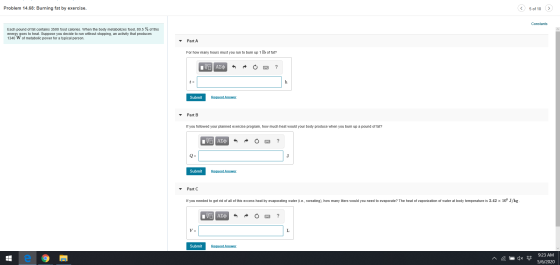
Each pound of fat contains 3500 food calories. When the body metabolizes food, 80.5% of this energy goes to heat. Suppose you decide to run without stopping, an activity that produces 1340 W of metabolic power for a typical person.
Part A) For how many hours must you run to burn up 1 lb of fat?
Part B) If you followed your planned exercise program, how much heat would your body produce when you burn up a pound of fat?
Part C) If you needed to get rid of all of this excess heat by evaporating water (i.e., sweating), how many liters would you need to evaporate? The heat of vaporization of water at body temperature is 2.42×10^6 J/kg
Homework Answers
Energy produced by a pound of food= 3500 KCal=3500*4.186*103J=14651000J
Time required to consume this energy=14651000 /1340 s=10934 s=3.04 hours.
b) Heat produced=0.805*14651000J=1.179*107J
c) mass of water evaporated= heat produced/latent heat of evaporation of water=1.179*107J/2.42*106 J/kg
=4.87 kg
Add Answer to:
Each pound of fat contains 3500 food calories. When the body
metabolizes food, 80.5% of this...
There are approximately 3500 kcalories in one pound of body fat. In general, if a person...
There are approximately 3500 kcalories in one pound of body fat. In general, if a person increased physical activity and decreased food intake for a total energy deficit of 500 kcal per day, how many days would it take to lose one pound of body fat? Must show your calculations to receive points, this is to show you know how to calculate this on your own.
1.A pound of body fat stores an amount of chemical energy equivalent to 3,500 Cal. When...
1.A pound of body fat stores an amount of chemical energy equivalent to 3,500 Cal. When sleeping, the average adult burns or expends about 0.40 Cal/h for every pound of body weight. How long would the person have to sleep continuously to lose 1 lb of body fat? (Assume the person weighs 145 lb.) h 2.On a brisk walk, a person burns about 365 Cal/h. At this rate, how many hours of brisk walking would it take to lose 1...
12. A man is lost in the woods and finds water and shelter but no food. He weighs 175 pounds and has 12% body fat....
 12. A man is lost in the woods and finds water and shelter but no food. He weighs 175 pounds and has 12% body fat. If he burns 2000 Calories of body fat each day, how long can he survive? Given: one pound of body fat = 4500 Calories in 1 290 = 700.
I Review Constants Part A An average sleeping person metabolizes at a rate of about 80.0...
 I Review Constants Part A An average sleeping person metabolizes at a rate of about 80.0 energy goes into bodily tunctions, such as cell repair, pumping W by digesting food or burning fat. Typically, 20.0 % of this blood, and other uses of mechanical energy, while the rest goes to heat. Most people get rid of all of this excess heat by transferring it (by conduction and the flow of blood) to the surface of the body, where it is...
How many kilocalories of heat does an expenditure of 703 kJ produce? _____ kcal A pound...
How many kilocalories of heat does an expenditure of 703 kJ produce? _____ kcal A pound of body fat stores an amount of chemical energy equivalent to 3500 Cal. When sleeping, the average adult burns or expends about 0.45 Cal/h for every pound of body weight. How many Calories would a 151 lb person burn during 7 hours of sleep? (Note that 1 Cal = 1 kcal.)______Cal How much heat in kcal must be added to 0.41 kg of water...
38. BIO The rate at which a resting person converts food energy is called one's basal...
 38. BIO The rate at which a resting person converts food energy is called one's basal metabolic rate (BMR). Assume that the resulting internal energy leaves a person's body by radiation and convection of dry air. When you jog, most of the food energy you burn above your BMR becomes internal energy that would raise your body temperature if it were not eliminated. Assume that evaporation of perspiration is the mechanism for eliminating this energy. Suppose a person is jogging...
When you jog, most of the food energy you burn above your basal metabolic rate (BMR)...
When you jog, most of the food energy you burn above your basal metabolic rate (BMR) ends up as internal energy that would raise your body temperature if it were not eliminated. The evaporation of perspiration is the primary mechanism for eliminating this energy. Determine the amount of water you lose to evaporation when running for 46 minutes at a rate that uses 400 kcal/h above your BMR. (That amount is often considered to be the "maximum fat-burning" energy output....
Thank you so much! Part A You have probably seen people jogging in extremely hot weather...
 Thank you so much!
Part A You have probably seen people jogging in extremely hot weather and wondered Why" As we shall see, there are good reasons nat to do thisl When jogging strenuously, an average runner of mass 69.0 kg ?nd surface aea 1 84 m2 produces energy at a How much heat per second is produced just by the act ot jogging? rate of up to 1310 W 800 % of which is converted to heat The jogger...
Thank you so much!
Part A You have probably seen people jogging in extremely hot weather and wondered Why" As we shall see, there are good reasons nat to do thisl When jogging strenuously, an average runner of mass 69.0 kg ?nd surface aea 1 84 m2 produces energy at a How much heat per second is produced just by the act ot jogging? rate of up to 1310 W 800 % of which is converted to heat The jogger...
Please answer with providing pictures. State any assumptions made and make sure to include all units...
 Please answer with providing pictures. State any assumptions
made and make sure to include all units with the answers and
calculations! Thanks
You are studying for the first physics exam and forget to watch the time. The next morning you ignore your alarm clock until you realize you will not reach the bus unless you run as fast as you can to the bus station in 15min. Carrying your school books during the run results in a total energy use...
Please answer with providing pictures. State any assumptions
made and make sure to include all units with the answers and
calculations! Thanks
You are studying for the first physics exam and forget to watch the time. The next morning you ignore your alarm clock until you realize you will not reach the bus unless you run as fast as you can to the bus station in 15min. Carrying your school books during the run results in a total energy use...
Thermal question A 60-kg hiker plans to climb Mt Kosciuszko (2228 m) starting from Thredbo (1365m). Assume that she is 25% efficient at converting chemical energy from food into mechanical work,...
 Thermal question
A 60-kg hiker plans to climb Mt Kosciuszko (2228 m) starting from Thredbo (1365m). Assume that she is 25% efficient at converting chemical energy from food into mechanical work, and that essentially all the work goes into the vertical climb. (a) (3 marks) With reference to the data above, how many servings of Nutrigrain should she eat to provide enough energy for the climb? (b) (6 marks) Climbing a mountain warms you up, and makes you sweat one...
Thermal question
A 60-kg hiker plans to climb Mt Kosciuszko (2228 m) starting from Thredbo (1365m). Assume that she is 25% efficient at converting chemical energy from food into mechanical work, and that essentially all the work goes into the vertical climb. (a) (3 marks) With reference to the data above, how many servings of Nutrigrain should she eat to provide enough energy for the climb? (b) (6 marks) Climbing a mountain warms you up, and makes you sweat one...
 12. A man is lost in the woods and finds water and shelter but no food. He weighs 175 pounds and has 12% body fat. If he burns 2000 Calories of body fat each day, how long can he survive? Given: one pound of body fat = 4500 Calories in 1 290 = 700.
 I Review Constants Part A An average sleeping person metabolizes at a rate of about 80.0 energy goes into bodily tunctions, such as cell repair, pumping W by digesting food or burning fat. Typically, 20.0 % of this blood, and other uses of mechanical energy, while the rest goes to heat. Most people get rid of all of this excess heat by transferring it (by conduction and the flow of blood) to the surface of the body, where it is...
 38. BIO The rate at which a resting person converts food energy is called one's basal metabolic rate (BMR). Assume that the resulting internal energy leaves a person's body by radiation and convection of dry air. When you jog, most of the food energy you burn above your BMR becomes internal energy that would raise your body temperature if it were not eliminated. Assume that evaporation of perspiration is the mechanism for eliminating this energy. Suppose a person is jogging...
 Thank you so much!
Part A You have probably seen people jogging in extremely hot weather and wondered Why" As we shall see, there are good reasons nat to do thisl When jogging strenuously, an average runner of mass 69.0 kg ?nd surface aea 1 84 m2 produces energy at a How much heat per second is produced just by the act ot jogging? rate of up to 1310 W 800 % of which is converted to heat The jogger...
Thank you so much!
Part A You have probably seen people jogging in extremely hot weather and wondered Why" As we shall see, there are good reasons nat to do thisl When jogging strenuously, an average runner of mass 69.0 kg ?nd surface aea 1 84 m2 produces energy at a How much heat per second is produced just by the act ot jogging? rate of up to 1310 W 800 % of which is converted to heat The jogger...
 Please answer with providing pictures. State any assumptions
made and make sure to include all units with the answers and
calculations! Thanks
You are studying for the first physics exam and forget to watch the time. The next morning you ignore your alarm clock until you realize you will not reach the bus unless you run as fast as you can to the bus station in 15min. Carrying your school books during the run results in a total energy use...
Please answer with providing pictures. State any assumptions
made and make sure to include all units with the answers and
calculations! Thanks
You are studying for the first physics exam and forget to watch the time. The next morning you ignore your alarm clock until you realize you will not reach the bus unless you run as fast as you can to the bus station in 15min. Carrying your school books during the run results in a total energy use...
 Thermal question
A 60-kg hiker plans to climb Mt Kosciuszko (2228 m) starting from Thredbo (1365m). Assume that she is 25% efficient at converting chemical energy from food into mechanical work, and that essentially all the work goes into the vertical climb. (a) (3 marks) With reference to the data above, how many servings of Nutrigrain should she eat to provide enough energy for the climb? (b) (6 marks) Climbing a mountain warms you up, and makes you sweat one...
Thermal question
A 60-kg hiker plans to climb Mt Kosciuszko (2228 m) starting from Thredbo (1365m). Assume that she is 25% efficient at converting chemical energy from food into mechanical work, and that essentially all the work goes into the vertical climb. (a) (3 marks) With reference to the data above, how many servings of Nutrigrain should she eat to provide enough energy for the climb? (b) (6 marks) Climbing a mountain warms you up, and makes you sweat one...
Most questions answered within 3 hours.
-
Where is the error in this code sequence?
String s1 = "Hello";
String s2 = "ello";...
asked 11 months ago -
Financial data for Joel de Paris, Inc., for last year
follow:
Joel de Paris, Inc.
Balance...
asked 11 months ago -
Consider this reaction:
Al2(SO4)3 (aq)+ BaCl3
(aq) Al2Cl6 (aq)- +
3BaSO4(s) . What is the...
asked 11 months ago -
Suppose that Savneet is considering increasing her
recent random sample from 20 car rentals to 40...
asked 11 months ago -
Trucks arrive at an unloading terminal at an average rate of 120
per hour.
Trucks arrive...
asked 11 months ago -
Why are methanol and ethanol completely soluble in water while
octanol is not very little soluble....
asked 11 months ago -
A facilities manager at a university reads in a research report
that the mean amount of...
asked 11 months ago -
When the CuSO4 is rehydrated by adding water to the anhydrous
compound, is this an endothermic...
asked 11 months ago -
A ray of sunlight is passing from diamond into crown glass; the
angle of incidence is...
asked 11 months ago -
A block of mass 0.249 kg is placed on top of a light, vertical
spring of...
asked 11 months ago -
how do the kidneys compensate in the presences of acidosis
a) trigger hyperventilate
b) reserve acid...
asked 11 months ago -
Question 501 pts
The rental rate of capital to the firm increases. Which of the
following...
asked 11 months ago