
Homework Answers
Add Answer to:
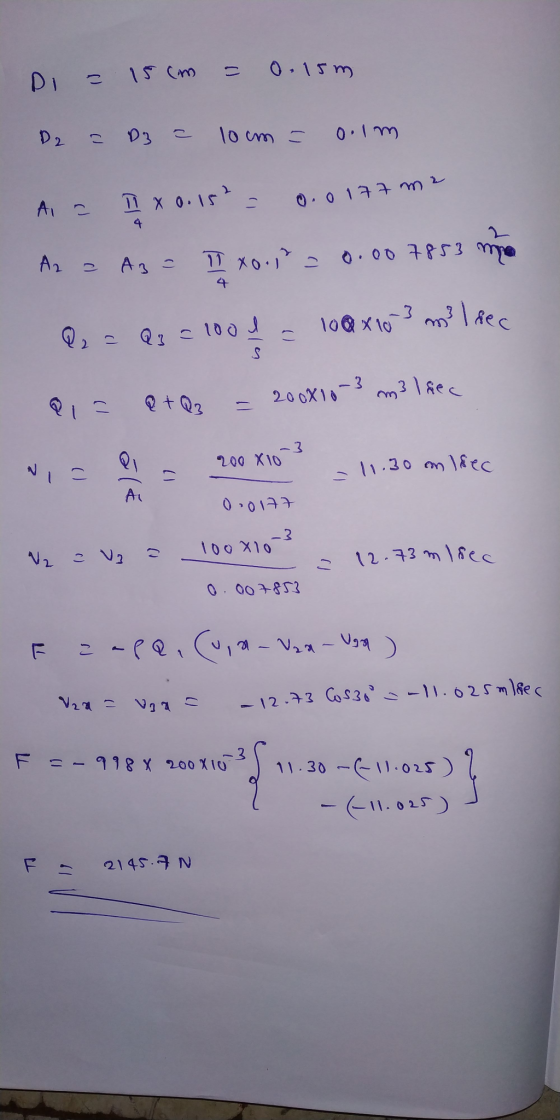
Problem 5: The water flow through a horizontal pipe is split into two flows as shown...
Water flow in a pipe and then exit through a bended nozzle as shown in Figure...
 Water flow in a pipe and then exit through a bended nozzle as shown in Figure 3. The nozzle is connected to the main pipe using a flanged joint at (1). The diameter of the pipe is D1 10 cm and is constant, whilst the diameter at the outlet section of the nozzle (2) is D2 3 em. The flowrate of the water is Q = 15 liter/s and the water pressure at the flange is Pi 230 kPa. By...
Water flows in the horizontal pipe shown in the figure. At point A the area is...
 Water flows in the horizontal pipe shown in the figure.
At point A the area is 26.0 cm2 and the
speed of the water is 2.20 m/s. At B the area is 15.0
cm2. The fluid in the manometer is mercury, which has a
density of 13,600 kg/m3. We can treat water as an ideal
fluid having a density of 1000 kg/m3. What is the
manometer reading h?
Question 10 (1 point) Water flows in the horizontal pipe shown in...
Water flows in the horizontal pipe shown in the figure.
At point A the area is 26.0 cm2 and the
speed of the water is 2.20 m/s. At B the area is 15.0
cm2. The fluid in the manometer is mercury, which has a
density of 13,600 kg/m3. We can treat water as an ideal
fluid having a density of 1000 kg/m3. What is the
manometer reading h?
Question 10 (1 point) Water flows in the horizontal pipe shown in...
02. (25 POINTS) Kerosene (p- 800 kg/m3) flows through the system in the figure below. The outflow is to the atmosphere. The pipe is horizontal. The fluid in the manometer is mercury. Neglect fric...
 02. (25 POINTS) Kerosene (p- 800 kg/m3) flows through the system in the figure below. The outflow is to the atmosphere. The pipe is horizontal. The fluid in the manometer is mercury. Neglect friction, Calculate (i) discharge O,(ii) velocity Vs (iii) Zs and (iv) ha Ds D4 10 cm D2 7 cm 20.0 m 4 10 cm 5 cm 10 cm Horizontal Pipe 3 5 2 Atmos る- D. D-D. Datum
02. (25 POINTS) Kerosene (p- 800 kg/m3) flows through...
02. (25 POINTS) Kerosene (p- 800 kg/m3) flows through the system in the figure below. The outflow is to the atmosphere. The pipe is horizontal. The fluid in the manometer is mercury. Neglect friction, Calculate (i) discharge O,(ii) velocity Vs (iii) Zs and (iv) ha Ds D4 10 cm D2 7 cm 20.0 m 4 10 cm 5 cm 10 cm Horizontal Pipe 3 5 2 Atmos る- D. D-D. Datum
02. (25 POINTS) Kerosene (p- 800 kg/m3) flows through...
Water at 60 °F flows through the elbow as shown below and is then injected to...
 Water at 60 °F flows through the elbow as shown below and is then injected to the atmosphere through a nozzle (on a horizontal plane). The pipe diameter is Di = 4 in. while the diameter of the exit of the nozzle is D2 = 1 in. At a flow rate of Q = 245 gpm, the gage pressure at the section (1) where the flange locates is Pi = 34 psig. Neglect the weight of the water and elbow,...
4. Water flows through the pipe as shown with Bolts 80 mm the coefficient of friction...
 4. Water flows through the pipe as shown with Bolts 80 mm the coefficient of friction between the wheels and the surface is μ = 0.3 . If the weight of the 20m horizontal pipe (roughness = 0.15 mm) is 200N with a diameter of 80mm (Neglect Minor Losses): 3.0 m Galvanized iron What is the velocity in the horizontal pipe and friction factor? 1. What is the fluid pressure at the location of the Bolts? 2. 3. Draw a...
Water flows through a pipe reducer as shown in the figure. If the manometer reading h - 2 m. Find...
 Water flows through a pipe reducer as shown in the figure. If the manometer reading h - 2 m. Find the flow rate in Liters per second. Assume DI-15 cm, D2-10 cm. SG:-0.80 a. What is the effect of the angle θ b. Is this a practical arrangement, if yes why, if not how would you improve it? c. Ca n mercury be used as a manometer fluid in this arrangement? Why, or why not? SG D2 Water Di
Water...
Water flows through a pipe reducer as shown in the figure. If the manometer reading h - 2 m. Find the flow rate in Liters per second. Assume DI-15 cm, D2-10 cm. SG:-0.80 a. What is the effect of the angle θ b. Is this a practical arrangement, if yes why, if not how would you improve it? c. Ca n mercury be used as a manometer fluid in this arrangement? Why, or why not? SG D2 Water Di
Water...
Question 10 (1 point) Water flows in the horizontal pipe shown in the figure. In Α....
 Question 10 (1 point) Water flows in the horizontal pipe shown in the figure. In Α. B At point A the area is 26.0 cm and the speed of the water is 2.20 m/s. At B the area is 15.0 cm . The fluid in the manometer is mercury, which has a density of 13,600 kg/m? We can treat water as an ideal fluid having a density of 1000 kg/m? What is the manometer reading h? 0.911 cm 4.32 cm...
Water flows through a horizontal pipe and then out into the atmosphere at a speed V2...
 Water flows through a horizontal pipe and then out into the atmosphere at a speed V2 = 40 m/s. The diameters of the left and right sections of the pipe are 10.0 cm and 4.0 cm, respectively. Treat water as an incompressible fluid. What is the speed v, in the left section of the pipe? 6.40 ms 0 16.0 m/s 1.02 m/s 100 ms
Water flows at a rate of 22 L/min through a horizontal 7.0-cm-diameter pipe under a pressure...
Water flows at a rate of 22 L/min through a horizontal 7.0-cm-diameter pipe under a pressure of 17.0 Pa . At one point, calcium deposits reduce the cross-sectional area of the pipe to 21 cm2 . What is the pressure at this point? (Consider the water to be an ideal fluid.) Express your answer using two significant figures.
Water flows at a rate of 21 L/min through a horizontal 8.0-cm-diameter pipe under a pressure...
Water flows at a rate of 21 L/min through a horizontal 8.0-cm-diameter pipe under a pressure of 3.8 Pa . At one point, calcium deposits reduce the cross-sectional area of the pipe to 39 cm2 . What is the pressure at this point? (Consider the water to be an ideal fluid.) Express your answer using two significant figures. p= Pa
 Water flow in a pipe and then exit through a bended nozzle as shown in Figure 3. The nozzle is connected to the main pipe using a flanged joint at (1). The diameter of the pipe is D1 10 cm and is constant, whilst the diameter at the outlet section of the nozzle (2) is D2 3 em. The flowrate of the water is Q = 15 liter/s and the water pressure at the flange is Pi 230 kPa. By...
 Water flows in the horizontal pipe shown in the figure.
At point A the area is 26.0 cm2 and the
speed of the water is 2.20 m/s. At B the area is 15.0
cm2. The fluid in the manometer is mercury, which has a
density of 13,600 kg/m3. We can treat water as an ideal
fluid having a density of 1000 kg/m3. What is the
manometer reading h?
Question 10 (1 point) Water flows in the horizontal pipe shown in...
Water flows in the horizontal pipe shown in the figure.
At point A the area is 26.0 cm2 and the
speed of the water is 2.20 m/s. At B the area is 15.0
cm2. The fluid in the manometer is mercury, which has a
density of 13,600 kg/m3. We can treat water as an ideal
fluid having a density of 1000 kg/m3. What is the
manometer reading h?
Question 10 (1 point) Water flows in the horizontal pipe shown in...
 02. (25 POINTS) Kerosene (p- 800 kg/m3) flows through the system in the figure below. The outflow is to the atmosphere. The pipe is horizontal. The fluid in the manometer is mercury. Neglect friction, Calculate (i) discharge O,(ii) velocity Vs (iii) Zs and (iv) ha Ds D4 10 cm D2 7 cm 20.0 m 4 10 cm 5 cm 10 cm Horizontal Pipe 3 5 2 Atmos る- D. D-D. Datum
02. (25 POINTS) Kerosene (p- 800 kg/m3) flows through...
02. (25 POINTS) Kerosene (p- 800 kg/m3) flows through the system in the figure below. The outflow is to the atmosphere. The pipe is horizontal. The fluid in the manometer is mercury. Neglect friction, Calculate (i) discharge O,(ii) velocity Vs (iii) Zs and (iv) ha Ds D4 10 cm D2 7 cm 20.0 m 4 10 cm 5 cm 10 cm Horizontal Pipe 3 5 2 Atmos る- D. D-D. Datum
02. (25 POINTS) Kerosene (p- 800 kg/m3) flows through...
 Water at 60 °F flows through the elbow as shown below and is then injected to the atmosphere through a nozzle (on a horizontal plane). The pipe diameter is Di = 4 in. while the diameter of the exit of the nozzle is D2 = 1 in. At a flow rate of Q = 245 gpm, the gage pressure at the section (1) where the flange locates is Pi = 34 psig. Neglect the weight of the water and elbow,...
 4. Water flows through the pipe as shown with Bolts 80 mm the coefficient of friction between the wheels and the surface is μ = 0.3 . If the weight of the 20m horizontal pipe (roughness = 0.15 mm) is 200N with a diameter of 80mm (Neglect Minor Losses): 3.0 m Galvanized iron What is the velocity in the horizontal pipe and friction factor? 1. What is the fluid pressure at the location of the Bolts? 2. 3. Draw a...
 Water flows through a pipe reducer as shown in the figure. If the manometer reading h - 2 m. Find the flow rate in Liters per second. Assume DI-15 cm, D2-10 cm. SG:-0.80 a. What is the effect of the angle θ b. Is this a practical arrangement, if yes why, if not how would you improve it? c. Ca n mercury be used as a manometer fluid in this arrangement? Why, or why not? SG D2 Water Di
Water...
Water flows through a pipe reducer as shown in the figure. If the manometer reading h - 2 m. Find the flow rate in Liters per second. Assume DI-15 cm, D2-10 cm. SG:-0.80 a. What is the effect of the angle θ b. Is this a practical arrangement, if yes why, if not how would you improve it? c. Ca n mercury be used as a manometer fluid in this arrangement? Why, or why not? SG D2 Water Di
Water...
 Question 10 (1 point) Water flows in the horizontal pipe shown in the figure. In Α. B At point A the area is 26.0 cm and the speed of the water is 2.20 m/s. At B the area is 15.0 cm . The fluid in the manometer is mercury, which has a density of 13,600 kg/m? We can treat water as an ideal fluid having a density of 1000 kg/m? What is the manometer reading h? 0.911 cm 4.32 cm...
 Water flows through a horizontal pipe and then out into the atmosphere at a speed V2 = 40 m/s. The diameters of the left and right sections of the pipe are 10.0 cm and 4.0 cm, respectively. Treat water as an incompressible fluid. What is the speed v, in the left section of the pipe? 6.40 ms 0 16.0 m/s 1.02 m/s 100 ms
Most questions answered within 3 hours.
-
Where is the error in this code sequence?
String s1 = "Hello";
String s2 = "ello";...
asked 11 months ago -
Financial data for Joel de Paris, Inc., for last year
follow:
Joel de Paris, Inc.
Balance...
asked 11 months ago -
Consider this reaction:
Al2(SO4)3 (aq)+ BaCl3
(aq) Al2Cl6 (aq)- +
3BaSO4(s) . What is the...
asked 11 months ago -
Suppose that Savneet is considering increasing her
recent random sample from 20 car rentals to 40...
asked 11 months ago -
Trucks arrive at an unloading terminal at an average rate of 120
per hour.
Trucks arrive...
asked 11 months ago -
Why are methanol and ethanol completely soluble in water while
octanol is not very little soluble....
asked 11 months ago -
A facilities manager at a university reads in a research report
that the mean amount of...
asked 11 months ago -
When the CuSO4 is rehydrated by adding water to the anhydrous
compound, is this an endothermic...
asked 11 months ago -
A ray of sunlight is passing from diamond into crown glass; the
angle of incidence is...
asked 11 months ago -
A block of mass 0.249 kg is placed on top of a light, vertical
spring of...
asked 11 months ago -
how do the kidneys compensate in the presences of acidosis
a) trigger hyperventilate
b) reserve acid...
asked 11 months ago -
Question 501 pts
The rental rate of capital to the firm increases. Which of the
following...
asked 11 months ago