
Homework Answers

Add Answer to:
A point charge of 5 uC is moved against a potential difference of + 20 V....
10. A charge q = -4.0 uC is moved 0.25 m horizontally to point P in...
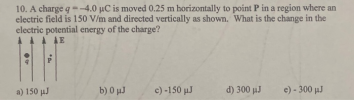 10. A charge q = -4.0 uC is moved 0.25 m horizontally to point P in a region where an electric field is 150 V/m and directed vertically as shown. What is the change in the electric potential energy of the charge? JE . a) 150 J b) O uJ c) -150 uJ d) 300 J e) - 300 uJ
1. A charge is moved from one point to another in an electric field. Explain briefly...
1. A charge is moved from one point to another in an electric field. Explain briefly the relationship between electric potential difference and work done in moving this charge? 2. what determines the direction of magnitude force acting on a moving charge? When is the magnitude of the magnetic force zero?
13. If a charge of 3.0 coulombs is transferred through a potential is: difference of 6.0...
 13. If a charge of 3.0 coulombs is transferred through a potential is: difference of 6.0 volts, the amount of work done zero. b. 0.50 c. 2.0 d. 18 J none of these One volt is equal to: a. one (N/C)(m) b. one (kg my (s C) c. one ev (1.6x 10- C) d. all of these e. e. -14. none of these 15. A charge is moved through the potential difference from A to B. In which case is...
The work done by an external force to move a particle of charge -2.20 uC at...
 The work done by an external force to move a particle of charge -2.20 uC at constant speed from point A to point B is 6.40x10⁻³J. (a) What is the difference between the electric potential energy of the charge at the two points? (b) What is the difference in the kinetic energy of the charge at the two points? (c) Determine the potential difference between the two points. (d) State which point is at the higher potential.
A 15 nC charge is moved from a point where V = 170 V to a...
A 15 nC charge is moved from a point where V = 170 V to a point where V = -30 V . How much work is done by the force that moves the charge?
a) b) A point charge Q is held fixed in place and another point charge q...
 a)
b)
A point charge Q is held fixed in place and another point charge q is brought closer to it moving at constant velocity. Which of the following statement(s) is (are) true? 1. I. The electrostatic potential energy of q increases as it is brought closer to Q if q and Q are of the same sign. 2. I. The work done by the electrostatic force is positive if q and Q are of the same sign. 3. III....
a)
b)
A point charge Q is held fixed in place and another point charge q is brought closer to it moving at constant velocity. Which of the following statement(s) is (are) true? 1. I. The electrostatic potential energy of q increases as it is brought closer to Q if q and Q are of the same sign. 2. I. The work done by the electrostatic force is positive if q and Q are of the same sign. 3. III....
capacitors are connected as shown to a potential difference of V=14.0 volts. CisC,-Cr=C,-C,-20 μ1: The charge...
 capacitors are connected as shown to a potential difference of V=14.0 volts. CisC,-Cr=C,-C,-20 μ1: The charge on C5 is A) 40 pC B) 60 HC C) 80 uC D) 120 HC E) 160 μC C1 C3 C2 29·Four identical 1 mF capacitors are connected together electrically what is the greatest possible capacitance of the combination? A) 8 mF B) 4 mF 30 Five capacitors are connected as shown. C2 40 μ F, C4# 10 μ1, Ci=C,sCF 20 μ F The...
2.) A +12 uC charge is located at the origin (x-o cm) and a-4 uC charge is located at x-S cm the ...
 2.) A +12 uC charge is located at the origin (x-o cm) and a-4 uC charge is located at x-S cm the voltage at the point A 10 cm) and the yoltage at the point B (x 3 cm), and then determine the work done BY the electric field in moving a -6 uC charge from A to B. Will you have to force this to happen or will
2.) A +12 uC charge is located at the origin (x-o...
2.) A +12 uC charge is located at the origin (x-o cm) and a-4 uC charge is located at x-S cm the voltage at the point A 10 cm) and the yoltage at the point B (x 3 cm), and then determine the work done BY the electric field in moving a -6 uC charge from A to B. Will you have to force this to happen or will
2.) A +12 uC charge is located at the origin (x-o...
Problem (5) A 1.35 uC charge is located 0.322 m to the left of a -3.78...
 Problem (5) A 1.35 uC charge is located 0.322 m to the left of a -3.78 C charge. The charges are locked in place. Point P, is the midpoint of the line joining the two charges. Point P2 is located 0.120 m to the right of the -3.78 uC charge. The black reference level probe of a voltmeter is touched to point P, while the red input probe is simultaneously touched to point P2. (a) What are the sign and...
Electric Potential Difference Homework Electric Potential Difference 1) Pages 85-87 in the homework tutorial do the...
 Electric Potential Difference
Homework Electric Potential Difference 1) Pages 85-87 in the homework tutorial do the problems 1 &2, skip problem 3 2) In the figure is an electric dipole, with-5 V applied to the negative conductor, shown on the left-side and + 5 V applied to the positive conductor, shown on the right-side. With the voltage applied between the conductors the resulting equipotential lines are mapped out a) Accurately draw the electric field lines between the two conductors 1.0...
Electric Potential Difference
Homework Electric Potential Difference 1) Pages 85-87 in the homework tutorial do the problems 1 &2, skip problem 3 2) In the figure is an electric dipole, with-5 V applied to the negative conductor, shown on the left-side and + 5 V applied to the positive conductor, shown on the right-side. With the voltage applied between the conductors the resulting equipotential lines are mapped out a) Accurately draw the electric field lines between the two conductors 1.0...
 10. A charge q = -4.0 uC is moved 0.25 m horizontally to point P in a region where an electric field is 150 V/m and directed vertically as shown. What is the change in the electric potential energy of the charge? JE . a) 150 J b) O uJ c) -150 uJ d) 300 J e) - 300 uJ
 13. If a charge of 3.0 coulombs is transferred through a potential is: difference of 6.0 volts, the amount of work done zero. b. 0.50 c. 2.0 d. 18 J none of these One volt is equal to: a. one (N/C)(m) b. one (kg my (s C) c. one ev (1.6x 10- C) d. all of these e. e. -14. none of these 15. A charge is moved through the potential difference from A to B. In which case is...
 The work done by an external force to move a particle of charge -2.20 uC at constant speed from point A to point B is 6.40x10⁻³J. (a) What is the difference between the electric potential energy of the charge at the two points? (b) What is the difference in the kinetic energy of the charge at the two points? (c) Determine the potential difference between the two points. (d) State which point is at the higher potential.
 a)
b)
A point charge Q is held fixed in place and another point charge q is brought closer to it moving at constant velocity. Which of the following statement(s) is (are) true? 1. I. The electrostatic potential energy of q increases as it is brought closer to Q if q and Q are of the same sign. 2. I. The work done by the electrostatic force is positive if q and Q are of the same sign. 3. III....
a)
b)
A point charge Q is held fixed in place and another point charge q is brought closer to it moving at constant velocity. Which of the following statement(s) is (are) true? 1. I. The electrostatic potential energy of q increases as it is brought closer to Q if q and Q are of the same sign. 2. I. The work done by the electrostatic force is positive if q and Q are of the same sign. 3. III....
 capacitors are connected as shown to a potential difference of V=14.0 volts. CisC,-Cr=C,-C,-20 μ1: The charge on C5 is A) 40 pC B) 60 HC C) 80 uC D) 120 HC E) 160 μC C1 C3 C2 29·Four identical 1 mF capacitors are connected together electrically what is the greatest possible capacitance of the combination? A) 8 mF B) 4 mF 30 Five capacitors are connected as shown. C2 40 μ F, C4# 10 μ1, Ci=C,sCF 20 μ F The...
 2.) A +12 uC charge is located at the origin (x-o cm) and a-4 uC charge is located at x-S cm the voltage at the point A 10 cm) and the yoltage at the point B (x 3 cm), and then determine the work done BY the electric field in moving a -6 uC charge from A to B. Will you have to force this to happen or will
2.) A +12 uC charge is located at the origin (x-o...
2.) A +12 uC charge is located at the origin (x-o cm) and a-4 uC charge is located at x-S cm the voltage at the point A 10 cm) and the yoltage at the point B (x 3 cm), and then determine the work done BY the electric field in moving a -6 uC charge from A to B. Will you have to force this to happen or will
2.) A +12 uC charge is located at the origin (x-o...
 Problem (5) A 1.35 uC charge is located 0.322 m to the left of a -3.78 C charge. The charges are locked in place. Point P, is the midpoint of the line joining the two charges. Point P2 is located 0.120 m to the right of the -3.78 uC charge. The black reference level probe of a voltmeter is touched to point P, while the red input probe is simultaneously touched to point P2. (a) What are the sign and...
 Electric Potential Difference
Homework Electric Potential Difference 1) Pages 85-87 in the homework tutorial do the problems 1 &2, skip problem 3 2) In the figure is an electric dipole, with-5 V applied to the negative conductor, shown on the left-side and + 5 V applied to the positive conductor, shown on the right-side. With the voltage applied between the conductors the resulting equipotential lines are mapped out a) Accurately draw the electric field lines between the two conductors 1.0...
Electric Potential Difference
Homework Electric Potential Difference 1) Pages 85-87 in the homework tutorial do the problems 1 &2, skip problem 3 2) In the figure is an electric dipole, with-5 V applied to the negative conductor, shown on the left-side and + 5 V applied to the positive conductor, shown on the right-side. With the voltage applied between the conductors the resulting equipotential lines are mapped out a) Accurately draw the electric field lines between the two conductors 1.0...
Most questions answered within 3 hours.
-
Where is the error in this code sequence?
String s1 = "Hello";
String s2 = "ello";...
asked 11 months ago -
Financial data for Joel de Paris, Inc., for last year
follow:
Joel de Paris, Inc.
Balance...
asked 11 months ago -
Consider this reaction:
Al2(SO4)3 (aq)+ BaCl3
(aq) Al2Cl6 (aq)- +
3BaSO4(s) . What is the...
asked 11 months ago -
Suppose that Savneet is considering increasing her
recent random sample from 20 car rentals to 40...
asked 11 months ago -
Trucks arrive at an unloading terminal at an average rate of 120
per hour.
Trucks arrive...
asked 11 months ago -
Why are methanol and ethanol completely soluble in water while
octanol is not very little soluble....
asked 11 months ago -
A facilities manager at a university reads in a research report
that the mean amount of...
asked 11 months ago -
When the CuSO4 is rehydrated by adding water to the anhydrous
compound, is this an endothermic...
asked 11 months ago -
A ray of sunlight is passing from diamond into crown glass; the
angle of incidence is...
asked 11 months ago -
A block of mass 0.249 kg is placed on top of a light, vertical
spring of...
asked 11 months ago -
how do the kidneys compensate in the presences of acidosis
a) trigger hyperventilate
b) reserve acid...
asked 11 months ago -
Question 501 pts
The rental rate of capital to the firm increases. Which of the
following...
asked 11 months ago