Construct pseudocolor images using these brain data t1,t2, flair in.nic.form if you know then only try...
Construct pseudocolor images
using these brain data
t1,t2, flair in.nic.form
if you know then only try or else leave for others
IMAGE PROCESSING,ELECTRICAL
Homework Answers
As the image is in .nii format we have to read it by using this
command.
[V info]=ReadData3D('Brats17_TCIA_103_1_flair.nii');
f=V(:,:,85);
f=imrotate(f,-90);
f_range=abs(max(max(f))-min(min(f)));
f_2=240*f/f_range;
%filtering it to remove noise
f=imgaussfilt(double(f),0.9);
[V1, info1]=ReadData3D('Brats17_TCIA_103_1_t1ce.nii');
t1=V1(:,:,85);
t1=imrotate(t1,-90);
t1_range=abs(max(max(t1))-min(min(t1)));
t1_2=240*t1/t1_range;
%t1=imgaussfilt(double(t1),0.9);
[V2, info2]=ReadData3D('Brats17_TCIA_103_1_flair.nii');
t2=V2(:,:,85);
t2=imrotate(t2,-90);
t2_range=abs(max(max(t2))-min(min(t2)));
t2_2=240*t2/t2_range;
% t2=imgaussfilt(double(t2),0.9);
%concatenated to form pseudo rgb
rgb1=cat(3,t2_2,f_2,t1_2);
r=rgb1(:,:,1);
g=rgb1(:,:,2);
b1=rgb1(:,:,3);
Add Answer to:
Construct pseudocolor images
using these brain data
t1,t2, flair in.nic.form
if you know then only try...
answer only if you know otherwise leave for others Fill the table. propulsion rel rused Compressive...
 answer only if you know otherwise leave for others
Fill the table. propulsion rel rused Compressive device components device Type of engine LP îurbojet pamjet Rocket
answer only if you know otherwise leave for others
Fill the table. propulsion rel rused Compressive device components device Type of engine LP îurbojet pamjet Rocket
it is possible to construct a telescope using only mirrors
 It is possible to construct a telescope using only mirrors, not lenses. Such a "Cassegrain" telescope is shown here. Analysis of such compound devices proceeds simply by doing one step (i.e. finding the first image) and then the next (use the image as the object for the next mirror). The large parabolic primary mirror has a focal lengh of 50.0 cm. The hyperbolic secondary is mounted 43.0 cm in front of the large mirror. The image is formed 3.00 cm behind the large mirror (where...
using python = 1. (12 points) Suppose that you are writing a class called Temperature that...
 using python
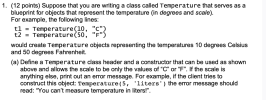
= 1. (12 points) Suppose that you are writing a class called Temperature that serves as a blueprint for objects that represent the temperature (in degrees and scale). For example, the following lines: t1 Temperature(10, "C") t2 Temperature(50, "F") would create Temperature objects representing the temperatures 10 degrees Celsius and 50 degrees Fahrenheit. (a) Define a Temperature class header and a constructor that can be used as shown above and allows the scale to be only the values...
using python
= 1. (12 points) Suppose that you are writing a class called Temperature that serves as a blueprint for objects that represent the temperature (in degrees and scale). For example, the following lines: t1 Temperature(10, "C") t2 Temperature(50, "F") would create Temperature objects representing the temperatures 10 degrees Celsius and 50 degrees Fahrenheit. (a) Define a Temperature class header and a constructor that can be used as shown above and allows the scale to be only the values...
Implement the PLA algorithm using Python (Only language I know). Generate linearly separable data using at...
Implement the PLA algorithm using Python (Only language I know). Generate linearly separable data using at least 20 points with two features, it is not required that the points be evenly divided between the positive and negative class. Run and test your code. Please show working code with explanations to help me understand how to implement my own. P.S. You guys are awesome Regarding Comment: "No information providing regarding dataset, features" It is a data set of nothing in particular,...
the picture above is the one you are supposed to use for the MATlab code please...
 the picture above is the one you are supposed to use for the
MATlab code please help
Problems. Grayscale images are composed of a 2D matrix of light intensities from O (Black) to 255 (White). In this lab you will be using grayscale images and do 2D-array operations along with loops and iflelse branches. 1. We can regard 2D grayscale images as 2D arrays. Now load the provided image of scientists at the Solvay Conference in 1927 using the imread)...
the picture above is the one you are supposed to use for the
MATlab code please help
Problems. Grayscale images are composed of a 2D matrix of light intensities from O (Black) to 255 (White). In this lab you will be using grayscale images and do 2D-array operations along with loops and iflelse branches. 1. We can regard 2D grayscale images as 2D arrays. Now load the provided image of scientists at the Solvay Conference in 1927 using the imread)...
3. You are teaching a lab section of a class in which you need to teach the students laboratory methods including collecting data on horse parasites. You know that the weights of these parasites are...
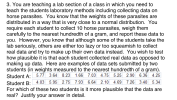 3. You are teaching a lab section of a class in which you need to teach the students laboratory methods including collecting data on horse parasites. You know that the weights of these parasites are distributed in a way that is very close to a normal distribution. You require each student to collect 10 horse parasites, weigh them carefully to the nearest hundredth of a gram, and report these data to you. However, you know that although some of the...
There is only one part to this lab. You will create a Gantt Chart using a...
There is only one part to this lab. You will create a Gantt Chart using a free online Gantt tool such as Gantt Project. When done, take a screen shot of your solution. Then create a word processing document with your name, date, course and unit lab info at the time. Paste your screen shot image into the document. Then turn in a PDF version of the document via the Unit Drop Box
•Using the data from Table 4: Reaction Rate Constants, you can now calculate the activation energy...
 •Using the data from Table 4: Reaction Rate Constants, you can
now calculate the activation energy for the reaction.
•Calculate the activation energy using the equation
below.
•You will calculate the activation energy 3 times by using the
data from:
•Reactions 1+5
•Reactions 1+6
•Reactions 5 + 6
•You will calculate the average activation energy for the
reaction.
k1 Ea 1 1 In ( ) T Where: ki = rate constant at T1 kzi = rate constant at T2 T1...
•Using the data from Table 4: Reaction Rate Constants, you can
now calculate the activation energy for the reaction.
•Calculate the activation energy using the equation
below.
•You will calculate the activation energy 3 times by using the
data from:
•Reactions 1+5
•Reactions 1+6
•Reactions 5 + 6
•You will calculate the average activation energy for the
reaction.
k1 Ea 1 1 In ( ) T Where: ki = rate constant at T1 kzi = rate constant at T2 T1...
Construct an UNGROUPED frequency distribution using the following data (if you have done an UNGROUPED one...
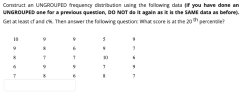 Construct an UNGROUPED frequency distribution using the following data (if you have done an UNGROUPED one for a previous question, DO NOT do it again as it is the SAME data as before). Get at least cf and c%. Then answer the following question: What score is at the 20 th percentile?
what things would you need to know to predict someone's success in a class as measure...
what things would you need to know to predict someone's success in a class as measure by scoring an A/B/C? What data would you need? How would you get the data? Are there things that can be done if you identify something to help correct? How can you 'catch' or 'identify' students who will fail quicker? What things can you do to help these students? Have fun with this exercise but most importantly try to approach it from an Economics...
 answer only if you know otherwise leave for others
Fill the table. propulsion rel rused Compressive device components device Type of engine LP îurbojet pamjet Rocket
answer only if you know otherwise leave for others
Fill the table. propulsion rel rused Compressive device components device Type of engine LP îurbojet pamjet Rocket
 using python
= 1. (12 points) Suppose that you are writing a class called Temperature that serves as a blueprint for objects that represent the temperature (in degrees and scale). For example, the following lines: t1 Temperature(10, "C") t2 Temperature(50, "F") would create Temperature objects representing the temperatures 10 degrees Celsius and 50 degrees Fahrenheit. (a) Define a Temperature class header and a constructor that can be used as shown above and allows the scale to be only the values...
using python
= 1. (12 points) Suppose that you are writing a class called Temperature that serves as a blueprint for objects that represent the temperature (in degrees and scale). For example, the following lines: t1 Temperature(10, "C") t2 Temperature(50, "F") would create Temperature objects representing the temperatures 10 degrees Celsius and 50 degrees Fahrenheit. (a) Define a Temperature class header and a constructor that can be used as shown above and allows the scale to be only the values...
 the picture above is the one you are supposed to use for the
MATlab code please help
Problems. Grayscale images are composed of a 2D matrix of light intensities from O (Black) to 255 (White). In this lab you will be using grayscale images and do 2D-array operations along with loops and iflelse branches. 1. We can regard 2D grayscale images as 2D arrays. Now load the provided image of scientists at the Solvay Conference in 1927 using the imread)...
the picture above is the one you are supposed to use for the
MATlab code please help
Problems. Grayscale images are composed of a 2D matrix of light intensities from O (Black) to 255 (White). In this lab you will be using grayscale images and do 2D-array operations along with loops and iflelse branches. 1. We can regard 2D grayscale images as 2D arrays. Now load the provided image of scientists at the Solvay Conference in 1927 using the imread)...
 3. You are teaching a lab section of a class in which you need to teach the students laboratory methods including collecting data on horse parasites. You know that the weights of these parasites are distributed in a way that is very close to a normal distribution. You require each student to collect 10 horse parasites, weigh them carefully to the nearest hundredth of a gram, and report these data to you. However, you know that although some of the...
 •Using the data from Table 4: Reaction Rate Constants, you can
now calculate the activation energy for the reaction.
•Calculate the activation energy using the equation
below.
•You will calculate the activation energy 3 times by using the
data from:
•Reactions 1+5
•Reactions 1+6
•Reactions 5 + 6
•You will calculate the average activation energy for the
reaction.
k1 Ea 1 1 In ( ) T Where: ki = rate constant at T1 kzi = rate constant at T2 T1...
•Using the data from Table 4: Reaction Rate Constants, you can
now calculate the activation energy for the reaction.
•Calculate the activation energy using the equation
below.
•You will calculate the activation energy 3 times by using the
data from:
•Reactions 1+5
•Reactions 1+6
•Reactions 5 + 6
•You will calculate the average activation energy for the
reaction.
k1 Ea 1 1 In ( ) T Where: ki = rate constant at T1 kzi = rate constant at T2 T1...
 Construct an UNGROUPED frequency distribution using the following data (if you have done an UNGROUPED one for a previous question, DO NOT do it again as it is the SAME data as before). Get at least cf and c%. Then answer the following question: What score is at the 20 th percentile?
Most questions answered within 3 hours.
-
Where is the error in this code sequence?
String s1 = "Hello";
String s2 = "ello";...
asked 11 months ago -
Financial data for Joel de Paris, Inc., for last year
follow:
Joel de Paris, Inc.
Balance...
asked 11 months ago -
Consider this reaction:
Al2(SO4)3 (aq)+ BaCl3
(aq) Al2Cl6 (aq)- +
3BaSO4(s) . What is the...
asked 11 months ago -
Suppose that Savneet is considering increasing her
recent random sample from 20 car rentals to 40...
asked 11 months ago -
Trucks arrive at an unloading terminal at an average rate of 120
per hour.
Trucks arrive...
asked 11 months ago -
Why are methanol and ethanol completely soluble in water while
octanol is not very little soluble....
asked 11 months ago -
A facilities manager at a university reads in a research report
that the mean amount of...
asked 11 months ago -
When the CuSO4 is rehydrated by adding water to the anhydrous
compound, is this an endothermic...
asked 11 months ago -
A ray of sunlight is passing from diamond into crown glass; the
angle of incidence is...
asked 11 months ago -
A block of mass 0.249 kg is placed on top of a light, vertical
spring of...
asked 11 months ago -
how do the kidneys compensate in the presences of acidosis
a) trigger hyperventilate
b) reserve acid...
asked 11 months ago -
Question 501 pts
The rental rate of capital to the firm increases. Which of the
following...
asked 11 months ago