In the production of vinegar, the fermentation of ethanol to produce acetic acid using acetic acid...
In the production of vinegar, the fermentation of ethanol to produce acetic acid using acetic acid bacteria can be simplified by the following reaction
Ethanol (A) + bacteria cells à more bacteria cells (C) + acetic acid (R)
The data below shows the concentration of ethanol from a 2 l MFR reactor at 50 0C.
(cco = 0 mg/l and fractional yield R/A = 0.25)
Table 3: Experimental data
|
ν (l/hr) |
Cethanol (mg/l) |
|
0.2 |
5 |
|
0.55 |
20 |
|
0.86 |
60 |
|
1.0 |
150 |
- Show that the data fits substrate-limited Monod kinetics. Find the k and CM values and state their unit. Please use the graph paper provided.
- The fermentation is then to be performed in a large MFR. Determine the size of the reactor needed to convert 90 % of 7 l/hr of ethanol with an inlet concentration of 200 mg/l and calculate the exit acetic acid concentration. (There is no cells entering the reactor( cco = 0) and R/A = 0.25)
- Is the MFR in (b) operated at an optimum condition? Support your answer with the appropriate calculations. If the operation is not optimum, how much flow need to be by-passed to operate at optimum?
Homework Answers
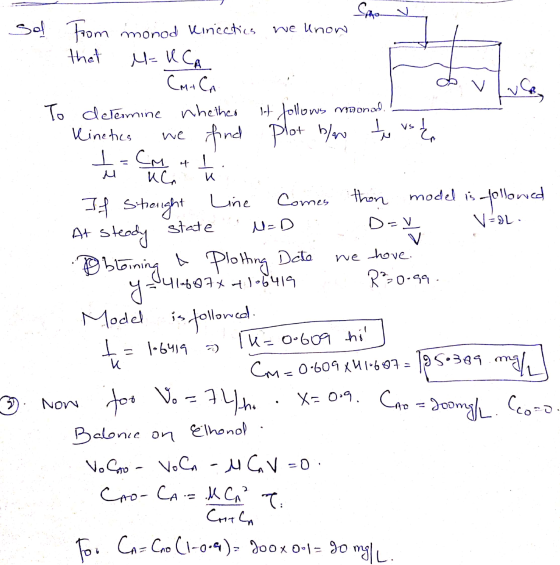
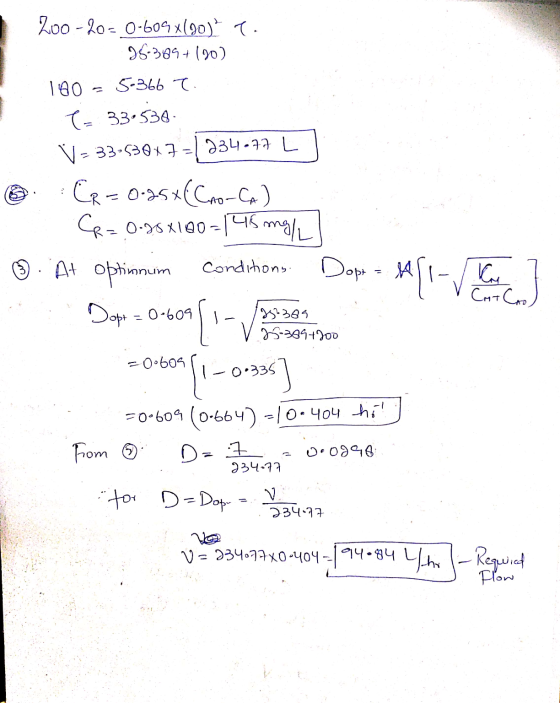
using given data and balance on MFR we can find the required variables
for any doubts write in comments
Add Answer to:
In the production of vinegar, the
fermentation of ethanol to produce acetic acid using acetic
acid...
4. Acetobacter aceti bacteria convert ethanol to acetic acid under aerobic conditions. A continuous fermentation process...
4. Acetobacter aceti bacteria convert ethanol to acetic acid under aerobic conditions. A continuous fermentation process for vinegar production using A. aceti cells immobilised on the surface of gelatine beads is used. An aqueous solution of ethanol is the reactant. The production target is 7 kg/h acetic acid in aqueous solution. However the maximum acetic acid concentration tolerated by the cells is 12 %. Air is pumped into the fermenter so that 4.5 kg/h of oxygen are delivered. Using mass...
6.31 M 7. Molarity of acetic acid, HC2H30in vinegar sample (show your calculations) Volume of vinegar...
 6.31 M 7. Molarity of acetic acid, HC2H30in vinegar sample (show your calculations) Volume of vinegar sample = 0.003L 0.003L Vinegar contain 0.01893 moles IL 0.01893 = 6.3 IM 0.003 Vinegar contain 8. Grams of Acetic Acid, HC,H,O2 (show your calculations) 1.1368 g HC2H5O2 Grams acid = 12 *MW = 0.01893 mot x 60.052 g/ mot = 1-1368 g 31.90 % L 3 100 9. Percent (m/v) of HC,H,O, in vinegar sample (show your calculations) 3.0 mL vinegar contain 0.01893...
3. The manufacturer of the vinegar used in this experiment claims that the vinegar contains 5% acetic acid by weig...
 3. The manufacturer of the vinegar used in this experiment claims that the vinegar contains 5% acetic acid by weight. Using your results, molarity of vinegar, and 1.0 g/ml for a density of vinegar, calculate the % acetic acid by weight. Can you tell if the manufacturer's claims is reasonable? Date Concentration of Acetic Acid in Vinegar: Results Instructor Name Partners Section Data molarity of the NaOH solution, M 0.250 M initial buret reading, ml - 0 ml 32mL Omt...
Fermentation ALWAYS results in the production of _______________________. acetic acid NADH NAD+ ethanol Which electron acceptor...
Fermentation ALWAYS results in the production of _______________________. acetic acid NADH NAD+ ethanol Which electron acceptor in respiration yields the largest ATP gain? oxygen Fe3+ sulfate hydrogen The electron transport chain uses the energy obtained by redox reactions to create a gradient of _________ that is then used to synthesize ATP. Choose all that apply. CO2 Na+ H2O H+ e- O2 Which of the following metabolic processes use the electron transport chain? Choose all that apply. Anaerobic respiration Kreb's cycle...
30 Using the following equation determine the average concentration (moles per liter) of acetic acid (CH,CO,H)...
 30 Using the following equation determine the average concentration (moles per liter) of acetic acid (CH,CO,H) present in your vinegar. Record the concentration in Data Table 2 average volume of NaOH (mL) X 1L NAOH 1000 mL NAOH 0,5 mol NaOH 1. NaOH 1 mol CH4COH 1 mol NaOH = average moles of CH,CO,H average moles of CH,CO,H 5.0 ml, vinegar 1000 ml IL = Concentration of CH.CO, H (M=mol/L) 31 Using the following equation and your result from Step...
Titration of Acetic Acid in Vinegar with NaOH Balanced Chemical Equation: NaOH + HC2H3O2 à H2O...
Titration of Acetic Acid in Vinegar with NaOH Balanced Chemical Equation: NaOH + HC2H3O2 à H2O + NaC2H3O2 Volume of HC2H3O2 used in the Erlenmeyer flask = 2.50 mL Molarity (M) of NaOH (stated on label) = 0.150 M NaOH Data Trial 1 Trial 2 Trial 3 Initial Volume (mL) 0.00 16.10 31.70 Final Volume (mL) 16.10 31.70 47.35 Total Volume (mL) 16.10 15.60 15.65 Average volume (mL) Average volume (L) First, Calculate the Average volume of NaOH in Liters
You are looking to design the first couple of units in a fermentation suite. The cells and produc...
 You are looking to design the first couple of units in a fermentation suite. The cells and product are particularly delicate. The cells need a substrate, S, that is extremely expensive. However we can make substrate S from a cheap reactant, A, and a slightly expensive reactant, B. At the end of the exam is a diagram of the whole system. Species A is continously fed into a reactor (Caf 1 mol/ vo 2 L/ s) initilly charged with species...
just the prelab worksheet, no data yet Lab Six: Fermentation Learning Objectives: • Explain the biochemistry...
 just the prelab worksheet, no data yet
Lab Six: Fermentation Learning Objectives: • Explain the biochemistry of fermentation, substrates and products, conditions, and purpose for cells • Describe alcoholic fermentation of yeast, naming reactants and products Perform a pre-designed experiment to measure the rate of yeast fermentation of glucose under two different conditions. Propose hypotheses and make predictions based on them. Design and perform a novel experiment to test additional substrates for yeast fermentation using findings of the pre-designed experiment....
just the prelab worksheet, no data yet
Lab Six: Fermentation Learning Objectives: • Explain the biochemistry of fermentation, substrates and products, conditions, and purpose for cells • Describe alcoholic fermentation of yeast, naming reactants and products Perform a pre-designed experiment to measure the rate of yeast fermentation of glucose under two different conditions. Propose hypotheses and make predictions based on them. Design and perform a novel experiment to test additional substrates for yeast fermentation using findings of the pre-designed experiment....
10. Write a one-page summary of the attached paper? INTRODUCTION Many problems can develop in activated...
10. Write a one-page summary of the attached paper? INTRODUCTION Many problems can develop in activated sludge operation that adversely affect effluent quality with origins in the engineering, hydraulic and microbiological components of the process. The real "heart" of the activated sludge system is the development and maintenance of a mixed microbial culture (activated sludge) that treats wastewater and which can be managed. One definition of a wastewater treatment plant operator is a "bug farmer", one who controls the aeration...
Based on the document below, 1. Describe the hypothesis Chaudhuri et al ids attempting to evaluate;...
 Based on the document below,
1. Describe the hypothesis Chaudhuri et al ids attempting to
evaluate; in other words, what is the goal of this paper? Why is he
writing it?
2. Does the data presented in the paper support the hypothesis
stated in the introduction? Explain.
3.According to Chaudhuri, what is the potential role of thew
alkaline phosphatase in the cleanup of industrial waste.
CHAUDHURI et al: KINETIC BEHAVIOUR OF CALF INTESTINAL ALP WITH PNPP 8.5, 9, 9.5, 10,...
Based on the document below,
1. Describe the hypothesis Chaudhuri et al ids attempting to
evaluate; in other words, what is the goal of this paper? Why is he
writing it?
2. Does the data presented in the paper support the hypothesis
stated in the introduction? Explain.
3.According to Chaudhuri, what is the potential role of thew
alkaline phosphatase in the cleanup of industrial waste.
CHAUDHURI et al: KINETIC BEHAVIOUR OF CALF INTESTINAL ALP WITH PNPP 8.5, 9, 9.5, 10,...
 6.31 M 7. Molarity of acetic acid, HC2H30in vinegar sample (show your calculations) Volume of vinegar sample = 0.003L 0.003L Vinegar contain 0.01893 moles IL 0.01893 = 6.3 IM 0.003 Vinegar contain 8. Grams of Acetic Acid, HC,H,O2 (show your calculations) 1.1368 g HC2H5O2 Grams acid = 12 *MW = 0.01893 mot x 60.052 g/ mot = 1-1368 g 31.90 % L 3 100 9. Percent (m/v) of HC,H,O, in vinegar sample (show your calculations) 3.0 mL vinegar contain 0.01893...
 3. The manufacturer of the vinegar used in this experiment claims that the vinegar contains 5% acetic acid by weight. Using your results, molarity of vinegar, and 1.0 g/ml for a density of vinegar, calculate the % acetic acid by weight. Can you tell if the manufacturer's claims is reasonable? Date Concentration of Acetic Acid in Vinegar: Results Instructor Name Partners Section Data molarity of the NaOH solution, M 0.250 M initial buret reading, ml - 0 ml 32mL Omt...
 30 Using the following equation determine the average concentration (moles per liter) of acetic acid (CH,CO,H) present in your vinegar. Record the concentration in Data Table 2 average volume of NaOH (mL) X 1L NAOH 1000 mL NAOH 0,5 mol NaOH 1. NaOH 1 mol CH4COH 1 mol NaOH = average moles of CH,CO,H average moles of CH,CO,H 5.0 ml, vinegar 1000 ml IL = Concentration of CH.CO, H (M=mol/L) 31 Using the following equation and your result from Step...
 You are looking to design the first couple of units in a fermentation suite. The cells and product are particularly delicate. The cells need a substrate, S, that is extremely expensive. However we can make substrate S from a cheap reactant, A, and a slightly expensive reactant, B. At the end of the exam is a diagram of the whole system. Species A is continously fed into a reactor (Caf 1 mol/ vo 2 L/ s) initilly charged with species...
 just the prelab worksheet, no data yet
Lab Six: Fermentation Learning Objectives: • Explain the biochemistry of fermentation, substrates and products, conditions, and purpose for cells • Describe alcoholic fermentation of yeast, naming reactants and products Perform a pre-designed experiment to measure the rate of yeast fermentation of glucose under two different conditions. Propose hypotheses and make predictions based on them. Design and perform a novel experiment to test additional substrates for yeast fermentation using findings of the pre-designed experiment....
just the prelab worksheet, no data yet
Lab Six: Fermentation Learning Objectives: • Explain the biochemistry of fermentation, substrates and products, conditions, and purpose for cells • Describe alcoholic fermentation of yeast, naming reactants and products Perform a pre-designed experiment to measure the rate of yeast fermentation of glucose under two different conditions. Propose hypotheses and make predictions based on them. Design and perform a novel experiment to test additional substrates for yeast fermentation using findings of the pre-designed experiment....
 Based on the document below,
1. Describe the hypothesis Chaudhuri et al ids attempting to
evaluate; in other words, what is the goal of this paper? Why is he
writing it?
2. Does the data presented in the paper support the hypothesis
stated in the introduction? Explain.
3.According to Chaudhuri, what is the potential role of thew
alkaline phosphatase in the cleanup of industrial waste.
CHAUDHURI et al: KINETIC BEHAVIOUR OF CALF INTESTINAL ALP WITH PNPP 8.5, 9, 9.5, 10,...
Based on the document below,
1. Describe the hypothesis Chaudhuri et al ids attempting to
evaluate; in other words, what is the goal of this paper? Why is he
writing it?
2. Does the data presented in the paper support the hypothesis
stated in the introduction? Explain.
3.According to Chaudhuri, what is the potential role of thew
alkaline phosphatase in the cleanup of industrial waste.
CHAUDHURI et al: KINETIC BEHAVIOUR OF CALF INTESTINAL ALP WITH PNPP 8.5, 9, 9.5, 10,...
Most questions answered within 3 hours.
-
Where is the error in this code sequence?
String s1 = "Hello";
String s2 = "ello";...
asked 11 months ago -
Financial data for Joel de Paris, Inc., for last year
follow:
Joel de Paris, Inc.
Balance...
asked 11 months ago -
Consider this reaction:
Al2(SO4)3 (aq)+ BaCl3
(aq) Al2Cl6 (aq)- +
3BaSO4(s) . What is the...
asked 11 months ago -
Suppose that Savneet is considering increasing her
recent random sample from 20 car rentals to 40...
asked 11 months ago -
Trucks arrive at an unloading terminal at an average rate of 120
per hour.
Trucks arrive...
asked 11 months ago -
Why are methanol and ethanol completely soluble in water while
octanol is not very little soluble....
asked 11 months ago -
A facilities manager at a university reads in a research report
that the mean amount of...
asked 11 months ago -
When the CuSO4 is rehydrated by adding water to the anhydrous
compound, is this an endothermic...
asked 11 months ago -
A ray of sunlight is passing from diamond into crown glass; the
angle of incidence is...
asked 11 months ago -
A block of mass 0.249 kg is placed on top of a light, vertical
spring of...
asked 11 months ago -
how do the kidneys compensate in the presences of acidosis
a) trigger hyperventilate
b) reserve acid...
asked 11 months ago -
Question 501 pts
The rental rate of capital to the firm increases. Which of the
following...
asked 11 months ago