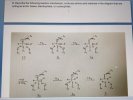
Describe the reaction mechanism for the enzyme aldolase, include the nucleophiles and the electrophiles in the...
Describe the reaction mechanism for the enzyme aldolase, include the nucleophiles and the electrophiles in the reaction. What would happen to the reaction mechanism if the active site Lysine were mutated to alanine?
Homework Answers


Add Answer to:
Describe the reaction mechanism for the enzyme aldolase, include
the nucleophiles and the electrophiles in the...
If there were a mutation to aldolase in which the active site aspartate was mutated to...
If there were a mutation to aldolase in which the active site aspartate was mutated to tyrosine, how might the mutation affect the kinetics of the aldose? Would the enzyme be catalytically competent? Which kinetic parameters would you expect to be affected and how?
Question 6 2 pts Fructose 1,6-P2 aldolase functions in both glycolysis and gluconeogenesis. Starting with DHAP...
 Question 6 2 pts Fructose 1,6-P2 aldolase functions in both glycolysis and gluconeogenesis. Starting with DHAP in Schiff base linkage with the active site lysine of aldolase, show how that intermediate reacts with G 3-P to form fructose 1,6-P2 in Schiff base linkage at the active site. Use B: and HA as necessary. Make sure that you indicate mechanism with curly arrows, and draw each step out, but don't go all the way to the end of the reaction where...
PLEASE WRITE OUT A MECHANISM SHOWING ARROWS (NUCLEOPHILES AND ELECTROPHILES) FOR THIS REACTION. I HAVE INCLUDED...
 PLEASE WRITE OUT A MECHANISM SHOWING ARROWS
(NUCLEOPHILES AND ELECTROPHILES) FOR THIS REACTION.
I HAVE INCLUDED THE REACTANTS, REAGENTS AND THE PRODUCT AS WELL
IN THIS PICTURE.
> Mechanisms OH TG HIGO (produt) Br mgbr -H bryetgo Dry Etao
PLEASE WRITE OUT A MECHANISM SHOWING ARROWS
(NUCLEOPHILES AND ELECTROPHILES) FOR THIS REACTION.
I HAVE INCLUDED THE REACTANTS, REAGENTS AND THE PRODUCT AS WELL
IN THIS PICTURE.
> Mechanisms OH TG HIGO (produt) Br mgbr -H bryetgo Dry Etao
please help thanks VI You are studying the mechanism of catalysis for an enzyme and find...
 please help thanks
VI You are studying the mechanism of catalysis for an enzyme and find that mutating an active site lysine to glutamate has no effect on initial binding, but it significantly decreases the rate at which the enzyme catalyzes its reaction. Predict how this mutation (Lys Glu) is affecting catalytic rate in three sentences or fewer. (Hint, what might the lysine be doing to facilitate catalysis?) LMS stabilizes transition State
please help thanks
VI You are studying the mechanism of catalysis for an enzyme and find that mutating an active site lysine to glutamate has no effect on initial binding, but it significantly decreases the rate at which the enzyme catalyzes its reaction. Predict how this mutation (Lys Glu) is affecting catalytic rate in three sentences or fewer. (Hint, what might the lysine be doing to facilitate catalysis?) LMS stabilizes transition State
PT1. Which of the following does not describe a mechanism that cells use to regulate enzyme...
PT1. Which of the following does not describe a mechanism that cells use to regulate enzyme activity? Explain. (5 points) Cells control enzyme activity by the binding of small molecules Cells control enzyme activity by phosphorylation and dephosphorylation Cells control the diffusion rates of substrate to enzymes Cells control the rate of enzyme degradation Cells control the rate of enzyme synthesis Cells control the targeting of enzymes to specific organelles PT2. Which of the following properties of an enzyme is...
Under typical conditions, many essential biochemical reactions proceed so slowly that life could not exist without...
 Under typical conditions, many essential biochemical reactions
proceed so slowly that life could not exist without the presence of
enzymes. Enzymes increase reaction rates through a wide variety of
mechanisms. These mechanisms generally utilize the following
strategies: improving the nucleophiles and electrophiles present in
the catalytic R groups or substrates; stabilizing the extra
electron density of the leaving group; and stabilizing transition
states. Proteases are enzymes that break down proteins by
hydrolyzing peptide bonds. Chymotrypsin is a protease found in...
Under typical conditions, many essential biochemical reactions
proceed so slowly that life could not exist without the presence of
enzymes. Enzymes increase reaction rates through a wide variety of
mechanisms. These mechanisms generally utilize the following
strategies: improving the nucleophiles and electrophiles present in
the catalytic R groups or substrates; stabilizing the extra
electron density of the leaving group; and stabilizing transition
states. Proteases are enzymes that break down proteins by
hydrolyzing peptide bonds. Chymotrypsin is a protease found in...
The molecule 1, is well known mechanism based inhibitor for one of the PLP containing enzyme....
 The molecule 1, is well known mechanism based inhibitor for one of the PLP containing enzyme. The molecule can adopt either pathway A or B, and can lead to I or II adduct formation. One adduct was formed from 1 covalently linked to pyridoxal 5-phosphate (PLP) (I) while the other adduct was formed with the inhibitor covalently linked to Lysine246, the active site lysine. NH 0 o,po HN н. Lys HN Co.
B. Describe the following reaction mechanism, circle any amino acid residues in the diagram that are...
 B. Describe the following reaction mechanism, circle any amino acid residues in the diagram that are acting as acids, bases, electrophiles, or nucleophiles. S, s Ss NH, NH, TS, R ~NH-R TS2 R NH-R R-C-NH-R His H 1 E E E: ES I, 12 S, S: NHS GH, NES 29 TS, TS, R- + H2O -R'NH2 R-C H His H SH B B E E E, E4 Et Ει E4 Ig 14
The second part of the mechanism for histidyl-tRNA-synthetase is shown below. Active site residues are in...
 The second part of the mechanism for histidyl-tRNA-synthetase is shown below. Active site residues are in black and the substrates are shown in green. Examine the image and complete the following questions. RNAH A76 Arg113 Gin 127 Glu131 M-o Histidy-Adenylate Arg259 Tyr264 c 1. Describe the role of Arg259 in the active site of histidyl- RNA-synthetase. Proton anor acid 2. If the substrates for this enzyme are histidine, ATP, and tRNAHs. Describe overall (not mechanism steps) what must have happened...
identify all reaction mechanism components and provide a forward synethesis and retrosynethesis for the product created....
 identify all reaction mechanism components and provide a
forward synethesis and retrosynethesis for the product created.
label all nucleophiles and electrophiles. show and explain how the
product becomes stabilized.
7. Please provide a reasonable mechanism for the transformation below. Be sure to include all intermediates, formal charges, and arrows depicting electron flow. Then, explain the source of stability for the nucleophile in the reaction. (8 points) Org. Lett. 2000 2, 2717. Me. Me. Me Me Me Me Me
identify all reaction mechanism components and provide a
forward synethesis and retrosynethesis for the product created.
label all nucleophiles and electrophiles. show and explain how the
product becomes stabilized.
7. Please provide a reasonable mechanism for the transformation below. Be sure to include all intermediates, formal charges, and arrows depicting electron flow. Then, explain the source of stability for the nucleophile in the reaction. (8 points) Org. Lett. 2000 2, 2717. Me. Me. Me Me Me Me Me
 Question 6 2 pts Fructose 1,6-P2 aldolase functions in both glycolysis and gluconeogenesis. Starting with DHAP in Schiff base linkage with the active site lysine of aldolase, show how that intermediate reacts with G 3-P to form fructose 1,6-P2 in Schiff base linkage at the active site. Use B: and HA as necessary. Make sure that you indicate mechanism with curly arrows, and draw each step out, but don't go all the way to the end of the reaction where...
 PLEASE WRITE OUT A MECHANISM SHOWING ARROWS
(NUCLEOPHILES AND ELECTROPHILES) FOR THIS REACTION.
I HAVE INCLUDED THE REACTANTS, REAGENTS AND THE PRODUCT AS WELL
IN THIS PICTURE.
> Mechanisms OH TG HIGO (produt) Br mgbr -H bryetgo Dry Etao
PLEASE WRITE OUT A MECHANISM SHOWING ARROWS
(NUCLEOPHILES AND ELECTROPHILES) FOR THIS REACTION.
I HAVE INCLUDED THE REACTANTS, REAGENTS AND THE PRODUCT AS WELL
IN THIS PICTURE.
> Mechanisms OH TG HIGO (produt) Br mgbr -H bryetgo Dry Etao
 please help thanks
VI You are studying the mechanism of catalysis for an enzyme and find that mutating an active site lysine to glutamate has no effect on initial binding, but it significantly decreases the rate at which the enzyme catalyzes its reaction. Predict how this mutation (Lys Glu) is affecting catalytic rate in three sentences or fewer. (Hint, what might the lysine be doing to facilitate catalysis?) LMS stabilizes transition State
please help thanks
VI You are studying the mechanism of catalysis for an enzyme and find that mutating an active site lysine to glutamate has no effect on initial binding, but it significantly decreases the rate at which the enzyme catalyzes its reaction. Predict how this mutation (Lys Glu) is affecting catalytic rate in three sentences or fewer. (Hint, what might the lysine be doing to facilitate catalysis?) LMS stabilizes transition State
 Under typical conditions, many essential biochemical reactions
proceed so slowly that life could not exist without the presence of
enzymes. Enzymes increase reaction rates through a wide variety of
mechanisms. These mechanisms generally utilize the following
strategies: improving the nucleophiles and electrophiles present in
the catalytic R groups or substrates; stabilizing the extra
electron density of the leaving group; and stabilizing transition
states. Proteases are enzymes that break down proteins by
hydrolyzing peptide bonds. Chymotrypsin is a protease found in...
Under typical conditions, many essential biochemical reactions
proceed so slowly that life could not exist without the presence of
enzymes. Enzymes increase reaction rates through a wide variety of
mechanisms. These mechanisms generally utilize the following
strategies: improving the nucleophiles and electrophiles present in
the catalytic R groups or substrates; stabilizing the extra
electron density of the leaving group; and stabilizing transition
states. Proteases are enzymes that break down proteins by
hydrolyzing peptide bonds. Chymotrypsin is a protease found in...
 The molecule 1, is well known mechanism based inhibitor for one of the PLP containing enzyme. The molecule can adopt either pathway A or B, and can lead to I or II adduct formation. One adduct was formed from 1 covalently linked to pyridoxal 5-phosphate (PLP) (I) while the other adduct was formed with the inhibitor covalently linked to Lysine246, the active site lysine. NH 0 o,po HN н. Lys HN Co.
 B. Describe the following reaction mechanism, circle any amino acid residues in the diagram that are acting as acids, bases, electrophiles, or nucleophiles. S, s Ss NH, NH, TS, R ~NH-R TS2 R NH-R R-C-NH-R His H 1 E E E: ES I, 12 S, S: NHS GH, NES 29 TS, TS, R- + H2O -R'NH2 R-C H His H SH B B E E E, E4 Et Ει E4 Ig 14
 The second part of the mechanism for histidyl-tRNA-synthetase is shown below. Active site residues are in black and the substrates are shown in green. Examine the image and complete the following questions. RNAH A76 Arg113 Gin 127 Glu131 M-o Histidy-Adenylate Arg259 Tyr264 c 1. Describe the role of Arg259 in the active site of histidyl- RNA-synthetase. Proton anor acid 2. If the substrates for this enzyme are histidine, ATP, and tRNAHs. Describe overall (not mechanism steps) what must have happened...
 identify all reaction mechanism components and provide a
forward synethesis and retrosynethesis for the product created.
label all nucleophiles and electrophiles. show and explain how the
product becomes stabilized.
7. Please provide a reasonable mechanism for the transformation below. Be sure to include all intermediates, formal charges, and arrows depicting electron flow. Then, explain the source of stability for the nucleophile in the reaction. (8 points) Org. Lett. 2000 2, 2717. Me. Me. Me Me Me Me Me
identify all reaction mechanism components and provide a
forward synethesis and retrosynethesis for the product created.
label all nucleophiles and electrophiles. show and explain how the
product becomes stabilized.
7. Please provide a reasonable mechanism for the transformation below. Be sure to include all intermediates, formal charges, and arrows depicting electron flow. Then, explain the source of stability for the nucleophile in the reaction. (8 points) Org. Lett. 2000 2, 2717. Me. Me. Me Me Me Me Me
Most questions answered within 3 hours.
-
Where is the error in this code sequence?
String s1 = "Hello";
String s2 = "ello";...
asked 10 months ago -
Financial data for Joel de Paris, Inc., for last year
follow:
Joel de Paris, Inc.
Balance...
asked 10 months ago -
Consider this reaction:
Al2(SO4)3 (aq)+ BaCl3
(aq) Al2Cl6 (aq)- +
3BaSO4(s) . What is the...
asked 10 months ago -
Suppose that Savneet is considering increasing her
recent random sample from 20 car rentals to 40...
asked 10 months ago -
Trucks arrive at an unloading terminal at an average rate of 120
per hour.
Trucks arrive...
asked 10 months ago -
Why are methanol and ethanol completely soluble in water while
octanol is not very little soluble....
asked 10 months ago -
A facilities manager at a university reads in a research report
that the mean amount of...
asked 10 months ago -
When the CuSO4 is rehydrated by adding water to the anhydrous
compound, is this an endothermic...
asked 10 months ago -
A ray of sunlight is passing from diamond into crown glass; the
angle of incidence is...
asked 10 months ago -
A block of mass 0.249 kg is placed on top of a light, vertical
spring of...
asked 10 months ago -
how do the kidneys compensate in the presences of acidosis
a) trigger hyperventilate
b) reserve acid...
asked 10 months ago -
Question 501 pts
The rental rate of capital to the firm increases. Which of the
following...
asked 10 months ago