![Assume there are two screw dislocations in a FCC crystal. If the two dislocations are parallel to each other and both have Burgers vector of [101], what will be the force on a unit length of one dislocation that is a. 2 exerted by the other dislocation if the two dislocation are 100 nm apart from each other? Assume a 0.25 nm, the shear modulus is 3 GPa.](http://img.homeworklib.com/questions/09a509a0-1971-11ec-858c-2f3af4be1246.png?x-oss-process=image/resize,w_560)
Homework Answers
![The magnitude of Berger vector is b-ah21 Here. Berger vector is expressed as a/2[10-1]. So, b = a(2)2 The required force on](http://img.homeworklib.com/questions/0a465380-1971-11ec-890a-8309dcdfb37a.png?x-oss-process=image/resize,w_560)
Add Answer to:
Assume there are two screw dislocations in a FCC crystal. If the two dislocations are parallel...
The figure below shows two parallel screw dislocations a distance r apart. Each dislocation has a...
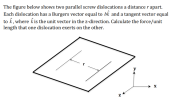 The figure below shows two parallel screw dislocations a distance r apart. Each dislocation has a Burgers vector equal to bk and a tangent vector equal to K, where k is the unit vector in the z-direction. Calculate the force/unit length that one dislocation exerts on the other.
4. (Character of dislocations) Three circular glide dislocation loops lying on a close packed pla...
 4. (Character of dislocations) Three circular glide dislocation loops lying on a close packed plane in an FCC crystal are shown in the figure below. The Burgers vectors of the loops, which are of the type a/2 110>, are indicated by the double ended arrows (the precise Burgers vector depends on the choice of tangent vector). The magnitudes of the Burgers vectors of the loops are assumed to be the same. If the loops expand by glide, they can combine...
Materials/Edge Dislocation Problem: 3. Problem 3: (40 points An edge dislocation given by burgers vector, 01]...
 Materials/Edge Dislocation Problem:
3. Problem 3: (40 points An edge dislocation given by burgers vector, 01] on the (111) plane in an fcc crystal dissociates into two partial dislocations a) Provide the dislocation reaction for the above. Vectorially depict the three dislocations on a (111) plane b) Prove that the reaction is thermodynamically feasible c) The two partial dislocations can each be split into horizontal and vertical components. Each of the components are either, pure screw or edge dislocations. These...
Materials/Edge Dislocation Problem:
3. Problem 3: (40 points An edge dislocation given by burgers vector, 01] on the (111) plane in an fcc crystal dissociates into two partial dislocations a) Provide the dislocation reaction for the above. Vectorially depict the three dislocations on a (111) plane b) Prove that the reaction is thermodynamically feasible c) The two partial dislocations can each be split into horizontal and vertical components. Each of the components are either, pure screw or edge dislocations. These...
20 points. The frictional shear stress to move a dislocation through a perfect crystal is given...
 20 points. The frictional shear stress to move a dislocation through a perfect crystal is given by Ti = G exp((-2nd / b(1-v)) where d is the atomic spacing on close packed plane and b is the magnitude of the Burgers vector. Calculate ty for an fcc Cu crystal, if the dislocation is a Shockley partial. The shear modulus Cu is 42 GPa, its Poisson's ratio is 0.3, and its lattice parameter is 3.618.
I learned that The energy of dislocation is : but, I can't understand this e.q :...
 I learned that The energy of dislocation is : but, I can't understand this
e.q :
And why density is Ev/E ?
Can you explain how it's coming out like that?
We were unable to transcribe this image2 Calculate the dislocation density (defined the total length of dislocation line in a unit volume) when the stored energy in a copper crystal due to the strain fields of dislocations is 12,000 kJ m-3. Assume shear modulus, G- 48 GPa and...
I learned that The energy of dislocation is : but, I can't understand this
e.q :
And why density is Ev/E ?
Can you explain how it's coming out like that?
We were unable to transcribe this image2 Calculate the dislocation density (defined the total length of dislocation line in a unit volume) when the stored energy in a copper crystal due to the strain fields of dislocations is 12,000 kJ m-3. Assume shear modulus, G- 48 GPa and...
Can a dislocation with the burgers vector given dissociate into partial dislocations per reaction i? how...
Can a dislocation with the burgers vector given dissociate into partial dislocations per reaction i? how about reaction ii? Explain how you know. What crystal structure is the dislocation found in in case i? How about case ii? What family of planes would the dislocation be slipping on in case i? In case ii? If both i and ii are edge dislocations suggest a plausible line vector for each dislocation. i) (ao/2)[10-1] (ao/6)[2-1-1] + (ao/6)[11-2] ii) (ao/2)[-101] ...
A single crystal in the form of a cube has two possible slip planes. (1) and...
 A single crystal in the form of a cube has two possible slip planes. (1) and (2). as shown in the sketch below. Each of these planes has two possible slip directions, (a) and (b), as is also shown. The angle between the tensile load axis and slip plane normal for both slip planes is 450 40 <plane (1)> <plane (2)> a) If a stress is applied to this crystal in the direction noted, specify which particular (eg. plane (1),...
Word Bank for Problem 6 Edge Dislocation Tensile Strength Screw Dislocation Shear Strain Coordination # Shear...
 Word Bank for Problem 6 Edge Dislocation Tensile Strength Screw Dislocation Shear Strain Coordination # Shear Stress Burgers Vector Elastic Modulus Elastic Plastic Deformation Deformation Strain Stress Crystal Anion 香 Planar density Unit Cell Linear Density substitutional Amorphous hardness vacancy interstitial Packing Factor Grain Boundary Lattice Constant Poisson's Ratio Galaga 6. (10 points) True or False a. Elastic Deformation is always recovered. Grain Boundaries weaken materials at room temperature. _The Hume-Rothery Rules predict solid solution alloying. % Hardness is a...
Two parallel power lines each carry a current of 450 A . The lines are 0.9...
Two parallel power lines each carry a current of 450 A . The lines are 0.9 m apart. What is the magnitude of the magnetic force per unit length that one of the wires feels from the other?
Two long, straight wires carry equal currents of 0.56 A. The two wires are parallel to...
Two long, straight wires carry equal currents of 0.56 A. The two wires are parallel to each other and carry parallel currents. What is the magnetic field at a midpoint between the two wires, if the wires are 0.5 cm apart? The magnetic field of a long, straight wire is: B=(μ_0 i)/2πr What is the force per unit length of one of the wires in number 2 on the other?
 The figure below shows two parallel screw dislocations a distance r apart. Each dislocation has a Burgers vector equal to bk and a tangent vector equal to K, where k is the unit vector in the z-direction. Calculate the force/unit length that one dislocation exerts on the other.
 4. (Character of dislocations) Three circular glide dislocation loops lying on a close packed plane in an FCC crystal are shown in the figure below. The Burgers vectors of the loops, which are of the type a/2 110>, are indicated by the double ended arrows (the precise Burgers vector depends on the choice of tangent vector). The magnitudes of the Burgers vectors of the loops are assumed to be the same. If the loops expand by glide, they can combine...
 Materials/Edge Dislocation Problem:
3. Problem 3: (40 points An edge dislocation given by burgers vector, 01] on the (111) plane in an fcc crystal dissociates into two partial dislocations a) Provide the dislocation reaction for the above. Vectorially depict the three dislocations on a (111) plane b) Prove that the reaction is thermodynamically feasible c) The two partial dislocations can each be split into horizontal and vertical components. Each of the components are either, pure screw or edge dislocations. These...
Materials/Edge Dislocation Problem:
3. Problem 3: (40 points An edge dislocation given by burgers vector, 01] on the (111) plane in an fcc crystal dissociates into two partial dislocations a) Provide the dislocation reaction for the above. Vectorially depict the three dislocations on a (111) plane b) Prove that the reaction is thermodynamically feasible c) The two partial dislocations can each be split into horizontal and vertical components. Each of the components are either, pure screw or edge dislocations. These...
 20 points. The frictional shear stress to move a dislocation through a perfect crystal is given by Ti = G exp((-2nd / b(1-v)) where d is the atomic spacing on close packed plane and b is the magnitude of the Burgers vector. Calculate ty for an fcc Cu crystal, if the dislocation is a Shockley partial. The shear modulus Cu is 42 GPa, its Poisson's ratio is 0.3, and its lattice parameter is 3.618.
 I learned that The energy of dislocation is : but, I can't understand this
e.q :
And why density is Ev/E ?
Can you explain how it's coming out like that?
We were unable to transcribe this image2 Calculate the dislocation density (defined the total length of dislocation line in a unit volume) when the stored energy in a copper crystal due to the strain fields of dislocations is 12,000 kJ m-3. Assume shear modulus, G- 48 GPa and...
I learned that The energy of dislocation is : but, I can't understand this
e.q :
And why density is Ev/E ?
Can you explain how it's coming out like that?
We were unable to transcribe this image2 Calculate the dislocation density (defined the total length of dislocation line in a unit volume) when the stored energy in a copper crystal due to the strain fields of dislocations is 12,000 kJ m-3. Assume shear modulus, G- 48 GPa and...
 A single crystal in the form of a cube has two possible slip planes. (1) and (2). as shown in the sketch below. Each of these planes has two possible slip directions, (a) and (b), as is also shown. The angle between the tensile load axis and slip plane normal for both slip planes is 450 40 <plane (1)> <plane (2)> a) If a stress is applied to this crystal in the direction noted, specify which particular (eg. plane (1),...
 Word Bank for Problem 6 Edge Dislocation Tensile Strength Screw Dislocation Shear Strain Coordination # Shear Stress Burgers Vector Elastic Modulus Elastic Plastic Deformation Deformation Strain Stress Crystal Anion 香 Planar density Unit Cell Linear Density substitutional Amorphous hardness vacancy interstitial Packing Factor Grain Boundary Lattice Constant Poisson's Ratio Galaga 6. (10 points) True or False a. Elastic Deformation is always recovered. Grain Boundaries weaken materials at room temperature. _The Hume-Rothery Rules predict solid solution alloying. % Hardness is a...
Most questions answered within 3 hours.
-
Where is the error in this code sequence?
String s1 = "Hello";
String s2 = "ello";...
asked 10 months ago -
Financial data for Joel de Paris, Inc., for last year
follow:
Joel de Paris, Inc.
Balance...
asked 10 months ago -
Consider this reaction:
Al2(SO4)3 (aq)+ BaCl3
(aq) Al2Cl6 (aq)- +
3BaSO4(s) . What is the...
asked 10 months ago -
Suppose that Savneet is considering increasing her
recent random sample from 20 car rentals to 40...
asked 10 months ago -
Trucks arrive at an unloading terminal at an average rate of 120
per hour.
Trucks arrive...
asked 10 months ago -
Why are methanol and ethanol completely soluble in water while
octanol is not very little soluble....
asked 10 months ago -
A facilities manager at a university reads in a research report
that the mean amount of...
asked 10 months ago -
When the CuSO4 is rehydrated by adding water to the anhydrous
compound, is this an endothermic...
asked 10 months ago -
A ray of sunlight is passing from diamond into crown glass; the
angle of incidence is...
asked 10 months ago -
A block of mass 0.249 kg is placed on top of a light, vertical
spring of...
asked 10 months ago -
how do the kidneys compensate in the presences of acidosis
a) trigger hyperventilate
b) reserve acid...
asked 10 months ago -
Question 501 pts
The rental rate of capital to the firm increases. Which of the
following...
asked 10 months ago