
Homework Answers
Carbocations have three options available for further reaction.These options are
i. reaction with nucleophile
ii. loss of beta proton to give an alkene
iii. it undergo rearrangement
Add Answer to:
Answer the following questions
Carbocations have three options available for further reaction. These options include reaction...
What three options does Prue have to pursue the complaint further if she is unhappy with...
What three options does Prue have to pursue the complaint further if she is unhappy with the outcome of her compliant to the disability service?
Please answer question 4.5 ran- options are available. For each of these three options, another three...
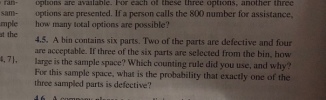 Please answer question 4.5
ran- options are available. For each of these three options, another three options are presented. If a person calls the 800 number for assistance, sam- mple how many total options are possible? t the 4.5. A bin contains six parts. Two of the parts are defective and four are acceptable. If three of the six parts are selected from the bin, how large is the sample space? Which counting rule did you use, and why? For...
Please answer question 4.5
ran- options are available. For each of these three options, another three options are presented. If a person calls the 800 number for assistance, sam- mple how many total options are possible? t the 4.5. A bin contains six parts. Two of the parts are defective and four are acceptable. If three of the six parts are selected from the bin, how large is the sample space? Which counting rule did you use, and why? For...
Use the reaction below to answer the three questions that follow: SNa DMSO 16. What effect...
 Use the reaction below to answer the three questions that follow: SNa DMSO 16. What effect would changing the nucleophile to ethoxide have on the rate of the reaction above? a. The rate would increase. C. The rate would decrease. b. There would be no reaction. d. No effect on rate would be observed. 17. What effect would changing the iodine atom to a chlorine atom have on the rate of the reaction? a. There would be no reaction. c....
15. Use the options below to answer the following questions: free energy, kJ/mol reaction coordinate reaction...
 15. Use the options below to answer the following questions: free energy, kJ/mol reaction coordinate reaction coordinate reaction coordinate reaction coordinate D. Which diagram(s) represent an endergonic process? Which diagram represent a single step reaction? Which diagram represents a 3 step reaction?
1 a) Maria answers 28 multiple-choice questions randomly guessing. 10 questions have 5 answer options, 15...
1 a) Maria answers 28 multiple-choice questions randomly guessing. 10 questions have 5 answer options, 15 questions have 6 answer options and 3 questions have 2 answer options. There is exactly one answer option for each problem. What is the expectation value of correct answers from Maria? 1. b) The pesticide content is adjusted so that 95% of the cabbage does not contain pests. What is the standard deviation of the number of pest cabbages in a random sample of...
Please explain answers Use the reaction below to answer the three questions that follow: SNa DMSO...
 Please explain answers
Use the reaction below to answer the three questions that follow: SNa DMSO 16. What effect would changing the nucleophile to ethoxide have on the rate of the reaction above? a. The rate would increase. c. The rate would decrease. b. There would be no reaction. d. No effect on rate would be observed. 17. What effect would changing the iodine atom to a chlorine atom have on the rate of the reaction? a. There would be...
Please explain answers
Use the reaction below to answer the three questions that follow: SNa DMSO 16. What effect would changing the nucleophile to ethoxide have on the rate of the reaction above? a. The rate would increase. c. The rate would decrease. b. There would be no reaction. d. No effect on rate would be observed. 17. What effect would changing the iodine atom to a chlorine atom have on the rate of the reaction? a. There would be...
What major product forms from the following E2 elimination reaction? Answer options: Question 4 1.5 pts...
 What major product forms from the following E2
elimination reaction?
Answer options:
Question 4 1.5 pts What major product forms from the following E2 elimination reaction? CH3 Br excess KOH ethanol, heat CH3 Hints: (1) Please be sure you understand where the possible anti-periplanar eliminations can occur for this substituted cyclohexane. Therefore, it is recommended that you convert the starting alkyl halide into its chair structural representation. (2) The ring beta-proton should be trans to the alpha-halogen leaving group in...
What major product forms from the following E2
elimination reaction?
Answer options:
Question 4 1.5 pts What major product forms from the following E2 elimination reaction? CH3 Br excess KOH ethanol, heat CH3 Hints: (1) Please be sure you understand where the possible anti-periplanar eliminations can occur for this substituted cyclohexane. Therefore, it is recommended that you convert the starting alkyl halide into its chair structural representation. (2) The ring beta-proton should be trans to the alpha-halogen leaving group in...
east stable most stable The following are three examples of the relative stability of carbocations in...
 east stable most stable The following are three examples of the relative stability of carbocations in your answer to question 2. Each of these reactions should show a relatively stable carbocation intermediate. (a) The two-step reaction of 1-methylcyclohexene with HBr follows the Markovnikov 3. rule. (b) Choose 1-butanol or tert-butyl alcohol to undergo a 3-step reaction with HBr to form the alkyl bromide. The second step is the S1 formation of a carbocation. (c) Show the one most stable resonance...
Consider the SN2 reaction shown below and answer the following questions. Consider the SN1 reaction shown...
 Consider the SN2 reaction shown below and answer the
following questions.
Consider the SN1 reaction shown below and answer the following
questions.
1. Consider the SN2 reaction shown below and answer the following questions. acetone Br NaSCH3 SCH3 NaBr + A. Write the rate law for the reaction B. Identify the nucleophile and the electrophile in the reaction C. State how each of the following factors would affect the rate of the reaction a. Increasing the concentration of 1-bromopropane. b....
Consider the SN2 reaction shown below and answer the
following questions.
Consider the SN1 reaction shown below and answer the following
questions.
1. Consider the SN2 reaction shown below and answer the following questions. acetone Br NaSCH3 SCH3 NaBr + A. Write the rate law for the reaction B. Identify the nucleophile and the electrophile in the reaction C. State how each of the following factors would affect the rate of the reaction a. Increasing the concentration of 1-bromopropane. b....
please answer questions 1-4 Question 1 Which of the following is the most stable carbocation? СН3...
 please answer questions 1-4
Question 1 Which of the following is the most stable carbocation? СН3 V. CH2 What is the major product of the following reaction? Н HBO C CHS CH CH CH3-CH ( CH, Br CH2-CH-C–CH, Br Br CH CH CH3-CH:-¢-CH Br ін, CHE CH CH.-CH- Br CH. D Question 3 What is the major product of the following reaction? CH, НО 1 Оснок IV. CH2OH CH3 "О" ОН Д. он СН3 CH3 Но Ш. CH, ОН Question...
please answer questions 1-4
Question 1 Which of the following is the most stable carbocation? СН3 V. CH2 What is the major product of the following reaction? Н HBO C CHS CH CH CH3-CH ( CH, Br CH2-CH-C–CH, Br Br CH CH CH3-CH:-¢-CH Br ін, CHE CH CH.-CH- Br CH. D Question 3 What is the major product of the following reaction? CH, НО 1 Оснок IV. CH2OH CH3 "О" ОН Д. он СН3 CH3 Но Ш. CH, ОН Question...
 Please answer question 4.5
ran- options are available. For each of these three options, another three options are presented. If a person calls the 800 number for assistance, sam- mple how many total options are possible? t the 4.5. A bin contains six parts. Two of the parts are defective and four are acceptable. If three of the six parts are selected from the bin, how large is the sample space? Which counting rule did you use, and why? For...
Please answer question 4.5
ran- options are available. For each of these three options, another three options are presented. If a person calls the 800 number for assistance, sam- mple how many total options are possible? t the 4.5. A bin contains six parts. Two of the parts are defective and four are acceptable. If three of the six parts are selected from the bin, how large is the sample space? Which counting rule did you use, and why? For...
 Use the reaction below to answer the three questions that follow: SNa DMSO 16. What effect would changing the nucleophile to ethoxide have on the rate of the reaction above? a. The rate would increase. C. The rate would decrease. b. There would be no reaction. d. No effect on rate would be observed. 17. What effect would changing the iodine atom to a chlorine atom have on the rate of the reaction? a. There would be no reaction. c....
 15. Use the options below to answer the following questions: free energy, kJ/mol reaction coordinate reaction coordinate reaction coordinate reaction coordinate D. Which diagram(s) represent an endergonic process? Which diagram represent a single step reaction? Which diagram represents a 3 step reaction?
 Please explain answers
Use the reaction below to answer the three questions that follow: SNa DMSO 16. What effect would changing the nucleophile to ethoxide have on the rate of the reaction above? a. The rate would increase. c. The rate would decrease. b. There would be no reaction. d. No effect on rate would be observed. 17. What effect would changing the iodine atom to a chlorine atom have on the rate of the reaction? a. There would be...
Please explain answers
Use the reaction below to answer the three questions that follow: SNa DMSO 16. What effect would changing the nucleophile to ethoxide have on the rate of the reaction above? a. The rate would increase. c. The rate would decrease. b. There would be no reaction. d. No effect on rate would be observed. 17. What effect would changing the iodine atom to a chlorine atom have on the rate of the reaction? a. There would be...
 What major product forms from the following E2
elimination reaction?
Answer options:
Question 4 1.5 pts What major product forms from the following E2 elimination reaction? CH3 Br excess KOH ethanol, heat CH3 Hints: (1) Please be sure you understand where the possible anti-periplanar eliminations can occur for this substituted cyclohexane. Therefore, it is recommended that you convert the starting alkyl halide into its chair structural representation. (2) The ring beta-proton should be trans to the alpha-halogen leaving group in...
What major product forms from the following E2
elimination reaction?
Answer options:
Question 4 1.5 pts What major product forms from the following E2 elimination reaction? CH3 Br excess KOH ethanol, heat CH3 Hints: (1) Please be sure you understand where the possible anti-periplanar eliminations can occur for this substituted cyclohexane. Therefore, it is recommended that you convert the starting alkyl halide into its chair structural representation. (2) The ring beta-proton should be trans to the alpha-halogen leaving group in...
 east stable most stable The following are three examples of the relative stability of carbocations in your answer to question 2. Each of these reactions should show a relatively stable carbocation intermediate. (a) The two-step reaction of 1-methylcyclohexene with HBr follows the Markovnikov 3. rule. (b) Choose 1-butanol or tert-butyl alcohol to undergo a 3-step reaction with HBr to form the alkyl bromide. The second step is the S1 formation of a carbocation. (c) Show the one most stable resonance...
 Consider the SN2 reaction shown below and answer the
following questions.
Consider the SN1 reaction shown below and answer the following
questions.
1. Consider the SN2 reaction shown below and answer the following questions. acetone Br NaSCH3 SCH3 NaBr + A. Write the rate law for the reaction B. Identify the nucleophile and the electrophile in the reaction C. State how each of the following factors would affect the rate of the reaction a. Increasing the concentration of 1-bromopropane. b....
Consider the SN2 reaction shown below and answer the
following questions.
Consider the SN1 reaction shown below and answer the following
questions.
1. Consider the SN2 reaction shown below and answer the following questions. acetone Br NaSCH3 SCH3 NaBr + A. Write the rate law for the reaction B. Identify the nucleophile and the electrophile in the reaction C. State how each of the following factors would affect the rate of the reaction a. Increasing the concentration of 1-bromopropane. b....
 please answer questions 1-4
Question 1 Which of the following is the most stable carbocation? СН3 V. CH2 What is the major product of the following reaction? Н HBO C CHS CH CH CH3-CH ( CH, Br CH2-CH-C–CH, Br Br CH CH CH3-CH:-¢-CH Br ін, CHE CH CH.-CH- Br CH. D Question 3 What is the major product of the following reaction? CH, НО 1 Оснок IV. CH2OH CH3 "О" ОН Д. он СН3 CH3 Но Ш. CH, ОН Question...
please answer questions 1-4
Question 1 Which of the following is the most stable carbocation? СН3 V. CH2 What is the major product of the following reaction? Н HBO C CHS CH CH CH3-CH ( CH, Br CH2-CH-C–CH, Br Br CH CH CH3-CH:-¢-CH Br ін, CHE CH CH.-CH- Br CH. D Question 3 What is the major product of the following reaction? CH, НО 1 Оснок IV. CH2OH CH3 "О" ОН Д. он СН3 CH3 Но Ш. CH, ОН Question...
Most questions answered within 3 hours.
-
Where is the error in this code sequence?
String s1 = "Hello";
String s2 = "ello";...
asked 10 months ago -
Financial data for Joel de Paris, Inc., for last year
follow:
Joel de Paris, Inc.
Balance...
asked 10 months ago -
Consider this reaction:
Al2(SO4)3 (aq)+ BaCl3
(aq) Al2Cl6 (aq)- +
3BaSO4(s) . What is the...
asked 10 months ago -
Suppose that Savneet is considering increasing her
recent random sample from 20 car rentals to 40...
asked 10 months ago -
Trucks arrive at an unloading terminal at an average rate of 120
per hour.
Trucks arrive...
asked 10 months ago -
Why are methanol and ethanol completely soluble in water while
octanol is not very little soluble....
asked 10 months ago -
A facilities manager at a university reads in a research report
that the mean amount of...
asked 10 months ago -
When the CuSO4 is rehydrated by adding water to the anhydrous
compound, is this an endothermic...
asked 10 months ago -
A ray of sunlight is passing from diamond into crown glass; the
angle of incidence is...
asked 10 months ago -
A block of mass 0.249 kg is placed on top of a light, vertical
spring of...
asked 10 months ago -
how do the kidneys compensate in the presences of acidosis
a) trigger hyperventilate
b) reserve acid...
asked 10 months ago -
Question 501 pts
The rental rate of capital to the firm increases. Which of the
following...
asked 10 months ago