

Homework Answers
Request Answer!
We need at least 10 more requests to produce the answer.
0 / 10 have requested this problem solution
The more requests, the faster the answer.
Add Answer to:
3. The given figure represents the agarose gel electrophoresis results from a restriction digest experiment. Lane...
A plasmid is cleaved by restriction endonucleases and analyzed by agarose gel electrophoresis. Assume there is...
 A plasmid is cleaved by restriction endonucleases and analyzed
by agarose gel electrophoresis. Assume there is no supercoiling.
Answer the following three questions about the plasmid.
Can you please help below? I also don't understand it so a
explanation for each would be helpful. For the first one I think
its 1000bp but unsure. For the second, I think there is 2 HindIII
sites and for the last one there is 1 EcoRI site? Please
explain.
A plasmid is cleaved...
A plasmid is cleaved by restriction endonucleases and analyzed
by agarose gel electrophoresis. Assume there is no supercoiling.
Answer the following three questions about the plasmid.
Can you please help below? I also don't understand it so a
explanation for each would be helpful. For the first one I think
its 1000bp but unsure. For the second, I think there is 2 HindIII
sites and for the last one there is 1 EcoRI site? Please
explain.
A plasmid is cleaved...
Use the results of the agarose gel electrophoresis separation to construct a restriction map for the...
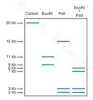 Use the results of the agarose gel electrophoresis separation to
construct a restriction map for the sample of DNA
EcoRI Control EcoRI Pst Pst 15kb-. 8kb → 3 kb
Use the results of the agarose gel electrophoresis separation to
construct a restriction map for the sample of DNA
EcoRI Control EcoRI Pst Pst 15kb-. 8kb → 3 kb
Luestion 3 1 pts Review: You have the DNA that is radioactively labeled at the S'ends...
 Luestion 3 1 pts Review: You have the DNA that is radioactively labeled at the S'ends of DNA as shown below. But you want DNA that is labeled only at one end of the DNA, not both ends. One of the other undergraduate students in the lab suggests that you use a restriction enzyme to cut the DNA, then electrophorese the DNA in an agarose gel, then cut out the region of the gel with radioactive DNA fragment you want,...
Suppose you are going to do a restriction digest with a plasmid, using the restriction enzyme...
Suppose you are going to do a restriction digest with a plasmid, using the restriction enzyme Eco R1. A map of the plasmid is shown here. The entire plasmid is 6000 bp, and there are Eco R1 restriction sites at 1500 bp, 2000 bp, and 4000 bp. You’re going to run the entire volume of the digest on a gel, and you want to cut just enough DNA to have 50 ng in the smallest band on your gel. Starting...
Sketch the predicted migration pattern on an agarose gel of the following DNA samples: (1) Undigested...
Sketch the predicted migration pattern on an agarose gel of the following DNA samples: (1) Undigested pET15b plasmid; (2) pET15b digested with the EagI restriction enzyme; (3) pET15b digested with NdeI and AhdI (see pET15b vector map for location of these enzyme cutting sites). Include in your sketch a DNA base-pair ladder from 0 to 10,000 bp with 1000 bp increments. Label each band in the DNA ladder with the known size (in base-pairs), and estimate the size of the...
Question 1. 1 2 3 4 5 6 7 8 Lane Name/Code Ladder 1B | 2B...
 Question 1. 1 2 3 4 5 6 7 8 Lane Name/Code Ladder 1B | 2B 2 DNA Sample/Treatment DNA ladder Digest Digest Digest Digest Digest Digest 3B 4B 5B Negative Figure 1: 1% Super buffer agarose gel electrophoresis of restriction digest of the plasmid containing the gdhA gene insert. Based on the information above answer the following questions? 1. What ladder size used? 2. What are the two top bands and bottom bands representing? 3. Explain why the observed...
can someone explain throughly on how to find a-c??? thanks!!! The following question will provide practice in interpreting and analyzing gel results. 5. You obtained the DNA electrophoresis gel be...
 can
someone explain throughly on how to find a-c??? thanks!!!
The following question will provide practice in interpreting and analyzing gel results. 5. You obtained the DNA electrophoresis gel below. Three samples of lambda phage DNA were digested with 3 different restriction enzymes and the digested DNA was applied to the gel in lane 4 and the bands were visualized. The Hind Ill digest was used as a molecular weight standard marker and produced 6 DNA fragments of known size:...
can
someone explain throughly on how to find a-c??? thanks!!!
The following question will provide practice in interpreting and analyzing gel results. 5. You obtained the DNA electrophoresis gel below. Three samples of lambda phage DNA were digested with 3 different restriction enzymes and the digested DNA was applied to the gel in lane 4 and the bands were visualized. The Hind Ill digest was used as a molecular weight standard marker and produced 6 DNA fragments of known size:...
The picture above represents an agarose gel that was used to analyze plasmid DNA after it...
 The picture above represents an agarose gel that was used to analyze plasmid DNA after it was cut with the restriction enzyme HindIll. The plasmid was incubated with Hindill until all of the available Hindlll cut sites were cut by HindIll. After running the sample on the gel, three bands were detected (Note that there are three wells shown at the top of the gel for loading samples, however, only the middle well was loaded with sample). Based on this...
While your gel is running, discuss your expected results for each lane on the gel •...
 While your gel is running, discuss your expected results for each lane on the gel • Remove the gel from the apparatus and image on a UV transilluminator. (Remember to only illuminate the UV light when the shield is in place). 3) Using the DNA ladder, estimate the experimental size of all bands observed in the sample lanes. (3pt) Gel Lane Plasmid Number of bands observed Estimated size (bp) of each band 2 (tube 1) A 3 (tube 2) B...
Can someone help me with this homework question on gel electrophoresis? Translocation and deletion 3. You...
 Can someone help me with this homework question on gel
electrophoresis?
Translocation and deletion 3. You PCR amplify a 500 bp (base pairs) piece of DNA that has diagnostic value in determining whether a patient has a mutation within a specific DNA region. You know that this DNA segment of the "normal" gene does not include an EcoRI restriction site; but the mutated DNA segment of the same gene contains an EcoRI restriction site due to a point mutation at...
Can someone help me with this homework question on gel
electrophoresis?
Translocation and deletion 3. You PCR amplify a 500 bp (base pairs) piece of DNA that has diagnostic value in determining whether a patient has a mutation within a specific DNA region. You know that this DNA segment of the "normal" gene does not include an EcoRI restriction site; but the mutated DNA segment of the same gene contains an EcoRI restriction site due to a point mutation at...
 A plasmid is cleaved by restriction endonucleases and analyzed
by agarose gel electrophoresis. Assume there is no supercoiling.
Answer the following three questions about the plasmid.
Can you please help below? I also don't understand it so a
explanation for each would be helpful. For the first one I think
its 1000bp but unsure. For the second, I think there is 2 HindIII
sites and for the last one there is 1 EcoRI site? Please
explain.
A plasmid is cleaved...
A plasmid is cleaved by restriction endonucleases and analyzed
by agarose gel electrophoresis. Assume there is no supercoiling.
Answer the following three questions about the plasmid.
Can you please help below? I also don't understand it so a
explanation for each would be helpful. For the first one I think
its 1000bp but unsure. For the second, I think there is 2 HindIII
sites and for the last one there is 1 EcoRI site? Please
explain.
A plasmid is cleaved...
 Use the results of the agarose gel electrophoresis separation to
construct a restriction map for the sample of DNA
EcoRI Control EcoRI Pst Pst 15kb-. 8kb → 3 kb
Use the results of the agarose gel electrophoresis separation to
construct a restriction map for the sample of DNA
EcoRI Control EcoRI Pst Pst 15kb-. 8kb → 3 kb
 Luestion 3 1 pts Review: You have the DNA that is radioactively labeled at the S'ends of DNA as shown below. But you want DNA that is labeled only at one end of the DNA, not both ends. One of the other undergraduate students in the lab suggests that you use a restriction enzyme to cut the DNA, then electrophorese the DNA in an agarose gel, then cut out the region of the gel with radioactive DNA fragment you want,...
 Question 1. 1 2 3 4 5 6 7 8 Lane Name/Code Ladder 1B | 2B 2 DNA Sample/Treatment DNA ladder Digest Digest Digest Digest Digest Digest 3B 4B 5B Negative Figure 1: 1% Super buffer agarose gel electrophoresis of restriction digest of the plasmid containing the gdhA gene insert. Based on the information above answer the following questions? 1. What ladder size used? 2. What are the two top bands and bottom bands representing? 3. Explain why the observed...
 can
someone explain throughly on how to find a-c??? thanks!!!
The following question will provide practice in interpreting and analyzing gel results. 5. You obtained the DNA electrophoresis gel below. Three samples of lambda phage DNA were digested with 3 different restriction enzymes and the digested DNA was applied to the gel in lane 4 and the bands were visualized. The Hind Ill digest was used as a molecular weight standard marker and produced 6 DNA fragments of known size:...
can
someone explain throughly on how to find a-c??? thanks!!!
The following question will provide practice in interpreting and analyzing gel results. 5. You obtained the DNA electrophoresis gel below. Three samples of lambda phage DNA were digested with 3 different restriction enzymes and the digested DNA was applied to the gel in lane 4 and the bands were visualized. The Hind Ill digest was used as a molecular weight standard marker and produced 6 DNA fragments of known size:...
 The picture above represents an agarose gel that was used to analyze plasmid DNA after it was cut with the restriction enzyme HindIll. The plasmid was incubated with Hindill until all of the available Hindlll cut sites were cut by HindIll. After running the sample on the gel, three bands were detected (Note that there are three wells shown at the top of the gel for loading samples, however, only the middle well was loaded with sample). Based on this...
 While your gel is running, discuss your expected results for each lane on the gel • Remove the gel from the apparatus and image on a UV transilluminator. (Remember to only illuminate the UV light when the shield is in place). 3) Using the DNA ladder, estimate the experimental size of all bands observed in the sample lanes. (3pt) Gel Lane Plasmid Number of bands observed Estimated size (bp) of each band 2 (tube 1) A 3 (tube 2) B...
 Can someone help me with this homework question on gel
electrophoresis?
Translocation and deletion 3. You PCR amplify a 500 bp (base pairs) piece of DNA that has diagnostic value in determining whether a patient has a mutation within a specific DNA region. You know that this DNA segment of the "normal" gene does not include an EcoRI restriction site; but the mutated DNA segment of the same gene contains an EcoRI restriction site due to a point mutation at...
Can someone help me with this homework question on gel
electrophoresis?
Translocation and deletion 3. You PCR amplify a 500 bp (base pairs) piece of DNA that has diagnostic value in determining whether a patient has a mutation within a specific DNA region. You know that this DNA segment of the "normal" gene does not include an EcoRI restriction site; but the mutated DNA segment of the same gene contains an EcoRI restriction site due to a point mutation at...
Most questions answered within 3 hours.
-
Where is the error in this code sequence?
String s1 = "Hello";
String s2 = "ello";...
asked 10 months ago -
Financial data for Joel de Paris, Inc., for last year
follow:
Joel de Paris, Inc.
Balance...
asked 10 months ago -
Consider this reaction:
Al2(SO4)3 (aq)+ BaCl3
(aq) Al2Cl6 (aq)- +
3BaSO4(s) . What is the...
asked 10 months ago -
Suppose that Savneet is considering increasing her
recent random sample from 20 car rentals to 40...
asked 10 months ago -
Trucks arrive at an unloading terminal at an average rate of 120
per hour.
Trucks arrive...
asked 10 months ago -
Why are methanol and ethanol completely soluble in water while
octanol is not very little soluble....
asked 10 months ago -
A facilities manager at a university reads in a research report
that the mean amount of...
asked 10 months ago -
When the CuSO4 is rehydrated by adding water to the anhydrous
compound, is this an endothermic...
asked 10 months ago -
A ray of sunlight is passing from diamond into crown glass; the
angle of incidence is...
asked 10 months ago -
A block of mass 0.249 kg is placed on top of a light, vertical
spring of...
asked 10 months ago -
how do the kidneys compensate in the presences of acidosis
a) trigger hyperventilate
b) reserve acid...
asked 10 months ago -
Question 501 pts
The rental rate of capital to the firm increases. Which of the
following...
asked 10 months ago