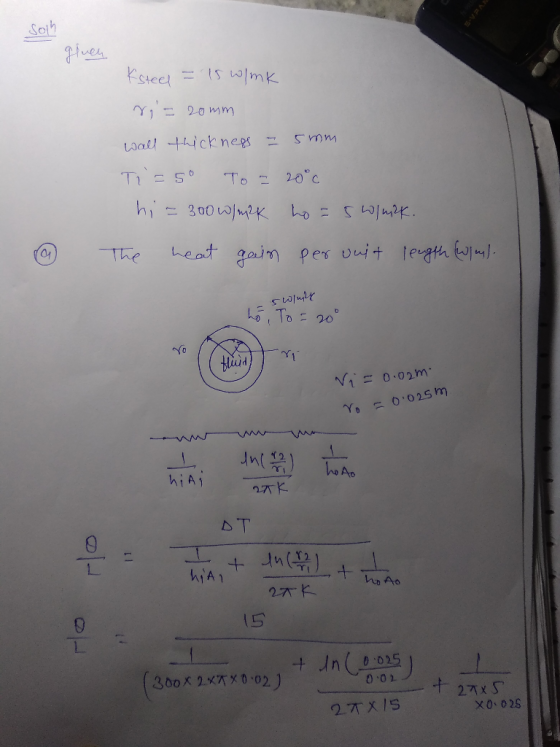
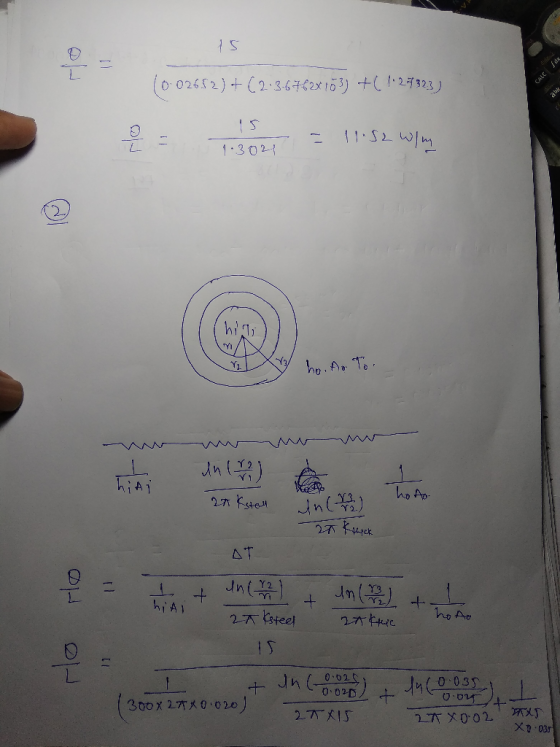
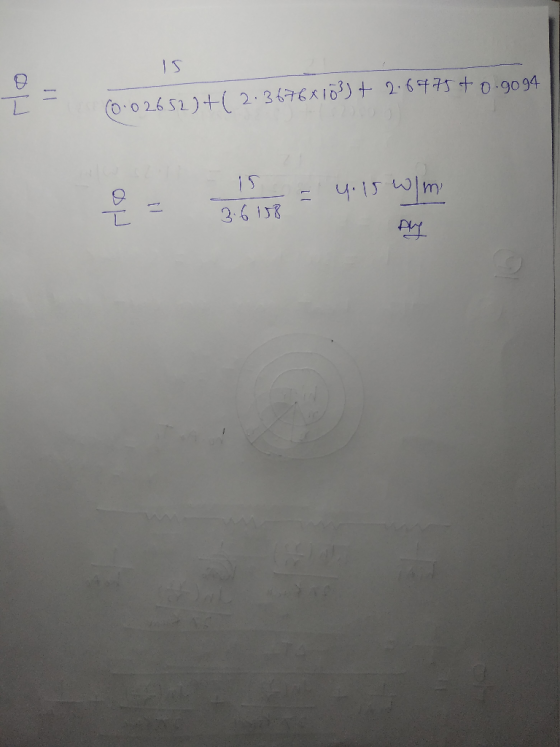
Please show every step clearly! Also, The blue is the answers, I
simply want to check my process.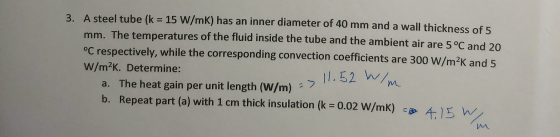
Homework Answers
Add Answer to:
Please show every step clearly! Also, The blue is the answers, I
simply want to check...
Questions 6-9 The walls of a refrigerator are typically constructed by sandwiching a layer of insulation...
 Questions 6-9 The walls of a refrigerator are typically constructed by sandwiching a layer of insulation between sheet metal panels. Consider a wall made from fiberglass insulation of thermal conductivity ki = 0.046 W/mK and thickness Li 50 mm and steel panels, each of thermal conductivity kp = 60 W/m. K and thickness Lp = 3 mm. If the wall separates refrigerated air at Too,i = 4°C from ambient air at T0o,0 = 25°C, what is the heat gain per...
Superheated steam flows steadily through steel tubing (k 35 W/m-K) applying a tube inner surface temperature...
 Superheated steam flows steadily through steel tubing (k 35 W/m-K) applying a tube inner surface temperature of 575°C. The tubing has an inner diameter of 300 mm and a wall thickness of 30 mm. Insulation (k 0.10 W/m-K) is applied to the outer surface of the tube while thin aluminum sheet is applied around the insulation as a protective covering. The ambient air at 27°C provides a convection coefficient of 6 W/m2-K. Determine the minimum insulation thickness necessary (mm) to...
IF YOU CANNOT SOLVE THEM ALL THEN PLEASE DONT SOLVE ANY. A hollow aluminum sphere, with...
 IF YOU CANNOT SOLVE THEM ALL THEN PLEASE DONT SOLVE ANY.
A hollow aluminum sphere, with an electrical heater in the center, is used in tests to determine the thermal conductivity of insulating materials. The inner and outer radii of the sphere are 0.15 and 0.18 m, respectively, and testing is done under steady-state conditions with the inner surface of the aluminum maintained at 250°C. In a particular test, a spherical shell of insulation is cast on the outer surface...
IF YOU CANNOT SOLVE THEM ALL THEN PLEASE DONT SOLVE ANY.
A hollow aluminum sphere, with an electrical heater in the center, is used in tests to determine the thermal conductivity of insulating materials. The inner and outer radii of the sphere are 0.15 and 0.18 m, respectively, and testing is done under steady-state conditions with the inner surface of the aluminum maintained at 250°C. In a particular test, a spherical shell of insulation is cast on the outer surface...
NE Steel tubes (k =35 W/m2.K) of 400-mm inner diameter and 30-mm wall thickness are used...
 NE Steel tubes (k =35 W/m2.K) of 400-mm inner diameter and 30-mm wall thickness are used to route superheated steam from the boller to the turbine in a power plant. Safety and economic concerns make it practical to add a 200-mm layer of Insulation (k =0.1 W/mK) to each tube, which is wrapped in a thin sheet of aluminum with an emissivity e =0.15. The air (with a convective coefficient h =5 W/m2K) and wail temperatures of the plant are...
A dormitory at a large university, built 50 years ago, has exterior walls constructed of L,...
 A dormitory at a large university, built 50 years ago, has exterior walls constructed of L, = 25-mm-thick sheathing with a thermal conductivity of k, = 0.1 W/m K. To reduce heat losses in the winter, the university decides to encapsulate the entire dormitory by applying an L = 25-mm-thick layer of extruded insulation characterized by kı = 0.029 W/m K to the exterior of the original sheathing. The extruded insulation is, in turn, covered with an L = 5-mm-thick...
Q1) Inner surface of a side wall is used for heating of ambient-room air as shown...
 Q1) Inner surface of a side wall is used for heating of ambient-room air as shown below. There is an electrical heater with 10 W/m2 heat flux generation between a layer of insulation and 2 cm thick marble exposed to ambient-room air at T-20 °C with h-20 W/m2K. k-0.04 W/mK Marble with a thickness of 2 cm Ts= 10 ℃ outside Ambient-room air at To Electrical heating layer (negligible thickness) of temperature T-? Insulation with a thickness of 5 cm...
A plane wall is composed of two materials. Material A has a uniform heat generation of...
 A plane wall is composed of two materials. Material A has a uniform heat generation of 100 kW/m3, a thermal conductivity of 50 W/mK, and a thickness of 10 cm. The inner surface of material A is well insulated. The other surface of material A is connected to Material B which has no generation with a thermal conductivity of 100 W/mK and a thickness of 20 cm. The outer surface of material B is cooled by ambient air at 300...
Consider the following composite wall of a building. It is made out of plaster board (Lp...
 Consider the following composite wall of a building. It is made out of plaster board (Lp 0.85 W/mK), glass fibre insulation (Lb-160 mm, k = 0.050 W/mK) and plywood (1,-40 m m, k = 0.70 W/mK) as shown below. On a certain day, the convective heat transfer coefficients inside and outside of the building are 35 W/m2K and 65 W/m2 K respectively. The inside and outside temperatures are 24°C and 36°C respectively. The wall has a total surface area of...
For such aircraft application (Figure 3), a wall is made from insulation material (k-0.030 W/m.K) and...
 For such aircraft application (Figure 3), a wall is made from insulation material (k-0.030 W/m.K) and the insulation material is mounted between four layers of carbon steel (2 mm thickness), the carbon layers are separated by a 2 mm air gap (kair-0.025 W/mK). Figure 3, the thermal conductivity of the carbon steel is (k-15.5 W/m.K). The temperature inside the wall is maintained at 6 °C. The environmental temperature is 24°C. The engineer would like to avoid condensation occurring at outer...
5. Hot water at 50 C is routed from one building in which it is generated...
 5. Hot water at 50 C is routed from one building in which it is generated to an adjoining building in which it is used for space heating. Transfer between the buildings occurs in a steel pipe (k -60 W/mK) of 100-mm outside diameter and 8-mm wall thickness. During the winter, representative environmental conditions involve air at T=-5 C and V= 3 m/s in cross flow over the pipe (a) If the cost of producing the hot water is $0.10...
 Questions 6-9 The walls of a refrigerator are typically constructed by sandwiching a layer of insulation between sheet metal panels. Consider a wall made from fiberglass insulation of thermal conductivity ki = 0.046 W/mK and thickness Li 50 mm and steel panels, each of thermal conductivity kp = 60 W/m. K and thickness Lp = 3 mm. If the wall separates refrigerated air at Too,i = 4°C from ambient air at T0o,0 = 25°C, what is the heat gain per...
 Superheated steam flows steadily through steel tubing (k 35 W/m-K) applying a tube inner surface temperature of 575°C. The tubing has an inner diameter of 300 mm and a wall thickness of 30 mm. Insulation (k 0.10 W/m-K) is applied to the outer surface of the tube while thin aluminum sheet is applied around the insulation as a protective covering. The ambient air at 27°C provides a convection coefficient of 6 W/m2-K. Determine the minimum insulation thickness necessary (mm) to...
 IF YOU CANNOT SOLVE THEM ALL THEN PLEASE DONT SOLVE ANY.
A hollow aluminum sphere, with an electrical heater in the center, is used in tests to determine the thermal conductivity of insulating materials. The inner and outer radii of the sphere are 0.15 and 0.18 m, respectively, and testing is done under steady-state conditions with the inner surface of the aluminum maintained at 250°C. In a particular test, a spherical shell of insulation is cast on the outer surface...
IF YOU CANNOT SOLVE THEM ALL THEN PLEASE DONT SOLVE ANY.
A hollow aluminum sphere, with an electrical heater in the center, is used in tests to determine the thermal conductivity of insulating materials. The inner and outer radii of the sphere are 0.15 and 0.18 m, respectively, and testing is done under steady-state conditions with the inner surface of the aluminum maintained at 250°C. In a particular test, a spherical shell of insulation is cast on the outer surface...
 NE Steel tubes (k =35 W/m2.K) of 400-mm inner diameter and 30-mm wall thickness are used to route superheated steam from the boller to the turbine in a power plant. Safety and economic concerns make it practical to add a 200-mm layer of Insulation (k =0.1 W/mK) to each tube, which is wrapped in a thin sheet of aluminum with an emissivity e =0.15. The air (with a convective coefficient h =5 W/m2K) and wail temperatures of the plant are...
 A dormitory at a large university, built 50 years ago, has exterior walls constructed of L, = 25-mm-thick sheathing with a thermal conductivity of k, = 0.1 W/m K. To reduce heat losses in the winter, the university decides to encapsulate the entire dormitory by applying an L = 25-mm-thick layer of extruded insulation characterized by kı = 0.029 W/m K to the exterior of the original sheathing. The extruded insulation is, in turn, covered with an L = 5-mm-thick...
 Q1) Inner surface of a side wall is used for heating of ambient-room air as shown below. There is an electrical heater with 10 W/m2 heat flux generation between a layer of insulation and 2 cm thick marble exposed to ambient-room air at T-20 °C with h-20 W/m2K. k-0.04 W/mK Marble with a thickness of 2 cm Ts= 10 ℃ outside Ambient-room air at To Electrical heating layer (negligible thickness) of temperature T-? Insulation with a thickness of 5 cm...
 A plane wall is composed of two materials. Material A has a uniform heat generation of 100 kW/m3, a thermal conductivity of 50 W/mK, and a thickness of 10 cm. The inner surface of material A is well insulated. The other surface of material A is connected to Material B which has no generation with a thermal conductivity of 100 W/mK and a thickness of 20 cm. The outer surface of material B is cooled by ambient air at 300...
 Consider the following composite wall of a building. It is made out of plaster board (Lp 0.85 W/mK), glass fibre insulation (Lb-160 mm, k = 0.050 W/mK) and plywood (1,-40 m m, k = 0.70 W/mK) as shown below. On a certain day, the convective heat transfer coefficients inside and outside of the building are 35 W/m2K and 65 W/m2 K respectively. The inside and outside temperatures are 24°C and 36°C respectively. The wall has a total surface area of...
 For such aircraft application (Figure 3), a wall is made from insulation material (k-0.030 W/m.K) and the insulation material is mounted between four layers of carbon steel (2 mm thickness), the carbon layers are separated by a 2 mm air gap (kair-0.025 W/mK). Figure 3, the thermal conductivity of the carbon steel is (k-15.5 W/m.K). The temperature inside the wall is maintained at 6 °C. The environmental temperature is 24°C. The engineer would like to avoid condensation occurring at outer...
 5. Hot water at 50 C is routed from one building in which it is generated to an adjoining building in which it is used for space heating. Transfer between the buildings occurs in a steel pipe (k -60 W/mK) of 100-mm outside diameter and 8-mm wall thickness. During the winter, representative environmental conditions involve air at T=-5 C and V= 3 m/s in cross flow over the pipe (a) If the cost of producing the hot water is $0.10...
Most questions answered within 3 hours.
-
Where is the error in this code sequence?
String s1 = "Hello";
String s2 = "ello";...
asked 11 months ago -
Financial data for Joel de Paris, Inc., for last year
follow:
Joel de Paris, Inc.
Balance...
asked 11 months ago -
Consider this reaction:
Al2(SO4)3 (aq)+ BaCl3
(aq) Al2Cl6 (aq)- +
3BaSO4(s) . What is the...
asked 11 months ago -
Suppose that Savneet is considering increasing her
recent random sample from 20 car rentals to 40...
asked 11 months ago -
Trucks arrive at an unloading terminal at an average rate of 120
per hour.
Trucks arrive...
asked 11 months ago -
Why are methanol and ethanol completely soluble in water while
octanol is not very little soluble....
asked 11 months ago -
A facilities manager at a university reads in a research report
that the mean amount of...
asked 11 months ago -
When the CuSO4 is rehydrated by adding water to the anhydrous
compound, is this an endothermic...
asked 11 months ago -
A ray of sunlight is passing from diamond into crown glass; the
angle of incidence is...
asked 11 months ago -
A block of mass 0.249 kg is placed on top of a light, vertical
spring of...
asked 11 months ago -
how do the kidneys compensate in the presences of acidosis
a) trigger hyperventilate
b) reserve acid...
asked 11 months ago -
Question 501 pts
The rental rate of capital to the firm increases. Which of the
following...
asked 11 months ago