
Homework Answers
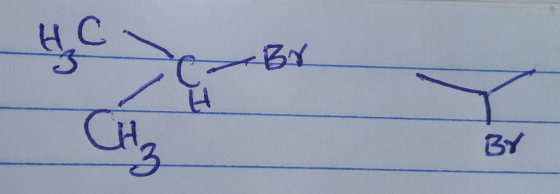
The compound has peak at 79 and 81 m/z in equal intensity might be due to bromide ion
The compound has base peak at m/z 43 might be due to isopropyl cation
The compound has intense peak at 15 is due methyl cation
Therefore the structure of the compound might be isopropyl bromide
Add Answer to:
. The peaks for 1.22. 21.16 The molecular ion for compound D does not appear in...
15. The mass spectrum of a compound appears below. The molecular ion, M+1, and M+2 peaks...
 15. The mass spectrum of a compound appears below. The molecular ion, M+1, and M+2 peaks have intensities of 100, 6.8, and 31.8 respectively. Use the information provided to determine the formula of the compound 100 MS-NW-5495 80 60 40 20 шшшl 110 10 20 30 40 50 60 70 80 90 100 m/z Relative Intensity
15. The mass spectrum of a compound appears below. The molecular ion, M+1, and M+2 peaks have intensities of 100, 6.8, and 31.8 respectively....
15. The mass spectrum of a compound appears below. The molecular ion, M+1, and M+2 peaks have intensities of 100, 6.8, and 31.8 respectively. Use the information provided to determine the formula of the compound 100 MS-NW-5495 80 60 40 20 шшшl 110 10 20 30 40 50 60 70 80 90 100 m/z Relative Intensity
15. The mass spectrum of a compound appears below. The molecular ion, M+1, and M+2 peaks have intensities of 100, 6.8, and 31.8 respectively....
a) Describe the difference between the base peak and the parent ion (or molecular ion) peak....
 a) Describe the difference between the base peak and the parent
ion (or molecular ion) peak.
b) Identify the base peak and the parent ion (or molecular ion)
peak (if any) according to the mass spectrum.
c) Identify the mass fragments which correspond to m/z = 77,
105, 111, and 139.
d) Identify and give explanations for the magnitude (or
intensity) of the peaks at m/z = 113, 141, and 218.
Mass Spectrum ofp-C hlorobenzophenone 105 100 80 139 CI...
a) Describe the difference between the base peak and the parent
ion (or molecular ion) peak.
b) Identify the base peak and the parent ion (or molecular ion)
peak (if any) according to the mass spectrum.
c) Identify the mass fragments which correspond to m/z = 77,
105, 111, and 139.
d) Identify and give explanations for the magnitude (or
intensity) of the peaks at m/z = 113, 141, and 218.
Mass Spectrum ofp-C hlorobenzophenone 105 100 80 139 CI...
Label the molecular ion and base peaks on the mass spectrui Delu 100 レase peak ion 1020 3o 40 o ...
 need to fill the boxes
Label the molecular ion and base peaks on the mass spectrui Delu 100 レase peak ion 1020 3o 40 o 6O 70 B0 100 m/z What element does the analyte molecule likely contain? Propose one possible molecular formula for the analyte molecule. ELEMENT: POSSIBLE FORMULA: The mass spectrum of 2.2'-dibromobiphenyl is shown below, along with a proposed structure of the m/z 314 peak. Based on this information, propose structures for the other two peaks indicated....
need to fill the boxes
Label the molecular ion and base peaks on the mass spectrui Delu 100 レase peak ion 1020 3o 40 o 6O 70 B0 100 m/z What element does the analyte molecule likely contain? Propose one possible molecular formula for the analyte molecule. ELEMENT: POSSIBLE FORMULA: The mass spectrum of 2.2'-dibromobiphenyl is shown below, along with a proposed structure of the m/z 314 peak. Based on this information, propose structures for the other two peaks indicated....
Compound A has the molecular formula C10H14. a) Calculate the unsaturation number or IHD. b) Prov...
 Compound A has the molecular formula C10H14.
a) Calculate the unsaturation number or IHD.
b) Provide the molecular ion observed in the mass spectrum,
including its units.
c) Propose a structure based on the carbon-13 NMR spectrum
given.
CH3 CH Compound A CDCl3 160 140 120100 80 60 40 20 0
CH3 CH Compound A CDCl3 160 140 120100 80 60 40 20 0
Compound A has the molecular formula C10H14.
a) Calculate the unsaturation number or IHD.
b) Provide the molecular ion observed in the mass spectrum,
including its units.
c) Propose a structure based on the carbon-13 NMR spectrum
given.
CH3 CH Compound A CDCl3 160 140 120100 80 60 40 20 0
CH3 CH Compound A CDCl3 160 140 120100 80 60 40 20 0
The molecular weight of a compound is typically indicated by the heaviest peak on a mass...
 The molecular weight of a compound is typically indicated by the heaviest peak on a mass spectrum, which i presumed to correspond to the molecular ion (M*). For smaller compounds, the heaviest peak tends to also be the most intense peak. The lighter peaks in the spectrum result from fragmentation of the molecule into smaller ions. Since peak intensity correlates to the relative stability of the ions produced, the peaks of the ionized fragments can be more intense than the...
1. Provide structures for the following peaks in the mass spectrum for methyl chloride 15, 49,...
 1. Provide structures for the following peaks in the mass spectrum for methyl chloride 15, 49, 50, 51, 52. No mechanism is needed; just provide the structures. LLLLLLLL TTTTT 120 140 160 80 100 . 4. Two mass spectra are shown below. One is that of 2-pentanone and the other is oly pentanone. Which is which? Show how you made your decision. TTTTTTTTTTTTTT 100 120 140 160 20 40 TT 140 . 1601 40 60 80 100 pronde a mechansen...
1. Identify the number of compounds in the image. 2. Find the RT of each compound...
 1. Identify the number of
compounds in the image.
2. Find the RT of each compound in the image.
3. Find the percent of each compound in the image.
Compound 15: 2,3-dibromobutane a. Draw out the structure. b. Label the molecular ion peak and base peak. C. Assign structures to the fragment ion peaks at m/e 135 & m/e 137, m/e 107 & m/e 109, and m/e 55. Mass Spectrum 100 80 135 137 Relative Intensity 107 109 214 216...
1. Identify the number of
compounds in the image.
2. Find the RT of each compound in the image.
3. Find the percent of each compound in the image.
Compound 15: 2,3-dibromobutane a. Draw out the structure. b. Label the molecular ion peak and base peak. C. Assign structures to the fragment ion peaks at m/e 135 & m/e 137, m/e 107 & m/e 109, and m/e 55. Mass Spectrum 100 80 135 137 Relative Intensity 107 109 214 216...
I am not understanding this assignment at all. Any assistance is very much appreciated. Mass Spectrum: Molecular Ion m/z value and structure of the Molecular Ion. Base Peak m/z value and structure of...
 I am not understanding this assignment at all. Any assistance is
very much appreciated.
Mass Spectrum:
Molecular Ion m/z value and structure of the Molecular Ion.
Base Peak m/z value and structure of that ion
One other significant peak m/z value and structure of that
ion
C13 NMR Spectrum-- Draw Structure of Compound
on the C13 NMR spectrum and identify each signal with the
appropriate Carbon.
Proton NMR Spectrum-- Draw Structure of
Compound on the Proton NMR spectrum and identify...
I am not understanding this assignment at all. Any assistance is
very much appreciated.
Mass Spectrum:
Molecular Ion m/z value and structure of the Molecular Ion.
Base Peak m/z value and structure of that ion
One other significant peak m/z value and structure of that
ion
C13 NMR Spectrum-- Draw Structure of Compound
on the C13 NMR spectrum and identify each signal with the
appropriate Carbon.
Proton NMR Spectrum-- Draw Structure of
Compound on the Proton NMR spectrum and identify...
28. A compound with the molecular formula of C3H.ON shows 1H NMR and 13C NMR as...
 28. A compound with the molecular formula of C3H.ON shows 1H NMR and 13C NMR as below. Give the most plausible structure in the box. 2H, 3 peaks 2H, 3 peaks 1H, 1 peak PPM 180 160 140 120 100 80 60 40 20 PPM
Determine the structure of the assigned acyl chloride. Find molecular formula, lable peaks and stuctures. Acyl...
 Determine the structure of the assigned acyl chloride. Find
molecular formula, lable peaks and stuctures.
Acyl Chloride #1 d-1.303 g/mL 100004-025 M+ 160 80 60 40 M+2 162 20 20 40 60 8100 120 140 160 180 200 m/z Hint: aromatic ring is a thiophene 11 10 5 432 ppm All singlets (6 total signals) Three peaks 200 180 160 140 120 100 60 420 CDS-05-174
Determine the structure of the assigned acyl chloride. Find
molecular formula, lable peaks and stuctures.
Acyl Chloride #1 d-1.303 g/mL 100004-025 M+ 160 80 60 40 M+2 162 20 20 40 60 8100 120 140 160 180 200 m/z Hint: aromatic ring is a thiophene 11 10 5 432 ppm All singlets (6 total signals) Three peaks 200 180 160 140 120 100 60 420 CDS-05-174
 15. The mass spectrum of a compound appears below. The molecular ion, M+1, and M+2 peaks have intensities of 100, 6.8, and 31.8 respectively. Use the information provided to determine the formula of the compound 100 MS-NW-5495 80 60 40 20 шшшl 110 10 20 30 40 50 60 70 80 90 100 m/z Relative Intensity
15. The mass spectrum of a compound appears below. The molecular ion, M+1, and M+2 peaks have intensities of 100, 6.8, and 31.8 respectively....
15. The mass spectrum of a compound appears below. The molecular ion, M+1, and M+2 peaks have intensities of 100, 6.8, and 31.8 respectively. Use the information provided to determine the formula of the compound 100 MS-NW-5495 80 60 40 20 шшшl 110 10 20 30 40 50 60 70 80 90 100 m/z Relative Intensity
15. The mass spectrum of a compound appears below. The molecular ion, M+1, and M+2 peaks have intensities of 100, 6.8, and 31.8 respectively....
 a) Describe the difference between the base peak and the parent
ion (or molecular ion) peak.
b) Identify the base peak and the parent ion (or molecular ion)
peak (if any) according to the mass spectrum.
c) Identify the mass fragments which correspond to m/z = 77,
105, 111, and 139.
d) Identify and give explanations for the magnitude (or
intensity) of the peaks at m/z = 113, 141, and 218.
Mass Spectrum ofp-C hlorobenzophenone 105 100 80 139 CI...
a) Describe the difference between the base peak and the parent
ion (or molecular ion) peak.
b) Identify the base peak and the parent ion (or molecular ion)
peak (if any) according to the mass spectrum.
c) Identify the mass fragments which correspond to m/z = 77,
105, 111, and 139.
d) Identify and give explanations for the magnitude (or
intensity) of the peaks at m/z = 113, 141, and 218.
Mass Spectrum ofp-C hlorobenzophenone 105 100 80 139 CI...
 need to fill the boxes
Label the molecular ion and base peaks on the mass spectrui Delu 100 レase peak ion 1020 3o 40 o 6O 70 B0 100 m/z What element does the analyte molecule likely contain? Propose one possible molecular formula for the analyte molecule. ELEMENT: POSSIBLE FORMULA: The mass spectrum of 2.2'-dibromobiphenyl is shown below, along with a proposed structure of the m/z 314 peak. Based on this information, propose structures for the other two peaks indicated....
need to fill the boxes
Label the molecular ion and base peaks on the mass spectrui Delu 100 レase peak ion 1020 3o 40 o 6O 70 B0 100 m/z What element does the analyte molecule likely contain? Propose one possible molecular formula for the analyte molecule. ELEMENT: POSSIBLE FORMULA: The mass spectrum of 2.2'-dibromobiphenyl is shown below, along with a proposed structure of the m/z 314 peak. Based on this information, propose structures for the other two peaks indicated....
 Compound A has the molecular formula C10H14.
a) Calculate the unsaturation number or IHD.
b) Provide the molecular ion observed in the mass spectrum,
including its units.
c) Propose a structure based on the carbon-13 NMR spectrum
given.
CH3 CH Compound A CDCl3 160 140 120100 80 60 40 20 0
CH3 CH Compound A CDCl3 160 140 120100 80 60 40 20 0
Compound A has the molecular formula C10H14.
a) Calculate the unsaturation number or IHD.
b) Provide the molecular ion observed in the mass spectrum,
including its units.
c) Propose a structure based on the carbon-13 NMR spectrum
given.
CH3 CH Compound A CDCl3 160 140 120100 80 60 40 20 0
CH3 CH Compound A CDCl3 160 140 120100 80 60 40 20 0
 The molecular weight of a compound is typically indicated by the heaviest peak on a mass spectrum, which i presumed to correspond to the molecular ion (M*). For smaller compounds, the heaviest peak tends to also be the most intense peak. The lighter peaks in the spectrum result from fragmentation of the molecule into smaller ions. Since peak intensity correlates to the relative stability of the ions produced, the peaks of the ionized fragments can be more intense than the...
 1. Provide structures for the following peaks in the mass spectrum for methyl chloride 15, 49, 50, 51, 52. No mechanism is needed; just provide the structures. LLLLLLLL TTTTT 120 140 160 80 100 . 4. Two mass spectra are shown below. One is that of 2-pentanone and the other is oly pentanone. Which is which? Show how you made your decision. TTTTTTTTTTTTTT 100 120 140 160 20 40 TT 140 . 1601 40 60 80 100 pronde a mechansen...
 1. Identify the number of
compounds in the image.
2. Find the RT of each compound in the image.
3. Find the percent of each compound in the image.
Compound 15: 2,3-dibromobutane a. Draw out the structure. b. Label the molecular ion peak and base peak. C. Assign structures to the fragment ion peaks at m/e 135 & m/e 137, m/e 107 & m/e 109, and m/e 55. Mass Spectrum 100 80 135 137 Relative Intensity 107 109 214 216...
1. Identify the number of
compounds in the image.
2. Find the RT of each compound in the image.
3. Find the percent of each compound in the image.
Compound 15: 2,3-dibromobutane a. Draw out the structure. b. Label the molecular ion peak and base peak. C. Assign structures to the fragment ion peaks at m/e 135 & m/e 137, m/e 107 & m/e 109, and m/e 55. Mass Spectrum 100 80 135 137 Relative Intensity 107 109 214 216...
 I am not understanding this assignment at all. Any assistance is
very much appreciated.
Mass Spectrum:
Molecular Ion m/z value and structure of the Molecular Ion.
Base Peak m/z value and structure of that ion
One other significant peak m/z value and structure of that
ion
C13 NMR Spectrum-- Draw Structure of Compound
on the C13 NMR spectrum and identify each signal with the
appropriate Carbon.
Proton NMR Spectrum-- Draw Structure of
Compound on the Proton NMR spectrum and identify...
I am not understanding this assignment at all. Any assistance is
very much appreciated.
Mass Spectrum:
Molecular Ion m/z value and structure of the Molecular Ion.
Base Peak m/z value and structure of that ion
One other significant peak m/z value and structure of that
ion
C13 NMR Spectrum-- Draw Structure of Compound
on the C13 NMR spectrum and identify each signal with the
appropriate Carbon.
Proton NMR Spectrum-- Draw Structure of
Compound on the Proton NMR spectrum and identify...
 28. A compound with the molecular formula of C3H.ON shows 1H NMR and 13C NMR as below. Give the most plausible structure in the box. 2H, 3 peaks 2H, 3 peaks 1H, 1 peak PPM 180 160 140 120 100 80 60 40 20 PPM
 Determine the structure of the assigned acyl chloride. Find
molecular formula, lable peaks and stuctures.
Acyl Chloride #1 d-1.303 g/mL 100004-025 M+ 160 80 60 40 M+2 162 20 20 40 60 8100 120 140 160 180 200 m/z Hint: aromatic ring is a thiophene 11 10 5 432 ppm All singlets (6 total signals) Three peaks 200 180 160 140 120 100 60 420 CDS-05-174
Determine the structure of the assigned acyl chloride. Find
molecular formula, lable peaks and stuctures.
Acyl Chloride #1 d-1.303 g/mL 100004-025 M+ 160 80 60 40 M+2 162 20 20 40 60 8100 120 140 160 180 200 m/z Hint: aromatic ring is a thiophene 11 10 5 432 ppm All singlets (6 total signals) Three peaks 200 180 160 140 120 100 60 420 CDS-05-174
Most questions answered within 3 hours.
-
Where is the error in this code sequence?
String s1 = "Hello";
String s2 = "ello";...
asked 11 months ago -
Financial data for Joel de Paris, Inc., for last year
follow:
Joel de Paris, Inc.
Balance...
asked 11 months ago -
Consider this reaction:
Al2(SO4)3 (aq)+ BaCl3
(aq) Al2Cl6 (aq)- +
3BaSO4(s) . What is the...
asked 11 months ago -
Suppose that Savneet is considering increasing her
recent random sample from 20 car rentals to 40...
asked 11 months ago -
Trucks arrive at an unloading terminal at an average rate of 120
per hour.
Trucks arrive...
asked 11 months ago -
Why are methanol and ethanol completely soluble in water while
octanol is not very little soluble....
asked 11 months ago -
A facilities manager at a university reads in a research report
that the mean amount of...
asked 11 months ago -
When the CuSO4 is rehydrated by adding water to the anhydrous
compound, is this an endothermic...
asked 11 months ago -
A ray of sunlight is passing from diamond into crown glass; the
angle of incidence is...
asked 11 months ago -
A block of mass 0.249 kg is placed on top of a light, vertical
spring of...
asked 11 months ago -
how do the kidneys compensate in the presences of acidosis
a) trigger hyperventilate
b) reserve acid...
asked 11 months ago -
Question 501 pts
The rental rate of capital to the firm increases. Which of the
following...
asked 11 months ago