Determine the Rankine active force per unit length of the wall.
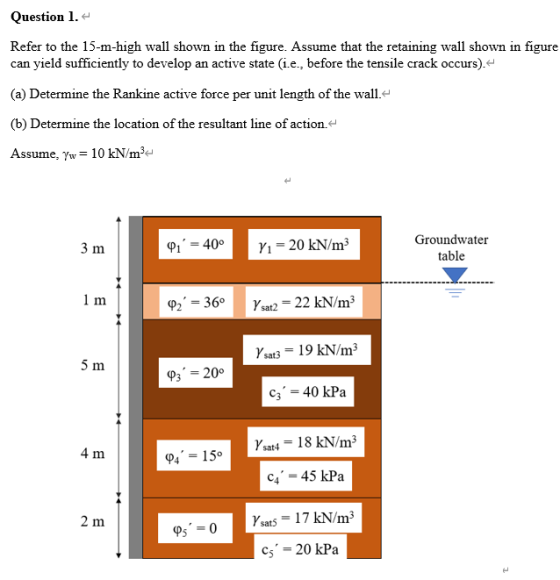
Refer to the 15-m-high wall shown in the figure. Assume that the retaining wall shown in figure can yield sufficiently to develop an active state (i.e., before the tensile crack occurs).
(a) Determine the Rankine active force per unit length of the wall.
(b) Determine the location of the resultant line of action.
Assume, γw = 10 kN/m3
Homework Answers
Request Answer!
We need at least 9 more requests to produce the answer.
1 / 10 have requested this problem solution
The more requests, the faster the answer.
fondation engineering si unit (8 marks) 4. A vertical retaining wall (shown in the figure below)...
 fondation engineering si unit
(8 marks) 4. A vertical retaining wall (shown in the figure below) is 8 m high with horizontal backfill. the properties of the backfill are as shown on the figure. Determine a. the Rankine active force per unit length of the wall before the occurrence of the tensile crack. Yw 9.81 kN/m3. b. The location of the Rankine active force. qs 20 kN/㎡ 5 m 2 Sandy Clay 3 m Sand
fondation engineering si unit
(8 marks) 4. A vertical retaining wall (shown in the figure below) is 8 m high with horizontal backfill. the properties of the backfill are as shown on the figure. Determine a. the Rankine active force per unit length of the wall before the occurrence of the tensile crack. Yw 9.81 kN/m3. b. The location of the Rankine active force. qs 20 kN/㎡ 5 m 2 Sandy Clay 3 m Sand
(1) Assume that the retaining wall shown in Fig. 1 can yield sufficiently to develop an...
 (1) Assume that the retaining wall shown in Fig. 1 can yield sufficiently to develop an active state. Determine the Rankine active force per unit length of the wall and the location of the resultant line of action. Given: 9 = 15 kN/mʻ, Hi = 3m, H2 = 6m, y1=19 kN/m, 61 = 28°, C'=0, Y 2 = y s =22 kN/m², 62 = 34°, ca'= 0.( 40%) Groundwater table H2 Fig. I
Question 3 125-Points Assume that the retaining wall shown in the figure below can yield suffieiently...
 Question 3 125-Points Assume that the retaining wall shown in the figure below can yield suffieiently to develop an active state. Determine the Rankine active force per unit length of the wall and the Jocation of the resultant line of action, y-16.5 kN/m de'm 30 2.5 m Ground water table Yeat= 19.3 kN/m '30° c'0 2.5 m (a) Question 4 I 25-Points and ie -hown in the figure below, Assume
Question 3 125-Points Assume that the retaining wall shown in...
Question 3 125-Points Assume that the retaining wall shown in the figure below can yield suffieiently to develop an active state. Determine the Rankine active force per unit length of the wall and the Jocation of the resultant line of action, y-16.5 kN/m de'm 30 2.5 m Ground water table Yeat= 19.3 kN/m '30° c'0 2.5 m (a) Question 4 I 25-Points and ie -hown in the figure below, Assume
Question 3 125-Points Assume that the retaining wall shown in...
( You do not have to solve number 2. I need number 3.) Problem 2(15 points). Refer...
 ( You do not have to solve number 2. I need
number 3.)
Problem 2(15 points). Refer to Figure 2 below. Given the height of the retaining wall, H is 18ft, the backfill is a saturated clay with, ф, 0°, c-500 lb/ft, Y-120 lb/ft. sat (a) Determine the Rankine active pressure distribution diagram behind the wall. Determine the depth of the tensile crack, zc (c) Estimate the Rankine active force per foot length of the wall before and after the occurrence...
( You do not have to solve number 2. I need
number 3.)
Problem 2(15 points). Refer to Figure 2 below. Given the height of the retaining wall, H is 18ft, the backfill is a saturated clay with, ф, 0°, c-500 lb/ft, Y-120 lb/ft. sat (a) Determine the Rankine active pressure distribution diagram behind the wall. Determine the depth of the tensile crack, zc (c) Estimate the Rankine active force per foot length of the wall before and after the occurrence...
problem 4: For the retaining wall shown, Determine a. the active lateral earth pressure distribution b....
 problem 4: For the retaining wall shown, Determine a. the active lateral earth pressure distribution b. the passive lateral earth pressure distribution c. the magnitude and location of the active lateral force on the wall d. the magnitude and location of the passive lateral force on the wall e. the depth of crack from the surface [use Rankine method] Ignore hydrostatic pressure. y 110 pcf p 12, C 420 psf 30' Y 110 pcf φ 100 C 500 psf Y...
A gravity retaining wall is shown in figure. Use Rankine active earth pressure theory. Determine: a. The factor of safety against overturning b. The factor of safety against sliding c. The factor of safety for bearing capacity d. The pressure on the soil
 A gravity retaining wall is shown in figure. Use Rankine active earth pressure theory. Determine:a. The factor of safety against overturningb. The factor of safety against slidingc. The factor of safety for bearing capacityd. The pressure on the soil at the toe and heelAssume, γconcrete = 24 kN/m3. Also, consider the weight of the soil behind the wall and consider the passive earth pressure.
6-12 Use Coulomb's method to determine the magnitude and direction of the total lateral force against...
6-12 Use Coulomb's method to determine the magnitude and direction of the total lateral force against the retaining wall of problem 6-5. Assume the friction angle between the wall and the soil to be 2/3*phi. Make one trial only, using an assumed failure surface at an angle of 60 degrees from horizontal. Problem 6-5 is: Use Rankine's method to determine the magnitude and location of the resultant active force against a retaining wall 6 m high. There is a water...
Sove for part 1 CV 5263 HW 1 (2018-19) Name: Problem 2: Lateral Earth Pressure Theories...
 Sove for part 1
CV 5263 HW 1 (2018-19) Name: Problem 2: Lateral Earth Pressure Theories For both part 1 and part 2 determine: Magnitude of active resultant force per length of wall Location (height) of the active resultant force from the base of wall Direction (angle above horizontal) of the active resultant force Horizontal component of the active resultant force per length of wall Vertical component of the active resultant force per length of wall . Part 1: Coulomb...
Sove for part 1
CV 5263 HW 1 (2018-19) Name: Problem 2: Lateral Earth Pressure Theories For both part 1 and part 2 determine: Magnitude of active resultant force per length of wall Location (height) of the active resultant force from the base of wall Direction (angle above horizontal) of the active resultant force Horizontal component of the active resultant force per length of wall Vertical component of the active resultant force per length of wall . Part 1: Coulomb...
I don't understand how to solve for the direction of the line of action. Refer to...
 I don't understand how to solve for the direction of the line of
action.
Refer to the retaining wall shown in Figure 12.45. Given: γ-16.5 kN/m H-3 m, and δ-0. Determine the magnitude of the passive force per unit length of the wall, its location, and its direction of the line of action.
I don't understand how to solve for the direction of the line of
action.
Refer to the retaining wall shown in Figure 12.45. Given: γ-16.5 kN/m H-3 m, and δ-0. Determine the magnitude of the passive force per unit length of the wall, its location, and its direction of the line of action.
Solve part 2, CV 5263 HW 1 (2018-19) Name: Problem 2: Lateral Earth Pressure Theories For...
 Solve part 2,
CV 5263 HW 1 (2018-19) Name: Problem 2: Lateral Earth Pressure Theories For both part 1 and part 2 determine: e Magnitude of active resultant force per length of wall e Location (height) of the active resultant force from the base of wall Direction (angle above horizontal) of the active resultant force Horizontal component of the active resultant force per length of wall Vertical component of the active resultant force per length of wall . Part 1:...
Solve part 2,
CV 5263 HW 1 (2018-19) Name: Problem 2: Lateral Earth Pressure Theories For both part 1 and part 2 determine: e Magnitude of active resultant force per length of wall e Location (height) of the active resultant force from the base of wall Direction (angle above horizontal) of the active resultant force Horizontal component of the active resultant force per length of wall Vertical component of the active resultant force per length of wall . Part 1:...
 fondation engineering si unit
(8 marks) 4. A vertical retaining wall (shown in the figure below) is 8 m high with horizontal backfill. the properties of the backfill are as shown on the figure. Determine a. the Rankine active force per unit length of the wall before the occurrence of the tensile crack. Yw 9.81 kN/m3. b. The location of the Rankine active force. qs 20 kN/㎡ 5 m 2 Sandy Clay 3 m Sand
fondation engineering si unit
(8 marks) 4. A vertical retaining wall (shown in the figure below) is 8 m high with horizontal backfill. the properties of the backfill are as shown on the figure. Determine a. the Rankine active force per unit length of the wall before the occurrence of the tensile crack. Yw 9.81 kN/m3. b. The location of the Rankine active force. qs 20 kN/㎡ 5 m 2 Sandy Clay 3 m Sand
 (1) Assume that the retaining wall shown in Fig. 1 can yield sufficiently to develop an active state. Determine the Rankine active force per unit length of the wall and the location of the resultant line of action. Given: 9 = 15 kN/mʻ, Hi = 3m, H2 = 6m, y1=19 kN/m, 61 = 28°, C'=0, Y 2 = y s =22 kN/m², 62 = 34°, ca'= 0.( 40%) Groundwater table H2 Fig. I
 Question 3 125-Points Assume that the retaining wall shown in the figure below can yield suffieiently to develop an active state. Determine the Rankine active force per unit length of the wall and the Jocation of the resultant line of action, y-16.5 kN/m de'm 30 2.5 m Ground water table Yeat= 19.3 kN/m '30° c'0 2.5 m (a) Question 4 I 25-Points and ie -hown in the figure below, Assume
Question 3 125-Points Assume that the retaining wall shown in...
Question 3 125-Points Assume that the retaining wall shown in the figure below can yield suffieiently to develop an active state. Determine the Rankine active force per unit length of the wall and the Jocation of the resultant line of action, y-16.5 kN/m de'm 30 2.5 m Ground water table Yeat= 19.3 kN/m '30° c'0 2.5 m (a) Question 4 I 25-Points and ie -hown in the figure below, Assume
Question 3 125-Points Assume that the retaining wall shown in...
 ( You do not have to solve number 2. I need
number 3.)
Problem 2(15 points). Refer to Figure 2 below. Given the height of the retaining wall, H is 18ft, the backfill is a saturated clay with, ф, 0°, c-500 lb/ft, Y-120 lb/ft. sat (a) Determine the Rankine active pressure distribution diagram behind the wall. Determine the depth of the tensile crack, zc (c) Estimate the Rankine active force per foot length of the wall before and after the occurrence...
( You do not have to solve number 2. I need
number 3.)
Problem 2(15 points). Refer to Figure 2 below. Given the height of the retaining wall, H is 18ft, the backfill is a saturated clay with, ф, 0°, c-500 lb/ft, Y-120 lb/ft. sat (a) Determine the Rankine active pressure distribution diagram behind the wall. Determine the depth of the tensile crack, zc (c) Estimate the Rankine active force per foot length of the wall before and after the occurrence...
 problem 4: For the retaining wall shown, Determine a. the active lateral earth pressure distribution b. the passive lateral earth pressure distribution c. the magnitude and location of the active lateral force on the wall d. the magnitude and location of the passive lateral force on the wall e. the depth of crack from the surface [use Rankine method] Ignore hydrostatic pressure. y 110 pcf p 12, C 420 psf 30' Y 110 pcf φ 100 C 500 psf Y...
 Sove for part 1
CV 5263 HW 1 (2018-19) Name: Problem 2: Lateral Earth Pressure Theories For both part 1 and part 2 determine: Magnitude of active resultant force per length of wall Location (height) of the active resultant force from the base of wall Direction (angle above horizontal) of the active resultant force Horizontal component of the active resultant force per length of wall Vertical component of the active resultant force per length of wall . Part 1: Coulomb...
Sove for part 1
CV 5263 HW 1 (2018-19) Name: Problem 2: Lateral Earth Pressure Theories For both part 1 and part 2 determine: Magnitude of active resultant force per length of wall Location (height) of the active resultant force from the base of wall Direction (angle above horizontal) of the active resultant force Horizontal component of the active resultant force per length of wall Vertical component of the active resultant force per length of wall . Part 1: Coulomb...
 I don't understand how to solve for the direction of the line of
action.
Refer to the retaining wall shown in Figure 12.45. Given: γ-16.5 kN/m H-3 m, and δ-0. Determine the magnitude of the passive force per unit length of the wall, its location, and its direction of the line of action.
I don't understand how to solve for the direction of the line of
action.
Refer to the retaining wall shown in Figure 12.45. Given: γ-16.5 kN/m H-3 m, and δ-0. Determine the magnitude of the passive force per unit length of the wall, its location, and its direction of the line of action.
 Solve part 2,
CV 5263 HW 1 (2018-19) Name: Problem 2: Lateral Earth Pressure Theories For both part 1 and part 2 determine: e Magnitude of active resultant force per length of wall e Location (height) of the active resultant force from the base of wall Direction (angle above horizontal) of the active resultant force Horizontal component of the active resultant force per length of wall Vertical component of the active resultant force per length of wall . Part 1:...
Solve part 2,
CV 5263 HW 1 (2018-19) Name: Problem 2: Lateral Earth Pressure Theories For both part 1 and part 2 determine: e Magnitude of active resultant force per length of wall e Location (height) of the active resultant force from the base of wall Direction (angle above horizontal) of the active resultant force Horizontal component of the active resultant force per length of wall Vertical component of the active resultant force per length of wall . Part 1:...
Most questions answered within 3 hours.
-
Where is the error in this code sequence?
String s1 = "Hello";
String s2 = "ello";...
asked 10 months ago -
Financial data for Joel de Paris, Inc., for last year
follow:
Joel de Paris, Inc.
Balance...
asked 10 months ago -
Consider this reaction:
Al2(SO4)3 (aq)+ BaCl3
(aq) Al2Cl6 (aq)- +
3BaSO4(s) . What is the...
asked 10 months ago -
Suppose that Savneet is considering increasing her
recent random sample from 20 car rentals to 40...
asked 10 months ago -
Trucks arrive at an unloading terminal at an average rate of 120
per hour.
Trucks arrive...
asked 10 months ago -
Why are methanol and ethanol completely soluble in water while
octanol is not very little soluble....
asked 10 months ago -
A facilities manager at a university reads in a research report
that the mean amount of...
asked 10 months ago -
When the CuSO4 is rehydrated by adding water to the anhydrous
compound, is this an endothermic...
asked 10 months ago -
A ray of sunlight is passing from diamond into crown glass; the
angle of incidence is...
asked 10 months ago -
A block of mass 0.249 kg is placed on top of a light, vertical
spring of...
asked 10 months ago -
how do the kidneys compensate in the presences of acidosis
a) trigger hyperventilate
b) reserve acid...
asked 10 months ago -
Question 501 pts
The rental rate of capital to the firm increases. Which of the
following...
asked 10 months ago