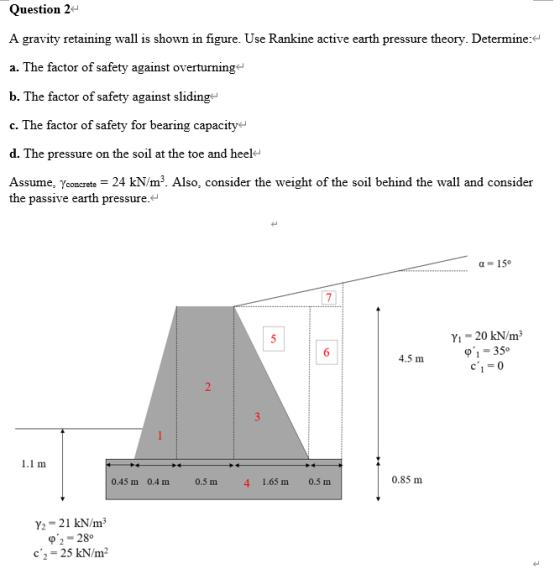
A gravity retaining wall is shown in figure. Use Rankine active earth pressure theory. Determine: a. The factor of safety against overturning b. The factor of safety against sliding c. The factor of safety for bearing capacity d. The pressure on the soil
A gravity retaining wall is shown in figure. Use Rankine active earth pressure theory. Determine:
a. The factor of safety against overturning
b. The factor of safety against sliding
c. The factor of safety for bearing capacity
d. The pressure on the soil at the toe and heel
Assume, γconcrete = 24 kN/m3. Also, consider the weight of the soil behind the wall and consider the passive earth pressure.
Homework Answers
Request Answer!
We need at least 9 more requests to produce the answer.
1 / 10 have requested this problem solution
The more requests, the faster the answer.
Add Answer to:
A gravity retaining wall is shown in figure. Use Rankine active earth pressure theory. Determine: a. The factor of safety against overturning b. The factor of safety against sliding c. The factor of safety for bearing capacity d. The pressure on the soil
Figure 15.45 shows a gravity retaining wall retaining a granular (c' = 0) backfill. The same soil is present at the bottom of the wall and on the left. The unit weight and the friction angle of the backfill are 18.5 kN/m3 and 35°, respectively. The unit w
 Figure 15.45 shows a gravity retaining wall retaining a granular (c' = 0) backfill. The same soil is present at the bottom of the wall and on the left. The unit weight and the friction angle of the backfill are 18.5 kN/m3 and 35°, respectively. The unit weight of concrete is 24.0 kN/m3. Determine the factors of safety with respect to overturning, sliding, and bearing capacity failure. Use Rankine earth pressure theory.
1 Calculate the factor of safety against overturning and sliding for the concrete retaining wall ...
 1 Calculate the factor of safety against overturning and sliding for the concrete retaining wall shown in the figure below, without taking into consideration the passive earth pressure. (50 Points) Assume that 115 lbs/cf unit weight of soil: unit weight of concrete: 150 lbs/cf angle of internal friction: 30 coefficient of friction: 0.350 0° B: 14 5' 2" Ha 14 2.5 Compaction (Soils engineering uses the symbol ys for dry density and uses the term dry unit weight. In the...
a) What is the factor of safety against overturning? b) What is the distance from A...
 a) What is the factor of safety against
overturning?
b) What is the distance from A the normal for N acts? Is
100% of the base in contact with the soil based on this
information?
c) If the foundation soil is sand and the interface
friction angle is 37 degrees, what is the factor of safety against
sliding
d) What is the factor of safety against bearing capacity
failure (use Meyerhoffs Method) if the ultimate capacity of the
foundation soil...
a) What is the factor of safety against
overturning?
b) What is the distance from A the normal for N acts? Is
100% of the base in contact with the soil based on this
information?
c) If the foundation soil is sand and the interface
friction angle is 37 degrees, what is the factor of safety against
sliding
d) What is the factor of safety against bearing capacity
failure (use Meyerhoffs Method) if the ultimate capacity of the
foundation soil...
Problem 1 For the cantilever retaining wall shown in Fig. 1, determine the factor of safety...
 Problem 1 For the cantilever retaining wall shown in Fig. 1, determine the factor of safety with respect to overturning, sliding, and bearing capacity. Use Rankine method to calculate the earth pressure. 18 in 100 Fig. 1 7 = 117 pcf (= 340 C = 0 4ft 30 in 6ft y = 110 pcf = 18 C = 800 psf
Please 7. As shown below, a cantilever type of retaining wall of 7.3 m high with two soil layers behin d the wall. The following parameters can be used: (i) soil l: c-0, φ-40° and γ-17 kNm3; (ii) soi...
 Please
7. As shown below, a cantilever type of retaining wall of 7.3 m high with two soil layers behin d the wall. The following parameters can be used: (i) soil l: c-0, φ-40° and γ-17 kNm3; (ii) soil 2: c-5 kN m 2, ф-35° andy-20 kN/m3; Assume a reduction factor k ,2/3 to comsider the cohesion and rietion angle at the base slaby the unit wecight of concrete be assumed to be 23.5 kN/m3. Calculate the factors of safety...
Please
7. As shown below, a cantilever type of retaining wall of 7.3 m high with two soil layers behin d the wall. The following parameters can be used: (i) soil l: c-0, φ-40° and γ-17 kNm3; (ii) soil 2: c-5 kN m 2, ф-35° andy-20 kN/m3; Assume a reduction factor k ,2/3 to comsider the cohesion and rietion angle at the base slaby the unit wecight of concrete be assumed to be 23.5 kN/m3. Calculate the factors of safety...
Consider the following concrete retaining wall: 1.5ft La = 12° Sand: y = 115pcf 16ft d'...
 Consider the following concrete retaining wall: 1.5ft La = 12° Sand: y = 115pcf 16ft d' = 32° c'=0 d' = (2/3) Concrete: y = 150pcf TAVI- N 3ft 5ft '1.5ft 6.5ft y = 120pcf ' = 22°C' = 200psf Clay Use Rankine active earth pressure with: cosa - Ka = cosa- cosa + cosa - cos2 cos2a - cos20 a. Calculate Rankine active and passive lateral forces and show their location onthe diagram. b. Calculate the factor of safety...
For the retaining wall shown in the two different soils, provide the following analysis: A. Determine...
 For the retaining wall shown in the two different soils, provide
the following analysis:
A. Determine the Ranking Active pressure force components
Phorizontal and Pvertical (given
Ka=0.3216)
B. Determine the Passive Pressure force Pp (given
Kp=2.1318)
C. Determine the Overturning Moment Mo
D. Determine the Righting Moment Mr (Include
Pvert and Pp as well)
E. Computer the Factor of Safety against overturning
instability
F. Compute the Factor of Safety against sliding instability
(include friction). Given coefficient of friction = .35....
For the retaining wall shown in the two different soils, provide
the following analysis:
A. Determine the Ranking Active pressure force components
Phorizontal and Pvertical (given
Ka=0.3216)
B. Determine the Passive Pressure force Pp (given
Kp=2.1318)
C. Determine the Overturning Moment Mo
D. Determine the Righting Moment Mr (Include
Pvert and Pp as well)
E. Computer the Factor of Safety against overturning
instability
F. Compute the Factor of Safety against sliding instability
(include friction). Given coefficient of friction = .35....
a) A cantilever retaining wall is constructed to retain the earth in order to create a...
 a) A cantilever retaining wall is constructed to retain the earth in order to create a change of elevation. The stability aspect of a retaining wall is important to prevent any failure of the structure. Referring to Figure 2, check the stability of the cantilever retaining wall against: (i) Sliding (ii) Rotation (ii) Bearing failure (iv) Short conclusion on the stability of the wall [5 marks] [4 marks] [3 marks [2 marks] 0.5 m 4.0 m 0.8 m 1.2 m...
The following figure shows a section of a long reinforced concrete cantilever wall with unit weight...
 The following figure shows a section of a long reinforced concrete cantilever wall with unit weight of 23.5 kN/m”. The distributed surcharge on the back of the wall is a live load. The following properties are known for the backfill: unit weight saturated unit weight shear strength parameters 7 = 17 kN/m3 7sat = 20 kN/m3 d =0 Ó' = 25° d = 20° friction angle between wall and soil a. Determine the factor of safety against overturning (about the...
problem 4: For the retaining wall shown, Determine a. the active lateral earth pressure distribution b....
 problem 4: For the retaining wall shown, Determine a. the active lateral earth pressure distribution b. the passive lateral earth pressure distribution c. the magnitude and location of the active lateral force on the wall d. the magnitude and location of the passive lateral force on the wall e. the depth of crack from the surface [use Rankine method] Ignore hydrostatic pressure. y 110 pcf p 12, C 420 psf 30' Y 110 pcf φ 100 C 500 psf Y...
 1 Calculate the factor of safety against overturning and sliding for the concrete retaining wall shown in the figure below, without taking into consideration the passive earth pressure. (50 Points) Assume that 115 lbs/cf unit weight of soil: unit weight of concrete: 150 lbs/cf angle of internal friction: 30 coefficient of friction: 0.350 0° B: 14 5' 2" Ha 14 2.5 Compaction (Soils engineering uses the symbol ys for dry density and uses the term dry unit weight. In the...
 a) What is the factor of safety against
overturning?
b) What is the distance from A the normal for N acts? Is
100% of the base in contact with the soil based on this
information?
c) If the foundation soil is sand and the interface
friction angle is 37 degrees, what is the factor of safety against
sliding
d) What is the factor of safety against bearing capacity
failure (use Meyerhoffs Method) if the ultimate capacity of the
foundation soil...
a) What is the factor of safety against
overturning?
b) What is the distance from A the normal for N acts? Is
100% of the base in contact with the soil based on this
information?
c) If the foundation soil is sand and the interface
friction angle is 37 degrees, what is the factor of safety against
sliding
d) What is the factor of safety against bearing capacity
failure (use Meyerhoffs Method) if the ultimate capacity of the
foundation soil...
 Problem 1 For the cantilever retaining wall shown in Fig. 1, determine the factor of safety with respect to overturning, sliding, and bearing capacity. Use Rankine method to calculate the earth pressure. 18 in 100 Fig. 1 7 = 117 pcf (= 340 C = 0 4ft 30 in 6ft y = 110 pcf = 18 C = 800 psf
 Please
7. As shown below, a cantilever type of retaining wall of 7.3 m high with two soil layers behin d the wall. The following parameters can be used: (i) soil l: c-0, φ-40° and γ-17 kNm3; (ii) soil 2: c-5 kN m 2, ф-35° andy-20 kN/m3; Assume a reduction factor k ,2/3 to comsider the cohesion and rietion angle at the base slaby the unit wecight of concrete be assumed to be 23.5 kN/m3. Calculate the factors of safety...
Please
7. As shown below, a cantilever type of retaining wall of 7.3 m high with two soil layers behin d the wall. The following parameters can be used: (i) soil l: c-0, φ-40° and γ-17 kNm3; (ii) soil 2: c-5 kN m 2, ф-35° andy-20 kN/m3; Assume a reduction factor k ,2/3 to comsider the cohesion and rietion angle at the base slaby the unit wecight of concrete be assumed to be 23.5 kN/m3. Calculate the factors of safety...
 Consider the following concrete retaining wall: 1.5ft La = 12° Sand: y = 115pcf 16ft d' = 32° c'=0 d' = (2/3) Concrete: y = 150pcf TAVI- N 3ft 5ft '1.5ft 6.5ft y = 120pcf ' = 22°C' = 200psf Clay Use Rankine active earth pressure with: cosa - Ka = cosa- cosa + cosa - cos2 cos2a - cos20 a. Calculate Rankine active and passive lateral forces and show their location onthe diagram. b. Calculate the factor of safety...
 For the retaining wall shown in the two different soils, provide
the following analysis:
A. Determine the Ranking Active pressure force components
Phorizontal and Pvertical (given
Ka=0.3216)
B. Determine the Passive Pressure force Pp (given
Kp=2.1318)
C. Determine the Overturning Moment Mo
D. Determine the Righting Moment Mr (Include
Pvert and Pp as well)
E. Computer the Factor of Safety against overturning
instability
F. Compute the Factor of Safety against sliding instability
(include friction). Given coefficient of friction = .35....
For the retaining wall shown in the two different soils, provide
the following analysis:
A. Determine the Ranking Active pressure force components
Phorizontal and Pvertical (given
Ka=0.3216)
B. Determine the Passive Pressure force Pp (given
Kp=2.1318)
C. Determine the Overturning Moment Mo
D. Determine the Righting Moment Mr (Include
Pvert and Pp as well)
E. Computer the Factor of Safety against overturning
instability
F. Compute the Factor of Safety against sliding instability
(include friction). Given coefficient of friction = .35....
 a) A cantilever retaining wall is constructed to retain the earth in order to create a change of elevation. The stability aspect of a retaining wall is important to prevent any failure of the structure. Referring to Figure 2, check the stability of the cantilever retaining wall against: (i) Sliding (ii) Rotation (ii) Bearing failure (iv) Short conclusion on the stability of the wall [5 marks] [4 marks] [3 marks [2 marks] 0.5 m 4.0 m 0.8 m 1.2 m...
 The following figure shows a section of a long reinforced concrete cantilever wall with unit weight of 23.5 kN/m”. The distributed surcharge on the back of the wall is a live load. The following properties are known for the backfill: unit weight saturated unit weight shear strength parameters 7 = 17 kN/m3 7sat = 20 kN/m3 d =0 Ó' = 25° d = 20° friction angle between wall and soil a. Determine the factor of safety against overturning (about the...
 problem 4: For the retaining wall shown, Determine a. the active lateral earth pressure distribution b. the passive lateral earth pressure distribution c. the magnitude and location of the active lateral force on the wall d. the magnitude and location of the passive lateral force on the wall e. the depth of crack from the surface [use Rankine method] Ignore hydrostatic pressure. y 110 pcf p 12, C 420 psf 30' Y 110 pcf φ 100 C 500 psf Y...
Most questions answered within 3 hours.
-
Where is the error in this code sequence?
String s1 = "Hello";
String s2 = "ello";...
asked 10 months ago -
Financial data for Joel de Paris, Inc., for last year
follow:
Joel de Paris, Inc.
Balance...
asked 10 months ago -
Consider this reaction:
Al2(SO4)3 (aq)+ BaCl3
(aq) Al2Cl6 (aq)- +
3BaSO4(s) . What is the...
asked 10 months ago -
Suppose that Savneet is considering increasing her
recent random sample from 20 car rentals to 40...
asked 10 months ago -
Trucks arrive at an unloading terminal at an average rate of 120
per hour.
Trucks arrive...
asked 10 months ago -
Why are methanol and ethanol completely soluble in water while
octanol is not very little soluble....
asked 10 months ago -
A facilities manager at a university reads in a research report
that the mean amount of...
asked 10 months ago -
When the CuSO4 is rehydrated by adding water to the anhydrous
compound, is this an endothermic...
asked 10 months ago -
A ray of sunlight is passing from diamond into crown glass; the
angle of incidence is...
asked 10 months ago -
A block of mass 0.249 kg is placed on top of a light, vertical
spring of...
asked 10 months ago -
how do the kidneys compensate in the presences of acidosis
a) trigger hyperventilate
b) reserve acid...
asked 10 months ago -
Question 501 pts
The rental rate of capital to the firm increases. Which of the
following...
asked 10 months ago