
Homework Answers
Add Answer to:
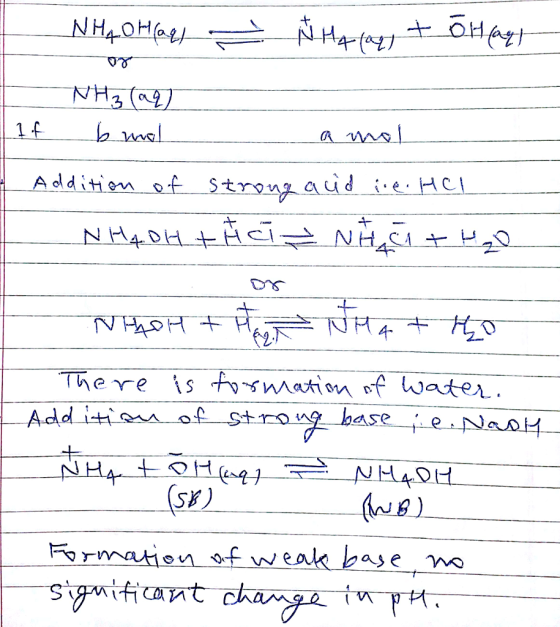
3. A buffer contains significant amounts of ammonia and ammonium chloride. Write equations to show how...
A buffer contains significant amounts of ammonia and ammonium chloride. Part A: Enter a net ionic...
A buffer contains significant amounts of ammonia and ammonium chloride. Part A: Enter a net ionic equation showing how this buffer neutralizes added aqueous acid (HI). Express your answer as a chemical equation. Identify all of the phases in your answer. Part B: Enter a net ionic equation showing how this buffer neutralizes added aqueous base (CsOH). Express your answer as a chemical equation. Identify all of the phases in your answer.
A buffer contains significant amounts of ammonia and ammonium chloride. (Part A) Enter an equation showing...
A buffer contains significant amounts of ammonia and ammonium chloride. (Part A) Enter an equation showing how this buffer neutralizes added aqueous acid (HNO3). Express your answer as a chemical equation. Identify all of the phases in your answer. (Part B) Enter an equation showing how this buffer neutralizes added aqueous base (NaOH). Express your answer as a chemical equation. Identify all of the phases in your answer. ** Make sure to identify ALL phases (states) in your answer **
A buffer contains significant amounts of acetic acid and sodium acetate.
A buffer contains significant amounts of acetic acid and sodium acetate. Write an equation showing how this buffer neutralizes added acid (HNO3 (aq). Write an equation showing how this buffer neutralizes added base (KOH(aq)).
A buffer solution contains 0.229 M ammonium chloride and 0.457 M ammonia. If 0.0568 moles of...
 A buffer solution contains 0.229 M ammonium chloride and 0.457 M ammonia. If 0.0568 moles of hydroiodic acid are added to 250 mL of this buffer, what is the pH of the resulting solution ? (Assume that the volume does not change upon adding hydroiodic acid) pH = Submit Answer Retry Entire Group 9 more group attempts remaining A buffer solution contains 0.443 M ammonium chloride and 0.314 M ammonia. If 0.0313 moles of potassium hydroxide are added to 225...
(UNITS_26_27 Exercise 17.34 - Enhanced - with Feedback A buffer contains significant amounts of ammonia and...
 (UNITS_26_27 Exercise 17.34 - Enhanced - with Feedback A buffer contains significant amounts of ammonia and ammonium chloride.
A buffer solution contains 0.392 M ammonium chloride and 0.498 M ammonia. If 0.0206 moles of...
A buffer solution contains 0.392 M ammonium chloride and 0.498 M ammonia. If 0.0206 moles of perchloric acid are added to 150 mL of this buffer, what is the pH of the resulting solution ? (Assume that the volume does not change upon adding perchloric acid)
A buffer solution contains 0.322 M ammonium chloride and 0.486 M ammonia. If 0.0545 moles of...
A buffer solution contains 0.322 M ammonium chloride and 0.486 M ammonia. If 0.0545 moles of hydrochloric acid are added to 250 mL of this buffer, what is the pH of the resulting solution? (Assume that the volume does not change upon adding hydrochloric acid.)
part a.) A buffer solution contains 0.309 M ammonium chloride and 0.345 M ammonia. If 0.0556...
part a.) A buffer solution contains 0.309 M ammonium chloride and 0.345 M ammonia. If 0.0556 moles of hydrochloric acid are added to 225 mL of this buffer, what is the pH of the resulting solution ? part b.) A buffer solution contains 0.429 M hydrocyanic acid and 0.234 M potassium cyanide . If 0.0306 moles of sodium hydroxide are added to 150 mL of this buffer, what is the pH of the resulting solution ?
With this how I calculate the Ammonia solutions pH and Ammonia Buffer solutions ph B. Preparation...
 With this how I calculate the Ammonia solutions pH and
Ammonia Buffer solutions ph
B. Preparation of Ammonia-Ammonium Buffer Solution Note that an ammonia buffer contains the conjugate base, ammonia, and its conjugate acid, the ammonium ion, NH typically added as NH,CI. Accordingly, the pk, value stated in Eq. (7) is that of the buffer's conjugate acid, NH.. For ammonia, pk, -log (1.8 x 10⁷ 4.74. (Note that the fact that the pk for NH, is the same value as...
With this how I calculate the Ammonia solutions pH and
Ammonia Buffer solutions ph
B. Preparation of Ammonia-Ammonium Buffer Solution Note that an ammonia buffer contains the conjugate base, ammonia, and its conjugate acid, the ammonium ion, NH typically added as NH,CI. Accordingly, the pk, value stated in Eq. (7) is that of the buffer's conjugate acid, NH.. For ammonia, pk, -log (1.8 x 10⁷ 4.74. (Note that the fact that the pk for NH, is the same value as...
A buffer solution contains 0.341 M ammonium chloride and 0.291 M ammonia. If 0.0213 moles of potassium hydroxide are add...
A buffer solution contains 0.341 M ammonium chloride and 0.291 M ammonia. If 0.0213 moles of potassium hydroxide are added to 150 mL of this buffer, what is the pH of the resulting solution ? (Assume that the volume does not change upon adding potassium hydroxide) pH=?
 A buffer solution contains 0.229 M ammonium chloride and 0.457 M ammonia. If 0.0568 moles of hydroiodic acid are added to 250 mL of this buffer, what is the pH of the resulting solution ? (Assume that the volume does not change upon adding hydroiodic acid) pH = Submit Answer Retry Entire Group 9 more group attempts remaining A buffer solution contains 0.443 M ammonium chloride and 0.314 M ammonia. If 0.0313 moles of potassium hydroxide are added to 225...
 (UNITS_26_27 Exercise 17.34 - Enhanced - with Feedback A buffer contains significant amounts of ammonia and ammonium chloride.
 With this how I calculate the Ammonia solutions pH and
Ammonia Buffer solutions ph
B. Preparation of Ammonia-Ammonium Buffer Solution Note that an ammonia buffer contains the conjugate base, ammonia, and its conjugate acid, the ammonium ion, NH typically added as NH,CI. Accordingly, the pk, value stated in Eq. (7) is that of the buffer's conjugate acid, NH.. For ammonia, pk, -log (1.8 x 10⁷ 4.74. (Note that the fact that the pk for NH, is the same value as...
With this how I calculate the Ammonia solutions pH and
Ammonia Buffer solutions ph
B. Preparation of Ammonia-Ammonium Buffer Solution Note that an ammonia buffer contains the conjugate base, ammonia, and its conjugate acid, the ammonium ion, NH typically added as NH,CI. Accordingly, the pk, value stated in Eq. (7) is that of the buffer's conjugate acid, NH.. For ammonia, pk, -log (1.8 x 10⁷ 4.74. (Note that the fact that the pk for NH, is the same value as...
Most questions answered within 3 hours.
-
Where is the error in this code sequence?
String s1 = "Hello";
String s2 = "ello";...
asked 10 months ago -
Financial data for Joel de Paris, Inc., for last year
follow:
Joel de Paris, Inc.
Balance...
asked 10 months ago -
Consider this reaction:
Al2(SO4)3 (aq)+ BaCl3
(aq) Al2Cl6 (aq)- +
3BaSO4(s) . What is the...
asked 10 months ago -
Suppose that Savneet is considering increasing her
recent random sample from 20 car rentals to 40...
asked 10 months ago -
Trucks arrive at an unloading terminal at an average rate of 120
per hour.
Trucks arrive...
asked 10 months ago -
Why are methanol and ethanol completely soluble in water while
octanol is not very little soluble....
asked 10 months ago -
A facilities manager at a university reads in a research report
that the mean amount of...
asked 10 months ago -
When the CuSO4 is rehydrated by adding water to the anhydrous
compound, is this an endothermic...
asked 10 months ago -
A ray of sunlight is passing from diamond into crown glass; the
angle of incidence is...
asked 10 months ago -
A block of mass 0.249 kg is placed on top of a light, vertical
spring of...
asked 10 months ago -
how do the kidneys compensate in the presences of acidosis
a) trigger hyperventilate
b) reserve acid...
asked 10 months ago -
Question 501 pts
The rental rate of capital to the firm increases. Which of the
following...
asked 10 months ago