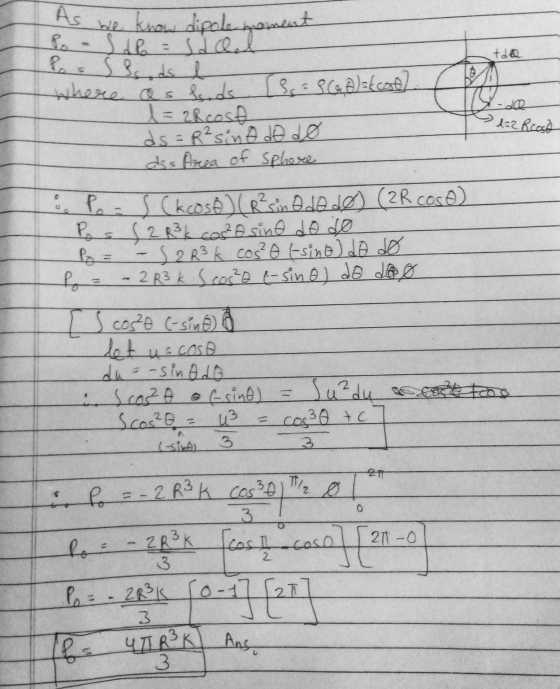
A sphere with radius R has charge distribution as given
 (r,
(r, )=k*cos(
 )
.
)
.
Calculate electric dipole moment.(Hint:remember symmetry of charge
distribution)
Homework Answers
Add Answer to:
A sphere with radius R has charge distribution as given
(r,)=k*cos()
.
Calculate electric dipole moment.(Hint:remember...
A charge is glued on the cylindrical surface of a long circular cylinder of radius R....
 A charge
is glued on the cylindrical surface of a long circular cylinder of
radius R. The cylinder is made of a linear dielectric material of
dielectric constant
.
Find the electric field inside the cylinder and show that this
field is uniform.
If a small metal sphere of radius a (a<< R) gets into the
center of the cylinder, find the total dipole moment of the setup
by all charges: free charge, bound charge, and induced charge,
given the...
A charge
is glued on the cylindrical surface of a long circular cylinder of
radius R. The cylinder is made of a linear dielectric material of
dielectric constant
.
Find the electric field inside the cylinder and show that this
field is uniform.
If a small metal sphere of radius a (a<< R) gets into the
center of the cylinder, find the total dipole moment of the setup
by all charges: free charge, bound charge, and induced charge,
given the...
Problem 1: Dipole moment. We have a sphere of radius R with a uniform surface charge...
 Problem 1: Dipole moment. We have a sphere of radius R with a uniform surface charge density +ao over the northern hemisphere, and -oo over the southern hemisphere (oo is a positive constant). There are no other charges present inside or outside the sphere. Compute the dipole moment p of this charge distribution assuming the z-axis is the symmetry axis of the distribution. Does p depend on your choice of origin? Why or why not? Are any components of p...
(a) A sphere with radius R rotates with constant angular velocity . A uniform charge distribution...
(a) A sphere with radius R rotates with constant angular velocity . A uniform charge distribution is fixed on the surface. The total charge is q. Calculate the current density in this scenario where . Show how the E-field is calculated using Gauss' Law and the direction (in spherical coordinates) of the current density. We were unable to transcribe this imageWe were unable to transcribe this image7 =
A neutral hydrogen atom in its normal state behaves like an electric charge distribution that consists...
A neutral hydrogen atom in its normal state behaves like an electric charge distribution that consists of a point charge of magnitude surrounded by a distribution of negative charge whose density is given by . Here m is the Bohr radius, and is a constant with the value required to make the total amount of negative charge exactly . What is the electric field strength for radius ? What is the electric field strength at radius ? We were unable...
A hollow sphere of radius a has uniform surface charge density σ and is centered at...
 A hollow sphere of radius a has uniform
surface charge density σ and is centered at the origin. It
sits inside a bigger sphere, also centered at the origin, with
radius b > a and uniform
surface charge density −σ. Because of the spherical
symmetry, the electric field will have the form () =
E(r) r̂, where
negative E(r) corresponds to an
electric field pointing towards the origin, and positive
E(r) corresponds to a field
pointing away. What is E(r)...
A hollow sphere of radius a has uniform
surface charge density σ and is centered at the origin. It
sits inside a bigger sphere, also centered at the origin, with
radius b > a and uniform
surface charge density −σ. Because of the spherical
symmetry, the electric field will have the form () =
E(r) r̂, where
negative E(r) corresponds to an
electric field pointing towards the origin, and positive
E(r) corresponds to a field
pointing away. What is E(r)...
held. A solid sphere has a radius R. The top hemisphere carries a uniform charge density...
 held. A solid sphere has a radius R. The top hemisphere carries a uniform charge density p while the lower hemisphere has a uniform charge density of -p. Find an approximate formula for the potential outside the sphere, valid at distances r >> R. A solid sphere has a radius R. The top hemisphere carries a uniform charge density p while the lower hemisphere has a uniform charge density of -p. Find an approximate formula for the potential outside the...
A sphere or radius R has a charge density given by p(r') = kr'. A) Calculate...
A sphere or radius R has a charge density given by p(r') = kr'. A) Calculate the electric field inside and out. B) Calculate the electric potential using the integral E*dl. C) Calculate the energy stored in this configuration by integrating pVdT.
TD P4. A charged sphere of radius R has a non-uniform charge distribution given by PPo...
 TD P4. A charged sphere of radius R has a non-uniform charge distribution given by PPo co where R- 2.50 cm, and Po-3.40 nC/cm'. (a) Determine the electric field forr< R. (b) Determine the electric field forr > R.
Find the electric dipole moment of a cylinder of radius R and height h. The volume...
Find the electric dipole moment of a cylinder of radius R and height h. The volume charge density in the cylinder is given by ρ(z) = k·cos(πz/h). The z-axis is the axis of the cylinder, and the origin is placed at the bottom of the cylinder. Give the answer in terms of k, h, and R in unit vector notation.
Charge distribution with spherical symmetry A) Consider a uniformly charged spherical crust of radius R and...
Charge distribution with spherical symmetry A) Consider a uniformly charged spherical crust of radius R and total charge Q. Calculate the value of the electric field E inside and outside the crust. b) Consider a solid sphere with radius R that has a uniform volumetric charge density ρy has a total charge Q.Calculate the value of the electric field E inside and outside the sphere.
 A charge
is glued on the cylindrical surface of a long circular cylinder of
radius R. The cylinder is made of a linear dielectric material of
dielectric constant
.
Find the electric field inside the cylinder and show that this
field is uniform.
If a small metal sphere of radius a (a<< R) gets into the
center of the cylinder, find the total dipole moment of the setup
by all charges: free charge, bound charge, and induced charge,
given the...
A charge
is glued on the cylindrical surface of a long circular cylinder of
radius R. The cylinder is made of a linear dielectric material of
dielectric constant
.
Find the electric field inside the cylinder and show that this
field is uniform.
If a small metal sphere of radius a (a<< R) gets into the
center of the cylinder, find the total dipole moment of the setup
by all charges: free charge, bound charge, and induced charge,
given the...
 Problem 1: Dipole moment. We have a sphere of radius R with a uniform surface charge density +ao over the northern hemisphere, and -oo over the southern hemisphere (oo is a positive constant). There are no other charges present inside or outside the sphere. Compute the dipole moment p of this charge distribution assuming the z-axis is the symmetry axis of the distribution. Does p depend on your choice of origin? Why or why not? Are any components of p...
 A hollow sphere of radius a has uniform
surface charge density σ and is centered at the origin. It
sits inside a bigger sphere, also centered at the origin, with
radius b > a and uniform
surface charge density −σ. Because of the spherical
symmetry, the electric field will have the form () =
E(r) r̂, where
negative E(r) corresponds to an
electric field pointing towards the origin, and positive
E(r) corresponds to a field
pointing away. What is E(r)...
A hollow sphere of radius a has uniform
surface charge density σ and is centered at the origin. It
sits inside a bigger sphere, also centered at the origin, with
radius b > a and uniform
surface charge density −σ. Because of the spherical
symmetry, the electric field will have the form () =
E(r) r̂, where
negative E(r) corresponds to an
electric field pointing towards the origin, and positive
E(r) corresponds to a field
pointing away. What is E(r)...
 held. A solid sphere has a radius R. The top hemisphere carries a uniform charge density p while the lower hemisphere has a uniform charge density of -p. Find an approximate formula for the potential outside the sphere, valid at distances r >> R. A solid sphere has a radius R. The top hemisphere carries a uniform charge density p while the lower hemisphere has a uniform charge density of -p. Find an approximate formula for the potential outside the...
 TD P4. A charged sphere of radius R has a non-uniform charge distribution given by PPo co where R- 2.50 cm, and Po-3.40 nC/cm'. (a) Determine the electric field forr< R. (b) Determine the electric field forr > R.
Most questions answered within 3 hours.
-
Where is the error in this code sequence?
String s1 = "Hello";
String s2 = "ello";...
asked 10 months ago -
Financial data for Joel de Paris, Inc., for last year
follow:
Joel de Paris, Inc.
Balance...
asked 10 months ago -
Consider this reaction:
Al2(SO4)3 (aq)+ BaCl3
(aq) Al2Cl6 (aq)- +
3BaSO4(s) . What is the...
asked 10 months ago -
Suppose that Savneet is considering increasing her
recent random sample from 20 car rentals to 40...
asked 10 months ago -
Trucks arrive at an unloading terminal at an average rate of 120
per hour.
Trucks arrive...
asked 10 months ago -
Why are methanol and ethanol completely soluble in water while
octanol is not very little soluble....
asked 10 months ago -
A facilities manager at a university reads in a research report
that the mean amount of...
asked 10 months ago -
When the CuSO4 is rehydrated by adding water to the anhydrous
compound, is this an endothermic...
asked 10 months ago -
A ray of sunlight is passing from diamond into crown glass; the
angle of incidence is...
asked 10 months ago -
A block of mass 0.249 kg is placed on top of a light, vertical
spring of...
asked 10 months ago -
how do the kidneys compensate in the presences of acidosis
a) trigger hyperventilate
b) reserve acid...
asked 10 months ago -
Question 501 pts
The rental rate of capital to the firm increases. Which of the
following...
asked 10 months ago