Which value is not required for the chi‑square test? a. expected progeny counts b.expected progeny ratio...
Which value is not required for the chi‑square test?
a. expected progeny counts
b.expected progeny ratio
c. age of parents at the time of cross
d. degree of freedom
e. observed progeny counts
Homework Answers
c. age of parents at the time of cross
The chi-square test is used to determine if there is a significant difference between the expected frequencies and the observed frequencies in one or more categories.
The formula used to calculate a statistical value for the chi-squared test is:
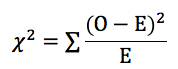
where, ∑ = Sum, O = Observed frequency, E = Expected frequency.
Degree of freedom = No. of phenotypes - 1
Add Answer to:
Which value is not required for the chi‑square test?
a. expected progeny counts
b.expected progeny ratio...
Please help me with this Contingency test for Locus (A), including expected counts, observed counts, chi-square...
Please help me with this Contingency test for Locus (A), including expected counts, observed counts, chi-square statistic, degree of freedom, and p values A1/A1 A1/A2 A2/A2 Row Sum Taster 62 26 48 136 Non-Taster 18 15 56 89 Column Sum 80 41 104 225
Perform a chi-square test to determine if an observed ratio of 40 tall:10 dwarf pea plants...
Perform a chi-square test to determine if an observed ratio of 40 tall:10 dwarf pea plants is consistent with an expected ratio of 1:1 from the cross of Dd x dd. What is your degrees of freedom What is your critical value Is this observed ratio consistent with an expected ratio of 1:1? (yes or no)
How do you answer if your data support the expected ratio? Use a chi-square analysis to...
 How do you answer if your data support the expected
ratio?
Use a chi-square analysis to test the expected ratio for the F2 of Cross C. Phenotype Observed Expected Expected (O-E) (O-E) (O-E) IE Number Fraction Number Yellow 10082 10248.0625 - 1610.0625 2516,75391 2.69 13/16 Purple 2531 3/16 2364.9375 166.0625 27576.7539111966 Total = Chi-square 14.35 Number of degrees of freedom= 2-1 = 1 Probability of a match= p<0.05 On the basis of your chi-square test, does your data support the...
How do you answer if your data support the expected
ratio?
Use a chi-square analysis to test the expected ratio for the F2 of Cross C. Phenotype Observed Expected Expected (O-E) (O-E) (O-E) IE Number Fraction Number Yellow 10082 10248.0625 - 1610.0625 2516,75391 2.69 13/16 Purple 2531 3/16 2364.9375 166.0625 27576.7539111966 Total = Chi-square 14.35 Number of degrees of freedom= 2-1 = 1 Probability of a match= p<0.05 On the basis of your chi-square test, does your data support the...
What is the most likely goestypes of the F1 parents? Using a chi-square test, compare the...
 What is the most likely goestypes of the F1 parents? Using a chi-square test, compare the observed numbers of progerry with those expected from the cross. What conclusions can you draw from the chi-square test. Explain biologically what the chi-square test is telling you about this cross? From the chi-squared test I conclude that these offspring ratios are not correlating to the given geno types of the F1 parents. Therefore I reject the counts of the offsprings present There could...
Which of the statements are correct? A condition for using the chi-square goodness-of-fit test is that...
Which of the statements are correct? A condition for using the chi-square goodness-of-fit test is that all expected counts must be at least two. A condition for using the chi-square goodness-of-fit test is the observations are based on a random sample. The chi-square goodness-of-fit test uses n − 5 degrees of freedom. A) I only B) II only C) I and II only D) II and III only E) I, II, and III
Review the following output from a chi-square test, and answer the questions below. Chi-Square Test Frequencies:Preference...
Review the following output from a chi-square test, and answer the questions below. Chi-Square Test Frequencies:Preference Observed N Expected N Residual Nuts & Grits 9 20.0 -11.0 Bacon Surprise 27 20.0 7.0 Dimples 16 20.0 -4.0 Froggy 17 20.0 -3.0 Chocolate Delight 31 20.0 11.0 Total 100 Test Statistics Preference Chi-Square 15.800a df 4 Asymp. Sig. .003 a 0 cells (0.0%) have expected frequencies less than 5. The minimum expected cell frequency is 20.0. Answer the following questions about this...
a) true b) false 42. For a chi-square distributed random variable with 10 degrees of freedom and a level of sigpificanoe computed value of the test statistics is 16.857. This will lead us to reje...
 a) true b) false 42. For a chi-square distributed random variable with 10 degrees of freedom and a level of sigpificanoe computed value of the test statistics is 16.857. This will lead us to reject the null hypothesis. a) true b) false 43. A chi-square goodness-of-fit test is always conducted as: a. a lower-tail test b. an upper-tail test d. either a lower tail or upper tail test e. a two-tail test 44. A left-tailed area in the chi-square distribution...
Under which circumstances are chi-square tests biased? ___ if any expected value is less than 1.0...
Under which circumstances are chi-square tests biased? ___ if any expected value is less than 1.0 or > 25% of the expected values are less than 5.0 small sample size when there is 1 degree of freedom all of the above
True or false: regarding the chi-square test, the expected counts represent the frequency we would expect...
True or false: regarding the chi-square test, the expected counts represent the frequency we would expect to see in each cell under the assumption that the null hypothesis is true.
In a chi-square test, what would it mean if the P-value were less than 5%? a....
In a chi-square test, what would it mean if the P-value were less than 5%? a. That there is no real difference between observed and expected values. b. That there is a difference between observed and expected values. c. That any difference between observed and expected values is probably not due to random chance. d. a and c are true e. b and c are true
 How do you answer if your data support the expected
ratio?
Use a chi-square analysis to test the expected ratio for the F2 of Cross C. Phenotype Observed Expected Expected (O-E) (O-E) (O-E) IE Number Fraction Number Yellow 10082 10248.0625 - 1610.0625 2516,75391 2.69 13/16 Purple 2531 3/16 2364.9375 166.0625 27576.7539111966 Total = Chi-square 14.35 Number of degrees of freedom= 2-1 = 1 Probability of a match= p<0.05 On the basis of your chi-square test, does your data support the...
How do you answer if your data support the expected
ratio?
Use a chi-square analysis to test the expected ratio for the F2 of Cross C. Phenotype Observed Expected Expected (O-E) (O-E) (O-E) IE Number Fraction Number Yellow 10082 10248.0625 - 1610.0625 2516,75391 2.69 13/16 Purple 2531 3/16 2364.9375 166.0625 27576.7539111966 Total = Chi-square 14.35 Number of degrees of freedom= 2-1 = 1 Probability of a match= p<0.05 On the basis of your chi-square test, does your data support the...
 What is the most likely goestypes of the F1 parents? Using a chi-square test, compare the observed numbers of progerry with those expected from the cross. What conclusions can you draw from the chi-square test. Explain biologically what the chi-square test is telling you about this cross? From the chi-squared test I conclude that these offspring ratios are not correlating to the given geno types of the F1 parents. Therefore I reject the counts of the offsprings present There could...
 a) true b) false 42. For a chi-square distributed random variable with 10 degrees of freedom and a level of sigpificanoe computed value of the test statistics is 16.857. This will lead us to reject the null hypothesis. a) true b) false 43. A chi-square goodness-of-fit test is always conducted as: a. a lower-tail test b. an upper-tail test d. either a lower tail or upper tail test e. a two-tail test 44. A left-tailed area in the chi-square distribution...
Most questions answered within 3 hours.
-
Where is the error in this code sequence?
String s1 = "Hello";
String s2 = "ello";...
asked 10 months ago -
Financial data for Joel de Paris, Inc., for last year
follow:
Joel de Paris, Inc.
Balance...
asked 10 months ago -
Consider this reaction:
Al2(SO4)3 (aq)+ BaCl3
(aq) Al2Cl6 (aq)- +
3BaSO4(s) . What is the...
asked 10 months ago -
Suppose that Savneet is considering increasing her
recent random sample from 20 car rentals to 40...
asked 10 months ago -
Trucks arrive at an unloading terminal at an average rate of 120
per hour.
Trucks arrive...
asked 10 months ago -
Why are methanol and ethanol completely soluble in water while
octanol is not very little soluble....
asked 10 months ago -
A facilities manager at a university reads in a research report
that the mean amount of...
asked 10 months ago -
When the CuSO4 is rehydrated by adding water to the anhydrous
compound, is this an endothermic...
asked 10 months ago -
A ray of sunlight is passing from diamond into crown glass; the
angle of incidence is...
asked 10 months ago -
A block of mass 0.249 kg is placed on top of a light, vertical
spring of...
asked 10 months ago -
how do the kidneys compensate in the presences of acidosis
a) trigger hyperventilate
b) reserve acid...
asked 10 months ago -
Question 501 pts
The rental rate of capital to the firm increases. Which of the
following...
asked 10 months ago