Refrigerant 134a enters the expansion valve of an air conditioning unit at 140 Lbf/in2, 80 0F...
- Refrigerant 134a enters the expansion valve of an air conditioning unit at 140 Lbf/in2, 80 0F and exits at 50 Lbf/in2. If the refrigerant undergoes a throttling process, what are the temperature and the quality at the exit of the valve? Also determine the rate of entropy production from the inlet to the exit?
Homework Answers
 NOTE: in the question, properties of R134a
refrigerant are not given so i used them from internet. By little
bit interpolation I calculated exact values at that given
condition.
NOTE: in the question, properties of R134a
refrigerant are not given so i used them from internet. By little
bit interpolation I calculated exact values at that given
condition.
Add Answer to:
Refrigerant 134a enters the expansion valve of an air
conditioning unit at 140 Lbf/in2, 80 0F...
Refrigerant 134a enters a well-insulated nozzle at 200 lbf/in.2, 140°F, with a velocity of 120 ft/s...
Refrigerant 134a enters a well-insulated nozzle at 200 lbf/in.2, 140°F, with a velocity of 120 ft/s and exits at 90 lbf/in.2 with a velocity of 1500 ft/s. For steady-state operation, and neglecting potential energy effects, determine the temperature, in °F, and the quality of the refrigerant at the exit.
Question 1 Refrigerant 134a enters an insulated diffuser as a saturated vapor at 80°F with a...
 Question 1 Refrigerant 134a enters an insulated diffuser as a saturated vapor at 80°F with a velocity of 1400 ft/s. The inlet area is 1.4 in2. At the exit, the pressure is 400 lb/in and the velocity is negligible. The diffuser operates at steady state and potential energy effects can be neglected. Determine the mass flow rate, in Ib/s, and the exit temperature, in °F
Steam at 500 lbf/in2 , 500°F enters a well-insulated valve operating at steady state with a...
Steam at 500 lbf/in2 , 500°F enters a well-insulated valve operating at steady state with a mass flow rate of 0.11 lbm/s through a 1-in-diameter pipe. The steam expands to 200 lbf/in2 with no significant change in elevation. (a) Derive the equation by which the exit state may be fixed. Simplify. (b) Determine the exit velocity, in ft/s, and the exit temperature, in °F, if the ratio of inlet to exit pipe diameters, d1/d2, is 0.64. (c) Plot the exit...
6. Refrigerant-134a enters an adiabatic compressor as saturated vapor at 100 kPa at a rate of...
 6. Refrigerant-134a enters an adiabatic compressor as saturated vapor at 100 kPa at a rate of 0.7 m3/min and exits at 1 MPa pressure. If the isentropic efficiency of the compressor is 87%, determine (a) the temperature of the refrigerant at the exit of the compressor, (b) the power input (in kW), and (c) the rate of entropy generation during this process.
3. An air-conditioning system is shown in Fig.3, in which air flows over tubes carrying Refrigerant...
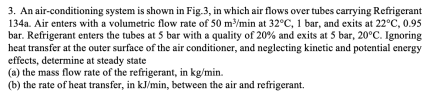 3. An air-conditioning system is shown in Fig.3, in which air flows over tubes carrying Refrigerant 134a. Air enters with a volumetric flow rate of 50 m3/min at 32°C, 1 bar, and exits at 22°C, 0.95 bar. Refrigerant enters the tubes at 5 bar with a quality of 20% and exits at 5 bar, 20°C. Ignoring heat transfer at the outer surface of the air conditioner, and neglecting kinetic and potential energy effects, determine at steady state (a) the mass...
Problem #3 Refrigerant R-134a enters the condenser of a heat pump at 1000 kPa and 80°C...
 Problem #3 Refrigerant R-134a enters the condenser of a heat pump at 1000 kPa and 80°C at a rate of 0.025 kg/s and leaves at 1000 kPa as saturated liquid. If the compressor consumes 2 kW of power, determine: a) The COP of the heat pump (as heating device). b) The rate of heat absorption from the outside air. тан Condenser Throttling valve Compressor Evaporator To
.0.5 kg/s of refrigerant R-134a undergoes a series of steady-state operations as indicated in the figure below: 12:...
 .0.5 kg/s of refrigerant R-134a undergoes a series of steady-state operations as indicated in the figure below: 12: Isobaric heating process. 23: Reversible and adiabatic compression process 34: Isobaric cooling. 45: Expansion process using throttling va Ive. 1) Determine the amount of heat needed during the evaporation process (12) 2) Determine the ch ange of entropy during the compression process and the temperature of the refrigerant at state 3. 3) Calculate the power input for the compression process. 4) Determine...
value 10.00 points Question An air-conditioner with refrigerant-134a s the working fluid is used to keep...
 value 10.00 points Question An air-conditioner with refrigerant-134a s the working fluid is used to keep a room at 21°C-Ass by rejecting the waste heat to the outdoor air at 37°C. The room gains heat through the walls and the windows at a rate of 249 kJ/min while the heat generated by the computer, TV, and T lights amounts to 600 W. The refrigerant enters the compressor at 360 kPa as a saturatedV vapor at a rate of 100 L/min...
System Model: Automotive Air Conditioning System Outside Air Temp: 45 oC Car Interior Air Temp: 22...
System Model: Automotive Air Conditioning System Outside Air Temp: 45 oC Car Interior Air Temp: 22 oC Heat Load = 4.2 kJ/sec rate at which heat must go in to the air conditioner to be removed from the car’s interior Refrigerant: R134a HINT: Heat enters an air conditioning system where? Refrigerant 134a … - leaves the evaporator coil and enters the compressor as a saturated vapor at the evaporator pressure of 2.8 bars. - It leaves the compressor at...
A Refrigeration System Using R-134A In a refrigeration system, the refrigerant R-134A begins as s...
 A Refrigeration System Using R-134A In a refrigeration system, the refrigerant R-134A begins as saturated vapor at -15°(State 1). It then goes through a reversible adiabatic compressor to reach State 2. After flowing through the condenser (a heat exchanger), the refrigerant exits as saturated liquid at 70°C (State 3). It is then throttled by going through an expansion valve, to reach State 4. It finishes the cycle by going through another heat exchanger (the evaporator), to return to State 1....
 Question 1 Refrigerant 134a enters an insulated diffuser as a saturated vapor at 80°F with a velocity of 1400 ft/s. The inlet area is 1.4 in2. At the exit, the pressure is 400 lb/in and the velocity is negligible. The diffuser operates at steady state and potential energy effects can be neglected. Determine the mass flow rate, in Ib/s, and the exit temperature, in °F
 6. Refrigerant-134a enters an adiabatic compressor as saturated vapor at 100 kPa at a rate of 0.7 m3/min and exits at 1 MPa pressure. If the isentropic efficiency of the compressor is 87%, determine (a) the temperature of the refrigerant at the exit of the compressor, (b) the power input (in kW), and (c) the rate of entropy generation during this process.
 3. An air-conditioning system is shown in Fig.3, in which air flows over tubes carrying Refrigerant 134a. Air enters with a volumetric flow rate of 50 m3/min at 32°C, 1 bar, and exits at 22°C, 0.95 bar. Refrigerant enters the tubes at 5 bar with a quality of 20% and exits at 5 bar, 20°C. Ignoring heat transfer at the outer surface of the air conditioner, and neglecting kinetic and potential energy effects, determine at steady state (a) the mass...
 Problem #3 Refrigerant R-134a enters the condenser of a heat pump at 1000 kPa and 80°C at a rate of 0.025 kg/s and leaves at 1000 kPa as saturated liquid. If the compressor consumes 2 kW of power, determine: a) The COP of the heat pump (as heating device). b) The rate of heat absorption from the outside air. тан Condenser Throttling valve Compressor Evaporator To
 .0.5 kg/s of refrigerant R-134a undergoes a series of steady-state operations as indicated in the figure below: 12: Isobaric heating process. 23: Reversible and adiabatic compression process 34: Isobaric cooling. 45: Expansion process using throttling va Ive. 1) Determine the amount of heat needed during the evaporation process (12) 2) Determine the ch ange of entropy during the compression process and the temperature of the refrigerant at state 3. 3) Calculate the power input for the compression process. 4) Determine...
 value 10.00 points Question An air-conditioner with refrigerant-134a s the working fluid is used to keep a room at 21°C-Ass by rejecting the waste heat to the outdoor air at 37°C. The room gains heat through the walls and the windows at a rate of 249 kJ/min while the heat generated by the computer, TV, and T lights amounts to 600 W. The refrigerant enters the compressor at 360 kPa as a saturatedV vapor at a rate of 100 L/min...
 A Refrigeration System Using R-134A In a refrigeration system, the refrigerant R-134A begins as saturated vapor at -15°(State 1). It then goes through a reversible adiabatic compressor to reach State 2. After flowing through the condenser (a heat exchanger), the refrigerant exits as saturated liquid at 70°C (State 3). It is then throttled by going through an expansion valve, to reach State 4. It finishes the cycle by going through another heat exchanger (the evaporator), to return to State 1....
Most questions answered within 3 hours.
-
Where is the error in this code sequence?
String s1 = "Hello";
String s2 = "ello";...
asked 11 months ago -
Financial data for Joel de Paris, Inc., for last year
follow:
Joel de Paris, Inc.
Balance...
asked 11 months ago -
Consider this reaction:
Al2(SO4)3 (aq)+ BaCl3
(aq) Al2Cl6 (aq)- +
3BaSO4(s) . What is the...
asked 11 months ago -
Suppose that Savneet is considering increasing her
recent random sample from 20 car rentals to 40...
asked 11 months ago -
Trucks arrive at an unloading terminal at an average rate of 120
per hour.
Trucks arrive...
asked 11 months ago -
Why are methanol and ethanol completely soluble in water while
octanol is not very little soluble....
asked 11 months ago -
A facilities manager at a university reads in a research report
that the mean amount of...
asked 11 months ago -
When the CuSO4 is rehydrated by adding water to the anhydrous
compound, is this an endothermic...
asked 11 months ago -
A ray of sunlight is passing from diamond into crown glass; the
angle of incidence is...
asked 11 months ago -
A block of mass 0.249 kg is placed on top of a light, vertical
spring of...
asked 11 months ago -
how do the kidneys compensate in the presences of acidosis
a) trigger hyperventilate
b) reserve acid...
asked 11 months ago -
Question 501 pts
The rental rate of capital to the firm increases. Which of the
following...
asked 11 months ago