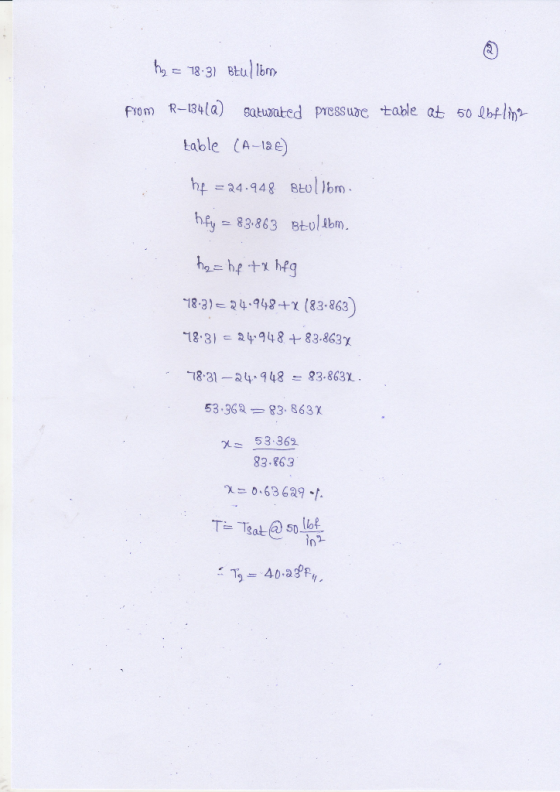
Refrigerant 134a enters a well-insulated nozzle at 200 lbf/in.2, 140°F, with a velocity of 120 ft/s...
Refrigerant 134a enters a well-insulated nozzle at 200
lbf/in.2, 140°F, with a velocity of 120 ft/s and exits
at 90 lbf/in.2 with a velocity of 1500 ft/s.
For steady-state operation, and neglecting potential energy
effects, determine the temperature, in °F, and the quality of the
refrigerant at the exit.
Homework Answers
ANSWER
Mechanical energy is the energy that is possessed by an object
due to its motion or due to its position. Mechanical energy can be
either kinetic energy (energy of motion) or potential energy
(stored energy of position). A drawn bow possesses mechanical
energy due to its stretched position (elastic potential
energy).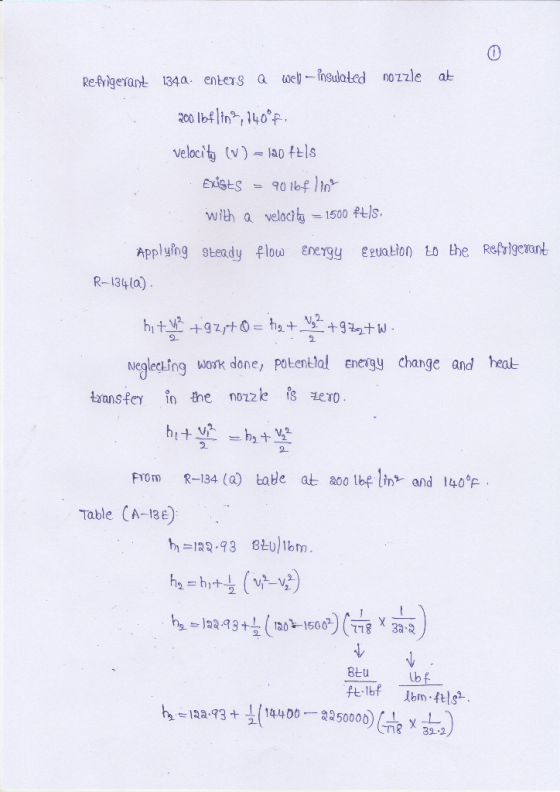
Add Answer to:
Refrigerant 134a enters a well-insulated nozzle at 200
lbf/in.2, 140°F, with a velocity of 120 ft/s...
Problem 4.021 Your answer is partially correct. Try again. Refrigerant 134a enters a well-insulat...
 Problem 4.021 Your answer is partially correct. Try again. Refrigerant 134a enters a well-insulated nozzle at 200 Ibf/in.2, 170°F, with a velocity of 120 ft/s and exits at 10 Ibf/in.2 with a velocity of 1500 ft/s For steady-state operation, and neglecting potential energy effects, determine the temperature, in °F, and the quality of the refrigerant at the exit. T2 -29.52 x2872284 OF
Problem 4.021 Your answer is partially correct. Try again. Refrigerant 134a enters a well-insulated nozzle at 200 Ibf/in.2,...
Problem 4.021 Your answer is partially correct. Try again. Refrigerant 134a enters a well-insulated nozzle at 200 Ibf/in.2, 170°F, with a velocity of 120 ft/s and exits at 10 Ibf/in.2 with a velocity of 1500 ft/s For steady-state operation, and neglecting potential energy effects, determine the temperature, in °F, and the quality of the refrigerant at the exit. T2 -29.52 x2872284 OF
Problem 4.021 Your answer is partially correct. Try again. Refrigerant 134a enters a well-insulated nozzle at 200 Ibf/in.2,...
1 Steam enters a well-insulated nozzle at 300 lbf/in.2, 600°F, with a velocity of 100 ft/s...
 1
Steam enters a well-insulated nozzle at 300 lbf/in.2, 600°F, with a velocity of 100 ft/s and exits at 60 Ibf/in.2 with a velocity of 1800 ft/s. For steady-state operation, and neglecting potential energy effects, determine the exit temperature, in °F OF
1
Steam enters a well-insulated nozzle at 300 lbf/in.2, 600°F, with a velocity of 100 ft/s and exits at 60 Ibf/in.2 with a velocity of 1800 ft/s. For steady-state operation, and neglecting potential energy effects, determine the exit temperature, in °F OF
Refrigerant 134a enters a well-insulated nozzle at 14 bar, 60°C, with a velocity of 40 m/s...
Refrigerant 134a enters a well-insulated nozzle at 14 bar, 60°C, with a velocity of 40 m/s and exits at 1.2 bar with a velocity of 460 m/s. For steady-state operation, and neglecting potential energy effects, determine: (a) the exit temperature, in K.
Question 1 Refrigerant 134a enters an insulated diffuser as a saturated vapor at 80°F with a...
 Question 1 Refrigerant 134a enters an insulated diffuser as a saturated vapor at 80°F with a velocity of 1400 ft/s. The inlet area is 1.4 in2. At the exit, the pressure is 400 lb/in and the velocity is negligible. The diffuser operates at steady state and potential energy effects can be neglected. Determine the mass flow rate, in Ib/s, and the exit temperature, in °F
Refrigerant 134a enters the expansion valve of an air conditioning unit at 140 Lbf/in2, 80 0F...
Refrigerant 134a enters the expansion valve of an air conditioning unit at 140 Lbf/in2, 80 0F and exits at 50 Lbf/in2. If the refrigerant undergoes a throttling process, what are the temperature and the quality at the exit of the valve? Also determine the rate of entropy production from the inlet to the exit?
Steam at 500 lbf/in2 , 500°F enters a well-insulated valve operating at steady state with a...
Steam at 500 lbf/in2 , 500°F enters a well-insulated valve operating at steady state with a mass flow rate of 0.11 lbm/s through a 1-in-diameter pipe. The steam expands to 200 lbf/in2 with no significant change in elevation. (a) Derive the equation by which the exit state may be fixed. Simplify. (b) Determine the exit velocity, in ft/s, and the exit temperature, in °F, if the ratio of inlet to exit pipe diameters, d1/d2, is 0.64. (c) Plot the exit...
2. Saturated vapor of refrigerant 134a enters a well-insulated compressor at 140 kPa and leaves at...
 2. Saturated vapor of refrigerant 134a enters a well-insulated compressor at 140 kPa and leaves at 800 kPa and 50°C at a flowrate of 0.04 kg/s. Estimate the work done by the compressor.
10. (25 Points) Steam enters an insulated nozzle at 140 psia, 600 F with a velocity...
 10. (25 Points) Steam enters an insulated nozzle at 140 psia, 600 F with a velocity of 100 ft/s. It leaves the nozzle at 20 psia, 360°F. The mass flow rate is 10 lbm/s. Find: Ans a) b) Ans. The actual kinetic energy of the steam at the exit, in Btu The exit velocity in ft/s for part a) The exit cross sectional area of the nozzle, in in The nozzle isentropic efficiency (%) Show the actual and the ideal...
Problem 4.041 SI Refrigerant 134a enters an insulated compressor operating at steady state as saturated vapor...
 Problem 4.041 SI Refrigerant 134a enters an insulated compressor operating at steady state as saturated vapor at -26°C with a volumetric flow rate of 0.18 m3/s. Refrigerant exits at 9 bar, 70°C. Changes in kinetic and potential energy from inlet to exit can be ignored. Determine the volumetric flow rate at the exit, in m3/s, and the compressor power, in kW.
Steam enters a well-insulated nozzle at 10 bar and 200ºC. It exits as saturated vapor at...
Steam enters a well-insulated nozzle at 10 bar and 200ºC. It exits as saturated vapor at 100 kPa. The mass flow rate is 1 kg/s. What is the steady-state exit velocity? What is the outlet cross-sectional area?
 Problem 4.021 Your answer is partially correct. Try again. Refrigerant 134a enters a well-insulated nozzle at 200 Ibf/in.2, 170°F, with a velocity of 120 ft/s and exits at 10 Ibf/in.2 with a velocity of 1500 ft/s For steady-state operation, and neglecting potential energy effects, determine the temperature, in °F, and the quality of the refrigerant at the exit. T2 -29.52 x2872284 OF
Problem 4.021 Your answer is partially correct. Try again. Refrigerant 134a enters a well-insulated nozzle at 200 Ibf/in.2,...
Problem 4.021 Your answer is partially correct. Try again. Refrigerant 134a enters a well-insulated nozzle at 200 Ibf/in.2, 170°F, with a velocity of 120 ft/s and exits at 10 Ibf/in.2 with a velocity of 1500 ft/s For steady-state operation, and neglecting potential energy effects, determine the temperature, in °F, and the quality of the refrigerant at the exit. T2 -29.52 x2872284 OF
Problem 4.021 Your answer is partially correct. Try again. Refrigerant 134a enters a well-insulated nozzle at 200 Ibf/in.2,...
 1
Steam enters a well-insulated nozzle at 300 lbf/in.2, 600°F, with a velocity of 100 ft/s and exits at 60 Ibf/in.2 with a velocity of 1800 ft/s. For steady-state operation, and neglecting potential energy effects, determine the exit temperature, in °F OF
1
Steam enters a well-insulated nozzle at 300 lbf/in.2, 600°F, with a velocity of 100 ft/s and exits at 60 Ibf/in.2 with a velocity of 1800 ft/s. For steady-state operation, and neglecting potential energy effects, determine the exit temperature, in °F OF
 Question 1 Refrigerant 134a enters an insulated diffuser as a saturated vapor at 80°F with a velocity of 1400 ft/s. The inlet area is 1.4 in2. At the exit, the pressure is 400 lb/in and the velocity is negligible. The diffuser operates at steady state and potential energy effects can be neglected. Determine the mass flow rate, in Ib/s, and the exit temperature, in °F
 2. Saturated vapor of refrigerant 134a enters a well-insulated compressor at 140 kPa and leaves at 800 kPa and 50°C at a flowrate of 0.04 kg/s. Estimate the work done by the compressor.
 10. (25 Points) Steam enters an insulated nozzle at 140 psia, 600 F with a velocity of 100 ft/s. It leaves the nozzle at 20 psia, 360°F. The mass flow rate is 10 lbm/s. Find: Ans a) b) Ans. The actual kinetic energy of the steam at the exit, in Btu The exit velocity in ft/s for part a) The exit cross sectional area of the nozzle, in in The nozzle isentropic efficiency (%) Show the actual and the ideal...
 Problem 4.041 SI Refrigerant 134a enters an insulated compressor operating at steady state as saturated vapor at -26°C with a volumetric flow rate of 0.18 m3/s. Refrigerant exits at 9 bar, 70°C. Changes in kinetic and potential energy from inlet to exit can be ignored. Determine the volumetric flow rate at the exit, in m3/s, and the compressor power, in kW.
Most questions answered within 3 hours.
-
Where is the error in this code sequence?
String s1 = "Hello";
String s2 = "ello";...
asked 11 months ago -
Financial data for Joel de Paris, Inc., for last year
follow:
Joel de Paris, Inc.
Balance...
asked 11 months ago -
Consider this reaction:
Al2(SO4)3 (aq)+ BaCl3
(aq) Al2Cl6 (aq)- +
3BaSO4(s) . What is the...
asked 11 months ago -
Suppose that Savneet is considering increasing her
recent random sample from 20 car rentals to 40...
asked 11 months ago -
Trucks arrive at an unloading terminal at an average rate of 120
per hour.
Trucks arrive...
asked 11 months ago -
Why are methanol and ethanol completely soluble in water while
octanol is not very little soluble....
asked 11 months ago -
A facilities manager at a university reads in a research report
that the mean amount of...
asked 11 months ago -
When the CuSO4 is rehydrated by adding water to the anhydrous
compound, is this an endothermic...
asked 11 months ago -
A ray of sunlight is passing from diamond into crown glass; the
angle of incidence is...
asked 11 months ago -
A block of mass 0.249 kg is placed on top of a light, vertical
spring of...
asked 11 months ago -
how do the kidneys compensate in the presences of acidosis
a) trigger hyperventilate
b) reserve acid...
asked 11 months ago -
Question 501 pts
The rental rate of capital to the firm increases. Which of the
following...
asked 11 months ago