PYTHON CODE Given that play_list has been defined to be a list, write an expression that...
PYTHON CODE
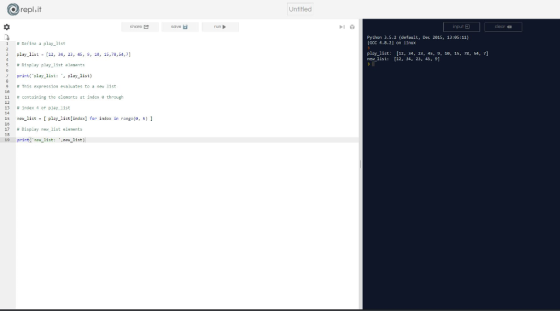
Given that play_list has been defined to be a list, write an expression that evaluates to a new list containing the elements at index 0 through index 4 play_list. Do not modify play_list.
Homework Answers
code:
# Define a play_list
play_list = [12, 34, 23, 45, 9, 10, 15,78,54,7]
# Display play_list elements
print('play_list: ', play_list)
# This expression evaluates to a new list
# containing the elements at index 0 through
# index 4 of play_list
new_list = [ play_list[index] for index in range(0, 5) ]
# Display new_list elements
print('new_list: ',new_list)
----------------------
Add Answer to:
PYTHON CODE
Given that play_list has been defined to be a list, write an
expression that...
Write Python code examples of statements to remove the name at position 2 from the list...
Write Python code examples of statements to remove the name at position 2 from the list in problem 32, and to remove one of the remaining names by referencing that name. Write Python code to declare a tuple named stuck that holds the three remaining names from famfri by referencing those names as elemens of famfri. Declare a Python set containing the names of the four seasons. What happens if you declare a set using a list that contains two...
Python code: 1. This question practices the use of a list method. Assign to the variable...
Python code: 1. This question practices the use of a list method. Assign to the variable grades a list of 10 letter grades from among ‘A’, ‘B’, ‘C’, ‘D’, and ‘F’. For example: grades = [‘A’, ‘F’, ‘C’, ‘F’, ‘A’, ‘B’, ‘A’, ‘C’, ‘A’, ‘B’] Write a Python expression that creates a list named frequency, in which the elements are the number of times each of the letters A, B, C, D and F appear in grades. For example, for...
Python: P2 Write a function that reverses a python list using recursion (Chapter 6-3 in our...
Python: P2 Write a function that reverses a python list using recursion (Chapter 6-3 in our textbook) E.g.: Input: [9, 8, 7, 6, 5, 4, 3, 2, 1, 0] Output: [0, 1, 2, 3, 4, 5, 6, 7, 8, 9] Constraints: - List elements are integers - The function should return a reversed array, not print its elements You may use the following code as template: def reverse(my_list, index = None): # your code here
Python recursive function: Given an ordered list L. A permutation of L is a rearrangement of...
 Python recursive function:
Given an ordered list L. A permutation of L is a rearrangement of its elements in some order. For example (1,3, 2) and (3, 2, 1) are two different permutations of L=(1,2,3). Implement the following function: def permutations (lst, low, high) The function is given a list 1st of integers, and two indices: low and high (lows high), which indicate the range of indices that need to be considered The function should return a list containing all...
Python recursive function:
Given an ordered list L. A permutation of L is a rearrangement of its elements in some order. For example (1,3, 2) and (3, 2, 1) are two different permutations of L=(1,2,3). Implement the following function: def permutations (lst, low, high) The function is given a list 1st of integers, and two indices: low and high (lows high), which indicate the range of indices that need to be considered The function should return a list containing all...
Need to do in Python? Can do in Javascript but not in Python Write a function...
Need to do in Python? Can do in Javascript but not in Python Write a function named "indexed_list" that takes a list as a parameter. Your function should create a new array. Update the newly created list so that it has the same number of entries as the function's input. Assign each entry in the list you created the value of it's index. So the entry at index 0 would have the value 0, the entry at index 1 would...
Python program - Write a Python program, in a file called sortList.py, which, given a list...
 Python program
- Write a Python program, in a file called sortList.py, which, given a list of names, sorts the names into alphabetical order. Use a one dimensional array to hold the list of names. To do the sorting use a simple sorting algorithm that repeatedly takes an element from the unsorted list and puts it in alphabetical order within the same list. Initially the entire list is unsorted. As each element is placed in alphabetical order, the elements in...
Python program
- Write a Python program, in a file called sortList.py, which, given a list of names, sorts the names into alphabetical order. Use a one dimensional array to hold the list of names. To do the sorting use a simple sorting algorithm that repeatedly takes an element from the unsorted list and puts it in alphabetical order within the same list. Initially the entire list is unsorted. As each element is placed in alphabetical order, the elements in...
Assume the variable LIST is defined as a list of numbers. Write a code segment that...
Assume the variable LIST is defined as a list of numbers. Write a code segment that utilizes a loop to total up all of the numbers in the list up to, but not including, the first negative number. Store the result in the variable TOTAL. % test cases % LIST = [ 1 4 6 -2 7 9]; TOTAL = 11; % LIST = [ -2 4 5 7 9]; TOTAL = 0; % your code segment here %----------------------- %...
Python code The power set of a list L is a list containing all possible combinations of the eleme...
python code The power set of a list L is a list containing all possible combinations of the elements of L. For example, the power set of [1, 2, 3] is [[], [1], [2], [3], [1, 2], [1, 3], [2, 3], [1, 2, 3]]. Section 9.3 of your textbook describes a (subtle) algorithm for generating the power set. • Read and understand the structure of the code in Figure 9.6 • Write (your own) function powerset(L) that generates and returns...
Python: We defined two variables, x = 'Python' and y = '3.0'. Write code to concatenate...
Python: We defined two variables, x = 'Python' and y = '3.0'. Write code to concatenate the two numbers (the result should be 'Python3.0').
(Python)Implement the function deep_list, which takes in a list, and returns a new list which contains...
(Python)Implement the function deep_list, which takes in a list, and returns a new list which contains only elements of the original list that are also lists. Use a list comprehension. def deep_list(seq): "" "Returns a new list containing elements of the original list that are lists. >>> seq = [49, 8, 2, 1, 102] >>> deep_list(seq) [] >>> seq = [[500], [30, 25, 24], 8, [0]] >>> deep_list(seq) [[500], [30, 25, 24], [0]] >>> seq = ["hello", [12, [25], 24],...
 Python recursive function:
Given an ordered list L. A permutation of L is a rearrangement of its elements in some order. For example (1,3, 2) and (3, 2, 1) are two different permutations of L=(1,2,3). Implement the following function: def permutations (lst, low, high) The function is given a list 1st of integers, and two indices: low and high (lows high), which indicate the range of indices that need to be considered The function should return a list containing all...
Python recursive function:
Given an ordered list L. A permutation of L is a rearrangement of its elements in some order. For example (1,3, 2) and (3, 2, 1) are two different permutations of L=(1,2,3). Implement the following function: def permutations (lst, low, high) The function is given a list 1st of integers, and two indices: low and high (lows high), which indicate the range of indices that need to be considered The function should return a list containing all...
 Python program
- Write a Python program, in a file called sortList.py, which, given a list of names, sorts the names into alphabetical order. Use a one dimensional array to hold the list of names. To do the sorting use a simple sorting algorithm that repeatedly takes an element from the unsorted list and puts it in alphabetical order within the same list. Initially the entire list is unsorted. As each element is placed in alphabetical order, the elements in...
Python program
- Write a Python program, in a file called sortList.py, which, given a list of names, sorts the names into alphabetical order. Use a one dimensional array to hold the list of names. To do the sorting use a simple sorting algorithm that repeatedly takes an element from the unsorted list and puts it in alphabetical order within the same list. Initially the entire list is unsorted. As each element is placed in alphabetical order, the elements in...
Most questions answered within 3 hours.
-
Where is the error in this code sequence?
String s1 = "Hello";
String s2 = "ello";...
asked 10 months ago -
Financial data for Joel de Paris, Inc., for last year
follow:
Joel de Paris, Inc.
Balance...
asked 10 months ago -
Consider this reaction:
Al2(SO4)3 (aq)+ BaCl3
(aq) Al2Cl6 (aq)- +
3BaSO4(s) . What is the...
asked 10 months ago -
Suppose that Savneet is considering increasing her
recent random sample from 20 car rentals to 40...
asked 10 months ago -
Trucks arrive at an unloading terminal at an average rate of 120
per hour.
Trucks arrive...
asked 10 months ago -
Why are methanol and ethanol completely soluble in water while
octanol is not very little soluble....
asked 10 months ago -
A facilities manager at a university reads in a research report
that the mean amount of...
asked 10 months ago -
When the CuSO4 is rehydrated by adding water to the anhydrous
compound, is this an endothermic...
asked 10 months ago -
A ray of sunlight is passing from diamond into crown glass; the
angle of incidence is...
asked 10 months ago -
A block of mass 0.249 kg is placed on top of a light, vertical
spring of...
asked 10 months ago -
how do the kidneys compensate in the presences of acidosis
a) trigger hyperventilate
b) reserve acid...
asked 10 months ago -
Question 501 pts
The rental rate of capital to the firm increases. Which of the
following...
asked 10 months ago