In terrapins, sharp beaks are an autosomal dominant condition with a penetrance of 77%. If two...
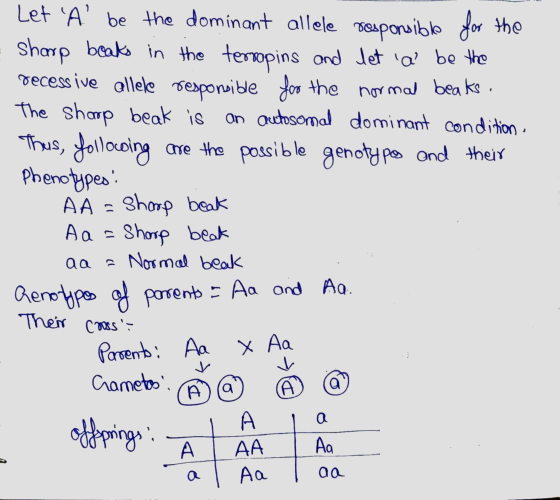
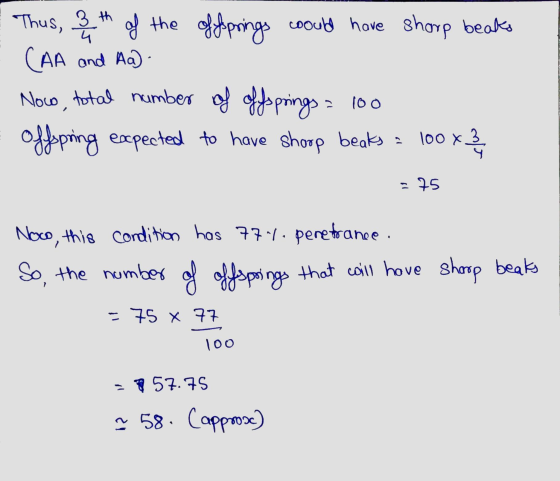
In terrapins, sharp beaks are an autosomal dominant condition with a penetrance of 77%. If two heterozygous sharp-beaked terrapins mate, how many of their 100 offspring would you expect to have sharp beaks?
Homework Answers
Add Answer to:
In terrapins, sharp beaks are an autosomal dominant condition
with a penetrance of 77%. If two...
Assume that long earlobes in humans is an autosomal dominant trait that exhibits 30% penetrance. A...
Assume that long earlobes in humans is an autosomal dominant trait that exhibits 30% penetrance. A person who is heterozygous for long earlobes mates with a person who is homozygous for normal earlobes. What is the probability that their first child will have long earlobes?
6 A human trait that is caused by an autosomal dominant mutant allele has a penetrance...
 6
A human trait that is caused by an autosomal dominant mutant allele has a penetrance of 50%. A man who is heterozygous for this mutant allele marries a woman who is homozygous recessive for the normal allele. If they have two children then what is the probability that both children will show the normal phenotype? O 1/4 o 1/2 03/16 0 7/8 09/16
6
A human trait that is caused by an autosomal dominant mutant allele has a penetrance of 50%. A man who is heterozygous for this mutant allele marries a woman who is homozygous recessive for the normal allele. If they have two children then what is the probability that both children will show the normal phenotype? O 1/4 o 1/2 03/16 0 7/8 09/16
Approximately one in 12,500 individuals in a given population have porphyria, an autosomal dominant condition. Approximately...
Approximately one in 12,500 individuals in a given population have porphyria, an autosomal dominant condition. Approximately how many individuals in this population will be in the heterozygous state?
Assume that Vulcan ears are inherited as an autosomal recessive trait with 70% penetrance. Two people...
Assume that Vulcan ears are inherited as an autosomal recessive trait with 70% penetrance. Two people heterozygous for Vulcan ears mate. a) What is the probability that their first child will have long fingers? b) Some people with the Vulcan ear phenotype have very tall, pointy ears whereas others have only a slight bump on the top of their ears. What is the name for variability of this phenotype?
a person is heterozygous for an autosomal dominant condition. if they have children with someone whonis...
a person is heterozygous for an autosomal dominant condition. if they have children with someone whonis homozygous recessive, which statement is correct? A) all of their children will have the condition B) none of their children will have the condition C) all of their children will be carriers D) half of their children will be carriers E) half of their children will have the condition
17. In cats, yellow fur is dominant to black fur. The heterozygous tortoise-shell" or "calico" condition...
 17. In cats, yellow fur is dominant to black fur. The heterozygous tortoise-shell" or "calico" condition is exhibited only by the female. The fur trait is sex-linked. What offspring (genotypes, phenotypes and frequencies) would you expect from the cross of a black male with a yellow female? What kinds of offspring would you expect to result from the cross of a black male with a tortoise-shell female? How about the cross of two tortoise-shell animals?! dong
Assume red plumage is encoded by an autosomal dominant allele (R). You crossed a male robin...
Assume red plumage is encoded by an autosomal dominant allele (R). You crossed a male robin with a red breast and a homozygous dominant genotype with a female robin with a homozygous recessive genotype. You get both male and female offspring, but find that only the male offspring have a red breast. How could you explain this? Group of answer choices a The red plumage has variable expressivity in males b The plumage gene is not present in females c...
In horses, black color is dominant to chestnut; trotting is dominant to a pacing gait. Two...
In horses, black color is dominant to chestnut; trotting is dominant to a pacing gait. Two black, trotting horses mate. They have a chestnut, pacing foal. This offspring is later backcrossed with one of the parents. What are the chances that an offspring of this cross will be heterozygous for both traits?
MONOHYBRID CROSS In mice the allele for wild color is dominant to the allele for albino....
MONOHYBRID CROSS In mice the allele for wild color is dominant to the allele for albino. Two wild color mice mate and have 13 wild colored pups and 7 albino pups. 1. What are the genotypes of the parents? 2. What percentage of the offspring are albino? How close is this to the theoretical percentage? 3. Theoretically, what percentage of the offspring should be heterozygous? 4. A cross between a heterozygous mouse and an albino yields 20 offspring. How many...
1) (4 pts) Black hair in rabbits is determined by a dominant allele, B, and white...
1) (4 pts) Black hair in rabbits is determined by a dominant allele, B, and white hair by homozygosity for a recessive allele, b. Two heterozygous rabbits mate and produce a litter of seven offspring. With what frequency would we expect to find: a) four whites and three black offspring? b) one white and six black offspring?
 6
A human trait that is caused by an autosomal dominant mutant allele has a penetrance of 50%. A man who is heterozygous for this mutant allele marries a woman who is homozygous recessive for the normal allele. If they have two children then what is the probability that both children will show the normal phenotype? O 1/4 o 1/2 03/16 0 7/8 09/16
6
A human trait that is caused by an autosomal dominant mutant allele has a penetrance of 50%. A man who is heterozygous for this mutant allele marries a woman who is homozygous recessive for the normal allele. If they have two children then what is the probability that both children will show the normal phenotype? O 1/4 o 1/2 03/16 0 7/8 09/16
 17. In cats, yellow fur is dominant to black fur. The heterozygous tortoise-shell" or "calico" condition is exhibited only by the female. The fur trait is sex-linked. What offspring (genotypes, phenotypes and frequencies) would you expect from the cross of a black male with a yellow female? What kinds of offspring would you expect to result from the cross of a black male with a tortoise-shell female? How about the cross of two tortoise-shell animals?! dong
Most questions answered within 3 hours.
-
Where is the error in this code sequence?
String s1 = "Hello";
String s2 = "ello";...
asked 10 months ago -
Financial data for Joel de Paris, Inc., for last year
follow:
Joel de Paris, Inc.
Balance...
asked 10 months ago -
Consider this reaction:
Al2(SO4)3 (aq)+ BaCl3
(aq) Al2Cl6 (aq)- +
3BaSO4(s) . What is the...
asked 10 months ago -
Suppose that Savneet is considering increasing her
recent random sample from 20 car rentals to 40...
asked 10 months ago -
Trucks arrive at an unloading terminal at an average rate of 120
per hour.
Trucks arrive...
asked 10 months ago -
Why are methanol and ethanol completely soluble in water while
octanol is not very little soluble....
asked 10 months ago -
A facilities manager at a university reads in a research report
that the mean amount of...
asked 10 months ago -
When the CuSO4 is rehydrated by adding water to the anhydrous
compound, is this an endothermic...
asked 10 months ago -
A ray of sunlight is passing from diamond into crown glass; the
angle of incidence is...
asked 10 months ago -
A block of mass 0.249 kg is placed on top of a light, vertical
spring of...
asked 10 months ago -
how do the kidneys compensate in the presences of acidosis
a) trigger hyperventilate
b) reserve acid...
asked 10 months ago -
Question 501 pts
The rental rate of capital to the firm increases. Which of the
following...
asked 10 months ago