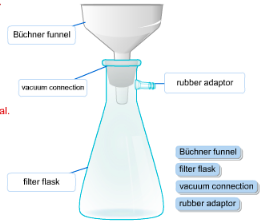
Please label she components of a common filter setup and answer the folowing question. All items...
Homework Answers
 Thank you
Add Answer to:
Please label she components of a common filter setup and answer the folowing question. All items...
Extraction of solids: Experiment outlined below Draw a “roadmap” of the experiment, containing chemical structures and...
 Extraction of solids: Experiment outlined below
Draw a “roadmap” of the experiment, containing chemical
structures and “layers” (organic and aqueous). This should contain
the individual reactions occurring in each step, and show which
layer the various components are present. Make sure you think about
whether the acetaminophen, caffeine and aspirin are neutral,
protonated or deprotonated.
Preliminary separation obtain a sample (1.0g) of the mixture. weigh the sample and record it. this sample should consist of a 2:1:1 mixture (by mass)...
Extraction of solids: Experiment outlined below
Draw a “roadmap” of the experiment, containing chemical
structures and “layers” (organic and aqueous). This should contain
the individual reactions occurring in each step, and show which
layer the various components are present. Make sure you think about
whether the acetaminophen, caffeine and aspirin are neutral,
protonated or deprotonated.
Preliminary separation obtain a sample (1.0g) of the mixture. weigh the sample and record it. this sample should consist of a 2:1:1 mixture (by mass)...
Separating a Mixture, Recrystallization, pre-lab assignment could you also explain why you chose that substance for...
 Separating a Mixture, Recrystallization, pre-lab
assignment
could you also explain why you chose that substance for the empty
spaces and question marks
EXPERIMENT 4 Pre-Lab Assignment Separating a Mixture, Recrystalliration Name Date 1. Complete the following flowchart which shows how to separate a mixture of sand, sodium chloride and acetanilide. Notice that after a separation process (a down arrow) the filtered solids are shown on the left and the filtrate (the liquid) is shown on the right. The terminal step...
Separating a Mixture, Recrystallization, pre-lab
assignment
could you also explain why you chose that substance for the empty
spaces and question marks
EXPERIMENT 4 Pre-Lab Assignment Separating a Mixture, Recrystalliration Name Date 1. Complete the following flowchart which shows how to separate a mixture of sand, sodium chloride and acetanilide. Notice that after a separation process (a down arrow) the filtered solids are shown on the left and the filtrate (the liquid) is shown on the right. The terminal step...
Please help with question 3. Thank you! Disposal of waste: When necessary, all organic waste must...
 Please help with question 3. Thank you!
Disposal of waste: When necessary, all organic waste must be disposed into the organic waste container, all aqueous waste to the aqueous waste container and all solid waste to the solid waste container. Nothing is disposed in the sink or trash can. Synthesis of acetanilide In a dry small conical vial, dissolve 300 mg (or 30 drops) of freshly distilled aniline in 1.0 mL of 1.0 M hydrochloric acid. Swirl the mixture to...
Please help with question 3. Thank you!
Disposal of waste: When necessary, all organic waste must be disposed into the organic waste container, all aqueous waste to the aqueous waste container and all solid waste to the solid waste container. Nothing is disposed in the sink or trash can. Synthesis of acetanilide In a dry small conical vial, dissolve 300 mg (or 30 drops) of freshly distilled aniline in 1.0 mL of 1.0 M hydrochloric acid. Swirl the mixture to...
Please answer and explain: QUESTION 8 Common items found on a cash flow statement include all...
 Please answer and explain:
QUESTION 8 Common items found on a cash flow statement include all of the following except for which of the following: O Net income O Change in working capital O Principal repayments on outstanding debt O Retained earnings O The proceeds of asset sales
Please answer and explain:
QUESTION 8 Common items found on a cash flow statement include all of the following except for which of the following: O Net income O Change in working capital O Principal repayments on outstanding debt O Retained earnings O The proceeds of asset sales
Please help!! with question (18 ,19, 20 ) the data is coming directly from professor and...
 Please help!! with question (18
,19, 20 )
the data is coming directly from
professor and i think she made a mistake because after I work out
problem I get theoritcal yeild of 0.850 grams
CaCO3 but the experiment actual yield is 8.322 grams (work out
question 12 )
Carbonate LI General Chemistry Lab I H.Y. & S.D. ame ata Sheet Section Date • Precipitating Cacos 1) Volume of Na2CO3, mL 8.22mL or 0.00824 2) Molarity of Na2CO3 solution, mol/L...
Please help!! with question (18
,19, 20 )
the data is coming directly from
professor and i think she made a mistake because after I work out
problem I get theoritcal yeild of 0.850 grams
CaCO3 but the experiment actual yield is 8.322 grams (work out
question 12 )
Carbonate LI General Chemistry Lab I H.Y. & S.D. ame ata Sheet Section Date • Precipitating Cacos 1) Volume of Na2CO3, mL 8.22mL or 0.00824 2) Molarity of Na2CO3 solution, mol/L...
#1 please answer all components. Question 1 (6 points) Consider the following fatty acids. Label each one as saturated, monounsaturated, polyunsaturated, or trans. Circle the one you would expect...
 #1
please answer all components.
Question 1 (6 points) Consider the following fatty acids. Label each one as saturated, monounsaturated, polyunsaturated, or trans. Circle the one you would expect to have the lowest melting point. Draw a rectangle around the one you would expect to be the most resistant to oxidation но но но HO
Question 1 (6 points) Consider the following fatty acids. Label each one as saturated, monounsaturated, polyunsaturated, or trans. Circle the one you would expect to...
#1
please answer all components.
Question 1 (6 points) Consider the following fatty acids. Label each one as saturated, monounsaturated, polyunsaturated, or trans. Circle the one you would expect to have the lowest melting point. Draw a rectangle around the one you would expect to be the most resistant to oxidation но но но HO
Question 1 (6 points) Consider the following fatty acids. Label each one as saturated, monounsaturated, polyunsaturated, or trans. Circle the one you would expect to...
Question to answer from the lab: What aspect(s) of the approach taken is/are NOT especially green?...
Question to answer from the lab: What aspect(s) of the approach taken is/are NOT especially green? What changes might be made to make the overall process greener? The Lab Experiment Summary Polyethylene glycols such as PEG-400 are currently of great interest to organic chemists, since their application as reaction solvents is very intriguing (1). PEG-400 is non-volatile and nonflammable in nature, and also possesses important properties such as recyclability, ease of work-up, thermal stability and economical cost. In addition, the...
Let's assume you have a mixture of equal parts benzoic acid, sand and toluene that are...
Let's assume you have a mixture of equal parts benzoic acid, sand and toluene that are intimately mixed together (the crude material is a mixture of solid and liquid). Propose a procedure to separate these three components using any of the chemicals commonly available (you've used all of the "common" chemicals in the lab by now) in the organic chemistry teaching laboratories and observing the typical limitations with the instruments and techniques (such as not being able to distill or...
Need help, numbers 3-6 please show work. and fill out table of chemicals for all chemical...
 Need help, numbers 3-6 please show work. and fill out table of
chemicals for all chemical used.
calculate mmol in the table as well show work please
and each of these must be listed in its own row. There are 10 column headings: IUPAC name OR common name, structure, CAS number (Chemical Abstract Service number) molecular mass, melting point (if applicable), boiling point (if applicable), solubility (in water, if applicable), density, amounts to be used in the experiment, and the...
Need help, numbers 3-6 please show work. and fill out table of
chemicals for all chemical used.
calculate mmol in the table as well show work please
and each of these must be listed in its own row. There are 10 column headings: IUPAC name OR common name, structure, CAS number (Chemical Abstract Service number) molecular mass, melting point (if applicable), boiling point (if applicable), solubility (in water, if applicable), density, amounts to be used in the experiment, and the...
Based on the Wittig Reaction exp. below, please answer a) and b). In b) you can...
 Based on the Wittig Reaction exp. below, please answer a) and
b). In b) you can disregard the part about the IR, just please
interpret and assign protons, shift values, which protons are for
which groups, etc on the HNMR. The % yield was 34%, and MP was
lower than expected (to assist with answering part a). This should
be all the information you need to answer the question.
HNMR
Discuss the percentage yield of the reaction. Explain and provide...
Based on the Wittig Reaction exp. below, please answer a) and
b). In b) you can disregard the part about the IR, just please
interpret and assign protons, shift values, which protons are for
which groups, etc on the HNMR. The % yield was 34%, and MP was
lower than expected (to assist with answering part a). This should
be all the information you need to answer the question.
HNMR
Discuss the percentage yield of the reaction. Explain and provide...
 Extraction of solids: Experiment outlined below
Draw a “roadmap” of the experiment, containing chemical
structures and “layers” (organic and aqueous). This should contain
the individual reactions occurring in each step, and show which
layer the various components are present. Make sure you think about
whether the acetaminophen, caffeine and aspirin are neutral,
protonated or deprotonated.
Preliminary separation obtain a sample (1.0g) of the mixture. weigh the sample and record it. this sample should consist of a 2:1:1 mixture (by mass)...
Extraction of solids: Experiment outlined below
Draw a “roadmap” of the experiment, containing chemical
structures and “layers” (organic and aqueous). This should contain
the individual reactions occurring in each step, and show which
layer the various components are present. Make sure you think about
whether the acetaminophen, caffeine and aspirin are neutral,
protonated or deprotonated.
Preliminary separation obtain a sample (1.0g) of the mixture. weigh the sample and record it. this sample should consist of a 2:1:1 mixture (by mass)...
 Separating a Mixture, Recrystallization, pre-lab
assignment
could you also explain why you chose that substance for the empty
spaces and question marks
EXPERIMENT 4 Pre-Lab Assignment Separating a Mixture, Recrystalliration Name Date 1. Complete the following flowchart which shows how to separate a mixture of sand, sodium chloride and acetanilide. Notice that after a separation process (a down arrow) the filtered solids are shown on the left and the filtrate (the liquid) is shown on the right. The terminal step...
Separating a Mixture, Recrystallization, pre-lab
assignment
could you also explain why you chose that substance for the empty
spaces and question marks
EXPERIMENT 4 Pre-Lab Assignment Separating a Mixture, Recrystalliration Name Date 1. Complete the following flowchart which shows how to separate a mixture of sand, sodium chloride and acetanilide. Notice that after a separation process (a down arrow) the filtered solids are shown on the left and the filtrate (the liquid) is shown on the right. The terminal step...
 Please help with question 3. Thank you!
Disposal of waste: When necessary, all organic waste must be disposed into the organic waste container, all aqueous waste to the aqueous waste container and all solid waste to the solid waste container. Nothing is disposed in the sink or trash can. Synthesis of acetanilide In a dry small conical vial, dissolve 300 mg (or 30 drops) of freshly distilled aniline in 1.0 mL of 1.0 M hydrochloric acid. Swirl the mixture to...
Please help with question 3. Thank you!
Disposal of waste: When necessary, all organic waste must be disposed into the organic waste container, all aqueous waste to the aqueous waste container and all solid waste to the solid waste container. Nothing is disposed in the sink or trash can. Synthesis of acetanilide In a dry small conical vial, dissolve 300 mg (or 30 drops) of freshly distilled aniline in 1.0 mL of 1.0 M hydrochloric acid. Swirl the mixture to...
 Please answer and explain:
QUESTION 8 Common items found on a cash flow statement include all of the following except for which of the following: O Net income O Change in working capital O Principal repayments on outstanding debt O Retained earnings O The proceeds of asset sales
Please answer and explain:
QUESTION 8 Common items found on a cash flow statement include all of the following except for which of the following: O Net income O Change in working capital O Principal repayments on outstanding debt O Retained earnings O The proceeds of asset sales
 Please help!! with question (18
,19, 20 )
the data is coming directly from
professor and i think she made a mistake because after I work out
problem I get theoritcal yeild of 0.850 grams
CaCO3 but the experiment actual yield is 8.322 grams (work out
question 12 )
Carbonate LI General Chemistry Lab I H.Y. & S.D. ame ata Sheet Section Date • Precipitating Cacos 1) Volume of Na2CO3, mL 8.22mL or 0.00824 2) Molarity of Na2CO3 solution, mol/L...
Please help!! with question (18
,19, 20 )
the data is coming directly from
professor and i think she made a mistake because after I work out
problem I get theoritcal yeild of 0.850 grams
CaCO3 but the experiment actual yield is 8.322 grams (work out
question 12 )
Carbonate LI General Chemistry Lab I H.Y. & S.D. ame ata Sheet Section Date • Precipitating Cacos 1) Volume of Na2CO3, mL 8.22mL or 0.00824 2) Molarity of Na2CO3 solution, mol/L...
 #1
please answer all components.
Question 1 (6 points) Consider the following fatty acids. Label each one as saturated, monounsaturated, polyunsaturated, or trans. Circle the one you would expect to have the lowest melting point. Draw a rectangle around the one you would expect to be the most resistant to oxidation но но но HO
Question 1 (6 points) Consider the following fatty acids. Label each one as saturated, monounsaturated, polyunsaturated, or trans. Circle the one you would expect to...
#1
please answer all components.
Question 1 (6 points) Consider the following fatty acids. Label each one as saturated, monounsaturated, polyunsaturated, or trans. Circle the one you would expect to have the lowest melting point. Draw a rectangle around the one you would expect to be the most resistant to oxidation но но но HO
Question 1 (6 points) Consider the following fatty acids. Label each one as saturated, monounsaturated, polyunsaturated, or trans. Circle the one you would expect to...
 Need help, numbers 3-6 please show work. and fill out table of
chemicals for all chemical used.
calculate mmol in the table as well show work please
and each of these must be listed in its own row. There are 10 column headings: IUPAC name OR common name, structure, CAS number (Chemical Abstract Service number) molecular mass, melting point (if applicable), boiling point (if applicable), solubility (in water, if applicable), density, amounts to be used in the experiment, and the...
Need help, numbers 3-6 please show work. and fill out table of
chemicals for all chemical used.
calculate mmol in the table as well show work please
and each of these must be listed in its own row. There are 10 column headings: IUPAC name OR common name, structure, CAS number (Chemical Abstract Service number) molecular mass, melting point (if applicable), boiling point (if applicable), solubility (in water, if applicable), density, amounts to be used in the experiment, and the...
 Based on the Wittig Reaction exp. below, please answer a) and
b). In b) you can disregard the part about the IR, just please
interpret and assign protons, shift values, which protons are for
which groups, etc on the HNMR. The % yield was 34%, and MP was
lower than expected (to assist with answering part a). This should
be all the information you need to answer the question.
HNMR
Discuss the percentage yield of the reaction. Explain and provide...
Based on the Wittig Reaction exp. below, please answer a) and
b). In b) you can disregard the part about the IR, just please
interpret and assign protons, shift values, which protons are for
which groups, etc on the HNMR. The % yield was 34%, and MP was
lower than expected (to assist with answering part a). This should
be all the information you need to answer the question.
HNMR
Discuss the percentage yield of the reaction. Explain and provide...
Most questions answered within 3 hours.
-
Where is the error in this code sequence?
String s1 = "Hello";
String s2 = "ello";...
asked 11 months ago -
Financial data for Joel de Paris, Inc., for last year
follow:
Joel de Paris, Inc.
Balance...
asked 11 months ago -
Consider this reaction:
Al2(SO4)3 (aq)+ BaCl3
(aq) Al2Cl6 (aq)- +
3BaSO4(s) . What is the...
asked 11 months ago -
Suppose that Savneet is considering increasing her
recent random sample from 20 car rentals to 40...
asked 11 months ago -
Trucks arrive at an unloading terminal at an average rate of 120
per hour.
Trucks arrive...
asked 11 months ago -
Why are methanol and ethanol completely soluble in water while
octanol is not very little soluble....
asked 11 months ago -
A facilities manager at a university reads in a research report
that the mean amount of...
asked 11 months ago -
When the CuSO4 is rehydrated by adding water to the anhydrous
compound, is this an endothermic...
asked 11 months ago -
A ray of sunlight is passing from diamond into crown glass; the
angle of incidence is...
asked 11 months ago -
A block of mass 0.249 kg is placed on top of a light, vertical
spring of...
asked 11 months ago -
how do the kidneys compensate in the presences of acidosis
a) trigger hyperventilate
b) reserve acid...
asked 11 months ago -
Question 501 pts
The rental rate of capital to the firm increases. Which of the
following...
asked 11 months ago