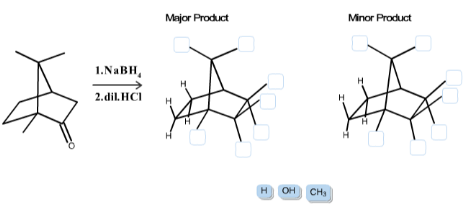
The reduction of camphor by sodium borohydride followed by acid workup with dilute hydrochloric acid produces...
Homework Answers
A reaction is given with the reactant, that is, camphor, whose correct major and minor product needs to be formed. Camphor is a bridged compound and undergoing a reduction reaction with sodium borohydride. Thus, consider the groups attached to the ring and major product will be formed based on the site which provide lesser steric hindrance to the incoming reagent.
Bridged compounds basically contain two or more rings with the formation of a bridge. Sodium borohydride is a mild reducing agent which reduces carbonyl group into alcohol.
Draw the structure of the possible products formed by the given reaction as shown below:

Identify the major and minor product from the products drawn in step 1 as follows:
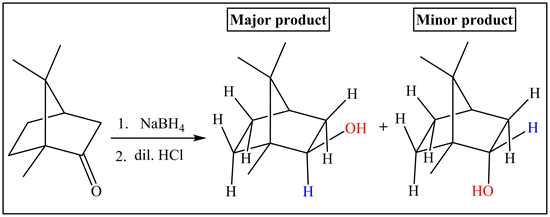
The major and minor product can be identified by knowing the mechanism of the reaction. Hydride ion from sodium borohydride will attack from the less hindered side to form the major product.
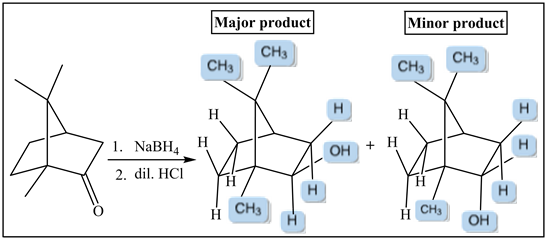
Ans:Hence, the major and minor products can be shown as follows:
Add Answer to:
The reduction of camphor by sodium borohydride followed by acid workup with dilute hydrochloric acid produces...
From experiment reduction of camphor 2. The major products from the sodium borohydride reduction can be...
 From experiment reduction of camphor
2. The major products from the sodium borohydride reduction can be predicted by the effect called 'steric approach control'. However, the major product from the reduction of 4-t-butylcyclohexane is not determined by this factor. Explain.
From experiment reduction of camphor
2. The major products from the sodium borohydride reduction can be predicted by the effect called 'steric approach control'. However, the major product from the reduction of 4-t-butylcyclohexane is not determined by this factor. Explain.
Sodium Borohydride Reduction of Benzoin Pre-Lab Worksheet (1) Why is it important to use 100% ethanol...
 Sodium Borohydride Reduction of Benzoin Pre-Lab
Worksheet
(1) Why is it important to use 100% ethanol for this reaction? 5, ethanol (absolute ethanol) rather than 95% of benzoin? ow would you expect the IR spectrum of the reduced product to differ from that 7. (2) How would you expect the 1H rom that of benzNMR spectrum of the reduced product to differ 8. (2) How many peaks do you expect in the 13C NMR spectrum of the product? Suppose you...
Sodium Borohydride Reduction of Benzoin Pre-Lab
Worksheet
(1) Why is it important to use 100% ethanol for this reaction? 5, ethanol (absolute ethanol) rather than 95% of benzoin? ow would you expect the IR spectrum of the reduced product to differ from that 7. (2) How would you expect the 1H rom that of benzNMR spectrum of the reduced product to differ 8. (2) How many peaks do you expect in the 13C NMR spectrum of the product? Suppose you...
hi, please help me with number 7. thank you EXPERIMENT SEVEN SODIUM BOROHYDRIDE REDUCTION OF ACETOPHENONE...
 hi, please help me with number 7. thank you
EXPERIMENT SEVEN SODIUM BOROHYDRIDE REDUCTION OF ACETOPHENONE HOCH, DISCUSSION The reduction of an aldehyde or ketone with sodium borohydride is straight forward and usually affords a high yield of the alcohol. The usual procedure (and the one employed in this experiment) involves dissolving the borohydride in 95% ethanol and adding the carbonyl compound to this solution. To ensure complete reaction, an excess of sodium borohydride is used. The reaction between sodium...
hi, please help me with number 7. thank you
EXPERIMENT SEVEN SODIUM BOROHYDRIDE REDUCTION OF ACETOPHENONE HOCH, DISCUSSION The reduction of an aldehyde or ketone with sodium borohydride is straight forward and usually affords a high yield of the alcohol. The usual procedure (and the one employed in this experiment) involves dissolving the borohydride in 95% ethanol and adding the carbonyl compound to this solution. To ensure complete reaction, an excess of sodium borohydride is used. The reaction between sodium...
Sodium bisulfite, NaHSO,, reacts with hydrochloric acid in a gas evolution reaction, producing water and two...
 Sodium bisulfite, NaHSO,, reacts with hydrochloric acid in a gas evolution reaction, producing water and two other products. Write the chemical formulas for the other two products to complete the reaction in molecular form . Do NOT write dissociated ions as separate species Provide your answer below NaHSO, (aq) + HCI(aq)-O()+K)+(aq)
Experiment . the reduction of bencil (March 2020) Your name Sodium borohydride is a convert recent...
 Experiment . the reduction of bencil (March 2020) Your name Sodium borohydride is a convert recent for the reduction of dehydes and ketones to 1" and 2 alcohols, respectively. The mechanism of the reaction - (below) is straightforward and is driven by boron's affinity for oxygen. In addition, given borohydride's remarkably low reactivity with OH groups under neutral and especially basic conditions, this reaction can be done in alcohol solvents. This means that (unlike LAH or Grignard reactions) no separate...
MyChart-Login Page the crux &Montana Google Drive GRE C Chems 2 WebExpressHome Page-Army Av.... Cengage troy utilities Hydrocarbon A reacts with cold aqueous sulfuric acid to give an alcohol...
 MyChart-Login Page the crux &Montana Google Drive GRE C Chems 2 WebExpressHome Page-Army Av.... Cengage troy utilities Hydrocarbon A reacts with cold aqueous sulfuric acid to give an alcohol, B (CAHI00). A also reacts with borane in anhydrous THF followed by hydrogen peroxide in aqueous sodium hydroxide to give an isomeric alcohol C. Draw the structure of A. You do not have to consider stereochemistry . In cases where there is more than one answer, just draw one. Previous Rety...
1. Add hydrochloric acid (HCl) to magnesium metal in a test tube. Observations: &
1. Add hydrochloric acid (HCl) to magnesium metal in a test tube. Observations: Reactants: Products: Chemical Equation: 2. Add calcium nitrate to sodium carbonate in a test tube. Observations: Reactants: Products: Chemical Equation: 3. Add iron (III) nitrate to sodium hydroxide in a test tube. Observations: Reactants: Products: Chemical Equation: 4. Add copper (II) nitrate to ammonium hydroxide in a test tube. For writing the equation, the Roman numeral indicates the charge of copper. Caution: ammonium hydroxide produces very pungent...
5) Rationalizing the stereochemical outc ome of this reaction requires an understanding of the f borohydride...
 5) Rationalizing the stereochemical outc ome of this reaction
requires an understanding of the f borohydride borohydride lcohol.
An three-dimensional structure of benzoin and the general reaction
mechanism o reductions. As shown previously (10-1), the usual mode
of activation tor reduction occurs via an intermolecular H-bond
between the carbonyl group and an a intramolecular H-bond can
stabilize the lowest-energy conformation of benzoin (pre and serve
to activate the carbonyl for reduction, thus generating the
lowest-energyt state. a) Draw the lowest-energy,...
5) Rationalizing the stereochemical outc ome of this reaction
requires an understanding of the f borohydride borohydride lcohol.
An three-dimensional structure of benzoin and the general reaction
mechanism o reductions. As shown previously (10-1), the usual mode
of activation tor reduction occurs via an intermolecular H-bond
between the carbonyl group and an a intramolecular H-bond can
stabilize the lowest-energy conformation of benzoin (pre and serve
to activate the carbonyl for reduction, thus generating the
lowest-energyt state. a) Draw the lowest-energy,...
1. what is the purpose of the following in this experiment: a. concentrated (and not dilute)...
 1. what is the purpose of the following in this
experiment:
a. concentrated (and not dilute) hydrochloric acid
b. collecting the distillate in ice
c. sodium bicarbonate extraction
d. water extraction
e. anhydrous sodium or magnesium sulfate
chapter Alkyl Halides and Nucleophilic Aliphatic Substitution 13.1 SYNTHESIS OF BUTYL CHLORIDE Alkyl halides can be prepared by reacting an alcohol with concentrated hydrogen halides: R-OH + H-X- R-OH, R-X. HO where X-CI, Br, I. The reaction of hydrochloric acid with 2 and...
1. what is the purpose of the following in this
experiment:
a. concentrated (and not dilute) hydrochloric acid
b. collecting the distillate in ice
c. sodium bicarbonate extraction
d. water extraction
e. anhydrous sodium or magnesium sulfate
chapter Alkyl Halides and Nucleophilic Aliphatic Substitution 13.1 SYNTHESIS OF BUTYL CHLORIDE Alkyl halides can be prepared by reacting an alcohol with concentrated hydrogen halides: R-OH + H-X- R-OH, R-X. HO where X-CI, Br, I. The reaction of hydrochloric acid with 2 and...
3) The hydrogen atom in HCl is electrophilic whereas the hydrogen atoms in sodium borohydride are...
 3) The hydrogen atom in HCl is electrophilic whereas the hydrogen atoms in sodium borohydride are nucleophilic. Offer a plausible rationale for this difference in reactivity. PROCEDURES 1. Add 2.00 g of 3-dimethylaminopropiophenone hydrochloride, 10 mL of distilled water and a magnetic stir bar to a 100 ml beaker, and stir to dissolve. This is the reaction beaker. 2. Add (with stirring) sufficient 10% NaOH (about 5-6 mL) to bring the solution to pH > 10. The free base will...
 From experiment reduction of camphor
2. The major products from the sodium borohydride reduction can be predicted by the effect called 'steric approach control'. However, the major product from the reduction of 4-t-butylcyclohexane is not determined by this factor. Explain.
From experiment reduction of camphor
2. The major products from the sodium borohydride reduction can be predicted by the effect called 'steric approach control'. However, the major product from the reduction of 4-t-butylcyclohexane is not determined by this factor. Explain.
 Sodium Borohydride Reduction of Benzoin Pre-Lab
Worksheet
(1) Why is it important to use 100% ethanol for this reaction? 5, ethanol (absolute ethanol) rather than 95% of benzoin? ow would you expect the IR spectrum of the reduced product to differ from that 7. (2) How would you expect the 1H rom that of benzNMR spectrum of the reduced product to differ 8. (2) How many peaks do you expect in the 13C NMR spectrum of the product? Suppose you...
Sodium Borohydride Reduction of Benzoin Pre-Lab
Worksheet
(1) Why is it important to use 100% ethanol for this reaction? 5, ethanol (absolute ethanol) rather than 95% of benzoin? ow would you expect the IR spectrum of the reduced product to differ from that 7. (2) How would you expect the 1H rom that of benzNMR spectrum of the reduced product to differ 8. (2) How many peaks do you expect in the 13C NMR spectrum of the product? Suppose you...
 hi, please help me with number 7. thank you
EXPERIMENT SEVEN SODIUM BOROHYDRIDE REDUCTION OF ACETOPHENONE HOCH, DISCUSSION The reduction of an aldehyde or ketone with sodium borohydride is straight forward and usually affords a high yield of the alcohol. The usual procedure (and the one employed in this experiment) involves dissolving the borohydride in 95% ethanol and adding the carbonyl compound to this solution. To ensure complete reaction, an excess of sodium borohydride is used. The reaction between sodium...
hi, please help me with number 7. thank you
EXPERIMENT SEVEN SODIUM BOROHYDRIDE REDUCTION OF ACETOPHENONE HOCH, DISCUSSION The reduction of an aldehyde or ketone with sodium borohydride is straight forward and usually affords a high yield of the alcohol. The usual procedure (and the one employed in this experiment) involves dissolving the borohydride in 95% ethanol and adding the carbonyl compound to this solution. To ensure complete reaction, an excess of sodium borohydride is used. The reaction between sodium...
 Sodium bisulfite, NaHSO,, reacts with hydrochloric acid in a gas evolution reaction, producing water and two other products. Write the chemical formulas for the other two products to complete the reaction in molecular form . Do NOT write dissociated ions as separate species Provide your answer below NaHSO, (aq) + HCI(aq)-O()+K)+(aq)
 Experiment . the reduction of bencil (March 2020) Your name Sodium borohydride is a convert recent for the reduction of dehydes and ketones to 1" and 2 alcohols, respectively. The mechanism of the reaction - (below) is straightforward and is driven by boron's affinity for oxygen. In addition, given borohydride's remarkably low reactivity with OH groups under neutral and especially basic conditions, this reaction can be done in alcohol solvents. This means that (unlike LAH or Grignard reactions) no separate...
 MyChart-Login Page the crux &Montana Google Drive GRE C Chems 2 WebExpressHome Page-Army Av.... Cengage troy utilities Hydrocarbon A reacts with cold aqueous sulfuric acid to give an alcohol, B (CAHI00). A also reacts with borane in anhydrous THF followed by hydrogen peroxide in aqueous sodium hydroxide to give an isomeric alcohol C. Draw the structure of A. You do not have to consider stereochemistry . In cases where there is more than one answer, just draw one. Previous Rety...
 5) Rationalizing the stereochemical outc ome of this reaction
requires an understanding of the f borohydride borohydride lcohol.
An three-dimensional structure of benzoin and the general reaction
mechanism o reductions. As shown previously (10-1), the usual mode
of activation tor reduction occurs via an intermolecular H-bond
between the carbonyl group and an a intramolecular H-bond can
stabilize the lowest-energy conformation of benzoin (pre and serve
to activate the carbonyl for reduction, thus generating the
lowest-energyt state. a) Draw the lowest-energy,...
5) Rationalizing the stereochemical outc ome of this reaction
requires an understanding of the f borohydride borohydride lcohol.
An three-dimensional structure of benzoin and the general reaction
mechanism o reductions. As shown previously (10-1), the usual mode
of activation tor reduction occurs via an intermolecular H-bond
between the carbonyl group and an a intramolecular H-bond can
stabilize the lowest-energy conformation of benzoin (pre and serve
to activate the carbonyl for reduction, thus generating the
lowest-energyt state. a) Draw the lowest-energy,...
 1. what is the purpose of the following in this
experiment:
a. concentrated (and not dilute) hydrochloric acid
b. collecting the distillate in ice
c. sodium bicarbonate extraction
d. water extraction
e. anhydrous sodium or magnesium sulfate
chapter Alkyl Halides and Nucleophilic Aliphatic Substitution 13.1 SYNTHESIS OF BUTYL CHLORIDE Alkyl halides can be prepared by reacting an alcohol with concentrated hydrogen halides: R-OH + H-X- R-OH, R-X. HO where X-CI, Br, I. The reaction of hydrochloric acid with 2 and...
1. what is the purpose of the following in this
experiment:
a. concentrated (and not dilute) hydrochloric acid
b. collecting the distillate in ice
c. sodium bicarbonate extraction
d. water extraction
e. anhydrous sodium or magnesium sulfate
chapter Alkyl Halides and Nucleophilic Aliphatic Substitution 13.1 SYNTHESIS OF BUTYL CHLORIDE Alkyl halides can be prepared by reacting an alcohol with concentrated hydrogen halides: R-OH + H-X- R-OH, R-X. HO where X-CI, Br, I. The reaction of hydrochloric acid with 2 and...
 3) The hydrogen atom in HCl is electrophilic whereas the hydrogen atoms in sodium borohydride are nucleophilic. Offer a plausible rationale for this difference in reactivity. PROCEDURES 1. Add 2.00 g of 3-dimethylaminopropiophenone hydrochloride, 10 mL of distilled water and a magnetic stir bar to a 100 ml beaker, and stir to dissolve. This is the reaction beaker. 2. Add (with stirring) sufficient 10% NaOH (about 5-6 mL) to bring the solution to pH > 10. The free base will...
Most questions answered within 3 hours.
-
Where is the error in this code sequence?
String s1 = "Hello";
String s2 = "ello";...
asked 11 months ago -
Financial data for Joel de Paris, Inc., for last year
follow:
Joel de Paris, Inc.
Balance...
asked 11 months ago -
Consider this reaction:
Al2(SO4)3 (aq)+ BaCl3
(aq) Al2Cl6 (aq)- +
3BaSO4(s) . What is the...
asked 11 months ago -
Suppose that Savneet is considering increasing her
recent random sample from 20 car rentals to 40...
asked 11 months ago -
Trucks arrive at an unloading terminal at an average rate of 120
per hour.
Trucks arrive...
asked 11 months ago -
Why are methanol and ethanol completely soluble in water while
octanol is not very little soluble....
asked 11 months ago -
A facilities manager at a university reads in a research report
that the mean amount of...
asked 11 months ago -
When the CuSO4 is rehydrated by adding water to the anhydrous
compound, is this an endothermic...
asked 11 months ago -
A ray of sunlight is passing from diamond into crown glass; the
angle of incidence is...
asked 11 months ago -
A block of mass 0.249 kg is placed on top of a light, vertical
spring of...
asked 11 months ago -
how do the kidneys compensate in the presences of acidosis
a) trigger hyperventilate
b) reserve acid...
asked 11 months ago -
Question 501 pts
The rental rate of capital to the firm increases. Which of the
following...
asked 11 months ago