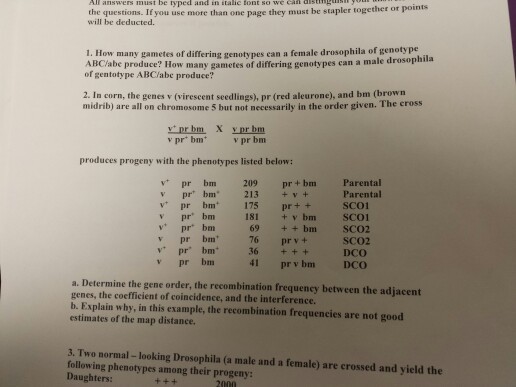
please answer#2 question in the photo. please explain the answers.
Thanks
Homework Answers
It is three point cross. In data we can observe, parental progeny, single cross overs and double cross overs.
The maximum number individuals are parents and the minimum number individuals are Double cross overs. By comparing parents with double cross overs, we can findout the middle gene. In the data v is the middle gene.
Recombinant frequency between pr & v = (175+181)+1/2 (36+41)/ 1000 =356+38.5/1000 = 0.394 x100 = 39.4 map units.
Similarly recombinant frequency between v & bm = total SCO+1/2 (DCO) / total progeny
= (69+76)+1/2 (36+41) /1000 = 145+38.5 /1000 = 0.183 x 100 = 18.3 map units
Genes map: pr---------39.4mu--------------------v-------18.3mu-----bm
In any cross the total recombinant frequencies should not exceed 50%. But here it is 57%. So in this case the recombinant frequencies are not fair
Add Answer to:
please answer#2 question in the photo. please explain the answers.
Thanks
All answers must be typed...
4. You are studying three genes in corn and performed a three-point cross. The three genes...
 4. You are studying three genes in corn and performed a three-point cross. The three genes are green (V) vs Viniscent (V) seedlings, blue (Pr) vs red kernels (pr) and white (B ) or brown (bm) leaf midrib color. The table below list the offspring resulting from a testcross with a female F1 heterozygote. Type of gamete (NR, SCO, DCO Phenotype Progeny Gamete from F1 heterozygote Virescent seedling red 101 kernel Red kernel 175 Red kernel, brown midrib 259 Virescent...
Drosophila T a heterozyg chromosome 2), and hot tamale Cht). 301 307 46 36 ap ht...
 Drosophila
T a heterozyg chromosome 2), and hot tamale Cht). 301 307 46 36 ap ht + 41 ap + b ht h 리)5 4. Black body (b/b), curved wing(c/e), and purple eye color (pr/pr) are recessive traits known to be on chromosome 2 in Drosophila. A testcross of a heterozygous female for all 3 genes was crossed to a black bodied, curved wing. purple eyed male fly and yielded the following progeny Phenotype class Number Type Phenotype class Number...
Drosophila
T a heterozyg chromosome 2), and hot tamale Cht). 301 307 46 36 ap ht + 41 ap + b ht h 리)5 4. Black body (b/b), curved wing(c/e), and purple eye color (pr/pr) are recessive traits known to be on chromosome 2 in Drosophila. A testcross of a heterozygous female for all 3 genes was crossed to a black bodied, curved wing. purple eyed male fly and yielded the following progeny Phenotype class Number Type Phenotype class Number...
Please answer this carefully Xd In Drosophila, the genes y, f, and vare all X-linked. Females...
 Please answer this carefully Xd
In Drosophila, the genes y, f, and vare all X-linked. Females who are homozygous for recessive alleles of all three genes (y fv/y fv) are crossed to wild-type males. The resulting trihybrid F1 females are testcrossed. Answer questions a, b and c. The F2 are distributed as follows: vfv3210 ly fyt 1024 678 690 1044 601 V + + 3222 10,000 (3)_ _and__ (4)_ a. The F2 progeny that have the parental genotypes are: _(1)__and__(2)...
Please answer this carefully Xd
In Drosophila, the genes y, f, and vare all X-linked. Females who are homozygous for recessive alleles of all three genes (y fv/y fv) are crossed to wild-type males. The resulting trihybrid F1 females are testcrossed. Answer questions a, b and c. The F2 are distributed as follows: vfv3210 ly fyt 1024 678 690 1044 601 V + + 3222 10,000 (3)_ _and__ (4)_ a. The F2 progeny that have the parental genotypes are: _(1)__and__(2)...
all of them please Question 10 (1 point) In Drosophila, the mutant black (b) has a...
 all of them please
Question 10 (1 point) In Drosophila, the mutant black (b) has a black body and the wild-type (b+) has a gray body; the mutant vestigial (v) has wings that are short and crumpled compared the long wild-type wings (V+). These genes are linked and are located on the X- chromosome. A cross between a female fly and a black, vestigial winged male fly produced the following progeny: gray (b+), normal (v+) 20 gray (b+), vestigial (v)...
all of them please
Question 10 (1 point) In Drosophila, the mutant black (b) has a black body and the wild-type (b+) has a gray body; the mutant vestigial (v) has wings that are short and crumpled compared the long wild-type wings (V+). These genes are linked and are located on the X- chromosome. A cross between a female fly and a black, vestigial winged male fly produced the following progeny: gray (b+), normal (v+) 20 gray (b+), vestigial (v)...
TABLE 2 e-Wa C-Ws Knob Knobless Knob Knobless Knob Knobless Knob Knobless 12 34 0 Reorganize...
 TABLE 2 e-Wa C-Ws Knob Knobless Knob Knobless Knob Knobless Knob Knobless 12 34 0 Reorganize the data into the table below that will look more like the tables found in your textbook. Where K-Knob and k-Knobless; C- colored, c colorless; W-Waxy, Female Gametes Observed Identify Rec Rec for Rec for se that are for W&c K&W Parental, K & C ScO, DCO K-C-w k-c-W K-C-W K-C-w K-c-W k-C-w K-c-w k-C-W TOTAI RF for K & C RF for C&W...
all please Question 2 (1 point) ✓ Saved In Drosophila, the mutant black (b) has a...
 all please
Question 2 (1 point) ✓ Saved In Drosophila, the mutant black (b) has a black body and the wild-type (b+) has a gray body; the mutant vestigial (v) has wings that are short and crumpled compared the long wild-type wings (v+). These genes are linked and are located on the X- chromosome. A cross between a female fly and a black, vestigial winged male fly produced the following progeny: gray (b+), normal (v+) 20 gray (b+), vestigial (v)...
all please
Question 2 (1 point) ✓ Saved In Drosophila, the mutant black (b) has a black body and the wild-type (b+) has a gray body; the mutant vestigial (v) has wings that are short and crumpled compared the long wild-type wings (v+). These genes are linked and are located on the X- chromosome. A cross between a female fly and a black, vestigial winged male fly produced the following progeny: gray (b+), normal (v+) 20 gray (b+), vestigial (v)...
 4. You are studying three genes in corn and performed a three-point cross. The three genes are green (V) vs Viniscent (V) seedlings, blue (Pr) vs red kernels (pr) and white (B ) or brown (bm) leaf midrib color. The table below list the offspring resulting from a testcross with a female F1 heterozygote. Type of gamete (NR, SCO, DCO Phenotype Progeny Gamete from F1 heterozygote Virescent seedling red 101 kernel Red kernel 175 Red kernel, brown midrib 259 Virescent...
 Drosophila
T a heterozyg chromosome 2), and hot tamale Cht). 301 307 46 36 ap ht + 41 ap + b ht h 리)5 4. Black body (b/b), curved wing(c/e), and purple eye color (pr/pr) are recessive traits known to be on chromosome 2 in Drosophila. A testcross of a heterozygous female for all 3 genes was crossed to a black bodied, curved wing. purple eyed male fly and yielded the following progeny Phenotype class Number Type Phenotype class Number...
Drosophila
T a heterozyg chromosome 2), and hot tamale Cht). 301 307 46 36 ap ht + 41 ap + b ht h 리)5 4. Black body (b/b), curved wing(c/e), and purple eye color (pr/pr) are recessive traits known to be on chromosome 2 in Drosophila. A testcross of a heterozygous female for all 3 genes was crossed to a black bodied, curved wing. purple eyed male fly and yielded the following progeny Phenotype class Number Type Phenotype class Number...
 Please answer this carefully Xd
In Drosophila, the genes y, f, and vare all X-linked. Females who are homozygous for recessive alleles of all three genes (y fv/y fv) are crossed to wild-type males. The resulting trihybrid F1 females are testcrossed. Answer questions a, b and c. The F2 are distributed as follows: vfv3210 ly fyt 1024 678 690 1044 601 V + + 3222 10,000 (3)_ _and__ (4)_ a. The F2 progeny that have the parental genotypes are: _(1)__and__(2)...
Please answer this carefully Xd
In Drosophila, the genes y, f, and vare all X-linked. Females who are homozygous for recessive alleles of all three genes (y fv/y fv) are crossed to wild-type males. The resulting trihybrid F1 females are testcrossed. Answer questions a, b and c. The F2 are distributed as follows: vfv3210 ly fyt 1024 678 690 1044 601 V + + 3222 10,000 (3)_ _and__ (4)_ a. The F2 progeny that have the parental genotypes are: _(1)__and__(2)...
 all of them please
Question 10 (1 point) In Drosophila, the mutant black (b) has a black body and the wild-type (b+) has a gray body; the mutant vestigial (v) has wings that are short and crumpled compared the long wild-type wings (V+). These genes are linked and are located on the X- chromosome. A cross between a female fly and a black, vestigial winged male fly produced the following progeny: gray (b+), normal (v+) 20 gray (b+), vestigial (v)...
all of them please
Question 10 (1 point) In Drosophila, the mutant black (b) has a black body and the wild-type (b+) has a gray body; the mutant vestigial (v) has wings that are short and crumpled compared the long wild-type wings (V+). These genes are linked and are located on the X- chromosome. A cross between a female fly and a black, vestigial winged male fly produced the following progeny: gray (b+), normal (v+) 20 gray (b+), vestigial (v)...
 TABLE 2 e-Wa C-Ws Knob Knobless Knob Knobless Knob Knobless Knob Knobless 12 34 0 Reorganize the data into the table below that will look more like the tables found in your textbook. Where K-Knob and k-Knobless; C- colored, c colorless; W-Waxy, Female Gametes Observed Identify Rec Rec for Rec for se that are for W&c K&W Parental, K & C ScO, DCO K-C-w k-c-W K-C-W K-C-w K-c-W k-C-w K-c-w k-C-W TOTAI RF for K & C RF for C&W...
 all please
Question 2 (1 point) ✓ Saved In Drosophila, the mutant black (b) has a black body and the wild-type (b+) has a gray body; the mutant vestigial (v) has wings that are short and crumpled compared the long wild-type wings (v+). These genes are linked and are located on the X- chromosome. A cross between a female fly and a black, vestigial winged male fly produced the following progeny: gray (b+), normal (v+) 20 gray (b+), vestigial (v)...
all please
Question 2 (1 point) ✓ Saved In Drosophila, the mutant black (b) has a black body and the wild-type (b+) has a gray body; the mutant vestigial (v) has wings that are short and crumpled compared the long wild-type wings (v+). These genes are linked and are located on the X- chromosome. A cross between a female fly and a black, vestigial winged male fly produced the following progeny: gray (b+), normal (v+) 20 gray (b+), vestigial (v)...
Most questions answered within 3 hours.
-
Where is the error in this code sequence?
String s1 = "Hello";
String s2 = "ello";...
asked 10 months ago -
Financial data for Joel de Paris, Inc., for last year
follow:
Joel de Paris, Inc.
Balance...
asked 10 months ago -
Consider this reaction:
Al2(SO4)3 (aq)+ BaCl3
(aq) Al2Cl6 (aq)- +
3BaSO4(s) . What is the...
asked 10 months ago -
Suppose that Savneet is considering increasing her
recent random sample from 20 car rentals to 40...
asked 10 months ago -
Trucks arrive at an unloading terminal at an average rate of 120
per hour.
Trucks arrive...
asked 10 months ago -
Why are methanol and ethanol completely soluble in water while
octanol is not very little soluble....
asked 10 months ago -
A facilities manager at a university reads in a research report
that the mean amount of...
asked 10 months ago -
When the CuSO4 is rehydrated by adding water to the anhydrous
compound, is this an endothermic...
asked 10 months ago -
A ray of sunlight is passing from diamond into crown glass; the
angle of incidence is...
asked 10 months ago -
A block of mass 0.249 kg is placed on top of a light, vertical
spring of...
asked 10 months ago -
how do the kidneys compensate in the presences of acidosis
a) trigger hyperventilate
b) reserve acid...
asked 10 months ago -
Question 501 pts
The rental rate of capital to the firm increases. Which of the
following...
asked 10 months ago