You are patch-clamping a cell. While holding the neuron at different membrane potentials, you observed the current recordings below
You are patch-clamping a cell. While
holding the neuron at different membrane potentials, you observed
the current recordings below
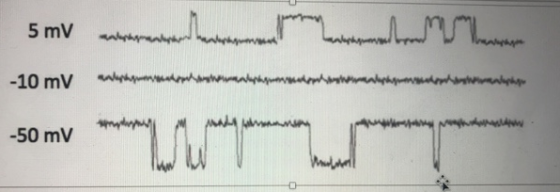
a. How many channels does your patch likely contain?
b. Given the recordings above, what is the reversal potential for the channel? Explain your reasoning in 1 sentence.
Homework Answers
a) there are five ion channels as per the graph.
b) in the reversal potential a given neurotransmitter causes no net current flow of ions.
So as per the graph -10mv is the resting potential.
Add Answer to:
You are patch-clamping a cell. While holding the neuron at different membrane potentials, you observed the current recordings below
This time you get into a snail brain neuron that is completely quiet. The cell doesn't...
 This time you get into a snail brain neuron that is
completely quiet. The cell doesn't even begin to fire action
potentials when you inject depolarizing current, so you question
yourself if you are actually in a neuron. Nevertheless, you briefly
hyperpolarize thecell, and right after the hyperpolarization stops,
the cell fires a few action potentials that have a quite large
amplitude and then the cell becomes quite again. What could be
going on here? Your traces kind of look...
This time you get into a snail brain neuron that is
completely quiet. The cell doesn't even begin to fire action
potentials when you inject depolarizing current, so you question
yourself if you are actually in a neuron. Nevertheless, you briefly
hyperpolarize thecell, and right after the hyperpolarization stops,
the cell fires a few action potentials that have a quite large
amplitude and then the cell becomes quite again. What could be
going on here? Your traces kind of look...
29 Figure Q12-4 shows a recording from a patch-clamp expeniment in which the electrical current passing across a patch of membrane is measured as a function of time The membrane patch was plucked...
 29 Figure Q12-4 shows a recording from a patch-clamp expeniment in which the electrical current passing across a patch of membrane is measured as a function of time The membrane patch was plucked from the plasma membrane of a muscle cell by the technique shown in figure 12-24 in the textbook and contains molecules of the acetylcholine receptor, which is a ligand-gated cation channel that is opened by the binding of acetylcholine to the extracellular face of the channel To...
IMAGE K shows single-channel recordings from an ionotropicreceptor, that were made using the cell-attached patch-clamp...
 IMAGE K shows single-channel recordings from an ionotropic
receptor, that were made using the cell-attached patch-clamp
configuration. All ion concentrations are as with normal neurons,
and ENa = +60 mV, EK = -80 mV, and ECl = -70 mV. In these traces,
the membrane potential is being held at -60 mV. In the top trace,
the experimenter stimulated the presynaptic neuron with no drug
present, and in the bottom trace they had applied a drug.
Unfortunately, the experimenter forgot which...
IMAGE K shows single-channel recordings from an ionotropic
receptor, that were made using the cell-attached patch-clamp
configuration. All ion concentrations are as with normal neurons,
and ENa = +60 mV, EK = -80 mV, and ECl = -70 mV. In these traces,
the membrane potential is being held at -60 mV. In the top trace,
the experimenter stimulated the presynaptic neuron with no drug
present, and in the bottom trace they had applied a drug.
Unfortunately, the experimenter forgot which...
You are recording from a neuron that has without current injection a tonic firing pattern of...
 You are recording from a neuron that has without current
injection a tonic firing pattern of action potentials. While you
inject a long pulse of a depolarizing current, the spikes that the
cell produces are first quite large, but become wider over time,
their amplitude decreases, and eventually there is no response any
more. It looks like of like this:
For a moment you then hyperpolarize the cell. Then you
depolarize the cell again, and you see the same thing...
You are recording from a neuron that has without current
injection a tonic firing pattern of action potentials. While you
inject a long pulse of a depolarizing current, the spikes that the
cell produces are first quite large, but become wider over time,
their amplitude decreases, and eventually there is no response any
more. It looks like of like this:
For a moment you then hyperpolarize the cell. Then you
depolarize the cell again, and you see the same thing...
Please help me with several of these questions, thank you very much. 1. During the propagation...
Please help me with several of these questions, thank you very much. 1. During the propagation of an action potential along the axon of a neuron, what is happening at the leading edge (the front) of the region of depolarization as it moves down the axon? a. Ligand-gated Na+channels are opening. b. Voltage-gated Na+channels are opening. c. Ligand-gated K+channels are opening. d. Voltage-gated Na+channels have become inactive and refractory. e. Voltage-gated Na+channels are closing. 2. During transcellular transport of glucose...
SHOW YOUR WORK, PLEASE WRITE LEDGIBLY AND CLEARLY 1. Patch clamp recording of a single ion...
 SHOW YOUR WORK, PLEASE WRITE LEDGIBLY AND CLEARLY 1. Patch clamp recording of a single ion channel yields the following results: Holding Potential Measured Current (mV) 100 50 (pA) 1.0 0.0 +50 +100 +2.0 +3.0 A) Draw a graph of the current (on the vertical axis)-voltage relation for this channel. B) What is the electrical resistance (in ohms) of this channel? (keep in mind mVa 103 volts, pA 101 amperes, and an ohm is a derived unit that is equivalent...
Period. DLDE How d graded current is different from an action potential. Make sure you think...
 Period. DLDE How d graded current is different from an action potential. Make sure you think about: evenirea D Percom • Where in a neuron these take place and the direction they travel. • How does the strength of the signals change as it travels • Explain any differences in the velocity (how fast) of travel 56. Describe the 3 classifications of axons based on size and velocity of propagation. 57. The release of a neurotransmitter is dependent on what...
INFORMATION ABOUT IMAGE G FOR QUESTIONS 12-15: GABAB receptors (GABABRs) are G-protein-coupled receptors that can be...
 INFORMATION ABOUT IMAGE G FOR QUESTIONS 12-15:
GABAB receptors (GABABRs) are
G-protein-coupled receptors that can be found on both pre- and
postsynaptic neurons. When they are activated by GABA, they can
have a range of effects. For the synapse you are studying in the
following questions, the effects of GABABRs are
indicated in IMAGE G.
You are doing a series of experiments in which you are recording
from the pre- and postsynaptic cell at a synapse. The experiments
described below...
INFORMATION ABOUT IMAGE G FOR QUESTIONS 12-15:
GABAB receptors (GABABRs) are
G-protein-coupled receptors that can be found on both pre- and
postsynaptic neurons. When they are activated by GABA, they can
have a range of effects. For the synapse you are studying in the
following questions, the effects of GABABRs are
indicated in IMAGE G.
You are doing a series of experiments in which you are recording
from the pre- and postsynaptic cell at a synapse. The experiments
described below...
2. Below is a graph showing transport velocity of two solutes (A and B). Based on...
 2. Below is a graph showing transport velocity of two solutes (A and B). Based on the observed kinetics, what conclusions can you draw about the transport mechanisms for each solute? (6) 2007 Transport Velocity 2 100 200 4 10 50 Solute (UM) 3. The reason carrier transport proteins that carry out carrier-mediated diffusion are incapable of active transport is (5) a. The turnover number is different in both "A" and "B" conformations b. Vmax is different in both "A"...
A: The Disturbing Discharge You are working in a gynecologist's office. Your first patient is a...
 A: The Disturbing Discharge You are working in a gynecologist's office. Your first patient is a 19-year old woman who complains that she has experienced vaginal itching and a frothy greenish-white vaginal discharge with a strong odor for the past several days. When you examine her, you observe inflammation of the genital region. When you ask your patient if she is sexually active, she tells you she has had two sexual partners in the past 4 months. You swab the...
 This time you get into a snail brain neuron that is
completely quiet. The cell doesn't even begin to fire action
potentials when you inject depolarizing current, so you question
yourself if you are actually in a neuron. Nevertheless, you briefly
hyperpolarize thecell, and right after the hyperpolarization stops,
the cell fires a few action potentials that have a quite large
amplitude and then the cell becomes quite again. What could be
going on here? Your traces kind of look...
This time you get into a snail brain neuron that is
completely quiet. The cell doesn't even begin to fire action
potentials when you inject depolarizing current, so you question
yourself if you are actually in a neuron. Nevertheless, you briefly
hyperpolarize thecell, and right after the hyperpolarization stops,
the cell fires a few action potentials that have a quite large
amplitude and then the cell becomes quite again. What could be
going on here? Your traces kind of look...
 29 Figure Q12-4 shows a recording from a patch-clamp expeniment in which the electrical current passing across a patch of membrane is measured as a function of time The membrane patch was plucked from the plasma membrane of a muscle cell by the technique shown in figure 12-24 in the textbook and contains molecules of the acetylcholine receptor, which is a ligand-gated cation channel that is opened by the binding of acetylcholine to the extracellular face of the channel To...
 IMAGE K shows single-channel recordings from an ionotropic
receptor, that were made using the cell-attached patch-clamp
configuration. All ion concentrations are as with normal neurons,
and ENa = +60 mV, EK = -80 mV, and ECl = -70 mV. In these traces,
the membrane potential is being held at -60 mV. In the top trace,
the experimenter stimulated the presynaptic neuron with no drug
present, and in the bottom trace they had applied a drug.
Unfortunately, the experimenter forgot which...
IMAGE K shows single-channel recordings from an ionotropic
receptor, that were made using the cell-attached patch-clamp
configuration. All ion concentrations are as with normal neurons,
and ENa = +60 mV, EK = -80 mV, and ECl = -70 mV. In these traces,
the membrane potential is being held at -60 mV. In the top trace,
the experimenter stimulated the presynaptic neuron with no drug
present, and in the bottom trace they had applied a drug.
Unfortunately, the experimenter forgot which...
 You are recording from a neuron that has without current
injection a tonic firing pattern of action potentials. While you
inject a long pulse of a depolarizing current, the spikes that the
cell produces are first quite large, but become wider over time,
their amplitude decreases, and eventually there is no response any
more. It looks like of like this:
For a moment you then hyperpolarize the cell. Then you
depolarize the cell again, and you see the same thing...
You are recording from a neuron that has without current
injection a tonic firing pattern of action potentials. While you
inject a long pulse of a depolarizing current, the spikes that the
cell produces are first quite large, but become wider over time,
their amplitude decreases, and eventually there is no response any
more. It looks like of like this:
For a moment you then hyperpolarize the cell. Then you
depolarize the cell again, and you see the same thing...
 SHOW YOUR WORK, PLEASE WRITE LEDGIBLY AND CLEARLY 1. Patch clamp recording of a single ion channel yields the following results: Holding Potential Measured Current (mV) 100 50 (pA) 1.0 0.0 +50 +100 +2.0 +3.0 A) Draw a graph of the current (on the vertical axis)-voltage relation for this channel. B) What is the electrical resistance (in ohms) of this channel? (keep in mind mVa 103 volts, pA 101 amperes, and an ohm is a derived unit that is equivalent...
 Period. DLDE How d graded current is different from an action potential. Make sure you think about: evenirea D Percom • Where in a neuron these take place and the direction they travel. • How does the strength of the signals change as it travels • Explain any differences in the velocity (how fast) of travel 56. Describe the 3 classifications of axons based on size and velocity of propagation. 57. The release of a neurotransmitter is dependent on what...
 INFORMATION ABOUT IMAGE G FOR QUESTIONS 12-15:
GABAB receptors (GABABRs) are
G-protein-coupled receptors that can be found on both pre- and
postsynaptic neurons. When they are activated by GABA, they can
have a range of effects. For the synapse you are studying in the
following questions, the effects of GABABRs are
indicated in IMAGE G.
You are doing a series of experiments in which you are recording
from the pre- and postsynaptic cell at a synapse. The experiments
described below...
INFORMATION ABOUT IMAGE G FOR QUESTIONS 12-15:
GABAB receptors (GABABRs) are
G-protein-coupled receptors that can be found on both pre- and
postsynaptic neurons. When they are activated by GABA, they can
have a range of effects. For the synapse you are studying in the
following questions, the effects of GABABRs are
indicated in IMAGE G.
You are doing a series of experiments in which you are recording
from the pre- and postsynaptic cell at a synapse. The experiments
described below...
 2. Below is a graph showing transport velocity of two solutes (A and B). Based on the observed kinetics, what conclusions can you draw about the transport mechanisms for each solute? (6) 2007 Transport Velocity 2 100 200 4 10 50 Solute (UM) 3. The reason carrier transport proteins that carry out carrier-mediated diffusion are incapable of active transport is (5) a. The turnover number is different in both "A" and "B" conformations b. Vmax is different in both "A"...
 A: The Disturbing Discharge You are working in a gynecologist's office. Your first patient is a 19-year old woman who complains that she has experienced vaginal itching and a frothy greenish-white vaginal discharge with a strong odor for the past several days. When you examine her, you observe inflammation of the genital region. When you ask your patient if she is sexually active, she tells you she has had two sexual partners in the past 4 months. You swab the...
Most questions answered within 3 hours.
-
Where is the error in this code sequence?
String s1 = "Hello";
String s2 = "ello";...
asked 10 months ago -
Financial data for Joel de Paris, Inc., for last year
follow:
Joel de Paris, Inc.
Balance...
asked 10 months ago -
Consider this reaction:
Al2(SO4)3 (aq)+ BaCl3
(aq) Al2Cl6 (aq)- +
3BaSO4(s) . What is the...
asked 10 months ago -
Suppose that Savneet is considering increasing her
recent random sample from 20 car rentals to 40...
asked 10 months ago -
Trucks arrive at an unloading terminal at an average rate of 120
per hour.
Trucks arrive...
asked 10 months ago -
Why are methanol and ethanol completely soluble in water while
octanol is not very little soluble....
asked 10 months ago -
A facilities manager at a university reads in a research report
that the mean amount of...
asked 10 months ago -
When the CuSO4 is rehydrated by adding water to the anhydrous
compound, is this an endothermic...
asked 10 months ago -
A ray of sunlight is passing from diamond into crown glass; the
angle of incidence is...
asked 10 months ago -
A block of mass 0.249 kg is placed on top of a light, vertical
spring of...
asked 10 months ago -
how do the kidneys compensate in the presences of acidosis
a) trigger hyperventilate
b) reserve acid...
asked 10 months ago -
Question 501 pts
The rental rate of capital to the firm increases. Which of the
following...
asked 10 months ago