An airplane circles an airport. It flies in a circle with r= 1800 m at a...
An airplane circles an airport. It flies in a circle with r=
1800 m at a constant speed of 60 m/s in a counterclockwise
direction. Place airport at the origin of a circle, i hat pointing
east, j hat as pointing north. Only consider the lateral motion.
When the airplane is northeast of the airport (45 degrees angle
from i hat vector), then,
a. What are the x and the y components of the airplane's position
vector at this moment?
b. Make a sketch of the plane's velocity vector at this moment and
indicate i hat and j hat directions. what are the x and y
components of this velocity vector?
c. Sketch the airplane's acceleration vector at this moment. What
are the x and y components of a?
d. At a later time t, the airplane is due northwest of the airport
(position vector is 135 degrees angle from the i hat vector at this
moment. What is the DIRECTION of the average acceleration vector
between the time at 45 degrees and now? (Use the definition of
average acceleration vector and only calculate the direction, not
the magnitude)
Homework Answers


Add Answer to:
An airplane circles an airport. It flies in a circle with r=
1800 m at a...
An airplane flies in a great circle route of radius R with a constant relative velocity vo to the earth which is rotating at ae. The angle between the normal direction of the big circle plane and...
 An airplane flies in a great circle route of radius R with a constant relative velocity vo to the earth which is rotating at ae. The angle between the normal direction of the big circle plane and the earth axis is 45° Solve for the airplane's acceleration relative to a 1. non-rotating frame trang with the earth's center. (30 pints) ee er x' Great circle frame (x'y'z') Great circle route
An airplane flies in a great circle route of radius...
An airplane flies in a great circle route of radius R with a constant relative velocity vo to the earth which is rotating at ae. The angle between the normal direction of the big circle plane and the earth axis is 45° Solve for the airplane's acceleration relative to a 1. non-rotating frame trang with the earth's center. (30 pints) ee er x' Great circle frame (x'y'z') Great circle route
An airplane flies in a great circle route of radius...
1. An airplane leaves airport A and travels in a straight line in a direction 30...
1. An airplane leaves airport A and travels in a straight line in a direction 30 degrees East of North at a constant speed of 300km/hr for 40 minutes, then it abruptly changes its direction to 25 degrees South of East and now travels at a constant velocity of 200km/hr for 30 minutes, and finally it abruptly heads directly South and travels at a velocity of 300km/hr for 60 minutes before landing at airport B. (a) calculate the distance, D,...
A particle P travels with constant speed on a circle of radius r = 2.40 m...
 A particle P travels
with constant speed on a circle of radius r = 2.40 m (see
the figure) and completes one revolution in 20.0 s. The particle
passes through O at time t = 0.
At t = 5.00 s, what is the particle's position vector?
Give (a) magnitude and (b)
direction (as an angle relative to the positive direction of
x.
At t = 7.50 s, what is the particle's position vector?
Give (c) magnitude and (d)
direction...
A particle P travels
with constant speed on a circle of radius r = 2.40 m (see
the figure) and completes one revolution in 20.0 s. The particle
passes through O at time t = 0.
At t = 5.00 s, what is the particle's position vector?
Give (a) magnitude and (b)
direction (as an angle relative to the positive direction of
x.
At t = 7.50 s, what is the particle's position vector?
Give (c) magnitude and (d)
direction...
given a coordinate system where the xy-plane is the ground and the north is oriented in the positive y direction and the...
given a coordinate system where the xy-plane is the ground and the north is oriented in the positive y direction and the east is oriented in the positive x-direction. an airplane takes off from the origin and is traveling at a constant velocity of 100m/s in the NE direction with an angle of incline of 45 degrees. after two minutes the airplane instantaneously levels off and heads due noth and continues at that heading. (a)at time t = 4 minutes...
A bus driver heads south with a steady speed of v1=20.0 m/s for t1=3.00 min, then makes a right turn and travels at v2=25.0 m/s for t2=2.60 min
 A bus driver heads south with a steady speed of v1=20.0 m/s for t1=3.00 min, then makes a right turn and travels at v2=25.0 m/s for t2=2.60 min, and then drives northwest at v3=30.0 m/s for t3=1.00 min For this 6.60-min trip, calculate the following. Assume +x is in the eastward direction. (a) total vector displacement (Enter the magnitude in m and the direction in degrees south of west.) (b) average speed (in m/s) (c) average velocity (Enter the magnitude in m/s and...
You are standing on the ground at the origin of a coordinate system. An airplane flies over you with constant velocity parallel to the x-axis and at a height of 7.60 x 10³ At timet = 0s
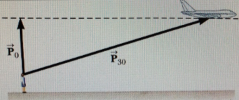 You are standing on the ground at the origin of a coordinate system. An airplane flies over you with constant velocity parallel to the x-axis and at a height of 7.60 x 10³ At timet = 0s, the airplane is directly above you so that the vector leading from you to it is Po = 7.60 x 10³ m. At t = 30 s, the position vector leading from you to the air is P30 = (8.04 x 10³ +7.60...
You are standing on the ground at the origin of a coordinate system. An airplane flies...
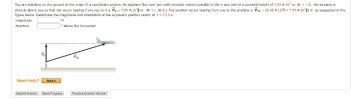 You are standing on the ground at the origin of a coordinate system. An airplane flies over you with constant velocity parallel to the als and at a constant height o 7.95 × 10 m. At 1 directly above you so lhal lhe vector lead ng rom you Lll is po-7.95 x 10 m. AI I 30.0 s lhe pusilion vector leading rom you lo Lhe ar plane is p30- 8.98 x 1031+ 7.95 x 10 figure below. Determine the...
A particle's position ?⃗ as a function of time ? is given by ?⃗ (?)=??^3?̂ +(??−??4)?̂...
A particle's position ?⃗ as a function of time ? is given by ?⃗ (?)=??^3?̂ +(??−??4)?̂ . where a=5.00 m/s^3, b=3.00 m/s, and c=6.00 m/s^4. At t=2.45 s find: (e)The x-component of velocity. (f)The y-component of velocity. (g)The magnitude of the velocity vector. (h)The direction of the velocity vector. Your answer for this part should be in the range of -180 to 180 degrees. (i)The x-component of the acceleration. (j)The y-component of the acceleration. (k)The magnitude of the acceleration vector....
Please help! :) Discussion #3 1. Consider the motion of an object that can be treated...
 Please help! :)
Discussion #3 1. Consider the motion of an object that can be treated as a point particle and is traveling counter-clockwise in a circle of radius R. This motion can (and will for the purposes of these discussion activities) be described and analyzed using a Cartesian (x-y) coordinate system with a spatial origin at the center of the particle's circular trajectory (the physical path its motion traces out in space). (a) Draw a diagram of the position...
Please help! :)
Discussion #3 1. Consider the motion of an object that can be treated as a point particle and is traveling counter-clockwise in a circle of radius R. This motion can (and will for the purposes of these discussion activities) be described and analyzed using a Cartesian (x-y) coordinate system with a spatial origin at the center of the particle's circular trajectory (the physical path its motion traces out in space). (a) Draw a diagram of the position...
Help! A fish swimming in a horizontal plane has velocity V (4.00 i1.00 j) m/s at...
 Help!
A fish swimming in a horizontal plane has velocity V (4.00 i1.00 j) m/s at a point in the ocean where the position relative to a certain rock is fter the fish swims with constant acceleration for 19.0 s, its velocity is V (15.0 1-3.00 j) m/s (16.0 1 4.20) m (a) What are the components of the acceleration of the fish? ax0.579 m/s2 0.105X Review the definition of average acceleration and remember that each component is treated separately....
Help!
A fish swimming in a horizontal plane has velocity V (4.00 i1.00 j) m/s at a point in the ocean where the position relative to a certain rock is fter the fish swims with constant acceleration for 19.0 s, its velocity is V (15.0 1-3.00 j) m/s (16.0 1 4.20) m (a) What are the components of the acceleration of the fish? ax0.579 m/s2 0.105X Review the definition of average acceleration and remember that each component is treated separately....
 An airplane flies in a great circle route of radius R with a constant relative velocity vo to the earth which is rotating at ae. The angle between the normal direction of the big circle plane and the earth axis is 45° Solve for the airplane's acceleration relative to a 1. non-rotating frame trang with the earth's center. (30 pints) ee er x' Great circle frame (x'y'z') Great circle route
An airplane flies in a great circle route of radius...
An airplane flies in a great circle route of radius R with a constant relative velocity vo to the earth which is rotating at ae. The angle between the normal direction of the big circle plane and the earth axis is 45° Solve for the airplane's acceleration relative to a 1. non-rotating frame trang with the earth's center. (30 pints) ee er x' Great circle frame (x'y'z') Great circle route
An airplane flies in a great circle route of radius...
 A particle P travels
with constant speed on a circle of radius r = 2.40 m (see
the figure) and completes one revolution in 20.0 s. The particle
passes through O at time t = 0.
At t = 5.00 s, what is the particle's position vector?
Give (a) magnitude and (b)
direction (as an angle relative to the positive direction of
x.
At t = 7.50 s, what is the particle's position vector?
Give (c) magnitude and (d)
direction...
A particle P travels
with constant speed on a circle of radius r = 2.40 m (see
the figure) and completes one revolution in 20.0 s. The particle
passes through O at time t = 0.
At t = 5.00 s, what is the particle's position vector?
Give (a) magnitude and (b)
direction (as an angle relative to the positive direction of
x.
At t = 7.50 s, what is the particle's position vector?
Give (c) magnitude and (d)
direction...
 You are standing on the ground at the origin of a coordinate system. An airplane flies over you with constant velocity parallel to the als and at a constant height o 7.95 × 10 m. At 1 directly above you so lhal lhe vector lead ng rom you Lll is po-7.95 x 10 m. AI I 30.0 s lhe pusilion vector leading rom you lo Lhe ar plane is p30- 8.98 x 1031+ 7.95 x 10 figure below. Determine the...
 Please help! :)
Discussion #3 1. Consider the motion of an object that can be treated as a point particle and is traveling counter-clockwise in a circle of radius R. This motion can (and will for the purposes of these discussion activities) be described and analyzed using a Cartesian (x-y) coordinate system with a spatial origin at the center of the particle's circular trajectory (the physical path its motion traces out in space). (a) Draw a diagram of the position...
Please help! :)
Discussion #3 1. Consider the motion of an object that can be treated as a point particle and is traveling counter-clockwise in a circle of radius R. This motion can (and will for the purposes of these discussion activities) be described and analyzed using a Cartesian (x-y) coordinate system with a spatial origin at the center of the particle's circular trajectory (the physical path its motion traces out in space). (a) Draw a diagram of the position...
 Help!
A fish swimming in a horizontal plane has velocity V (4.00 i1.00 j) m/s at a point in the ocean where the position relative to a certain rock is fter the fish swims with constant acceleration for 19.0 s, its velocity is V (15.0 1-3.00 j) m/s (16.0 1 4.20) m (a) What are the components of the acceleration of the fish? ax0.579 m/s2 0.105X Review the definition of average acceleration and remember that each component is treated separately....
Help!
A fish swimming in a horizontal plane has velocity V (4.00 i1.00 j) m/s at a point in the ocean where the position relative to a certain rock is fter the fish swims with constant acceleration for 19.0 s, its velocity is V (15.0 1-3.00 j) m/s (16.0 1 4.20) m (a) What are the components of the acceleration of the fish? ax0.579 m/s2 0.105X Review the definition of average acceleration and remember that each component is treated separately....
Most questions answered within 3 hours.
-
Where is the error in this code sequence?
String s1 = "Hello";
String s2 = "ello";...
asked 11 months ago -
Financial data for Joel de Paris, Inc., for last year
follow:
Joel de Paris, Inc.
Balance...
asked 11 months ago -
Consider this reaction:
Al2(SO4)3 (aq)+ BaCl3
(aq) Al2Cl6 (aq)- +
3BaSO4(s) . What is the...
asked 11 months ago -
Suppose that Savneet is considering increasing her
recent random sample from 20 car rentals to 40...
asked 11 months ago -
Trucks arrive at an unloading terminal at an average rate of 120
per hour.
Trucks arrive...
asked 11 months ago -
Why are methanol and ethanol completely soluble in water while
octanol is not very little soluble....
asked 11 months ago -
A facilities manager at a university reads in a research report
that the mean amount of...
asked 11 months ago -
When the CuSO4 is rehydrated by adding water to the anhydrous
compound, is this an endothermic...
asked 11 months ago -
A ray of sunlight is passing from diamond into crown glass; the
angle of incidence is...
asked 11 months ago -
A block of mass 0.249 kg is placed on top of a light, vertical
spring of...
asked 11 months ago -
how do the kidneys compensate in the presences of acidosis
a) trigger hyperventilate
b) reserve acid...
asked 11 months ago -
Question 501 pts
The rental rate of capital to the firm increases. Which of the
following...
asked 11 months ago