A 5.00 kg block rests on a level table. The coefficient of friction between the block...
A 5.00 kg block rests on a level table. The coefficient of friction between the block and the table is 0.55. A 4.00 kg mass is attached to the block by a string of negligible mass passed over a light frictionless pulley (as shown below). What is the acceleration of the block when the 4.00 kg weight is released?
Homework Answers

There are 4 forces acting on the resting block. First, gravity
pulling it down. Next, the normal force pushing the resting block
up. Third, the gravitational force from the other block. Last, the
friction force from the surface.
Apply Newton's laws of motion. F=MA.
The force of gravity must equal the normal force (or else it would be floating or sinking).
Normal = Gravity = M*g = 5 * 9.8 = 49 Newtons.
The frictional force is dependent upon the normal force (not
weight force). Friction =  *N = 0.55*49 =
26.95N.
*N = 0.55*49 =
26.95N.
The weight of the second block is W = M*g = 4*9.8 = 39.2 Newtons.
m2g+m2a=*N-m1a
=a(m2+m1)=39.2-26.95=12.25
a=12.25/9=1.4m/s2
So acceleration is a=1.4m/s2
Add Answer to:
A 5.00 kg block rests on a level table. The coefficient of
friction between the block...
A 5.8- kg concrete block rests on a level table. A 3.9- kg mass is attached...
A 5.8- kg concrete block rests on a level table. A 3.9- kg mass is attached to the block by a string passing over a light, frictionless pulley. If the acceleration of the block is measured to be 1.4 m/s2, what is the coefficient of friction between the block and the table?
3. A 5.00 kg block rests on a level frictionless surface and is attached by a...
 3. A 5.00 kg block rests on a level frictionless surface and is attached by a light string to an 7.00 kg hanging mass where the string passes over a massless, frictionless pulley. Ifg=9.80 m/s, what is the tension in the connecting string? 4. A light string connects a 16 kg mass and a 4.0 kg mass over a massless, frictionless pulley. (a) If g= 9.8 m/s, what is the acceleration of the system when released? (b) What is the...
Block B, with mass 5.00 kg, rests on block A, with mass 8.00kg. There is no...
 Block B, with mass 5.00 kg, rests on block A, with mass 8.00kg. There is no friction between the table and block A, but the coefficient of static friction between block A and B is 0.750. A "massless" string attached to block A passes over a frictionless pulley and block C is suspended from the other end of the string. If we want ALL the blocks moving together with the same acceleration, the largest possible mass that block C can...
A block A with a mass of 3 kg rests on a horizontal table top. The...
A block A with a mass of 3 kg rests on a horizontal table top. The coefficient of kinetic friction, μk = 0.5. A horizontal string is attached to A and passes over a massless, frictionless pulley, and block B with mass 2 kg hangs from it. Because of the pull of gravity, the masses accelerate. What is the Tension in the string (in Newtons)?
A 2.5 kg block rests on a 30 ∘ slope and is attached by a string...
A 2.5 kg block rests on a 30 ∘ slope and is attached by a string of negligible mass to a solid drum of mass 0.70 kg and radius 3.6 cm , as shown in the figure (Figure 1) . When released, the block accelerates down the slope at 1.3 m/s2 . What is the coefficient of friction between block and slope?
A wooden block with mass 0.37 kg rests on a horizontal table, connected to a string...
A wooden block with mass 0.37 kg rests on a horizontal table, connected to a string that hangs vertically over a friction-less pulley on the table's edge. From the other end of the string hangs a 0.12 kg mass. What minimum coefficient of static friction μ s between the block and table will keep the system at rest? Find the block's acceleration if μ k =0.20.
A light rope is attached to a block with mass 3.40 kg that rests on a...
A light rope is attached to a block with mass 3.40 kg that rests on a frictionless, horizontal surface. The horizontal rope passes over a frictionless, massless pulley, and a block with mass m is suspended from the other end. When the blocks are released, the tension in the rope is 19.1 N . c. What is the acceleration of either block? Express your answer with the appropriate units. d. Find m. Express your answer with the appropriate units. e....
A 16.0-kg block rests on a level floor; the coefficient of kinetic friction between the block...
A 16.0-kg block rests on a level floor; the coefficient of kinetic friction between the block and the floor is 0.463. A force of 200 N acts for 4.00 m. How fast is the block moving after being pushed 4.00 m? Assume it starts from rest. (Express your answer to three significant figures.)
jer A 2.9 kg block rests on a 30 degree slope and is attached by a...
 jer
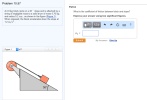
A 2.9 kg block rests on a 30 degree slope and is attached by a string of negligible mass to a solid drum of mass 0.70 kg and radius 5.2 cm. as shown in the figure (Figure 1). When released, the block accelerates down the slope at 1.2 m/s^2. What is the coefficient of friction between block and slope? Express your answer using two significant figures.
jer
A 2.9 kg block rests on a 30 degree slope and is attached by a string of negligible mass to a solid drum of mass 0.70 kg and radius 5.2 cm. as shown in the figure (Figure 1). When released, the block accelerates down the slope at 1.2 m/s^2. What is the coefficient of friction between block and slope? Express your answer using two significant figures.
Block A has a mass of 20 kg and rests on a frictionless table. A cord...
Block A has a mass of 20 kg and rests on a frictionless table. A cord attached to block A extends horizontally to a pulley at the edge of the table, block B has a 10 kg mass and hangs over the edge attached to the string. How would I calculate the tension in the cord?
 3. A 5.00 kg block rests on a level frictionless surface and is attached by a light string to an 7.00 kg hanging mass where the string passes over a massless, frictionless pulley. Ifg=9.80 m/s, what is the tension in the connecting string? 4. A light string connects a 16 kg mass and a 4.0 kg mass over a massless, frictionless pulley. (a) If g= 9.8 m/s, what is the acceleration of the system when released? (b) What is the...
 Block B, with mass 5.00 kg, rests on block A, with mass 8.00kg. There is no friction between the table and block A, but the coefficient of static friction between block A and B is 0.750. A "massless" string attached to block A passes over a frictionless pulley and block C is suspended from the other end of the string. If we want ALL the blocks moving together with the same acceleration, the largest possible mass that block C can...
 jer
A 2.9 kg block rests on a 30 degree slope and is attached by a string of negligible mass to a solid drum of mass 0.70 kg and radius 5.2 cm. as shown in the figure (Figure 1). When released, the block accelerates down the slope at 1.2 m/s^2. What is the coefficient of friction between block and slope? Express your answer using two significant figures.
jer
A 2.9 kg block rests on a 30 degree slope and is attached by a string of negligible mass to a solid drum of mass 0.70 kg and radius 5.2 cm. as shown in the figure (Figure 1). When released, the block accelerates down the slope at 1.2 m/s^2. What is the coefficient of friction between block and slope? Express your answer using two significant figures.
Most questions answered within 3 hours.
-
Where is the error in this code sequence?
String s1 = "Hello";
String s2 = "ello";...
asked 10 months ago -
Financial data for Joel de Paris, Inc., for last year
follow:
Joel de Paris, Inc.
Balance...
asked 10 months ago -
Consider this reaction:
Al2(SO4)3 (aq)+ BaCl3
(aq) Al2Cl6 (aq)- +
3BaSO4(s) . What is the...
asked 10 months ago -
Suppose that Savneet is considering increasing her
recent random sample from 20 car rentals to 40...
asked 10 months ago -
Trucks arrive at an unloading terminal at an average rate of 120
per hour.
Trucks arrive...
asked 10 months ago -
Why are methanol and ethanol completely soluble in water while
octanol is not very little soluble....
asked 10 months ago -
A facilities manager at a university reads in a research report
that the mean amount of...
asked 10 months ago -
When the CuSO4 is rehydrated by adding water to the anhydrous
compound, is this an endothermic...
asked 10 months ago -
A ray of sunlight is passing from diamond into crown glass; the
angle of incidence is...
asked 10 months ago -
A block of mass 0.249 kg is placed on top of a light, vertical
spring of...
asked 10 months ago -
how do the kidneys compensate in the presences of acidosis
a) trigger hyperventilate
b) reserve acid...
asked 10 months ago -
Question 501 pts
The rental rate of capital to the firm increases. Which of the
following...
asked 10 months ago