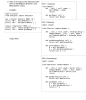
![Question 4 2 pts What is the output of the following code? def count(word): d = {} for char in word: if char in d: d[char] +=](http://img.homeworklib.com/questions/6f72cd00-94e5-11ec-9388-a71fb7cd685a.png?x-oss-process=image/resize,w_560)
Homework Answers
Output = 4
Reason :
This function count each character in given word and sort in the dictionary, Here the given word contain contains:
r = 2 times
a = 2 times
so, the output of the given program is 2 +2 = 4
Add Answer to:
Question 4 2 pts What is the output of the following code? def count(word): d =...
In the following code I give, everytime it will output ")". Input : ((A+B)*((C-D)/(E^F))) Expect...
In the following code I give, everytime it will output ")". Input : ((A+B)*((C-D)/(E^F))) Expected output : ((A+B)*((C-D)/(E^F))) A+B*C-D/E^F my output : ) My code : class Et: def __init__(self , value): self.value = value self.left = None self.right = None def isOperator(c): if (c == '+' or c == '-' or c == '*' or c == '/' or c == '^' ): return True else: return False def inorder(t): if t is not None: inorder(t.left) print (t.value) inorder(t.right)...
python please 11 def add_item(items, word): 14 15 16 F # check if the word is...
 python please
11 def add_item(items, word): 14 15 16 F # check if the word is in the dictionary (keys of dictionary) if word in items: items [word] = items (word] + 1 # update the count else: # word is not in dictionary items[word] = 1 # add the word with count 1 return items [word] # return the current count of word after updation Create a function named build_dictionary that takes a list of words (as a parameter)...
python please
11 def add_item(items, word): 14 15 16 F # check if the word is in the dictionary (keys of dictionary) if word in items: items [word] = items (word] + 1 # update the count else: # word is not in dictionary items[word] = 1 # add the word with count 1 return items [word] # return the current count of word after updation Create a function named build_dictionary that takes a list of words (as a parameter)...
In the following code I give, everytime it will output ")". Input : ((A+B)*((C-D)/(E^F))) Expected output...
In the following code I give, everytime it will output ")". Input : ((A+B)*((C-D)/(E^F))) Expected output : ((A+B)*((C-D)/(E^F))) A+B*C-D/E^F my output : ) My code : class Et: def __init__(self , value): self.value = value self.left = None self.right = None def isOperator(c): if (c == '+' or c == '-' or c == '*' or c == '/' or c == '^' ): return True else: return False def inorder(t): if t is not None: inorder(t.left) print (t.value) inorder(t.right)...
Mele!!! Question 24 2 pts What is the output of the following code: def XXX(array,y): X...
 Mele!!! Question 24 2 pts What is the output of the following code: def XXX(array,y): X = for i in range (y): x += array[i] print (x) list=[10,20,30] XXX(list, 3) 60 N 3 0
QUESTION 8 What (if anything) will be the output of the following code: int count =...
QUESTION 8 What (if anything) will be the output of the following code: int count = 3; while (count++ <= 6) { System.out.print(++count + " "); } 3 4 5 6 4 5 6 7 3 4 5 6 7 5 7 4 6 The above code contains a syntax error and will not run. 8 points QUESTION 9 What (if anything) will be the output of the following code: int count = 0; while (count < 5) {...
What is the output of the following Python code if the user enters 4? count =...
What is the output of the following Python code if the user enters 4? count = int(input()) the_sum = 0 for i in range (1, count): the_sum = the_sum + i print("Sum is", the_sum)
convert the following code from python to java. def topkFrequent(nums, k): if not nums: return [...
 convert the following code from python to java.
def topkFrequent(nums, k): if not nums: return [ ] if len(nums) == 1: return nums [0] # first find freq freq dict d = {} for num in nums: if num in d: d[num] -= 1 # reverse the sign on the freq for the heap's sake else: d[num] = -1 h = [] from heapq import heappush, heappop for key in di heappush(h, (d[key], key)) res = [] count = 0...
convert the following code from python to java.
def topkFrequent(nums, k): if not nums: return [ ] if len(nums) == 1: return nums [0] # first find freq freq dict d = {} for num in nums: if num in d: d[num] -= 1 # reverse the sign on the freq for the heap's sake else: d[num] = -1 h = [] from heapq import heappush, heappop for key in di heappush(h, (d[key], key)) res = [] count = 0...
In python Count the frequency of each word in a text file. Let the user choose...
In python Count the frequency of each word in a text file. Let the user choose a filename to read. 1. The program will count the frequency with which each word appears in the text. 2. Words which are the spelled the same but differ by case will be combined. 3. Punctuation should be removed 4. If the file does not exist, use a ‘try-execption’ block to handle the error 5. Output will list the words alphabetically, with the word...
Draw a stack diagram to show how the following code is executed and write the generated output. def sequence(n, m):...
Draw a stack diagram to show how the following code is executed and write the generated output. def sequence(n, m): if n < 0: return 1 elif n + m > 5: return sequence(n, m - 1) else: return n * sequence(m - 1, n + 1) print(sequence(5, 3))
9c Python 1) What is the output of the following code? Refer to the Weapon, Blaster,...
 9c
Python
1) What is the output of the following code? Refer to the Weapon, Blaster, and Bowcaster classes. File 1: weapon.py class Weapon: def init ( self, power ): self.mPower = power return Example: import blaster from bowcaster import Bowcaster def getPower( self ): return self.mPower han = blaster.Blaster( 8000, 20 ) print("HP:", han.getPower( ) ) print( "HR:", han.getFireRate()) chewie = Bowcaster( 3000, 6) print( "CB:", chewie.getBarrelSize()) print( "CR:", chewie.getRange()) File 2: blaster.py import weapon class Blaster( weapon. Weapon):...
9c
Python
1) What is the output of the following code? Refer to the Weapon, Blaster, and Bowcaster classes. File 1: weapon.py class Weapon: def init ( self, power ): self.mPower = power return Example: import blaster from bowcaster import Bowcaster def getPower( self ): return self.mPower han = blaster.Blaster( 8000, 20 ) print("HP:", han.getPower( ) ) print( "HR:", han.getFireRate()) chewie = Bowcaster( 3000, 6) print( "CB:", chewie.getBarrelSize()) print( "CR:", chewie.getRange()) File 2: blaster.py import weapon class Blaster( weapon. Weapon):...
 python please
11 def add_item(items, word): 14 15 16 F # check if the word is in the dictionary (keys of dictionary) if word in items: items [word] = items (word] + 1 # update the count else: # word is not in dictionary items[word] = 1 # add the word with count 1 return items [word] # return the current count of word after updation Create a function named build_dictionary that takes a list of words (as a parameter)...
python please
11 def add_item(items, word): 14 15 16 F # check if the word is in the dictionary (keys of dictionary) if word in items: items [word] = items (word] + 1 # update the count else: # word is not in dictionary items[word] = 1 # add the word with count 1 return items [word] # return the current count of word after updation Create a function named build_dictionary that takes a list of words (as a parameter)...
 Mele!!! Question 24 2 pts What is the output of the following code: def XXX(array,y): X = for i in range (y): x += array[i] print (x) list=[10,20,30] XXX(list, 3) 60 N 3 0
 convert the following code from python to java.
def topkFrequent(nums, k): if not nums: return [ ] if len(nums) == 1: return nums [0] # first find freq freq dict d = {} for num in nums: if num in d: d[num] -= 1 # reverse the sign on the freq for the heap's sake else: d[num] = -1 h = [] from heapq import heappush, heappop for key in di heappush(h, (d[key], key)) res = [] count = 0...
convert the following code from python to java.
def topkFrequent(nums, k): if not nums: return [ ] if len(nums) == 1: return nums [0] # first find freq freq dict d = {} for num in nums: if num in d: d[num] -= 1 # reverse the sign on the freq for the heap's sake else: d[num] = -1 h = [] from heapq import heappush, heappop for key in di heappush(h, (d[key], key)) res = [] count = 0...
 9c
Python
1) What is the output of the following code? Refer to the Weapon, Blaster, and Bowcaster classes. File 1: weapon.py class Weapon: def init ( self, power ): self.mPower = power return Example: import blaster from bowcaster import Bowcaster def getPower( self ): return self.mPower han = blaster.Blaster( 8000, 20 ) print("HP:", han.getPower( ) ) print( "HR:", han.getFireRate()) chewie = Bowcaster( 3000, 6) print( "CB:", chewie.getBarrelSize()) print( "CR:", chewie.getRange()) File 2: blaster.py import weapon class Blaster( weapon. Weapon):...
9c
Python
1) What is the output of the following code? Refer to the Weapon, Blaster, and Bowcaster classes. File 1: weapon.py class Weapon: def init ( self, power ): self.mPower = power return Example: import blaster from bowcaster import Bowcaster def getPower( self ): return self.mPower han = blaster.Blaster( 8000, 20 ) print("HP:", han.getPower( ) ) print( "HR:", han.getFireRate()) chewie = Bowcaster( 3000, 6) print( "CB:", chewie.getBarrelSize()) print( "CR:", chewie.getRange()) File 2: blaster.py import weapon class Blaster( weapon. Weapon):...
Most questions answered within 3 hours.
-
Where is the error in this code sequence?
String s1 = "Hello";
String s2 = "ello";...
asked 11 months ago -
Financial data for Joel de Paris, Inc., for last year
follow:
Joel de Paris, Inc.
Balance...
asked 11 months ago -
Consider this reaction:
Al2(SO4)3 (aq)+ BaCl3
(aq) Al2Cl6 (aq)- +
3BaSO4(s) . What is the...
asked 11 months ago -
Suppose that Savneet is considering increasing her
recent random sample from 20 car rentals to 40...
asked 11 months ago -
Trucks arrive at an unloading terminal at an average rate of 120
per hour.
Trucks arrive...
asked 11 months ago -
Why are methanol and ethanol completely soluble in water while
octanol is not very little soluble....
asked 11 months ago -
A facilities manager at a university reads in a research report
that the mean amount of...
asked 11 months ago -
When the CuSO4 is rehydrated by adding water to the anhydrous
compound, is this an endothermic...
asked 11 months ago -
A ray of sunlight is passing from diamond into crown glass; the
angle of incidence is...
asked 11 months ago -
A block of mass 0.249 kg is placed on top of a light, vertical
spring of...
asked 11 months ago -
how do the kidneys compensate in the presences of acidosis
a) trigger hyperventilate
b) reserve acid...
asked 11 months ago -
Question 501 pts
The rental rate of capital to the firm increases. Which of the
following...
asked 11 months ago