Glycogen phosphorylase will be active when glycogen synthase is off because they are allosterically regulated in...
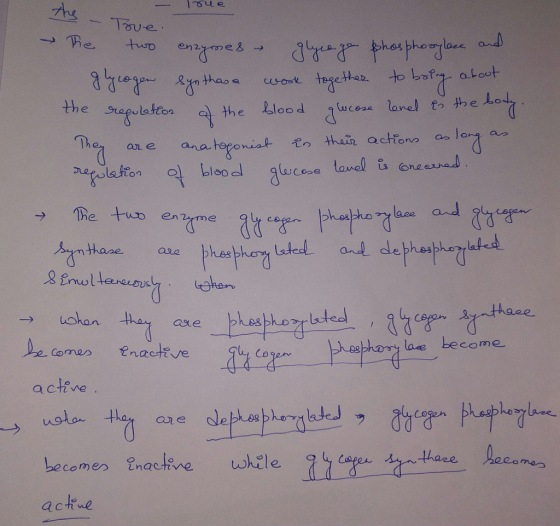
Glycogen phosphorylase will be active when glycogen synthase is off because they are allosterically regulated in opposite manners.
A. True
B. False
Homework Answers
Add Answer to:
Glycogen phosphorylase will be active when glycogen synthase is
off because they are allosterically regulated in...
Which of the following statements is true regarding glycogen phosphorylase? Glycogen phosphorylase in muscle is allosterically...
Which of the following statements is true regarding glycogen phosphorylase? Glycogen phosphorylase in muscle is allosterically activated by ATP and G6P. Glycogen phosphorylase catalyzes the cleavage of both alpha1, 4) and alpha (1,6) bonds. Glycogen phosphorylase is activated by both phosphorylase kinase and PKA. All of the above are false
1. Which of the following is true regarding glycogen metabolism? a. Glycogen synthase is activated by...
1. Which of the following is true regarding glycogen metabolism? a. Glycogen synthase is activated by phosporylation. b. Glycogen phosphorylase kinase activates glycogen phosphorylase through phosphorylation. c. The activation of PKA is downstream of insulin signaling in muscle cells. d. Glycogen phosphorylase releases free glucose from the ends of glycogen.
Protein kinase A phosphorylates _____, which then activates _____. A) phosphorylase kinase; glycogen phosphorylase B) protein...
Protein kinase A phosphorylates _____, which then activates _____. A) phosphorylase kinase; glycogen phosphorylase B) protein phosphatase 1; glycogen synthase C) glycogen phosphorylase; phosphoglucomutase D) adenylate cyclase; phosphorylase kinase
Which protein is regulated by phosphorylation? ect one: a. glycogen phosphorylase b. myoglobin C. collagen d....
 Which protein is regulated by phosphorylation? ect one: a. glycogen phosphorylase b. myoglobin C. collagen d. All of the above. e. None of the above.
8. The figure on the right is a glycogen phosphorylase (7 pts). Quo), (1) Two hormones...
 8. The figure on the right is a glycogen phosphorylase (7 pts). Quo), (1) Two hormones regulate glycogen phosphorylase. Explain the effect of each hormone on this enzyme, especially for a) phosphorylation status (phosphorylated vs. non-phosphorylated), and b) the enzyme activity (activated vs. inactivated) of this enzyme (4 pts). Glucagon: Insulin: (2) Glycogen synthase is a processive enzyme. What may be the unique structural feature of glycogen synthase that makes it a processive enzyme? (3 pts)
How does insulin inactivate glycogen synthase kinase? By activating a kinase that phosphorylates the active form...
How does insulin inactivate glycogen synthase kinase? By activating a kinase that phosphorylates the active form of glycogen synthase kinase, thereby inactivating it. Insulin is a kinase -- an enzyme that phosphorylates various proteins -- and among the proteins it phosphorylates is glycogen synthase. Insulin enters sensitive cells (cells having the insulin receptor) and binds to glycogen synthase, inactivating it. All of the above.
In my last answer, I put B, A for the first column and A, B for...
 In my last answer, I put B, A for the first column and A, B for
the second column and they were partially wrong
The activities of glycogen phosphorylase and glycogen synthase are regulated by protein phosphorylation. Show the relationship between each of their a and b states. Ilglycogen phosphorylase glycogen synthase More active form Phosphorylated form
In my last answer, I put B, A for the first column and A, B for
the second column and they were partially wrong
The activities of glycogen phosphorylase and glycogen synthase are regulated by protein phosphorylation. Show the relationship between each of their a and b states. Ilglycogen phosphorylase glycogen synthase More active form Phosphorylated form
Which pair of opposite enzymes in the glycolysis and gluconeogenesis pathway are not allosterically regulated but...
Which pair of opposite enzymes in the glycolysis and gluconeogenesis pathway are not allosterically regulated but rather regulated by compartmentalization? Select one: a. pyruvate kinase/PEP carboxykinase b. phosphofructokinase 1/fructose-1,6-bisphosphatase c. phosphofructokinase 2/fructose-2,6-bisphosphatase d. hexokinase/glucose-6-phosphatase
Which of these enzymes is correctly paired with one of its immediate products? a. Glycogen phosphorylase:...
Which of these enzymes is correctly paired with one of its immediate products? a. Glycogen phosphorylase: Glucose 6-P b. Fatty acid synthase: Oleate c. HMG CoA Reductase: HMG CoA d. Debranching enzyme: Free glucose
€ → C .ap2020.collegeboard.org/Praott-aa857320- glucagon (a) A cell where PKB is always active has a mutation...
 € → C .ap2020.collegeboard.org/Praott-aa857320- glucagon (a) A cell where PKB is always active has a mutation that results in the permanent activation of GSK3. Based on the information in Figure 2, predict the effect of this mutation on the activity of glycogen synthase. (b) Justify your prediction in part (a). Describe the process that results in the activation of multiple copies of PKB in response to the binding of a single molecule of insulin to its receptor. (d) Explain why...
 Which protein is regulated by phosphorylation? ect one: a. glycogen phosphorylase b. myoglobin C. collagen d. All of the above. e. None of the above.
 8. The figure on the right is a glycogen phosphorylase (7 pts). Quo), (1) Two hormones regulate glycogen phosphorylase. Explain the effect of each hormone on this enzyme, especially for a) phosphorylation status (phosphorylated vs. non-phosphorylated), and b) the enzyme activity (activated vs. inactivated) of this enzyme (4 pts). Glucagon: Insulin: (2) Glycogen synthase is a processive enzyme. What may be the unique structural feature of glycogen synthase that makes it a processive enzyme? (3 pts)
 In my last answer, I put B, A for the first column and A, B for
the second column and they were partially wrong
The activities of glycogen phosphorylase and glycogen synthase are regulated by protein phosphorylation. Show the relationship between each of their a and b states. Ilglycogen phosphorylase glycogen synthase More active form Phosphorylated form
In my last answer, I put B, A for the first column and A, B for
the second column and they were partially wrong
The activities of glycogen phosphorylase and glycogen synthase are regulated by protein phosphorylation. Show the relationship between each of their a and b states. Ilglycogen phosphorylase glycogen synthase More active form Phosphorylated form
 € → C .ap2020.collegeboard.org/Praott-aa857320- glucagon (a) A cell where PKB is always active has a mutation that results in the permanent activation of GSK3. Based on the information in Figure 2, predict the effect of this mutation on the activity of glycogen synthase. (b) Justify your prediction in part (a). Describe the process that results in the activation of multiple copies of PKB in response to the binding of a single molecule of insulin to its receptor. (d) Explain why...
Most questions answered within 3 hours.
-
Where is the error in this code sequence?
String s1 = "Hello";
String s2 = "ello";...
asked 10 months ago -
Financial data for Joel de Paris, Inc., for last year
follow:
Joel de Paris, Inc.
Balance...
asked 10 months ago -
Consider this reaction:
Al2(SO4)3 (aq)+ BaCl3
(aq) Al2Cl6 (aq)- +
3BaSO4(s) . What is the...
asked 10 months ago -
Suppose that Savneet is considering increasing her
recent random sample from 20 car rentals to 40...
asked 10 months ago -
Trucks arrive at an unloading terminal at an average rate of 120
per hour.
Trucks arrive...
asked 10 months ago -
Why are methanol and ethanol completely soluble in water while
octanol is not very little soluble....
asked 10 months ago -
A facilities manager at a university reads in a research report
that the mean amount of...
asked 10 months ago -
When the CuSO4 is rehydrated by adding water to the anhydrous
compound, is this an endothermic...
asked 10 months ago -
A ray of sunlight is passing from diamond into crown glass; the
angle of incidence is...
asked 10 months ago -
A block of mass 0.249 kg is placed on top of a light, vertical
spring of...
asked 10 months ago -
how do the kidneys compensate in the presences of acidosis
a) trigger hyperventilate
b) reserve acid...
asked 10 months ago -
Question 501 pts
The rental rate of capital to the firm increases. Which of the
following...
asked 10 months ago