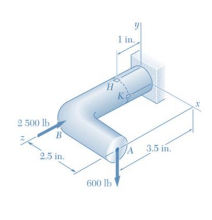
Forces are applied at points A and B of the steel support AISI 1020 that can be seen in the figure. If the support has a diameter of 0.7 in, determine
Forces are appliet at points A and B of the steel support AISI 1020 that can be seen in the figure, if the support has a diameter of 07in, determine:
*The factor of safety point H, using the distortion energy theory
*The factor of safety point k, using shear stress theory maximun
Homework Answers
Request Answer!
We need at least 10 more requests to produce the answer.
0 / 10 have requested this problem solution
The more requests, the faster the answer.
Add Answer to:
Forces are applied at points A and B of the steel support AISI 1020 that can be seen in the figure. If the support has a diameter of 0.7 in, determine
A 20-mm-diameter steel shaft, made of AISI 1035 HR steel, transmits power while rotating at 400...
A 20-mm-diameter steel shaft, made of AISI 1035 HR steel, transmits power while rotating at 400 rev/min. Assume any bending moments in the shaft to be relatively small compared to the torque. Determine how much power, in units of kW, the shaft can transmit with a static factor of safety of 1.5 based on (a) the maximum-shear-stress theory. (b) distortion-energy theory.
The cantilever bar in the figure is made from AISI 1018 CD steel and is statically loaded
 The cantilever bar in the figure is made from AISI 1018 CD
steel and is statically loaded with Fy = 800 N, and Fx = Fz = 0.
The fillet radius at the wall is 2 mm with theoretical stress
concentrations of 1.5 for bending, 1.2 for axial, and 2.1 for
torsion.Sut = 440 MPa = 64 kpsi, Sy = 370 MPa = 54 kpsi. Analyze the
stress situation in rod AB by obtaining the following
information.a) Determine the precise...
The cantilever bar in the figure is made from AISI 1018 CD
steel and is statically loaded with Fy = 800 N, and Fx = Fz = 0.
The fillet radius at the wall is 2 mm with theoretical stress
concentrations of 1.5 for bending, 1.2 for axial, and 2.1 for
torsion.Sut = 440 MPa = 64 kpsi, Sy = 370 MPa = 54 kpsi. Analyze the
stress situation in rod AB by obtaining the following
information.a) Determine the precise...
A 1-in, constant diameter shaft is loaded with forces at A and B as shown, with...
 A 1-in, constant diameter shaft is loaded with forces at A and B as shown, with ground reaction forces at O and C. The shaft also transmits a torque of 1500 lbf in throughout the length of the shaft. The shaft has a tensile yield strength of 130 kpsi. 460 lbf 575 lbf -12 in 18 in 1500 lbf-in А B ° To |--10 in- RO Rc Determine the minimum static factor of safety using the maximum-shear-stress failure theory, The...
For the shaft shown in figure 1, made of AISI steel 1030 CD with Sut =...
 For the shaft shown in figure 1, made of AISI steel 1030 CD with Sut = 520 MPa and Sy = 440 MPa., determine the factor of safety based on failure theories for ductile of Maximum Shear Stress and Distortion Energy (Von Misses). The point selected for analysis is determined form the following table. The loads are F= 2.13 kN, P= 5.13 kN, and T = 31.3 N. m. 100 mm B 15-mm D. Р T
A support beam of a conveyor system supports the loads shown in the figure...
 A support beam of a conveyor system supports the loads shown in the figure. The support points are points A and C. The 20kN load in B and the 10 kN load in D must be applied suddenly many thousands of times. A 50mm diameter circular steel bar was proposed to make the beam. A torque of 10 kN-m was added to the original design at point D. The steel is AISI 4140, determine the factor of safety by the...
An shown in the folloing figure, shaft A. made of AISI 1020 hot-rolled steelis welded to...
 An shown in the folloing figure, shaft A. made of AISI 1020 hot-rolled steelis welded to a ised suppot and is subjected to loading by simultaneous forces Fr and F:via shat B. A theoretieal stress concentration factor K of 1.6 and K, of 1.4 is induced in the shat by the E in weld fillet 1 he, lengi h of shaft A from the fixed support to the connection at shaft B is 2 ft. The load cycles thom 1S0...
Consider a cold-drawn steel bar of AISI 1020. Using the distortion-energy and maximum-shea stresses obtained from...
 Consider a cold-drawn steel bar of AISI 1020. Using the distortion-energy and maximum-shea stresses obtained from the given equation. Round the answers to two decimal places. r-stress theories determine the factors of safety for the following principal xy 9A =-60 kpsi, σ B = 20 kpsi MSS: n DE: n
the hollow tube down has an outside diameter of 45 mm and an inside diameter of...
 the hollow tube down has an outside diameter of 45 mm
and an inside diameter of 40 mm. the tube is made of an aluminum
alloy with a minimum yield strength of 280 MPa. the bending load is
F =1.5 kN, the axial load is P = 10kN and the twisting moment is T
= 70 N-m. Determine the factor of safety based on the stress at
point A using (a) the maximum shear stress theory and (b) the
distortion...
the hollow tube down has an outside diameter of 45 mm
and an inside diameter of 40 mm. the tube is made of an aluminum
alloy with a minimum yield strength of 280 MPa. the bending load is
F =1.5 kN, the axial load is P = 10kN and the twisting moment is T
= 70 N-m. Determine the factor of safety based on the stress at
point A using (a) the maximum shear stress theory and (b) the
distortion...
Determine the required diameter of a steel transmission shaft 10 m in length and of yield...
 Determine the required diameter of a steel transmission shaft 10 m in length and of yield strength 350 MPa in order to resist a torque of up to 500 N-m. The shaft is supported by frictionless bearings at its ends. Design the shaft with a factor of safety of 1.5 according to (a) the maximum shear stress theory and (b) the maximum distortion energy theory
2. Figure 2 below shows a crank loaded by a force F. The material used for...
 2. Figure 2 below shows a crank loaded by a force F. The material used for the crank is steel AISI 4142, and its yield stress is 235 kpsi. Determine the critical load F by using the following different failure theories (assume factor of safety n-2): a. Maximum normal stress theory (MNS); b. Maximum shear stress theory (MSS); c. Distortion-energy theory (DE). Figure 2. A crank under a force F
 The cantilever bar in the figure is made from AISI 1018 CD
steel and is statically loaded with Fy = 800 N, and Fx = Fz = 0.
The fillet radius at the wall is 2 mm with theoretical stress
concentrations of 1.5 for bending, 1.2 for axial, and 2.1 for
torsion.Sut = 440 MPa = 64 kpsi, Sy = 370 MPa = 54 kpsi. Analyze the
stress situation in rod AB by obtaining the following
information.a) Determine the precise...
The cantilever bar in the figure is made from AISI 1018 CD
steel and is statically loaded with Fy = 800 N, and Fx = Fz = 0.
The fillet radius at the wall is 2 mm with theoretical stress
concentrations of 1.5 for bending, 1.2 for axial, and 2.1 for
torsion.Sut = 440 MPa = 64 kpsi, Sy = 370 MPa = 54 kpsi. Analyze the
stress situation in rod AB by obtaining the following
information.a) Determine the precise...
 A 1-in, constant diameter shaft is loaded with forces at A and B as shown, with ground reaction forces at O and C. The shaft also transmits a torque of 1500 lbf in throughout the length of the shaft. The shaft has a tensile yield strength of 130 kpsi. 460 lbf 575 lbf -12 in 18 in 1500 lbf-in А B ° To |--10 in- RO Rc Determine the minimum static factor of safety using the maximum-shear-stress failure theory, The...
 For the shaft shown in figure 1, made of AISI steel 1030 CD with Sut = 520 MPa and Sy = 440 MPa., determine the factor of safety based on failure theories for ductile of Maximum Shear Stress and Distortion Energy (Von Misses). The point selected for analysis is determined form the following table. The loads are F= 2.13 kN, P= 5.13 kN, and T = 31.3 N. m. 100 mm B 15-mm D. Р T
 An shown in the folloing figure, shaft A. made of AISI 1020 hot-rolled steelis welded to a ised suppot and is subjected to loading by simultaneous forces Fr and F:via shat B. A theoretieal stress concentration factor K of 1.6 and K, of 1.4 is induced in the shat by the E in weld fillet 1 he, lengi h of shaft A from the fixed support to the connection at shaft B is 2 ft. The load cycles thom 1S0...
 Consider a cold-drawn steel bar of AISI 1020. Using the distortion-energy and maximum-shea stresses obtained from the given equation. Round the answers to two decimal places. r-stress theories determine the factors of safety for the following principal xy 9A =-60 kpsi, σ B = 20 kpsi MSS: n DE: n
 the hollow tube down has an outside diameter of 45 mm
and an inside diameter of 40 mm. the tube is made of an aluminum
alloy with a minimum yield strength of 280 MPa. the bending load is
F =1.5 kN, the axial load is P = 10kN and the twisting moment is T
= 70 N-m. Determine the factor of safety based on the stress at
point A using (a) the maximum shear stress theory and (b) the
distortion...
the hollow tube down has an outside diameter of 45 mm
and an inside diameter of 40 mm. the tube is made of an aluminum
alloy with a minimum yield strength of 280 MPa. the bending load is
F =1.5 kN, the axial load is P = 10kN and the twisting moment is T
= 70 N-m. Determine the factor of safety based on the stress at
point A using (a) the maximum shear stress theory and (b) the
distortion...
 Determine the required diameter of a steel transmission shaft 10 m in length and of yield strength 350 MPa in order to resist a torque of up to 500 N-m. The shaft is supported by frictionless bearings at its ends. Design the shaft with a factor of safety of 1.5 according to (a) the maximum shear stress theory and (b) the maximum distortion energy theory
 2. Figure 2 below shows a crank loaded by a force F. The material used for the crank is steel AISI 4142, and its yield stress is 235 kpsi. Determine the critical load F by using the following different failure theories (assume factor of safety n-2): a. Maximum normal stress theory (MNS); b. Maximum shear stress theory (MSS); c. Distortion-energy theory (DE). Figure 2. A crank under a force F
Most questions answered within 3 hours.
-
Where is the error in this code sequence?
String s1 = "Hello";
String s2 = "ello";...
asked 11 months ago -
Financial data for Joel de Paris, Inc., for last year
follow:
Joel de Paris, Inc.
Balance...
asked 11 months ago -
Consider this reaction:
Al2(SO4)3 (aq)+ BaCl3
(aq) Al2Cl6 (aq)- +
3BaSO4(s) . What is the...
asked 11 months ago -
Suppose that Savneet is considering increasing her
recent random sample from 20 car rentals to 40...
asked 11 months ago -
Trucks arrive at an unloading terminal at an average rate of 120
per hour.
Trucks arrive...
asked 11 months ago -
Why are methanol and ethanol completely soluble in water while
octanol is not very little soluble....
asked 11 months ago -
A facilities manager at a university reads in a research report
that the mean amount of...
asked 11 months ago -
When the CuSO4 is rehydrated by adding water to the anhydrous
compound, is this an endothermic...
asked 11 months ago -
A ray of sunlight is passing from diamond into crown glass; the
angle of incidence is...
asked 11 months ago -
A block of mass 0.249 kg is placed on top of a light, vertical
spring of...
asked 11 months ago -
how do the kidneys compensate in the presences of acidosis
a) trigger hyperventilate
b) reserve acid...
asked 11 months ago -
Question 501 pts
The rental rate of capital to the firm increases. Which of the
following...
asked 11 months ago